Tag: CPR

  • Get To Know An Aed

    MEDICAL NEWS

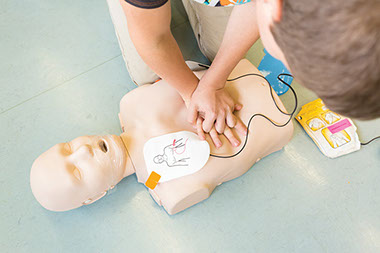
    Person training to use an AED.

    Automated external defibrillators help a person who is in cardiac arrest. They can deliver an electric shock to help get the heart beating normally again.

    You may have seen AEDs at places like stores, malls, hotels or gyms. Many public places have them and they are usually mounted on a wall.

    What is cardiac arrest?

    Cardiac arrest and a heart attack are not the same thing.

    In a heart attack, a blockage stops blood flow to the heart. But with cardiac arrest, the heart’s electrical rhythm isn’t working properly. The heart stops pumping, or is “arrested.” A heart attack can cause cardiac arrest.

    Why should I learn to use an AED?

    Sudden cardiac arrest is a major cause of death. An AED is the only way to restore a person’s heart rhythm during cardiac arrest. Knowing how to do cardiopulmonary resuscitation (CPR) is also helpful.

    You still need to call 911 if someone is in cardiac arrest. But it takes a few minutes for an ambulance to arrive. In those minutes, an AED could be life-saving.

    When to use one

    If a person has cardiac arrest, they will be completely unresponsive. If the person cannot talk or wake up, check to see if they are breathing. If they aren’t breathing and don’t have a pulse, start CPR and ask someone else to get the AED, if possible.

    What to do

    Even if you’re not trained, you can use an AED on someone in cardiac arrest. The machine helps guide you along. Here’s what to do:

    *  Call 911 or have someone else call.

    *  If possible, have someone do chest compressions or CPR while someone else gets the AED ready.

    *  Turn on the AED.

    *  Remove clothes from the person’s chest. Dry their skin with a cloth if needed.

    *  Put the pads on the chest as pictured on the pads.

    *  Do not place AED pads on top of a pace maker.

    *  First, the AED will measure the person’s heart rhythm. Don’t touch the person while this happens.

    *  If the person needs a shock, the AED will tell you.

    *  The AED will tell you when it gives a shock and what to do next. Stand back while it gives a shock through the pads.

    Together, CPR and an AED can save lives.

    Sources: American Heart Association, American Red Cross

    © American Institute for Preventive Medicine

  • Cpr

    First Aid

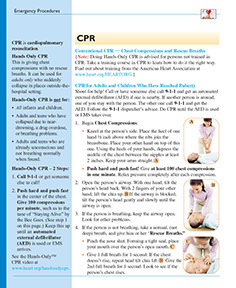
    Conventional CPR ─ Chest Compressions and Rescue Breaths {Note: Doing Hands-Only CPR is advised for persons not trained in CPR. Take a training course in CPR to learn how to do it the right way. Find out about training course in CPR to learn how to do it the right way. Find out about training atwww.cpr.heart.org.} Do CPR when the person is not responsive, is not breathing, and does not have a pulse.

    Hands Only CPR

    This is giving chest compressions with no rescue breaths. It can be used for adults and teens who suddenly collapse.

    Hands-Only CPR is not for:

    *  All infants and children.

    *  Adults and teens who have collapsed due to near-drowning, a drug overdose, or breathing problems.

    *  Adults and teens who are already unconscious and not breathing normally when found.

    Hands-Only CPR – 2 Steps:

    1.  Call 9-1-1 or get someone else to call!

    2.  Push hard and push fast in the center of the chest. Give 100 compressions per minute, such as to the tune of “Staying Alive” by the Bee Gees. Keep this up until an automated external defibrillator (AED) is used or EMS arrives.

    See the Hands-Only™ CPR video atwww.cpr.heart.org.

    CPR for Adults & Teens

    Shout for help! Call or have someone else call 9-1-1 and get an automated external defibrillator (AED) if one is nearby. If another person is around, one of you stay with the person. The other one call 9-1-1 and get the AED. Follow the 9-1-1 dispatcher’s advice. Do CPR until the AED is used or EMS takes over.

    1. Begin Chest Compressions:

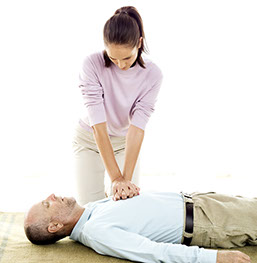
    *  Kneel at the person’s side. Place the heel of one hand ½ inch above where the ribs join the breastbone. Place your other hand on top of this one. Using the heels of your hands, depress the middle of the chest between the nipples at least  2 inches, but not more than 2.4 inches deep. Keep your arms straight. See image A.

    *  Push hard and push fast! Give at least 100 chest compressions in one minute. Relax pressure completely after each compression.

    Image of chest compressions.

    Image A

    2. Open the person’s airway.

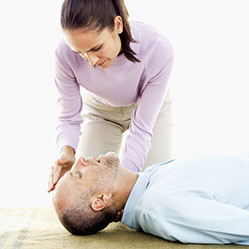
    With one hand, tilt the person’s head back. With 2 fingers of your other hand, lift the chin up. See image B. If the airway is blocked,  tilt the person’s head gently and slowly until the airway is open.

    Image of opening a person's airway.

    Image B

    3. If the person is breathing, keep the airway open.

    Look for other problems.

    4. If the person is not breathing, take a normal, (not deep) breath, and give him or her “Rescue Breaths.”

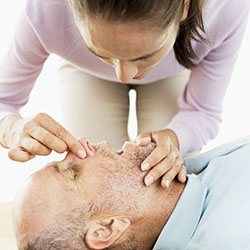
    *  Pinch the nose shut. Forming a tight seal, place your mouth over the person’s open mouth. See image C.

    *  Give 1 full breath for 1 second. If the chest doesn’t rise, repeat head tilt chin lift. See image B. Give the 2nd full breath for 1 second. Look to see if the person’s chest rises.

    Image of Rescue Breaths.

    Image C

    5. Give cycles of 30 chest compressions and 2 rescue breaths, without a break, until the person starts to move, an AED is used, or EMS provides care.

    Children Ages 1 to Puberty

    Shout for help! If you are alone, do CPR for 2 minutes before you call 9-1-1. If the child does not appear to have a serious injury, carry the child to nearest phone and call 9-1-1! Put the phone on speaker mode. Follow the dispatcher’s advice. If you are not alone, someone start CPR; someone else call 9-1-1 and get an AED, if one is nearby.

    1. Place the child on his or her back.

    2. Start Chest Compressions:

    *  Put one hand on the child’s breastbone right between his or her nipples.

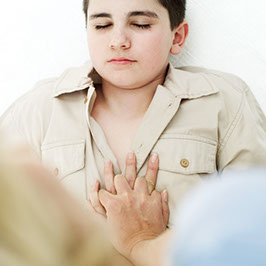
    *  Using the heel of your hand (or both hands like in image A under Adults & Children Who Reached Puberty) push straight down about 2 inches (at least one-third of the depth of the child’s chest). See image D. Let the chest rise back up after each push.

    *  Push hard and push fast! Give at least 100 chest compressions in one minute. Relax pressure completely after each compression.

    Image of child chest compressions.

    Image D

    3. Follow steps 2, 3, 4, and 5 under CPR For Adults and Children who Have Reached Puberty on this page.

    {Note: Chest compressions alone are better than doing nothing, but it is best to give chest compressions plus rescue breaths. Why? Airway problems are the main cause of cardiac arrest in infants and children.}

    Babies Up to 1 Year Old

    1. If you are alone, do CPR for 2 minutes before you call 9-1-1.

    If the child does not appear to have a serious injury, carry the child to nearest cell or other phone and call 9-1-1!  Put the phone on speaker mode. Follow the dispatcher’s advice. If you are not alone, someone start CPR; someone else call 9-1-1!

    2. Start Chest Compressions:

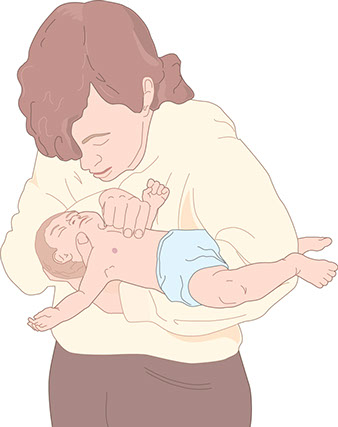
    *  Put the tips of your middle and ring fingers on the baby’s breastbone right between his or her nipples. See image E.

    *  Slip your other hand underneath the baby’s back for support.

    *  Push straight down about 1½ inches (at least one-third of the depth of the baby’s chest). Push at a rate of at least 100 compressions per minute. Let the chest rise back up after each push.

    Illustration of baby chest compressions.

    Image E

    3. If the baby is not breathing, or you are not sure he or she is breathing, give Rescue Breaths:

    *  Cover the infant’s mouth and nose with your mouth, forming a tight seal.

    *  Give 1 full breath for 1 second. Look to see if the chest rises. Give the 2nd full breath for 1 second and look to see if the chest rises.

    *  If the chest does not rise, go back to giving chest compressions. See step 2 listed above. After 30 more compressions, try rescue breaths again. {Note: If you can’t give rescue breaths, just keep giving chest compressions.}

    4. Give cycles of 30 chest compressions and 2 rescue breaths, without a break.

    Do this until the baby starts to move or until EMS provides care.
    Healthier at Home book by the American Institute for Preventive Medicine. www.HealthyLife.com. All rights reserved.

    © American Institute for Preventive Medicine

  • Learn Cpr. It Could Help Save A Life!

    First Aid

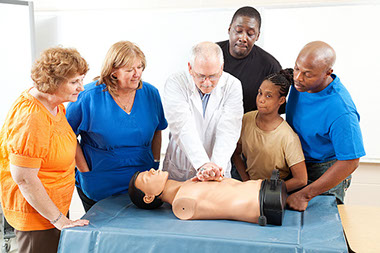
    An image of a class learning CPR.

    Knowing how to perform cardiopulmonary resuscitation (CPR) can mean the difference between life and death. CPR can restore the flow of oxygen to the brain if the heart has stopped beating due to heart attack, drowning, electrical shock, suffocation, or a drug overdose. Learn to perform CPR correctly. Take a CPR training course to learn:

    *  How to contact emergency medical help.

    *  How to use an automated external defribrillator (AED).

    *  How to give rescue breaths, compress the person’s chest and when and how to do chest-compression only CPR. (It is important to push hard and push fast, giving 100 compressions a minute in cycles of 30 compressions for every 2 breaths.) {Note: Guidelines for CPR may change. Get updates for CPR and find out where you can learn how to perform it from the American Heart Association atwww.americanheart.org.}

    You can also call your local chapter of the Red Cross or your local hospital to find out where you can learn CPR.

    A Year of Health Hints book by the American Institute for Preventive Medicine. www.HealthyLife.com. All rights reserved.

    © American Institute for Preventive Medicine

  • Near-Drowning

    First Aid

    Near-drowning is when a person is in danger of drowning. Each year, almost 8,000 people die from drowning. Seventy percent of all near-drowning victims recover; 25% die, and 5% have brain damage.

    A toddler can drown in as little as 2 inches of water in a bathtub, sink, etc. Toilet bowls are unsafe, too, if a small child falls into one head-first.

    Signs & Symptoms

    *  A person is in the water with signs of distress. He or she can’t stay above water, swims unevenly, signals for help, etc.

    *  Blue lips or ears. The skin is cold and pale.

    *  Bloated abdomen. Vomiting. Choking.

    *  Confusion. Lethargy.

    *  The person does not respond or can’t breathe.

    Causes

    *  Not being able to swim. Being in water too deep and too rough for one’s ability to swim.

    *  Water sport and other accidents. Not following water safety rules. Not wearing a life preserver, etc. Unsupervised swimming.

    *  Falling through ice while fishing, skating, etc.

    *  Injury or problems that occur while swimming, boating, etc. Examples are leg or stomach cramps, fatigue, and alcohol or drug use. A heart attack, stroke, seizure, and a marine animal bite or sting may have occurred.

    Prevention

    For Children

    *  Never leave an infant or child alone in any type of bathtub. Supervise young children in the bathroom.

    *  Never leave a child alone near water, swimming pools, etc. Lock gates to keep children from getting near swimming pools.

    *  Have a phone near outdoor pools, etc.

    *  Teach children to swim. Tell them not to swim alone and not to swim too far from shore without a lifeguard or other adult swimmer.

    *  Put a personal floatation device on each child when near the water or on a boat.

    *  Tell children to check the depth of water before diving in. It should be at least 9 feet deep.

    *  Do not allow children to go on untested ice.

    *  Take CPR and water safety courses.

    For Adults

    *  Learn to swim. Never swim alone at the beach or in a swimming pool. A lifeguard or other adult swimmer should be nearby in case you suffer a leg cramp or other problem.

    *  Wear a personal floatation device when you are on a boat, when you fish, etc.

    *  Check the depth of the water before diving in. It should be at least 9 feet deep. Never dive into an above-ground pool.

    *  Do not use a hot tub or jacuzzi if you’ve had any alcoholic drinks. You could fall asleep, slip under the surface, and drown.

    *  Take CPR and water safety courses.

    Questions to Ask

    Self-Care / First Aid

    First Aid for Near-Drowning

    *  Shout for help! Send someone to call 9-1-1!

    *  If it is safe and possible, try to reach the person. Use a long pole, rope, life preserver, etc. Then pull him or her to safety.

    *  Did the person fall through ice? Try a human chain rescue to safely reach the person, but stay as far away from cracked ice as you can.

    *  If you must swim to the person, be sure you are strong and capable enough. Take a flotation device with you. Approach the person from behind in a calm manner. Grab a piece of the person’s clothing. Or, cup one hand under the person’s chin.

    *  When getting the person out of the water, support the head and neck. (Suspect a neck injury, especially with diving or water sports.)

    *  CHECK for a response. Give Rescue Breaths and CPR, as needed. If you suspect a spinal injury, use jaw thrust instead of chin-lift for rescue breaths.

    *  Once out of the water, keep checking the person for a response. Give first aid, as needed.

    *  Put the person in the Recovery Position. Immobilize the person as much as possible. If the person is vomiting, clear his or her mouth of it.

    *  Remove cold, wet clothes. Cover the person with a blanket, etc.

    Healthier at Home book by the American Institute for Preventive Medicine. www.HealthyLife.com. All rights reserved.

    © American Institute for Preventive Medicine