Tag: crash

  • Drowsy Driving: Know The Signs

    WELL-BEING

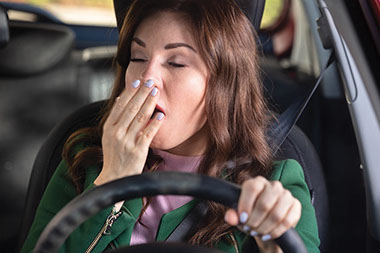
    Women yawning while driving.

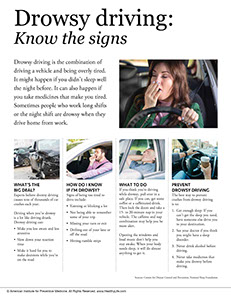
    Drowsy driving is the combination of driving a vehicle and being overly tired. It might happen if you didn’t sleep well the night before. It can also happen if you take medicines that make you tired. Sometimes people who work long shifts or the night shift are drowsy when they drive home from work.

    What’s the big deal?

    Experts believe drowsy driving causes tens of thousands of car crashes each year.

    Driving when you’re drowsy is a lot like driving drunk. Drowsy driving can:

    *  Make you less aware and less attentive

    *  Slow down your reaction time

    *  Make it hard for you to make decisions while you’re  on the road

    How do I know if I’m drowsy?

    Signs of being too tired to drive include:

    *  Yawning or blinking a lot

    *  Not being able to remember some of your trip

    *  Missing your turn or exit

    *  Drifting out of your lane or off the road

    *  Hitting rumble strips

    What to do

    If you think you’re driving while drowsy, pull over in a safe place. If you can, get some coffee or a caffeinated drink. Then lock the doors and take a 15- to 20-minute nap in your vehicle. The caffeine and nap combination may help you be more alert.

    Opening the windows and loud music don’t help you stay awake. When your body needs sleep, it will do almost anything to get it.

    Prevent drowsy driving

    The best way to prevent crashes from drowsy driving is to:

    1. Get enough sleep. If you can’t get the sleep you need, have someone else drive you to your destination.

    2. See your doctor if you think you might have a sleep disorder.

    3. Never drink alcohol before driving.

    4. Never take medicines that make you drowsy before driving.

    Sources: Centers for Disease Control and Prevention, National Sleep Foundation
    © American Institute for Preventive Medicine

  • Six Things You Should Never Do In Your Car

    Personal Safety

    Image of man driving.

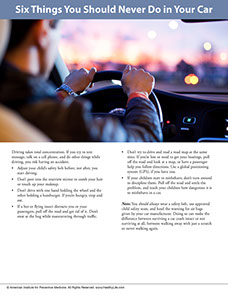
    Driving takes total concentration. If you try to text message, talk on a cell phone, and do other things while driving, you risk having an accident.

    *  Adjust your child’s safety belt before, not after, you start driving.

    *  Don’t peer into the rearview mirror to comb your hair or touch up your makeup.

    *  Don’t drive with one hand holding the wheel and the other holding a hamburger. If you’re hungry, stop and eat.

    *  If a bee or flying insect distracts you or your passengers, pull off the road and get rid of it. Don’t swat at the bug while maneuvering through traffic.

    *  Don’t try to drive and read a road map at the same time. If you’re lost or need to get your bearings, pull off the road and look at a map, or have a passenger help you follow directions. Use a global positioning system (GPS), if you have one.

    *  If your children start to misbehave, don’t turn around to discipline them. Pull off the road and settle the problem, and teach your children how dangerous it is to misbehave in a car.

    Note: You should always wear a safety belt, use approved child safety seats, and heed the warning for air bags given by your car manufacturer. Doing so can make the difference between surviving a car crash intact or not surviving at all, between walking away with just a scratch or never walking again.

    A Year of Health Hints book by the American Institute for Preventive Medicine. www.HealthyLife.com. All rights reserved.

    © American Institute for Preventive Medicine
  • The Dangers Of Distracted Driving

    WELL-BEING

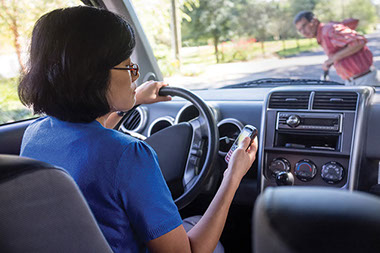
    Image of women driving while looking at her phone about to hit a pedestrian.

    Though driving a car may seem like a simple task, it requires quick reflexes, concentration and reasoning. When a driver is distracted, some – or all – of these important skills can be lost.

    Distracted driving means the driver is doing something other than focusing on the road ahead. It can be anything that takes the driver’s mind off of driving, hands off the wheel or eyes off the road. In the age of smartphones, tablets and other electronic devices, it’s easy to get distracted when driving – even for just a second.

    Though it seems harmless, a quick glance at a phone to read a text can be dangerous or even deadly. The National Highway Traffic Safety Administration (NHTSA) says sending or reading a text takes your eyes off the road for 5 seconds. That’s like driving the length of an entire football field with your eyes closed if you’re going 55 miles per hour. In that amount of time, a driver can hit a pedestrian, run a red light or stop sign, or crash into another vehicle.

    The NHTSA says nearly 3,500 people died and almost 400,000 were injured in 2015 due to distracted driving crashes. Here’s what we can do to help stop distracted driving:

    *  Never use a phone while driving. Put it in the back seat or out of reach to reduce the urge to look at it “just for a second.”

    *  Talk with your teens about distracted driving and tell them that the texts can wait. Lead by example.

    *  Sign a pledge to not drive distracted and stick to it. Ask family members and friends to sign it too. The “It Can Wait” pledge is available atitcanwait.usaa.com.

    Did you know?

    There are laws that prohibit distracted driving. Talking on a hand-held cellphone while driving is banned in 15 states and the District of Columbia. Text messaging is banned for all drivers in 47 states and the District of Columbia.

    To learn about your state laws, go towww.iihs.org/iihs/topics/laws/cellphonelaws.

    © American Institute for Preventive Medicine