Tag: credit

  • Declare Your Independence From Credit Card Overuse

    Financial Health

    Credit cards fanned out on table.

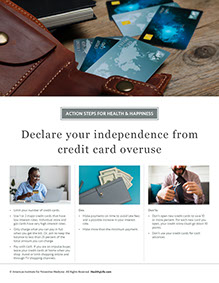
    *  Limit your number of credit cards.

    *  Use 1 or 2 major credit cards that have low interest rates. Individual store and gas cards have very high interest rates.

    *  Only charge what you can pay in full when you get the bill. Or, aim to keep the balance to less than 25 percent of the total amount you can charge.

    *  Pay with cash. If you are an impulse buyer, leave your credit cards at home when you shop. Avoid or limit shopping online and through TV shopping channels.

    Dos

    *  Make payments on time to avoid late fees and a possible increase in your interest rate.

    *  Make more than the minimum payment.

    Don’ts

    *  Don’t open new credit cards to save 10 or more percent. For each new card you open, your credit score could go down 10 points.

    *  Don’t use your credit cards for cash advances.

    ays to Well-Being book by the American Institute for Preventive Medicine. www.HealthyLife.com. All rights reserved.

    © American Institute for Preventive Medicine

  • Use Credit Cards Carefully

    Financial Health

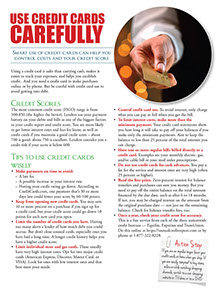
    Smart use of credit cards can help you control costs and your credit score.

    Using a credit card is safer than carrying cash, makes it easier to track your expenses, and helps you establish credit. And you need a credit card to make purchases online or by phone. But be careful with credit card use to avoid getting into debt.

    Tips to use credit cards wisely:

    *  Make payments on time to avoid: A late fee; a possible increase in your interest rate; having your credit rating go down. According toCreditCards.com, one payment that’s 30 or more days late could lower your score by 60-100 points.

    *  Keep from opening new credit cards. You may save 10 or more percent on a purchase if you sign up for a credit card, but your credit score could go down 10 points for each new card you open.

    *  Limit the number of credit cards you have. Having too many alerts a lender of how much debt you could accrue. But don’t close unused cards, especially ones you have had a long time. A longer credit history helps you have a higher credit score.

    *  Limit individual store and gas cards. These usually have very high interest rates. Opt for two major credit cards (American Express, Discover, Master Card, or VISA). Look for ones with low interest rates and that best meet your needs.

    *  Control credit card use. To avoid interest, only charge what you can pay in full when you get the bill.

    *  To limit interest costs, make more than the minimum payment. Your credit card statements show you how long it will take to pay off your balances if you make only the minimum payments. Aim to keep the balance to less than 25 percent of the total amount you can charge.

    *  Have one or more regular bills billed directly to a credit card. Examples are your monthly electric, gas, and/or cable bill or your mail order prescriptions.

    *  Do not use credit cards for cash advances. You pay a fee for the service and interest rates are very high (often 25 percent or higher).

    *  Read the fine print. Zero-percent interest for balance transfers and purchases can save you money. But you need to pay off the entire balance on the total amount financed by the due date, such as after 6 to 18 months. If not, you may be charged interest on the amount from the original purchase date – not just on the remaining balance. Check for balance transfer fees, too.

    *  Once a year, check your credit score for accuracy. This is a free service from each of the three nationwide credit bureaus – Equifax, Experian and TransUnion. Do this online athttps://annualcreditreport.comor by phone at 1-877-322-8228.

    Credit Scores

    The most common credit score (FICO) range is from 300-850 (the higher the better). Lenders use your payment history on your debts and bills as one of the biggest factors in your credit report and credit score. You are more likely to get lower interest rates and fees for loans, as well as credit cards if you maintain a good credit score – about 700 is good; above 750 is excellent. Lenders consider you a credit risk if your score is below 600.

    Action Step

    If you are an impulse buyer, leave your credit cards at home when you shop. If you are easily tempted to buy items online or while watching shopping channels, switch to a non-shopping website or  TV show, or to a DVD.

    Ways to Well-Being. Published by the American Institute for Preventive Medicine.

    © American Institute for Preventive Medicine

  • Learn How To Check Your Credit Report

    FINANCIAL HEALTH

    Image of finger pointing to the words 'Credit Report'

    The Consumer Financial Protection Bureau says everyone should check their credit report at least once a year. The information on your credit report could affect your ability to get a mortgage, car loan, a credit card or other loans. It can also affect the interest rate you get. Usually, a higher credit score makes it easier for you to get a loan and a lower interest rate. Most credit scores range from 300-850.

    You are entitled by law to a free report from all three credit reporting agencies (Equifax, Experian and TransUnion) once every 12 months. Take advantage of it – and check it over carefully when you receive it.

    But what should you look for when you get your report? Errors can happen, so be on the lookout for:

    *  Wrong name, phone number or address

    *  Accounts that don’t belong to you (this can happen when two people have similar names, or as a result of identity theft)

    *  Closed accounts reported as open

    *  Being listed as owner of an account where you are only an authorized user

    *  Accounts incorrectly reported as late or delinquent

    *  Wrong dates of payments, when the account was open or delinquency dates

    *  Same loan or debt listed multiple times (possibly with different names)

    *  Past errors that were corrected that may show up again

    *  Incorrect current balance or credit limit

    *  Accounts that appear more than once with different creditors listed (especially in the case of delinquent accounts or accounts in collections)

    If you find errors, contact:

    *  The credit reporting company who sent you the report, or

    *  The creditor or company that provided the incorrect information. This is known as the “furnisher” of the information.

    Your credit report tells you how to dispute inaccurate information. Sample dispute letters are available atwww.consumerfinance.gov. Go to Consumer Tools, then click on Credit Reports and Scores. You can use these letters if you find something incorrect on your credit report.

    How do I get my report?

    Many websites claim to offer free credit reports. But, some of them are trying to sell other products or services. To get your free credit report authorized by federal law, visit:

    *  AnnualCreditReport.com, or

    *  Call 1-877-322-8228

    This website offers free reports only, not scores. Your credit score is available for a fee. You do not have to buy any products or services advertised onannualcreditreport.com.

    You can also contact the credit agencies directly if you have questions or problems with your report:

    *  Equifax: 1-866-349-5191

    *  Experian: 1-888-397-3742

    *  TransUnion: 1-800-916-8800
    © American Institute for Preventive Medicine

  • Using This Credit Card May Be Bad For Your Health

    WELL-BEING

    Image of young women cutting up a credit card.

    High levels of credit card debt and the stress of having debt may be bad for your health, a study in Social Science & Medicine suggests. People who reported higher levels of stress about their debt showed higher levels of physical impairment and reported worse health than those with lower levels of debt.

    In the study, researchers asked people to rate their own health on a scale of very poor to very good. They rated how much they worried about their total debt. Researchers also asked how difficult it was for survey participants to do everyday activities such as climbing stairs and carrying groceries. Participants also reported how many credit cards they have and whether they carry a balance from month to month.

    But it didn’t matter how many credit cards a person had, the big stress factor related to health was the ratio of credit card debt to their total family income-in other words, how much you owe compared with what you earn.

    “The stress of owing money, and knowledge that we’re paying high interest rates, may lead to increased stress resulting in worsening health,” said the director of Ohio State’s Center for Survey Research. Credit counseling is one way to reverse debt-stress.

    © American Institute for Preventive Medicine