Tag: dehydration

  • What To Do If Turista Strikes

    Healthy Travel

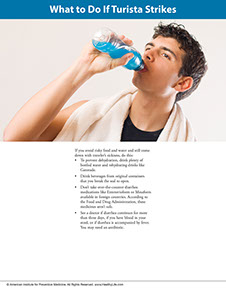
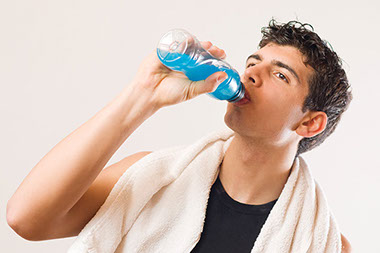
    Image of man rehydrating with liquids.

    If you avoid risky food and water and still come down with traveler’s sickness, do this:

    *  To prevent dehydration, drink plenty of bottled water and rehydrating drinks like Gatorade.

    *  Drink beverages from original containers that you break the seal to open.

    *  Don’t take over-the-counter diarrhea medications like Enterovioform or Mesaform available in foreign countries. According to the Food and Drug Administration, these medicines aren’t safe.

    *  See a doctor if diarrhea continues for more than three days, if you have blood in your stool, or if diarrhea is accompanied by fever. You may need an antibiotic.

    Page image from A Year of Health Hints book by the American Institute for Preventive Medicine. www.HealthyLife.com. All rights reserved.

    © American Institute for Preventive Medicine

  • Dehydration

    First Aid

    Image of women drinking a glass of water.

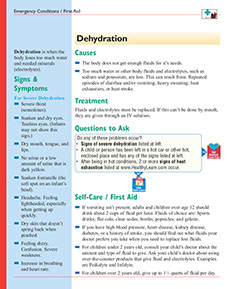
    Dehydration is when the body loses too much water and needed minerals (electrolytes).

    Signs & Symptoms

    For Severe Dehydration

    *  Severe thirst (sometimes).

    *  Sunken and dry eyes. Tearless eyes. (Infants may not show this sign.)

    *  Dry mouth, tongue, and lips.

    *  No urine or a low amount of urine that is dark yellow.

    *  Sunken fontanelle (the soft spot on an infant’s head).

    *  Headache. Feeling lightheaded, especially when getting up quickly.

    *  Dry skin that doesn’t spring back when pinched.

    *  Feeling dizzy. Confusion. Severe weakness.

    *  Increase in breathing and heart rate.

    Causes

    *  The body does not get enough fluids for it’s needs.

    *  Too much water or other body fluids and electrolytes, such as sodium and potassium, are lost. This can result from: Repeated episodes of diarrhea and/or vomiting; heavy sweating; heat exhaustion; or heat stroke.

    Treatment

    Fluids and electrolytes must be replaced. If this can’t be done by mouth, they are given through an IV solution.

    Questions to Ask

    Self-Care / First Aid

    *  If vomiting isn’t present, adults and children over age 12 should drink about 2 cups of fluid per hour. Fluids of choice are: Sports drinks; flat cola; clear sodas; broths; popsicles; and gelatin.

    *  If you have high blood pressure, heart disease, kidney disease, diabetes, or a history of stroke, you should find out what fluids your doctor prefers you take when you need to replace lost fluids.

    *  For children under 2 years old, consult your child’s doctor about the amount and type of fluid to give. Ask your child’s doctor about using over-the-counter products that give fluid and electrolytes. Examples are Pedialyte and Infalyte.

    *  For children over 2 years old, give up to 1-1/2 quarts of fluid per day.

    Healthier at Home book by the American Institute for Preventive Medicine. www.HealthyLife.com. All rights reserved.

    © American Institute for Preventive Medicine

  • Diarrhea

    Abdominal & Urinary Conditions

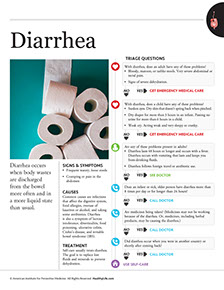
    Image of medicine in pink bottle.

    Diarrhea occurs when body wastes are discharged from the bowel more often and in a more liquid state than usual.

    Signs & Symptoms

    *  Frequent watery, loose stools.

    *  Cramping or pain in the abdomen.

    Causes

    Common causes are infections that affect the digestive system, food allergies, overuse of laxatives or alcohol, and taking some antibiotics. Diarrhea is also a symptom of lactose intolerance, diverticulitis, food poisoning, ulcerative colitis, Crohn’s disease, and irritable bowel syndrome (IBS).

    Treatment

    Self-care usually treats diarrhea. The goal is to replace lost fluids and minerals to prevent dehydration.

    Questions to Ask

    Self-Care / Prevention

    *  If vomiting is also present, treat for vomiting first.

    *  To prevent dehydration:

    – Drink plenty of water and other fluids, such as sports drinks, broths, and Kool-Aid (which usually has less sugar than soda).

    – Avoid drinks with caffeine or alcohol.

    – Avoid having high “simple” sugar drinks, like apple juice, grape juice, and sodas. These can make the diarrhea persist. Or, dilute juices and sodas with water.

    If you have signs of dehydration seek medical care. Until you get care, drink fluids:

    *  Broths and sports drinks.

    *  For children less than 2 years old, give over- the-counter mixtures, such as Pedialyte as advised by their doctors.

    *  If you breast-feed, give only as much milk as your baby wants. Feed every 2 hours.

    *  Avoid caffeine and alcohol.

    *  Choose foods that don’t upset your stomach.

    *  Do not have foods that are greasy, high in fiber, or very sweet.

    *  Avoid milk, but try yogurt that has live cultures of lactobacillus acidophilus (unless you are lactose intolerant).

    *  Follow a light diet. Eat foods that are easy to digest, such as:

    – Bananas.

    – Plain rice.

    – Boiled potatoes.

    – Toast.

    – Crackers.

    – Cooked carrots.

    – Baked chicken without the skin or fat.

    – Soups with vegetables and noodles or rice.

    *  Don’t exercise too hard.

    *  Adults can try an over-the-counter medicine, such as Imodium A-D or Pepto-Bismol. Follow the directions on the label. {Note: Stools can become black after taking Pepto- Bismol. Also, do not give aspirin or any medication that has salicylates, such as Pepto- Bismol, to anyone under 19 years of age, due to the link to Reye’s syndrome.}

    *  Wash your hands after you go to the toilet and before you prepare food. Use paper towels to dry your hands. Throw the towels away.

    Resources

    National Institute of Diabetes and Digestive and Kidney Diseases (NIDDK)www2.niddk.nih.gov
    Healthier at Home book by the American Institute for Preventive Medicine. www.HealthyLife.com. All rights reserved.

    © American Institute for Preventive Medicine

  • Heat Illnesses

    First Aid

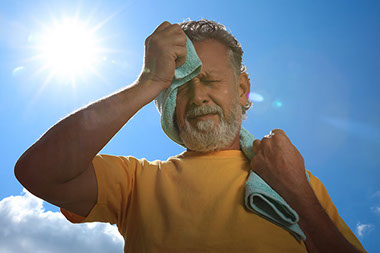
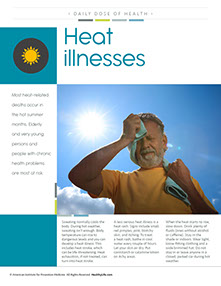
    Man outside in bright sun, wiping forehead with towel.

    Most heat-related deaths occur in the hot summer months. Elderly and very young persons and people with chronic health problems are most at risk.

    Sweating normally cools the body. During hot weather, sweating isn’t enough. Body temperature can rise to dangerous levels and you can develop a heat illness. This includes heat stroke, which can be life-threatening. Heat exhaustion, if not treated, can turn into heat stroke.

    A less serious heat illness is a heat rash. Signs include small red pimples, pink, blotchy skin, and itching. To treat a heat rash, bathe in cool water every couple of hours. Let your skin air dry. Put cornstarch or calamine lotion on itchy areas.

    When the heat starts to rise, slow down. Drink plenty of fluids (ones without alcohol or caffeine). Stay in the shade or indoors. Wear light, loose-fitting clothing and a wide brimmed hat. Do not stay in or leave anyone in a closed, parked car during hot weather.

    Health at Home Lifetime book by the American Institute for Preventive Medicine. www.HealthyLife.com. All rights reserved.

    © American Institute for Preventive Medicine