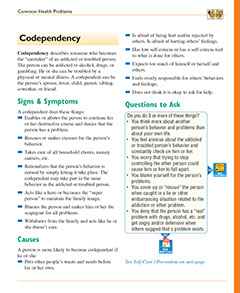
Codependency describes someone who becomes the “caretaker” of an addicted or troubled person. The person can be addicted to alcohol, drugs, or gambling. He or she can be troubled by a physical or mental illness. A codependent can be the person’s spouse, lover, child, parent, sibling, coworker, or friend.
Signs & Symptoms
A codependent does these things:
* Enables or allows the person to continue his or her destructive course and denies that the person has a problem.
* Rescues or makes excuses for the person’s behavior.
* Takes care of all household chores, money matters, etc.
* Rationalizes that the person’s behavior is normal by simply letting it take place. The codependent may take part in the same behavior as the addicted or troubled person.
* Acts like a hero or becomes the “super person” to maintain the family image.
* Blames the person and makes him or her the scapegoat for all problems.
* Withdraws from the family and acts like he or she doesn’t care.
Causes
A person is more likely to become codependent if he or she:
* Consistently puts other people’s wants and needs before his or her own.
* Is afraid of being hurt and/or rejected by others. Is afraid of hurting others’ feelings.
* Has low self-esteem or has a self-esteem tied to what is done for others.
* Expects too much of himself or herself and others.
* Feels overly responsible for others’ behaviors and feelings.
* Does not think it is okay to ask for help.
Treatment
Most codependents do not realize they have a problem. They think they are helping the troubled person, but they are not.
The first step in treatment is to admit to the problem. Self-care and counseling treat codependency. For many people, self-care is not easy to do without the help of a counselor.
Questions to Ask
Self-Care / Prevention
* Read books and online information on codependency. You may find you identify with what you read and gain understanding.
* Focus on these 3 Cs:
– You did not cause the other person’s problem.
– You can’t control the other person.
– You can’t cure the problem.
* Don’t lie or make excuses. Don’t cover up for the person’s drinking or other problem. Admit that this way of living is not normal. Accept that the troubled person has a real problem and needs professional help.
* Refuse to come to the person’s aid. Every time you bail the person out of trouble, you reinforce their helplessness and your hopelessness.
* Get help for physical, verbal, and/or sexual abuse. For information, contact: National Domestic Violence Hotline 800.799.SAFE (799.7233).
* Join a support group for codependents. Examples are self-help groups for family and friends of substance abusers, such as Al-Anon and Alateen. For information, contact: AL-ANON / ALATEEN Family Group Headquarters, Inc., 888.4AL-ANON (425.2666)www.al-anon.org.
* Continue with your normal family routines. For example, include a drinker when he/she is sober.
* Focus on your own feelings, desires, and needs. Vent negative thoughts in healthy ways. Do what is good for your own well-being.
* Set limits on what you will and won’t do. Be firm and stick to your limits.
* Explore new interests. Find diversions from your loved one’s problem.
* Be responsible for yourself and others in the family to live a better life. Do this whether your loved one recovers or not.
Resources
Mental Health America
800.969.6642
www.mentalhealthamerica.net