
Tag: dessert

  • Recipe: Sweet Potato Cheesecake

    HEALTHY EATING

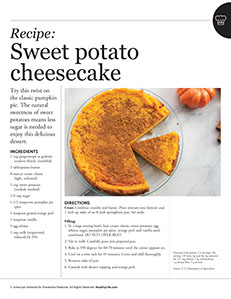
    Sweet potato cheesecake with a couple pieces missing.

    Try this twist on the classic pumpkin pie. The natural sweetness of sweet potatoes means less sugar is needed to enjoy this delicious dessert.

    Ingredients

    1 cup gingersnaps or graham crackers (finely crumbled)

    3 tablespoons butter

    8 ounces cream cheese (light, softened)

    1 cup sweet potatoes (cooked, mashed)

    1/3 cup sugar

    1-1/2 teaspoons pumpkin pie spice

    1 teaspoon grated orange peel

    1 teaspoon vanilla

    5 egg whites

    1 cup milk (evaporated, reduced-fat 2%)

    Directions

    Crust:Combine crumbs and butter. Press mixture into bottom and 1 inch up sides of an 8-inch springform pan. Set aside.

    Filling:

    1.  In a large mixing bowl, beat cream cheese, sweet potatoes, egg whites, sugar, pumpkin pie spice, orange peel, and vanilla until combined. DO NOT OVER BEAT.

    2.  Stir in milk. Carefully pour into prepared pan.

    3.  Bake at 350 degrees for 60-70 minutes until the center appears set.

    4.  Cool on a wire rack for 45 minutes. Cover and chill thoroughly.

    5.  Remove sides of pan.

    6.  Garnish with dessert topping and orange peel.

    Nutrition Information: (14 servings). Per serving: 139 kcals, 6g total fat, 3g saturated fat, 137 mg sodium, 17g carbohydrates, 1 g dietary fiber, 5 g protein.

    Source: U.S. Department of Agriculture
    © American Institute for Preventive Medicine
  • How Sweet It Is

    HEALTHY EATING

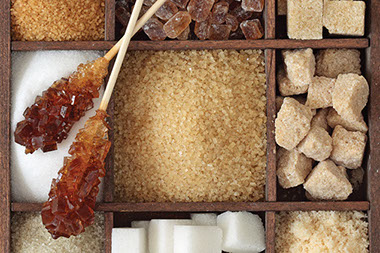
    Image of different types of sweeteners.

    Is sugar really bad for us? How about artificial or low-calorie sweeteners?

    Our bodies need one type of sugar, called glucose, to survive. “Glucose is the number one food for the brain, and it’s an extremely important source of fuel throughout the body,” said Dr. Kristina Rother, pediatrician with the National Institute on Health and expert on sweeteners.

    But there’s no need to add glucose to your diet, because your body can make the glucose it needs by breaking down food molecules like carbohydrates, proteins, and fats. Some sugars are found naturally in foods such as fruits, vegetables, and milk.

    Much of the sugar we eat isn’t found naturally in food but is added during processing or preparation.

    Although sugar itself isn’t bad, said Dr. Rother, “Sugar has a bad reputation that’s mostly deserved because we consume too much of it. It’s now in just about every food we eat.”

    You can cut down on added sugars. NIH in Health offers these suggestions:

    *  Choose water, fat-free milk, or unsweetened tea or coffee instead of sodas, sports drinks, energy drinks, and fruit drinks.

    *  Reduce sugar in recipes. If a recipe says 1 cup, use 2/3 cup.

    *  To enhance flavor, add vanilla, cinnamon, or nutmeg.

    *  Eat fresh, canned, frozen, and dried fruits without added sugar. Choose fruits canned in their own juice rather than in syrup.

    *  Use fruits to top foods like cereal and pancakes rather than sugars, syrups, or other sweet toppings.

    *  Read the ingredients list to pick food with little or no added sugar.

    © American Institute for Preventive Medicine