Tag: dizziness

  • Dizziness & Vertigo

    Brain & Nervous System

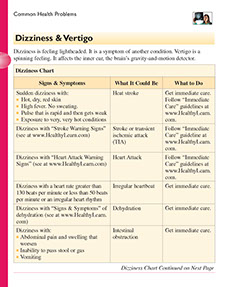
    Dizziness is feeling lightheaded. It is a symptom of another condition. Vertigo is a spinning feeling. It affects the inner ear, the brain’s gravity-and-motion detector.

    Dizziness Conditions

    Heat Stroke

    Signs & Symptoms

    Sudden dizziness with:

    *  Hot, dry, red skin

    *  High fever. No sweating.

    *  Pulse that is rapid and then gets weak

    *  Exposure to very, very hot conditions

    What to Do

    Get immediate care.

    Stroke or Transient Ischemic Attack
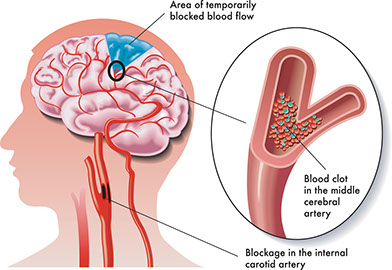
    Illustration on how a stroke is caused.

    Signs & Symptoms

    Dizziness with “Stroke Warning Signs

    What to Do

    Follow “Immediate Care” guideline.

    Heart Attack
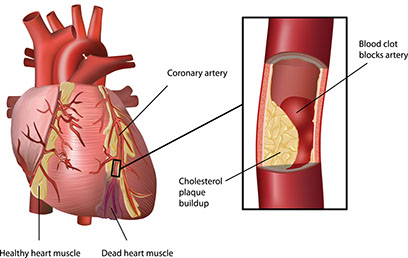
    Illustration of how a heart attack is caused.

    Signs & Symptoms

    Dizziness with “Heart Attack Warning Signs

    What to Do

    Follow “Immediate Care” guidelines

    Irregular Heartbeat

    Signs & Symptoms

    Dizziness with a heart rate greater than 130 beats per minute or less than 50 beats per minute or an irregular heart rhythm

    What to Do

    Get immediate care.

    Dehydration

    Signs & Symptoms

    Dizziness with “Signs & Symptoms” of dehydration

    What to Do

    Get immediate care.

    Intestinal Obstruction

    Signs & Symptoms

    Dizziness with:

    *  Abdominal pain and swelling that worsen

    *  Inability to pass stool or gas

    *  Vomiting

    What to Do

    Get immediate care.

    Dissecting Aortic Aneurysm
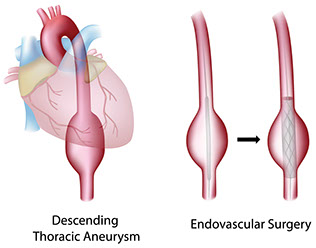
    Illstration of a descending thoracic aneurysm.

    This is a tear in the main artery from the heart.

    Signs & Symptoms

    Dizziness and fainting. Severe chest pain with extreme pain felt across the upper back (not just on one side) that came on within 15 minutes for no apparent reason, such as an injury or back strain. The pain can spread to the abdomen.

    What to Do

    Get immediate care. (Do not take aspirin.)

    Ear Infection

    Signs & Symptoms

    Dizziness with ear pain, ringing in the ear, pus or other ear discharge, fever

    What to Do

    Contact doctor.
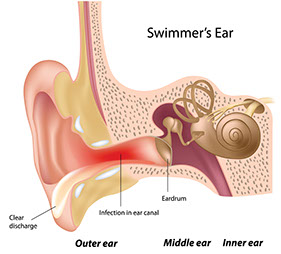
    Illustration of swimmer's ear.

    Labyrnthitis

    This is an inflammation in the ear that usually results from an upper respiratory infection.

    Signs & Symptoms

    Dizziness with:

    *  True spinning sensation

    *  Loss of balance

    *  Nausea and vomiting

    *  Ringing in the ears

    *  Jerky movements of the eye

    What to Do

    Contact doctor.

    Low Blood Sugar

    This can occur in persons taking insulin or oral pills for diabetes and/or after not eating for 4 or more hours.

    Signs & Symptoms

    Dizziness with hunger, sweating, trembling, anxiety, and confusion

    What to Do

    Use self-care.

    Temporary Drop in Blood Pressure (Orthostatic Hypotension)

    This could be a side effect of taking medicines, such as ones for high blood pressure and depression.

    Signs & Symptoms

    Dizziness when getting up too quickly from a seated or lying position

    What to Do

    Use self-care.

    Other Causes of Dizziness:

    *  Alcohol

    *  New medications, antibiotics, or high doses of aspirin

    *  A change in altitude or motion sickness

    *  Sudden movement, such as with turning the head quickly

    *  Seeing fast moving objects Treatment for dizziness depends on the cause.

    Vertigo

    Signs & Symptoms

    *  Wooziness

    *  Sense that the room is spinning

    *  Nausea

    *  Blurred vision

    *  Floating, rocking, and/or rolling feeling

    *  Sense of walking on an uneven surface

    *  Loss of balance

    Causes, Risk Factors & Care

    Vertigo is caused by a problem with the inner ear. Causes of vertigo are:

    *  Benign Positional Vertigo (BPV). This is the most common type. It may happen when you turn over in bed, get up, sit down, bend over, or just tilt your head. The sensations start within seconds of changing positions and last less than a minute. As bothersome as BPV is, it rarely signals more serious disease. Risk factors for BPV are aging, viral infections, and a prior head injury.

    *  Ménière’s disease. This condition may be due to spasms of blood vessels in the inner ear, fluid retention in the inner ear, or allergic reactions. Ménière’s disease is linked with a decrease in hearing and tinnitus. It sometimes leads to permanent hearing loss.

    *  Multiple sclerosis. With this, the covering that protects nerves (myelin) is destroyed. Over time, scar tissue (sclerosis) forms where the myelin used to be in the brain and spinal cord. Scar tissue or inflammation in the brain may cause vertigo symptoms.

    After proper diagnosis, most cases of vertigo are easily treated in the doctor’s office or at home with self-care.

    While attacks of Ménière’s disease can continue for many years, some symptoms can be controlled with medication.

    Self-Care

    For Orthostatic Hypotension:

    *  Don’t jump out of bed. Go from a lying position to a sitting position slowly. Sit on the edge of the bed a few minutes. Stand up slowly.

    *  From a sitting position, stand up slowly. Hold onto the arms of the chair or the head of the bed for support.

    *  If you feel lightheaded, sit back down for a few minutes. Take a few deep breaths. Get up again, slowly.

    For Benign Positional Vertigo (BPV):

    *  Sit on the side of the bed and lean to your right, resting the right ear on the bed. This might make you dizzy and nauseous at first.

    *  Wait 20 seconds until the dizziness stops and sit up straight.

    *  Wait another 20 seconds and repeat steps 1 and 2 on your left side.

    *  Do this exercise 10 to 15 times, 3 times a day.

    For Ménière’s Disease:

    *  Lie still in bed until the dizziness and nausea are gone.

    *  Walk with assistance.

    *  Don’t change positions too fast.

    *  Do not drive, climb ladders, or work around dangerous machinery.

    *  Decrease the amount of salt and fluids in your diet.

    *  Avoid bright lights. Do not read when you have a spinning feeling.

    *  Resume your normal activities when symptoms go away.

    *  Avoid alcohol, caffeine, and tobacco.
    Health at Home Lifetime book by the American Institute for Preventive Medicine. www.HealthyLife.com. All rights reserved.

    © American Institute for Preventive Medicine
  • Fainting

    Women’s Health

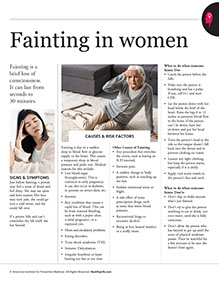
    Fainting is a brief loss of consciousness. It can last from seconds to 30 minutes.

    Signs & Symptoms

    Just before fainting, a person may feel a sense of dread and feel dizzy. She may see spots and have nausea. Her face may turn pale, she could go into a cold sweat, and she could fall over.

    If a person falls and can’t remember the fall itself, she has fainted.

    Causes

    Fainting is due to a sudden drop in blood flow or glucose supply to the brain. This causes a temporary drop in blood pressure and pulse rate. Medical reasons for this include:

    *  Low blood sugar (hypoglycemia). This is common in early pregnancy. It can also occur in diabetes, in persons on severe diets, etc.

    *  Anemia.

    *  Any condition that causes a rapid loss of blood. This can be from internal bleeding, such as with a peptic ulcer, a tubal pregnancy, or a ruptured cyst.

    *  Heart and circulatory problems, such as abnormal heart rhythm, heart attack, or stroke.

    *  Eating disorders.

    *  Toxic shock syndrome (TSS).

    *  Seizures.

    Other Causes of Fainting

    *  Any procedure that stretches the cervix, such as having an IUD inserted.

    *  Extreme pain.

    *  A sudden change in body position, such as standing up too fast.

    *  Sudden emotional stress or fright.

    *  A side effect of some prescription drugs, such as some that lower blood pressure.

    *  Recreational drugs or excessive alcohol.

    *  Being in hot, humid weather or being in a stuffy room.

    Know what to do when someone faints.

    Dos

    *  Catch the person before she falls.

    *  Lie the person down with her head below the level of the heart. Raise the legs 8 to 12 inches to promote blood flow to the brain. If the person can’t lie down, have her sit down, bend forward, and put her head between her knees.

    *  Turn the person’s head to the side so the tongue doesn’t fall back into the throat and to prevent choking on vomit.

    *  Loosen any tight clothing, but keep the person warm, especially if the surroundings are chilly.

    *  Apply moist towels to the person’s face and neck.

    Don’ts

    *  Don’t slap or shake anyone who’s just fainted.

    *  Don’t try to give the person anything to eat or drink, not even water, until she is fully conscious.

    *  Don’t allow the person who’s fainted to get up until the sense of physical weakness passes. Then be watchful for a few minutes to be sure she doesn’t faint again.

    Questions to Ask

    Self-Care / Prevention

    *  When you feel faint, lie down and elevate both legs. Or, sit down, bend forward and put your head between your knees.

    *  Get up slowly from bed or from a sitting position.

    *  Follow your doctor’s advice to treat any condition which may lead to fainting. Take prescribed medicines, but tell your doctor about any side effects, so he or she can monitor your condition.

    *  Don’t wear tight clothing around your neck.

    *  Avoid turning your head suddenly.

    *  Stay out of stuffy rooms and hot, humid places. If you can’t, use a fan.

    *  If you have fainting spells often, avoid activities that can put lives in danger, such as driving a car.

    *  Drink a lot of fluids, but drink alcoholic ones in moderation, if at all. Eat small, frequent meals.

    When Pregnant

    *  Get out of bed slowly.

    *  Keep crackers at your bedside and eat a few before getting out of bed.

    *  Eat small, frequent meals instead of a few large ones. With each meal, have a good source of protein, such as lean meat, low-fat cheese, milk, etc. Avoid sweets. Don’t skip meals or go for a long time without eating. Drink plenty of fluids.

    *  Don’t sit for long periods of time. Elevate your legs when you sit.

    *  When you stand, as in a line, move your legs to pump blood up to your heart.

    *  Take vitamin and mineral supplements, as your doctor prescribes.

    *  Don’t lay on your back during the 2nd and 3rd trimesters of your pregnancy. Lie on your left side. When you can’t, lie on your right side.

    Women's Self-Care book by the American Institute for Preventive Medicine. www.HealthyLife.com. All rights reserved.

    © American Institute for Preventive Medicine
  • Hyperventilation

    First Aid

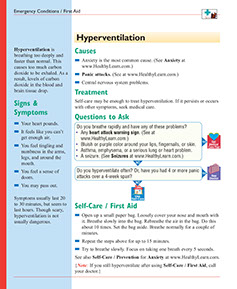
    Hyperventilation is breathing too deeply and faster than normal. This causes too much carbon dioxide to be exhaled. As a result, levels of carbon dioxide in the blood and brain tissue drop.

    Signs & Symptoms

    *  Your heart pounds.

    *  It feels like you can’t get enough air.

    *  You feel tingling and numbness in the arms, legs, and around the mouth.

    *  You feel a sense of doom.

    *  You may pass out.

    Symptoms usually last 20 to 30 minutes, but seem to last hours. Though scary, hyperventilation is not usually dangerous.

    Causes

    *  Anxiety is the most common cause.

    *  Panic attacks.

    *  Central nervous system problems.

    Treatment

    Self-care may be enough to treat hyperventilation. If it persists or occurs with other symptoms, seek medical care.

    Questions to Ask

    Self-Care / Prevention

    *  Open up a small paper bag. Loosely cover your nose and mouth with it. Breathe slowly into the bag. Rebreathe the air in the bag. Do this about 10 times. Set the bag aside. Breathe normally for a couple of minutes.

    *  Repeat the steps above for up to 15 minutes.

    *  Try to breathe slowly. Focus on taking one breath every 5 seconds.

    {Note: If you still hyperventilate after using Self-Care / First Aid, call your doctor.}

    Healthier at Home book by the American Institute for Preventive Medicine. www.HealthyLife.com. All rights reserved.

    © American Institute for Preventive Medicine