Tag: drinking

  • Drink Responsibly

    Substance Use & Abuse

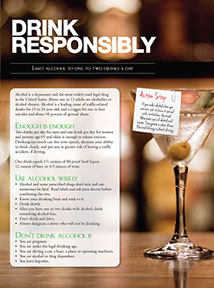
    Limit alcohol to one to two drinks a day.

    Alcohol is a depressant and the most widely used legal drug in the United States. About one in 13 adults are alcoholics or alcohol abusers. Alcohol is a leading cause of traffic-related deaths for 15 to 24 year olds and a trigger for one in four suicides and about 50 percent of spousal abuse.

    Enough is enough.

    Two drinks per day for men and one drink per day for women and persons age 65 and older is enough to release tension. Drinking too much can slur your speech, decrease your ability to think clearly, and put you at greater risk of having a traffic accident, if driving.

    One drink equals 1-1/2 ounces of 80-proof hard liquor, 12 ounces of beer, or 4-5 ounces of wine.

    Use alcohol wisely:

    *  Alcohol and some prescribed drugs don’t mix and can sometimes be fatal. Read labels and ask your doctor before combining the two.

    *  Know your drinking limit and stick to it.

    *  Drink slowly.

    *  After you have one to two drinks with alcohol, drink something alcohol-free.

    *  Don’t drink and drive.

    *  Always designate a driver who will not be drinking.

    Don’t drink alcohol if:

    *  You are pregnant.

    *  You are under the legal drinking age.

    *  You are driving a car, a boat, a plane or operating machines.

    *  You are alcohol or drug dependent.

    *  You have hepatitis.

    Action Step

    If you order alcohol when you eat out, ask to have it served with, not before, the meal. Alternate sips of alcohol and water. Designate a sober driver. Buzzed driving is drunk driving.

    Page from Ways to Well-Being book by the American Institute for Preventive Medicine. www.HealthyLife.com. All rights reserved.

    © American Institute for Preventive Medicine

  • Face Up To Your Drinking Habits

    Substance Use & Abuse

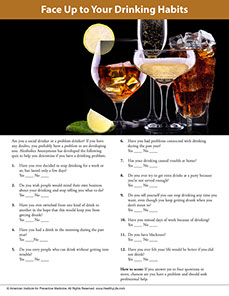
    Are you a social drinker or a problem drinker? If you have any doubts, you probably have a problem or are developing one. Alcoholics Anonymous has developed the following quiz to help you determine if you have a drinking problem.

    1.  Have you ever decided to stop drinking for a week or so, but lasted only a few days?  Yes ____ No ____

    2.  Do you wish people would mind their own business about your drinking and stop telling you what to do?  Yes ____ No ____

    3.  Have you ever switched from one kind of drink to another in the hope that this would keep you from getting drunk?  Yes ____ No ____

    4.  Have you had a drink in the morning during the past year?  Yes ____No ____

    5.  Do you envy people who can drink without getting into trouble?  Yes ____ No ____

    6.  Had problems connected with drinking during the past year?  Yes ____ No ____

    7.  Has your drinking caused trouble at home?  Yes ____ No ____

    8.  Do you ever try to get extra drinks at a party because you’re not served enough?

    Yes ____      No ____

    9.  Do you tell yourself you can stop drinking any time you want, even though you keep getting drunk when you don’t mean to?  Yes ____ No ____

    10. Have you missed days of work because of drinking?  Yes ____ No ____

    11. Do you have blackouts?  Yes ____ No ____

    12. Have you ever felt your life would be better if you did not drink?  Yes ____ No ____

    How to score: If you answer yes to four questions or more, chances are you have a problem and should seek professional help.

    Page from A Year of Health Hints book by the American Institute for Preventive Medicine. www.HealthyLife.com. All rights reserved.

    © American Institute for Preventive Medicine

  • Where To Get Help For A Drinking Problem

    Substance Use & Abuse

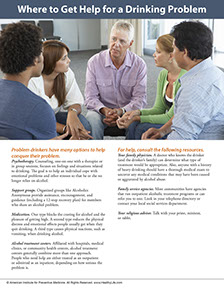
    Image of man seeking help.

    Problem drinkers have many options to help conquer their problem.

    *  Psychotherapy. Counseling, one-on-one with a therapist or in group sessions, focuses on feelings and situations related to drinking. The goal is to help an individual cope with emotional problems and other stresses so that he or she no longer relies on alcohol.

    *  Support groups. Organized groups like Alcoholics Anonymous provide assistance, encouragement, and guidance (including a 12-step recovery plan) for members who share an alcohol problem.

    *  Medication. One type blocks the craving for alcohol and the pleasure of getting high. A second type reduces the physical distress and emotional effects people usually get when they quit drinking. A third type causes physical reactions, such as vomiting, when drinking alcohol.

    *  Alcohol treatment centers. Affiliated with hospitals, medical clinics, or community health centers, alcohol treatment centers generally combine more than one approach. People who need help are either treated as an outpatient or admitted as an inpatient, depending on how serious the problem is.

    For help, consult the following resources.

    *  Your family physician. A doctor who knows the drinker (and the drinker’s family) can determine what type of treatment would be appropriate. Also, anyone with a history of heavy drinking should have a thorough medical exam to uncover any medical conditions that may have been caused or aggravated by alcohol abuse.

    *  Family service agencies. Most communities have agencies that run outpatient alcoholic treatment programs or can refer you to one. Look in your telephone directory or contact your local social services department.

    *  Your religious adviser. Talk with your priest, minister, or rabbi.

    Page from A Year of Health Hints book by the American Institute for Preventive Medicine. www.HealthyLife.com. All rights reserved.

    © American Institute for Preventive Medicine

  • Teach Your Kids Not To Drink

    Substance Use & Abuse

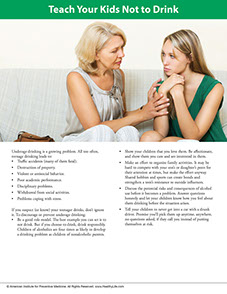
    Underage drinking is a growing problem. All too often, teenage drinking leads to:

    *  Traffic accidents (many of them fatal).

    *  Destruction of property.

    *  Violent or antisocial behavior.

    *  Poor academic performance.

    *  Disciplinary problems.

    *  Withdrawal from social activities.

    *  Problems coping with stress.

    If you suspect (or know) your teenager drinks, don’t ignore it. To discourage or prevent underage drinking:

    *  Be a good role model. The best example you can set is to not drink. But if you choose to drink, drink responsibly. Children of alcoholics are four times as likely to develop a drinking problem as children of nonalcoholic parents.

    *  Show your children that you love them. Be affectionate, and show them you care and are interested in them.

    *  Make an effort to organize family activities. It may be hard to compete with your son’s or daughter’s peers for their attention at times, but make the effort anyway. Shared hobbies and sports can create bonds and strengthen a teen’s resistance to outside influences.

    *  Discuss the potential risks and consequences of alcohol use before it becomes a problem. Answer questions honestly and let your children know how you feel about them drinking before the situation arises.

    *  Tell your children to never get into a car with a drunk driver. Promise you’ll pick them up anytime, anywhere, no questions asked, if they call you instead of putting themselves at risk.

    Page from A Year of Health Hints book by the American Institute for Preventive Medicine. www.HealthyLife.com. All rights reserved.

    © American Institute for Preventive Medicine

  • Alcohol & Alcohol Safety

    Student Health

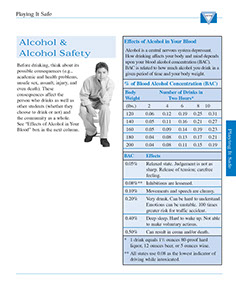
    Before drinking, think about its possible consequences (e.g., academic and health problems, unsafe sex, assault, injury, and even death). These consequences affect the person who drinks as well as other students (whether they choose to drink or not) and the community as a whole.

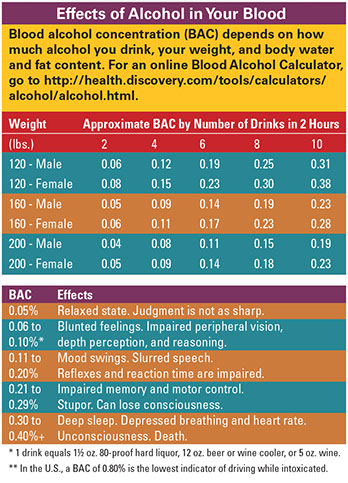
    Chart of effects of alcohol in your blood.

    Alcohol Poisoning

    Call 9-1-1 for one or more of the following signs of alcohol poisoning or combining alcohol and other drugs, such as sedatives or tranquilizers. Act quickly. Alcohol poisoning can be fatal.

    *  Unconsciousness. This means the person is hard to rouse and can’t be made aware of his or her surroundings. This can be brief, such as with fainting or blacking out. It can put a person into a coma.

    *  No breathing or slow and shallow breathing. This means 10 or fewer breaths per minute or time lapses of more than 8 seconds between breaths.

    *  Slow pulse rate (40 or fewer beats per minute).

    *  Skin that is cold, clammy, and/or pale or blue in color.

    {Note: Before emergency care arrives, place the person on his or her side with the knees bent, to prevent choking if he or she vomits. Loosen the person’s clothing around the neck and check the mouth and back of the throat to see that nothing obstructs the person’s breathing. Stay with the person.}

    Alcohol Poisoning

    *  Choose substance-free housing, if available and desired.

    *  Be aware and think about the risks and consequences of drinking, including getting arrested, getting sick, contracting an STI, etc. One incident of alcohol use could cause you to do something you will regret for the rest of your life. Alcohol plays a part in most sexual assaults.

    *  Mixing drinking with driving, drugs, or operating machines can be fatal. Designate a sober driver.

    *  Not everyone drinks. Be with people who drink non-alcoholic beverages or ones that look like “drinks,” such as non-alcoholic beer in a glass.

    *  It is better to get medical help for a person who needs it instead of worrying about getting a friend in trouble.

    *  Drink alcohol only if you want to, and if you do:

    – Know your limit and stick to it or don’t drink any alcohol.

    – Drink slowly. You are apt to drink less. Have one drink during a party. Take fake sips, if necessary. In reality, anything over two drinks does not increase the feeling of pleasure. Drinking too much leads to being unable to enjoy yourself.

    – Eat when you drink. Food helps to slow alcohol absorption.

    – Alternate an alcoholic beverage with a non-alcoholic one. Use non-alcohol or reduced alcohol beverages. Dilute distilled beverages. Use more and more mixer and less and less alcohol. After two drinks, your taste buds are dulled and you won’t be able to notice much difference.

    – Avoid drinking contests and games.

    Resources

    Emergency Medical Service (Call 9-1-1) if you suspect alcohol poisoning or a drug overdose

    Your school’s Student Health Service, Student Counseling Service, or Alcohol and other Drug Program

    Al-Anon/Alateen World Service Office

    888.4AL.ANON (425.2666)

    www.al-anon.org

    Alcoholics Anonymous (AA) World Services

    www.aa.org

    Center for Substance Abuse Treatment (CSAT) National Drug Treatment Referral Routing Service

    800.662.HELP (4357)

    www.findtreatment.samhsa.gov

    Narcotics Anonymous (NA)

    818.773.9999

    www.na.org

    National Institute on Alcohol Abuse & Alcoholism (NIAAA)

    www.niaaa.nih.gov

    www.thecoolspot.gov
    Student Self-Care book by the American Institute for Preventive Medicine. www.HealthyLife.com. All rights reserved.

    © American Institute for Preventive Medicine

  • The Buzz About Alcohol

    WELL-BEING

    Image of lemon water.

    Drinking at social events or bars and the ease that a little buzz provides make it hard to limit yourself when friends gather around a pitcher of beer. Dennis Donovan, director of the Alcohol and Drug Abuse Institute at the University of Washington, has advice for how to drink moderately-or not at all.

    *Count your drinks.In many cases, people lose track of how much they’ve had. This is especially true when sharing a pitcher of beer and someone refills the glass.

    *Know a standard serving size.Large wine glasses, higher alcohol content in some beers, and generous liquor pours in mixed drinks make the “I only had one!” claim questionable.

    *One drink, one hour.Most people’s bodies can process about one drink per hour. Pace yourself to one drink an hour or so, and every hour or two you might take a drink “off” and have water or another non-alcoholic beverage instead. Also, make sure to eat.

    *Ginger ale looks like a cocktail.Teetotalers not wanting to attract attention or questions can stick to ginger ale or other non-alcoholic drinks that look like cocktails.

    *Say no.Firmly, confidently turn down drinks and become resistant to social pressure and arm-twisting. Practice saying: “No, I’ve reached my limit” or “I’m not drinking tonight.”

    © American Institute for Preventive Medicine