Tag: dryness

  • Only You Can Prevent Christmas Tree Fires

    Home Safety

    Image of Christmas tress in front of fire place.

    Every Christmas season, many families tragically lose their homes because of Christmas tree fires. Here’s how to prevent them.

    To choose a tree:

    *  Pick the freshest tree you can find. Hold the tree by the trunk and tap it against the ground. If needles drop profusely, look for another tree.

    *  Keep the tree outdoors with the trunk in water as long as possible. Once you bring the tree into a heated building, it will dry out more quickly.

    *  Indoors, keep the trunk in water. Check the water level daily, and refill when needed.

    *  Don’t stand the tree near a fireplace, wood stove, heat register, or electrical wires.

    To decorate the tree:

    *  Purchase only tree lights bearing a UL label from Underwriters Laboratory, which shows they meet safety standards.

    *  Check for broken bulbs, worn-out insulation, and damaged sockets. Replace or repair as necessary.

    *  Never attach electrical lights to an artificial, metal tree. Don’t overload extension cords.

    *  Discourage children from touching a decorated tree-it may tip over.

    *  To discourage pets from attacking the tree, avoid shiny decorations, and don’t place tinsel or ornaments on the lower branches.

    A Year of Health Hints book by the American Institute for Preventive Medicine. www.HealthyLife.com. All rights reserved.

    © American Institute for Preventive Medicine

  • How Aging Affects The Eyes

    Eye Conditions

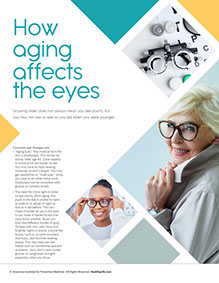
    Growing older does not always mean you see poorly. But you may not see as well as you did before. Common changes that affect your eyes are:

    *  “Aging Eyes.” The medical term for this is presbyopia (prez-bee-OH-pea-ah). This comes on slowly after age 40. Close objects or small print are harder to see. You may have to hold reading materials at arm’s length. You may get headaches or “tired eyes” while you read or do other close work. Presbyopia can be corrected with glasses or contact lenses.

    *  The need for more light in order to see clearly. With aging, the pupil in the eye is unable to open as wide or to adapt to light as fast as it did before. This can make it harder to see in the dark. It can make it harder to tell one color from another. Blues can look like different shades of gray. To help with this, add more and brighter lights in places around the house, such as at work counters, stairways, and favorite reading places. This may help you see better and can sometimes prevent accidents. Also, don’t wear tinted glasses or sunglasses at night, especially when you drive.

    Signs & Symptoms and What It Could Be

    Signs & Symptoms: Sudden loss of all or part of vision, especially in one eye with sudden weakness or numbness on one side.

    What It Could Be: Stroke

    What to Do: Get immediate care. Call 9-1-1.

    Signs & Symptoms: Vision loss after head or eye injury. Sudden vision loss or blurred vision, and seeing dark spots, or flashes of light all of a sudden.

    What It Could Be: Detached or torn retina.

    What to Do: Get immediate care.

    Signs & Symptoms: Severe pain in and above the eye. Eye redness, swollen upper eyelid. Dilated and fixed pupil. Very blurred vision, halos around lights.

    What It Could Be: Angle-closure glaucoma.

    What to Do: Get immediate care.

    Signs & Symptoms: Object or chemical in the eye.

    What It Could Be: Eye irritation or injury.

    See “Eye Irritations & Injuries” for more information.

    Signs & Symptoms: Gradual loss of side vision. Blurred vision. Halos around lights. Poor night vision.

    What It Could Be: Open-angle or chronic glaucoma.

    See “Glaucoma” for more information.

    Signs & Symptoms: Dark or blind spot in center of vision. Blurred or cloudy vision. Straight lines look wavy.

    What It Could Be: Macular degeneration.

    See “Macular Degeneration” for more information.

    Signs & Symptoms: Cloudy, fuzzy, foggy, or filmy vision. Halos around lights. Problems with glare from lamps or the sun.

    What It Could Be: Cataract.

    See “Cataracts” for more information.

    Signs & Symptoms: Pus discharge from the eye; the white of the eye and eyelid are red; crusting of the eyelid in the morning; feeling of sand in the eye

    What It Could Be: Conjunctivitis (“Pink Eye”).

    See “Conjunctivitis (Pink Eye)” for more information.

    Signs & Symptoms: Firm lump on eyelid or tender pimple on the edge of the eyelid.

    What It Could Be: Stye.

    See “Stye” for more information.

    Signs & Symptoms: Seeing spots, specks, wavy lines, or streaks of light.

    What It Could Be: Floaters and/or flashes.

    See “Floaters and/or flashes” for more information.

    Signs & Symptoms: Blurred vision when you look at close objects; headaches; eyestrain.

    What It Could Be: “Aging Eyes” or presbyopia.

    What to Do: Call eye doctor for an appointment and advice.

    Health at Home Lifetime book by the American Institute for Preventive Medicine. www.HealthyLife.com. All rights reserved.

    © American Institute for Preventive Medicine

  • Nosebleeds

    Ear, Nose & Throat Conditions

    Signs & Symptoms

    *  Bleeding from a nostril.

    *  Bleeding from the nose and down the back of the throat.

    Causes

    Nosebleeds are often caused by broken blood vessels just inside the nose. Risk factors include:

    *  A cold or allergies.

    *  A dry environment.

    *  Frequent nose blowing and picking.

    *  Using too much nasal spray.

    *  A punch or other blow to the nose.

    A nosebleed is serious when heavy bleeding from deep within the nose is hard to stop. This type occurs most often in the elderly. It can be caused by: Hardening of nasal blood vessels; high blood pressure; and medicines that treat blood clots.

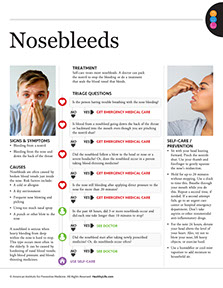
    Treatment

    Self-care treats most nosebleeds. A doctor can pack the nostril to stop the bleeding or do a treatment that seals the blood vessel that bleeds.

    Questions to Ask

    Self-Care / Prevention

    *  Sit with your head leaning forward. Pinch the nostrils shut. Use your thumb and forefinger to gently squeeze the nose’s midsection.

    *  Hold for up to 20 minutes without stopping. Use a clock to time this. Breathe through your mouth while you do this. Repeat a second time, if needed. If a second attempt fails, go to an urgent care center or hospital emergency department. Don’t take aspirin or other nonsteroidal anti-inflammatory drugs.

    *  For the next 24 hours, elevate your head above the level of your heart. Also, try not to blow your nose, lift heavy objects, or exercise hard.

    *  Use a humidifier or cool-mist vaporizer to add moisture to household air.

    Healthier at Home book by the American Institute for Preventive Medicine. www.HealthyLife.com. All rights reserved.

    © American Institute for Preventive Medicine

  • Winter Itch

    SELF-CARE CORNER

    Image of a snowman.

    All winter flakes are not made of snow. Cold weather, with its low relative humidity, wreaks havoc on your skin, making it dry and flaky. Skin dries out if it’s deprived of moisture, and this dryness often aggravates itchiness, resulting in a condition commonly referred to as “winter itch.” During the winter the air is drier, and indoor heating further robs your skin of moisture. Fortunately, there are several ways that you can replenish the water content of your skin.

    Dr. Robyn Gmyrek, a dermatologist and director of the Skin and Laser Center at New York-Presbyterian Hospital/Columbia University Medical Center, suggests the following skin advice:

    *Moisturize daily.Petrolatum or cream-based moisturizers are far better than lotions for normal to dry skin. If you have sensitive skin, choose a moisturizer without fragrance or lanolin. After bathing, apply moisturizer directly to your wet skin to ensure that the moisturizer can help to trap surface moisture.

    *Limit the use of hot water and soap.If you have “winter itch,” take short lukewarm showers or baths with a non-irritating, non-detergent-based cleanser. Immediately afterward, apply a thick cream or a petroleum-jelly-type moisturizer. Gently pat skin dry.

    *Humidify.Dry air can pull the moisture from your skin. Room humidifiers can be very helpful. However, be sure to clean the unit and change the water according to the manufacturer’s instructions to reduce mold and fungi.

    *Protect yourself from the wind.Cover your face and use a petrolatum-based balm for your lips.

    *Protect your skin from the sun.Remember that winter sun can also be dangerous to the skin. Even in the winter months you should use a sunscreen with a sun-protection factor of 15 or greater if you will be outdoors for prolonged periods.

    *Avoid winter tanning.Tanning beds and artificial sunlamps are always damaging to your skin and increase your risk of skin cancer.

    *Take vitamin D supplements.During the summer months your natural vitamin D production increases due to daily sun exposure, but when winter rolls around that exposure decreases. Taking vitamin supplements can ensure that you are getting the recommended amounts of vitamin D all year.

    © American Institute for Preventive Medicine