Tag: Ear, Nose & Throat

  • Hearing Loss

    Ear, Nose & Throat Conditions

    People over age 50 are likely to lose some hearing each year. The decline is usually gradual. About 30% of adults age 65 through 74 and about 50% of those age 85 and older have hearing problems.

    Hearing problems can get worse if they are ignored and not treated. People with hearing problems may withdraw from others because they may not be able to understand what others say. Hearing loss can cause an older person to be labeled “confused” or “senile.”

    Signs & Symptoms

    *  Words are hard to understand. This worsens when there is background noise.

    *  Certain sounds are overly loud or annoying.

    *  Hearing a hissing or ringing background noise. This can be constant or it can come and go.

    *  Concerts, TV shows, etc. are less enjoyable because much goes unheard.

    Causes

    Presbycusis (prez-bee-KU-sis). This is a gradual type of hearing loss. It is common with aging. With this, you can have a hard time understanding speech. You may not tolerate loud sounds. You may not hear high pitched sounds. Hearing loss from presbycusis does not cause deafness.

    *  Ear wax that blocks the ear canal.

    *  A chronic middle ear infection or an infection of the inner ear.

    *  Medicines (e.g., aspirin).

    *  Blood vessel disorders, such as high blood pressure.

    *  Acoustic trauma, such as from a blow to the ear or from excessive noise. Noise-Induced Hearing Loss (NIHL) can be from a one-time exposure to an extremely loud sound or to repeated exposure to loud level sounds.

    *  Ménière’s disease. This is a problem of the inner ear. The hearing loss comes and goes. Dizziness is also a symptom.

    *  Small tumors on the auditory nerve. Brain tumor (rarely).

    Treatment

    *  Earwax is removed by a health care provider.

    *  Hearing aid(s). These make sounds louder.

    *  Speech reading. This is learning to read lips and facial expressions.

    *  Auditory training. This helps with specific hearing problems.

    *  Surgery. This can be done if the problem requires it.

    Questions to Ask

    Self-Care / Prevention

    For Gradual, Age-Related Hearing Loss

    *  Ask people to speak clearly, distinctly, and in a normal tone.

    *  Look at people when they are talking to you. Watch their expressions.

    *  Try to limit background noise when speaking with someone.

    *  In a church or theater, sit in the 3rd or 4th row with people sitting around you.

    *  Install a flasher or amplifier on your phone, door chime, and alarm clock.

    To Hear Sounds Better

    *  Use a hearing aid. There are many kinds. Examples are ones worn:

    – In-the-Ear (ITE).

    – Behind-the-Ear (BTE).

    – In-the-Canal (ITC).

    *  To find the hearing aid that works best for you, see an audiologist. Ask him or her about a trial period with different hearing aids to find one you are comfortable with.

    *  Use devices and listening systems that help you hear better when you use your telephone, mobile phone, TV, stereo, etc.

    To Clear Earwax

    Use only if the eardrum is not ruptured. Check with your doctor if you are not sure.

    *  Lie on your side. Using a syringe or medicine dropper, carefully squeeze a few drops of lukewarm water into your ear (or have someone else do this). Let the water remain there for 10 to 15 minutes and then shake it out. Now, squeeze a few drops of hydrogen peroxide, mineral oil, or an over-the-counter cleaner, such as Debrox, into the ear. Let the excess fluid flow out of the ear.

    *  After several minutes, put warm water in the ear again. Let it stay there for 10 to 15 minutes. Tilt the head to allow it to drain out of the ear.

    Repeat this entire procedure again in 3 hours if the earwax has not cleared.

    Resources

    American Speech-Language Hearing Association

    800.638.8255

    www.asha.org

    Better Hearing Institute

    800.EAR.WELL (327.9355)
    www.betterhearing.org

    Healthier at Home book by the American Institute for Preventive Medicine. www.HealthyLife.com. All rights reserved.

    © American Institute for Preventive Medicine
  • Laryngitis

    Ear, Nose & Throat Conditions

    Laryngitis is when your larynx (voice box) is irritated or swollen.

    Signs & Symptoms

    *  Hoarse, husky, and weak voice or loss of voice.

    *  Cough.

    *  Sore throat, fever, and/or trouble swallowing.

    Causes

    Common causes are allergies and irritants like smoke; bacterial or viral infections; and strained vocal cords. Smoking, drinking alcohol, breathing cold air, and using already distressed vocal cords can make the problem worse. Growths on the vocal cords or nerve damage to the vocal cords can also cause hoarseness.

    Treatment

    Self-care treats most cases of laryngitis. If needed, your doctor may prescribe an antibiotic for a bacterial infection.

    Questions to Ask

    Self-Care / Prevention

    *  Don’t smoke. Avoid secondhand smoke.

    *  Don’t talk if you don’t need to. Write notes, instead.

    *  Use a cool-mist humidifier in your bedroom.

    *  Drink a lot of fluids. Drink warm drinks, such as weak tea, with honey and/or lemon juice.

    *  Gargle every few hours with warm salt water (1/4 teaspoon of salt in 1 cup of warm water).

    *  Run hot water in the shower to make steam. Sit in the bathroom and breathe the moist air.

    *  Suck on cough drops, throat lozenges, or hard candy. (Don’t give to children under age 5.) Take an over-the-counter medicine for pain as directed on the label.

    Resources

    American Academy of Otolaryngology –

    Head and Neck Surgery

    www.entnet.org

    Healthier at Home book by the American Institute for Preventive Medicine. www.HealthyLife.com. All rights reserved.

    © American Institute for Preventive Medicine
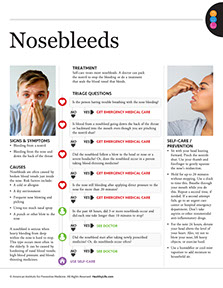
  • Nosebleeds

    Ear, Nose & Throat Conditions

    Signs & Symptoms

    *  Bleeding from a nostril.

    *  Bleeding from the nose and down the back of the throat.

    Causes

    Nosebleeds are often caused by broken blood vessels just inside the nose. Risk factors include:

    *  A cold or allergies.

    *  A dry environment.

    *  Frequent nose blowing and picking.

    *  Using too much nasal spray.

    *  A punch or other blow to the nose.

    A nosebleed is serious when heavy bleeding from deep within the nose is hard to stop. This type occurs most often in the elderly. It can be caused by: Hardening of nasal blood vessels; high blood pressure; and medicines that treat blood clots.

    Treatment

    Self-care treats most nosebleeds. A doctor can pack the nostril to stop the bleeding or do a treatment that seals the blood vessel that bleeds.

    Questions to Ask

    Self-Care / Prevention

    *  Sit with your head leaning forward. Pinch the nostrils shut. Use your thumb and forefinger to gently squeeze the nose’s midsection.

    *  Hold for up to 20 minutes without stopping. Use a clock to time this. Breathe through your mouth while you do this. Repeat a second time, if needed. If a second attempt fails, go to an urgent care center or hospital emergency department. Don’t take aspirin or other nonsteroidal anti-inflammatory drugs.

    *  For the next 24 hours, elevate your head above the level of your heart. Also, try not to blow your nose, lift heavy objects, or exercise hard.

    *  Use a humidifier or cool-mist vaporizer to add moisture to household air.

    Healthier at Home book by the American Institute for Preventive Medicine. www.HealthyLife.com. All rights reserved.

    © American Institute for Preventive Medicine
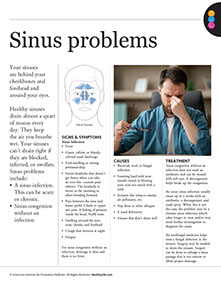
  • Sinus Problems

    Ear, Nose & Throat Conditions

    Your sinuses are behind your cheekbones and forehead and around your eyes. Healthy sinuses drain almost a quart of mucus every day. They keep the air you breathe wet. Your sinuses can’t drain right if they are blocked, infected, or swollen. Sinus problems include:

    *  A sinus infection. This can be acute or chronic.

    *  Sinus congestion without an infection.

    Signs & Symptoms

    For a Sinus Infection

    *  Fever.

    *  Green, yellow, or bloody-colored nasal discharge.

    *  Foul-smelling or tasting postnasal drip.

    *  Severe headache that doesn’t get better when you take an over-the-counter pain reliever. The headache is worse in the morning or when bending forward.

    *  Pain between the nose and lower eyelid. Cheek or upper jaw pain.

    *  A feeling of pressure inside the head. Stuffy nose.

    *  Swelling around the eyes, nose, cheeks, and forehead.

    *  Cough that worsens at night.

    *  Fatigue.

    For sinus congestion without an infection, drainage is clear and there is no fever.

    Causes

    *  Bacterial, viral, or fungal infection. Sneezing hard with your mouth closed or blowing your nose too much with a cold.

    *  Irritants like tobacco smoke, air pollutants, etc. Hay fever or other allergies.

    *  A nasal deformity. Sinuses that don’t drain well.

    Treatment

    Sinus congestion without an infection does not need an antibiotic and can be treated with self-care. A decongestant helps break up the congestion.

    An acute sinus infection usually clears up in 2 weeks with an antibiotic, a decongestant, and nose drops or a nasal spray. When this is not the case, the problem may be a chronic sinus infection which takes longer to treat and/or may need further investigation to diagnose the cause.

    An antifungal medicine helps treat a fungal infection in the sinuses. Surgery may be needed to drain the sinuses. Surgery can be done to enlarge a sinus passage that is too narrow to allow proper drainage.

    Questions to Ask

    Self-Care / Prevention

    *  Use a cool-mist humidifier especially in the bedroom. Put a humidifier on the furnace.

    *  Put a warm washcloth, warm or cold compress over the sinus area of your face. Use the one that helps most for the pain.

    *  Drink plenty of liquids.

    *  Take an over-the-counter (OTC) medicine for pain as directed on the label.

    *  Take an OTC decongestant or an OTC pain reliever with a decongestant (e.g., Tylenol Sinus). {Note: Some persons should not take decongestants.}

    *  Use nose drops only for the number of days prescribed. Repeated use of them creates a dependency. Don’t share nose drops with others. Throw the drops away after treatment.

    *  Nasal washes with salt water. Find out about this technique from the National Jewish Health.

    Healthier at Home book by the American Institute for Preventive Medicine. www.HealthyLife.com. All rights reserved.

    © American Institute for Preventive Medicine

  • Thyroid Awareness

    Ear, Nose & Throat Conditions

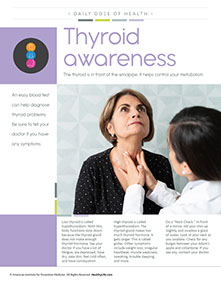
    Doctor examining women's neck.

    The thyroid is in front of the windpipe. It helps control your metabolism.

    An easy blood test can help diagnose thyroid problems. Be sure to tell your doctor if you have any symptoms.

    Low thyroid is called hypothyroidism. With this, body functions slow down because the thyroid gland does not make enough thyroid hormone. See your doctor if you have a lot of fatigue, are depressed, have dry, pale skin, feel cold often, and have constipation.

    High thyroid is called hyperthyroidism. The thyroid gland makes too much thyroid hormone. It gets larger. This is called goiter. Other symptoms include weight loss, irregular heartbeat, muscle weakness, sweating, trouble sleeping, and more.

    Do a “Neck Check:” In front of a mirror, tilt your chin up slightly and swallow a glass of water. Look at your neck as you swallow. Check for any bulges between your Adam’s apple and collarbone. If you see any, contact your doctor.

    Health at Home Lifetime book by the American Institute for Preventive Medicine. www.HealthyLife.com. All rights reserved.

    © American Institute for Preventive Medicine
  • Bloody Nose Know-How

    MEDICAL NEWS

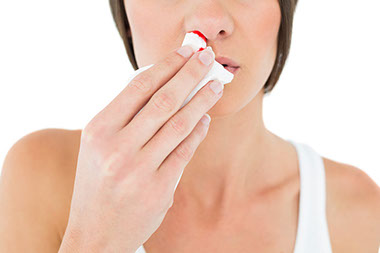
    Image of a nose bleed.

    Maybe you blew your nose too hard or bumped your nose. Causes aren’t always known. But when the blood starts gushing, nosebleeds can be frightening.

    Experts at eMedicineHealth tell what to do: Remain calm. Sit up straight and lean your head forward. Contrary to what some people think, do not lean your head back, you’ll only swallow the blood.

    Ice packs do not help either. Pinch your nostrils tightly together with your thumb and index finger for 10 minutes. Just hold it. Breathe through your mouth, of course. Do not release your grip.

    That should stop the blood flow, usually from an artery in the front of your nose. Then be nice to your tender nose for the rest of the day. Think about adding humidity to the air when you sleep, especially in dry winter weather.

    © American Institute for Preventive Medicine
  • Cautions About Sinus Rinsing

    SELF-CARE CORNER

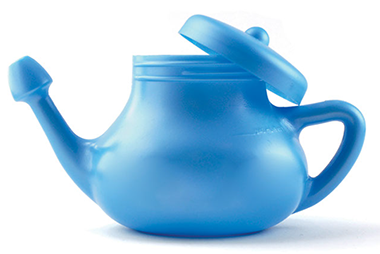
    Image of blue neti pot used to rinse nasal passages.

    Little teapots with long spouts have become a fixture in many homes for reasons that have nothing to do with tea.

    Called neti pots, they are used to rinse the nasal passages with a saline (salt-based) solution and have become a popular treatment for congested sinuses, colds and allergies, and for moistening nasal passages exposed to dry indoor air.

    The FDA has concerns about the risk of infection tied to the improper use of neti pots and other nasal rinsing devices. The agency is promoting safe practices for using all nasal rinsing devices, which include bulb syringes, squeeze bottles, and battery-operated pulsed water devices.

    These devices are generally safe and useful products, but they must be used and cleaned properly.

    Most important is the source of water that is used with nasal rinsing devices. Tap water that is not filtered, treated, or processed in specific ways is not safe for use as a nasal rinse.

    Some tap water contains low levels of organisms, such as bacteria and protozoa. These include amoebas, which may be safe to swallow because stomach acid kills them. But these “bugs” can stay alive in nasal passages and cause potentially serious infections, according to the CDC.

    The procedure for nasal rinsing may vary slightly by device, but generally involves these steps:

    *  Wash and dry hands. Check that the device is clean and completely dry. Wash the device with distilled, sterile, or boiled and cooled tap water. Then dry the inside with a paper towel or let it air dry between uses.

    *  Use the appropriate water to prepare the saline rinse, either with the prepared mixture supplied with the device, or one you make yourself with distilled or sterile water, which you can buy in stores. The label will state “distilled” or “sterile.” Boiled and cooled tap water-boiled for 3 to 5 minutes, then cooled until it is lukewarm may be used. Previously boiled water can be stored in a clean, closed container for use within 24 hours. Or use water passed through a filter with an absolute pore size of 1 micron or smaller, which traps potentially infectious organisms. CDC has information on selecting these filters, which you can buy online or from some hardware and discount stores.

    *  Lean over a sink, tilt your head sideways with your forehead and chin roughly level to avoid liquid flowing into your mouth.

    *  Breathe through your open mouth.  Insert the spout of the saline-filled container into your upper nostril so that the liquid drains through the lower nostril.

    *  Clear your nostrils, and then repeat the procedure, tilting your head sideways, on the other side. Some people like to do this procedure in the shower.

    Nasal rinsing can remove dirt, dust, pollen and other debris, as well as help to loosen thick mucus. It can also help relieve nasal symptoms of allergies, colds and flu.

    © American Institute for Preventive Medicine

  • How To Stop A Nosebleed

    SELF-CARE CORNER

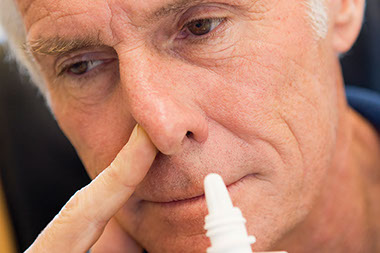
    Image of man using a nasal spray.

    When the furnace fires up and the humidity drops, the nose is most at risk. Nosebleeds can range from a simple, brief annoying amount of bleeding to life-threatening bleeding, according to Dr. Peter Shepard, an ear, nose, and throat expert.

    The nose has a collection of blood vessels called Kiesselbach’s plexus. This area is located at the front of the septum, the cartilage that divides the nose. Vessels from several different main trunks all meet in this spot and are very close to the surface. This is also the area of the nose that tends to dry out the most.

    If the surface cracks, the vessels will bleed. The size of the vessels determines how bad the bleeding is. People are more at risk if they have high blood pressure, take blood thinners, use oxygen, or have a deviated nasal septum.

    The best treatment for nosebleeds is avoiding them in the first place. Unless you can take an extended trip to Hawaii, you’ll want to work on improving the humidity inside your nose.

    Apply Vaseline at the front of your nostril twice a day. Saline spray can be kept with you and used throughout the day.

    If you do have a bleed, a few simple things will usually stop it.

    *  Apply pressure by squeezing the soft part of the nose between your thumb and index finger. Lean forward so you don’t swallow any blood (do not hold your head back, as some suggest).

    *  If that is not enough, oxymetazoline (Afrin) nasal spray can be a miracle drug for nosebleeds. It is a decongestant but works for nosebleeds since it causes blood vessels to tighten. Blow the blood out of the nose, spray twice, and then apply pressure for 15 minutes.

    *  If the bleeding won’t stop, go to the emergency room.

    © American Institute for Preventive Medicine