
Tag: ears

  • Listen To Your Ears

    SELF-CARE CORNER

    Workers with safety gear protecting head, eyes and ears.

    It’s easy to take hearing for granted. But without proper care of your ears, you could end up with hearing loss or ear problems.

    Worried about wax

    Your body makes ear wax to protect your ears. Wax keeps dust and other particles from getting inside.

    Only clean the outside of your ears with a tissue, washcloth or cotton swab. Never stick anything, including a cotton swab, in your ear. This will push wax farther down into the ear and can create a harmful blockage.

    If you feel that there’s a lot of wax in the ear, you can safely try to soften it with a drop of mineral oil or glycerin. Your doctor can also remove ear wax blockages without damaging your ear.

    Saying no to noise

    One of the most common reasons people lose their hearing is exposure to loud noises. This can happen very quickly after a loud sound like an explosion. Or, it can happen over time if a person is exposed to loud sounds for months or years.

    You can help prevent noise-induced hearing loss with one simple tool: ear plugs. Wear them when going to a loud concert, watching fireworks or attending loud events. Wear them when mowing the lawn or using loud power equipment at home.

    If you have a job where you are exposed to noise, make sure you are using the right hearing protection. You may need something more powerful than ear plugs for certain jobs. Talk about this with your employer.

    Use headphones with care

    The World Health Organization says people should limit how much they use headphones. Don’t use them more than one hour a day. Keep the volume as low as possible, but no louder than 60 percent.

    Noise-cancelling headphones help you keep the volume low because they block out sounds around you. But, you should not use these when driving, cycling or walking because you won’t be able to hear possible dangers nearby.

    Talk to your doctor about your hearing health. Together, you can decide when you may need a hearing test.

    Sources: American Academy of Family Physicians, National Institute on Deafness and Other Communication Disorders

    © American Institute for Preventive Medicine

  • Prevent In-Flight Ear Pops

    Healthy Travel

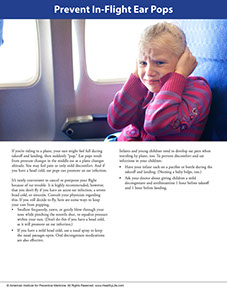
    Image of young girl on plane covering her ears.

    If you’re riding in a plane, your ears might feel full during takeoff and landing, then suddenly “pop.” Ear pops result from pressure changes in the middle ear as a plane changes altitude. You may feel pain or only mild discomfort. And if you have a head cold, ear pops can promote an ear infection.

    It’s rarely convenient to cancel or postpone your flight because of ear trouble. It is highly recommended, however, that you don’t fly if you have an acute ear infection, a severe head cold, or sinusitis. Consult your physician regarding this. If you still decide to fly, here are some ways to keep your ears from popping.

    *  Swallow frequently, yawn, or gently blow through your nose while pinching the nostrils shut, to equalize pressure within your ears. (Don’t do this if you have a head cold, as it will promote an ear infection.)

    *  If you have a mild head cold, use a nasal spray to keep the nasal passages open. Oral decongestant medications are also effective.

    Infants and young children tend to develop ear pain when traveling by plane, too. To prevent discomfort and ear infections in your children:

    *  Have your infant suck on a pacifier or bottle during the takeoff and landing. (Nursing a baby helps, too.)

    *  Ask your doctor about giving children a mild decongestant and antihistamine 1 hour before takeoff and 1 hour before landing.

    Page image from A Year of Health Hints book by the American Institute for Preventive Medicine. www.HealthyLife.com. All rights reserved.

    © American Institute for Preventive Medicine
  • Ringing In The Ears

    SELF-CARE CORNER

    Image of man holding a magnifying glass next to his ear.

    Developing tinnitus or ringing in the ears can be annoying at best. At worse, the condition can cause anxiety, depression, insomnia, and other serious medical issues. Tinnitus is often described as buzzing, ringing, hissing, humming, roaring, or whistling that someone hears. Imagine hearing something that seems to come from inside your head. More than 50 million people in the United States have the condition, according to the American Tinnitus Association.

    If you struggle with tinnitus, you may find help with these tips from Neuromonics:

    *Be good to yourself.Tinnitus can affect many areas of life.

    *Educate yourself.Tinnitus has several causes and affects each person differently. The more a tinnitus sufferer understands, the greater the chances of making the tinnitus less bothersome.

    *Educate others.Family members, friends, coworkers, and associates can benefit from understanding tinnitus and its effects. They can be more supportive if they understand the conditions that are difficult for a tinnitus sufferer.

    *Seek out support.A few individuals who understand the daily trials of tinnitus can be invaluable. Consider a formal support group-in-person or online-to find out about coping strategies.

    *Contact the ATA’s Support Networkatwww.ata.org/support.

    *Obtain counseling.For some people, a licensed therapist or counselor can help with techniques to make tinnitus symptoms less bothersome and with effects of tinnitus such as anxiety and depression.

    © American Institute for Preventive Medicine
  • Are Your Ears Ringing?

    WELL-BEING

    Women covering her ears with her fingers.

    Ringing in the ears, known as tinnitus, is not a disease. It’s a symptom of something wrong with your body’s hearing system. And, it may not be “ringing” at all. Some people hear sounds like roaring, hissing, clicking or buzzing.

    Experts think that tinnitus happens when certain nerve cells are out of balance. This makes a person hear a sound that isn’t really there.

    Why does it happen?

    Tinnitus can be caused by many different things. Some possible causes include:

    *  Certain medicines – see a doctor right away if this happens. Tinnitus can be a serious side effect.

    *  High blood pressure

    *  Being around loud noises

    *  Sinus infections

    *  Brain injuries

    *  Injuries to the neck or head

    * .  Anemia

    *  Thyroid problems

    *  Autoimmune diseases

    *  Temporomandibular joint (TMJ) disorders

    Sometimes a person has tinnitus without being able to identify an obvious cause.

    Can I make it stop?

    There is no cure for all types of tinnitus. But, if your doctor can find out what’s causing it, there may be a treatment to resolve the issue. For instance, you might need treatment for high blood pressure or a sinus or ear infection.

    Some people have tinnitus because they also have some hearing loss. That’s why using a hearing aid may be helpful in these cases.

    If there’s no obvious cause, other things may help. They include:

    *  Wearable sound generators. These small devices fit inside the ear. They create a soft, pleasant noise that helps you ignore the sound of tinnitus.

    *  White noise machines or sound machines. Some people notice tinnitus more at night. This is probably because when you’re lying down in a quiet room, the tinnitus is easier to hear. For these times, you may benefit from a machine that plays noise while you sleep to override the tinnitus sound.

    *  Antidepressants or anti-anxiety medicines. Some people have severe tinnitus that interferes with their life. Tinnitus can cause anxiety or depression. In these cases, medicine to treat these health conditions can help.

    If you notice sounds or ringing in your ears, see your doctor. They may be able to help you find a solution that improves your quality of life.

    Sources: American Tinnitus Association, National Institutes of Health

    © American Institute for Preventive Medicine