Tag: eating

  • Eating Disorders

    Student Health

    Five to 10 million adolescent girls and women have an eating disorder. About 1 million males do. The 3 most common eating disorders are anorexia nervosa, bulimia nervosa, and binge eating disorder. These eating disorders are a coping mechanism. They result in an obsession with food and/or weight; anxiety around eating; guilt; and severe and adverse effects on psychological and physical health. Eating disorders are very serious health problems.

    Signs & Symptoms

    For Anorexia Nervosa

    *  Loss of a lot of weight in a short period of time.

    *  Intense, irrational fear of weight gain and/or of looking fat. Obsession with fat, calories, and weight.

    *  A need to be perfect or in control in one area of life.

    *  Distorted body image. The person feels and sees herself or himself as fat despite being a normal weight for height and age.

    *  Marked physical signs. These include loss of hair, slowed heart rate, and low blood pressure. The person feels cold due to decreased body temperature. In females, menstrual periods can stop.

    For Bulimia Nervosa

    *  Repeated acts of binge eating and purging. Purging can be through vomiting; taking laxatives, water pills, and/or diet pills; fasting; and exercising a lot to “undo” the binge.

    *  Excessive concern about body weight.

    *  Being underweight, normal weight, or overweight.

    *  Dieting often.

    *  Dental problems. Mouth sores. Chronic sore throat.

    *  Spending a lot of time in bathrooms.

    *  Because of binge-purge cycles, severe health problems can occur. These include an irregular heartbeat and damage to the stomach, kidneys,  and bones.

    For Binge Eating Disorder

    *  Periods of nonstop eating that are not related to hunger.

    *  Impulsive binging on food without purging.

    *  Dieting and/or fasting over and over.

    *  Weight can range from normal weight to mild, moderate, or severe obesity.

    Causes

    An exact cause has not been found. Persons from all backgrounds, ages, and genders are affected. Risk factors include:

    *  A family history of eating disorders.

    *  Pressure from society to be thin.

    *  Personal and family pressures.

    *  Sexual, physical, or alcohol abuse in the past.

    *  Fear of starting puberty.

    *  Fear of having sex.

    *  Pressure for athletes to lose weight or to be thin for competitive sports.

    *  Chronic dieting.

    Treatment

    *  Counseling. This can be individual, family, group, and/or behavioral therapy.

    *  Support groups.

    *  Medication.

    *  Nutrition therapy.

    *  Outpatient treatment.

    *  Hospitalization, if needed.

    Treatment varies with the disorder and how severe it is. The earlier the condition is diagnosed and treated, the better the outcome.

    Questions to Ask

    Self-Care

    Eating disorders need professional treatment.

    To Help Prevent an Eating Disorder

    *  Learn to accept yourself and your body. You don’t need to look like anyone else. Spend time with people who accept you as you are, not people who focus on “thinness.”

    *  Know that self-esteem does not have to depend on body weight.

    *  Eat nutritious foods. Focus on whole grains, beans, fresh fruits and vegetables, low-fat dairy foods, and low-fat meats.

    *  Commit to a goal of normal eating. Realize that this will take time. It will also take courage to fight fears of gaining weight.

    *  Don’t skip meals. If you do, you are more likely to binge when you eat.

    *  Avoid white flour, sugar and foods high in sugar and fat, such as cakes, cookies, and pastries. Bulimics tend to binge on junk food. The more they eat, the more they want.

    *  Get regular, moderate exercise 3 to 4 times a week. If you exercise more than your doctor advises, do non-exercise activities with family and friends.

    *  Find success in things you do. Hobbies, work, school, etc. can promote self-esteem.

    *  Learn as much as you can about eating disorders from books and organizations that deal with them.

    *  To help their children avoid eating disorders, parents should promote a balance between their child’s competing needs for independence and family involvement.

    To Treat an Eating Disorder

    *  Follow your treatment plan.

    *  Attend counseling sessions and/or support group meetings as scheduled.

    *  Identify feelings before, during, and after you overeat, binge, purge, or restrict food intake. What is it that you are hoping the food will do?

    *  Set small goals that you can easily reach. Congratulate yourself for every success. This is a process. Accept set backs. Learn from them.

    *  Talk to someone instead of turning to food.

    *  Work toward the point where weight is no longer a way you rate your success. Think about your accomplishments, positive personal qualities, and valued relationships.

    *  Learn to express your rights. You have the right to say no and the right to express your feelings and your opinions. You have the right to ask that your needs are met.

    *  Keep a journal of your progress, feelings, thoughts, etc., but not about what you eat. The journal is just for you, not for others to read or judge. This is a safe place to be honest with yourself. The journal can also help you identify your “triggers” so that you can deal with them in the future.

    *  Don’t let the scale run your life. Better yet, throw out the scale!

    Resources

    Your school’s Student Health Service, Student Counseling or Mental Health Service

    National Eating Disorders Association (NEDA)Information and Referral Helpline

    800.931.2237
    www.nationaleatingdisorders.org

    Student Self-Care book by the American Institute for Preventive Medicine. www.HealthyLife.com. All rights reserved.

    © American Institute for Preventive Medicine

  • Eating Disorders 2

    Women’s Health

    Image of women sitting alone.

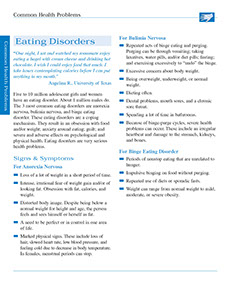
    Common eating disorders are anorexia nervosa, bulimia nervosa, and binge eating disorder. People who have these conditions are obsessed with food and/or body weight. Eating disorders are a way to cope. They are serious health problems and are more common in females than in males.

    Signs & Symptoms

    Anorexia Nervosa

    *  Loss of a lot of weight in a short period of time.

    *  Intense, irrational fear of weight gain and/or of looking fat, obsession with fat, calories and weight.

    *  A need to be perfect or in control in one area of life.

    *  Distorted body image; the person feels and sees herself or himself as fat despite being a normal weight for height and age.

    *  Marked physical signs, such as loss of hair, slowed heart rate, and low blood pressure. The person feels cold due to decreased body temperature. In females, menstrual periods can stop.

    Bulimia Nervosa

    *  Repeated acts of binge eating and purging, which can be through vomiting, taking laxatives, water pills, and/or diet pills, fasting, and exercising a lot to “undo” the binge.

    *  Excessive concern about body weight.

    *  Being underweight, normal weight, or overweight.

    *  Dieting often.

    *  Dental problems, mouth sores, chronic sore throat.

    *  Spending a lot of time in bathrooms.

    *  Because of binge-purge cycles, severe health problems can occur, including an irregular heartbeat and damage to the stomach, kidneys and bones.

    Binge Eating Disorder

    *  Periods of nonstop eating that are not related to hunger.

    *  Impulsive binging on food without purging.

    *  Dieting and/or fasting over and over.

    *  Weight can range from normal weight to mild, moderate, or severe obesity.

    Causes & Risk Factors

    An exact cause has not been found. Persons from all backgrounds, ages and genders are affected. Risk factors include:

    *  A family history of eating disorders.

    *  Pressure from society to be thin.

    *  Personal and family pressures.

    *  Sexual, physical, or alcohol abuse in the past.

    *  Fear of starting puberty.

    *  Fear of having sex.

    *  Pressure for athletes to lose weight or to be thin for competitive sports.

    *  Chronic dieting.

    Treatment

    *  Counseling. This can be individual, family, group, and/or behavioral therapy.

    *  Support groups.

    *  Medication.

    *  Nutrition therapy.

    *  Outpatient treatment.

    *  Hospitalization, if needed.

    Treatment varies with the disorder and how severe it is. The earlier the condition is diagnosed and treated, the better the outcome.

    Questions to Ask

    Self-Care

    Eating disorders need professional treatment.

    Prevent an Eating Disorder

    *  Learn to accept yourself and your body. You don’t need to look like anyone else. Spend time with people who accept you as you are, not people who focus on “thinness.”

    *  Know that self-esteem does not have to depend on body weight.

    *  Eat nutritious foods. Focus on whole grains, beans, fresh fruits and vegetables, low-fat dairy foods, and lean meats.

    *  Commit to a goal of normal eating. Realize that this will take time. It will also take courage to fight fears of gaining weight.

    *  Don’t skip meals. If you do, you are more likely to binge when you eat.

    *  Limit white flour, sugar and foods high in sugar and fat, such as cakes, cookies and pastries. People who have bulimia tend to binge on junk food. The more they eat, the more they want.

    *  Get regular, moderate exercise at least 3 to 4 times a week. If you exercise more than your doctor advises, do more non-exercise activities with family and friends.

    *  Find success in things you do. Hobbies, work, school, etc. can promote self-esteem.

    *  Discuss with family and friends how TV, movies and social media can send the message that only a certain body type is acceptable.

    *  Learn as much as you can about eating disorders from reputable websites, books and organizations that deal with them.

    *  To help children avoid eating disorders, parents should promote a balance between their child’s competing needs for independence and family involvement.

    Treat an Eating Disorder

    *  Follow your treatment plan from your health care provider. To be successful, you need to be actively involved in your treatment.

    *  Attend counseling sessions and/or support group meetings as scheduled.

    *  Set small goals that you can easily reach. Congratulate yourself for every success. This is a process. Accept set backs. Learn from them.

    *  Talk to someone instead of turning to food.

    *  Work toward the point where weight is no longer a way you rate your success. Think about your accomplishments, positive personal qualities, and valued relationships.

    *  Learn to express your rights. You have the right to say no and the right to express your feelings and your opinions. You have the right to ask that your needs are met.

    *  Keep a journal of your progress, feelings, thoughts, etc., but not about what you eat. The journal is just for you, not for others to read or judge. This is a safe place to be honest with yourself. The journal can also help you identify your “triggers” so that you can deal with them in the future.

    *  Don’t let the scale run your life. Better yet, throw out the scale!

    Resources

    National Eating Disorders Association (NEDA)Information and Referral Helpline

    800.931.2237

    www.nationaleatingdisorders.org

    Women's Self-Care book by the American Institute for Preventive Medicine. www.HealthyLife.com. All rights reserved.

    © American Institute for Preventive Medicine
  • Eating And Body Image Issues

    Healthylife® Weigh

    Part 5

    Group of friends eating at a resturant.

    Develop a healthy relationship with eating and your body image. Paying attention to your eating and exercise habits can be a positive step for your health, but you are also at risk for having a distorted body image, developing unhealthy eating patterns, and becoming preoccupied with food and body image.

    Healthy Concern

    *  I pay attention to what I eat in order to maintain a healthy body.

    *  I am flexible in my goals for eating well.

    *  I am not concerned what others think regarding what and how much I eat.

    *  Food only occupies a small part of my time.

    *  I balance my pleasure with eating with my concern for a healthy body.

    *  I feel no guilt or shame with what I eat.

    Food Pre-Occupied/Disruptive Eating

    *  It’s hard for me to enjoy eating with others.

    *  I think about food a lot.

    *  I feel ashamed when I eat more than others or more than what I feel I should be eating.

    *  I am afraid of gaining weight.

    *  Eating more than I wanted to makes me feel out of control.

    *  I feel strong when I can restrict how much I eat.

    Eating Disordered

    *  I am afraid to eat in front of others.

    *  When I eat, I have a hard time controlling the amount of food I eat.

    *  I regularly stuff myself and then exercise, vomit, or use diet pills or laxatives to get rid of the food or calories.

    *  I am terrified of gaining weight.

    *  My friends and family are concerned I am not eating enough.

    © American Institute for Preventive Medicine

  • Identify Disordered Eating

    Healthylife® Weigh

    Part 5

    Sad young women.

    Disordered eating can be hard on your body and your mind. Follow the guidelines in this book to develop a realistic, patient approach to managing weight. Be self-kind, not   self-critical.

    Eating Disorders

    If you are concerned that you may have an eating disorder (e.g., anorexia nervosa, bulimia nervosa, or a binge eating disorder), contact your doctor immediately, as these are serious medical conditions. You can also find more information here:

    National Eating Disorders Association (NEDA)

    www.nationaleatingdisorders.org

    Helpline: 800-931-2237

    National Institute of Mental Health

    www.nimh.nih.gov/health/topics/eating-disorders/index.shtml

    © American Institute for Preventive Medicine
  • Good Cheer For Holiday Dieting

    HEALTHY EATING

    Image of gift sitting on a plate.

    Big holiday coming up? Don’t panic. With a good game plan and strategic planning you and your diet can not only survive holidays but you can actually thrive on them. Holidays do not have to be a time of feast or famine-you can strike a happy balance between gorging and self-sacrifice.

    *  Review your eating habits from the previous year’s celebration. Does food take center stage during the holidays? Do you genuinely enjoy foods like fruitcake, for example, or do you just eat them out of custom and tradition?

    *  Before digging in at a big holiday feast, imagine how you will feel after eating it. Visualize the bloated, uncomfortable, and guilty feelings you’ve experienced on past occasions.

    *  Forget about being “perfect” on holidays. Stringent dieting may be unrealistic and you could sabotage your efforts by setting standards that are too high. Don’t set yourself up for failure by only thinking of what you can’t have. Concentrate instead on healthy options such as fruit baskets.

    *  Learn to be festive without depending on alcohol. A drink here, a toast there-the calories of alcohol can add up. Substitute club soda or mineral water for alcohol.

    *  If you’re invited to someone’s home for dinner, ask if you can bring a dish, then make it  low-calorie. (And be sure to make plenty. Low-calorie foods are usually very popular.)

    *  Remember that the major purpose of the holidays is to enjoy family and friends. Food and alcohol are secondary factors.

    © American Institute for Preventive Medicine

  • How To Eat Healthy At Holiday Parties

    HEALTHY EATING

    Image of holiday treat on small plate.

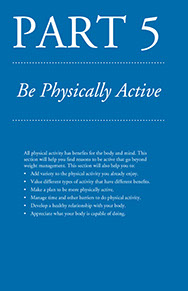
    Many people find that the holidays ruin their healthy eating plans. The sweet and high-calorie foods at family gatherings and parties can be hard to resist. After all, that pumpkin pie topped with whipped cream only comes once a year. Despite the many temptations, you can learn how to eat less. And, you can still enjoy your holiday favorites without eating too much or feeling guilty later.

    Try these tactics the next time you head to a holiday dinner or party:

    Don’t go to the party hungry.If you are faced with a table of goodies and you’re starving, it can be hard to control your eating. Before you go to the party, have a serving of fresh vegetables like carrots, broccoli or a greens salad. Make it a low-calorie snack so your stomach is partially full by eating only a few calories.

    Get water right away.Drinking water before your meal will help you slow down your eating and may help you to feel fuller, sooner. Then, move away from the food table and socialize with other guests for a while before making food choices.

    Start with a small plate.Rather than fill up a larger plate with lots of foods, use a smaller plate. Then, fill it with portions that are smaller than you would normally eat. You can always go back later for seconds if you’re still hungry.

    Eat slowly.Take sips of water with every few bites. Put your fork down and socialize during the middle of your meal. Chew each bite well and enjoy how it tastes before you swallow.

    Listen to your belly.When you feel almost full, that’s the time to stop eating. It takes time for your stomach to tell your brain that you’re full. Chances are, you will be very full in a few minutes.

    Allow yourself a special treat. If you really want that brownie, have it. But, take a small piece and enjoy it. A few bites can be just as satisfying as a big portion – without the guilt.

    If you do eat too much at a party this holiday season, don’t give up on your healthy eating goals. Everyone has slip-ups on diets once in a while. Consider it as a lesson learned or a minor setback. Come up with a plan to eat healthier at your next party. You can start fresh tomorrow!

    Sources: United States Department of Agriculture, Academy of Nutrition and Dietetics

    © American Institute for Preventive Medicine