Tag: emergency

  • The Id Card That Can Save Your Life

    Medical Care

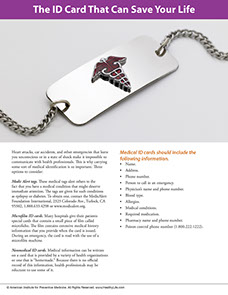
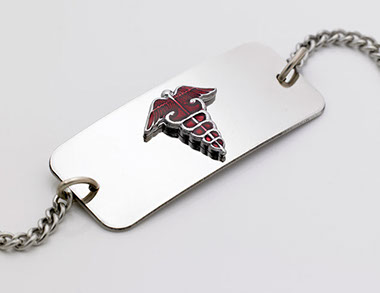
    Image of a medical alert tag.

    Heart attacks, car accidents, and other emergencies that leave you unconscious or in a state of shock make it impossible to communicate with health professionals. This is why carrying some sort of medical identification is so important. Three options to consider:

    *  Medic Alert tags. These medical tags alert others to the fact that you have a medical condition that might deserve immediate attention. The tags are given for such conditions as epilepsy or diabetes. To obtain one, contact the MedicAlert Foundation International, 2323 Colorado Ave., Turlock, CA 95382, 1.888.633.4298 orwww.medicalert.org.

    *  Microfilm ID cards. Many hospitals give their patients special cards that contain a small piece of film called microfiche. The film contains extensive medical history information that you provide when the card is issued. During an emergency, the card is read with the use of a microfilm machine.

    *  Nonmedical ID cards. Medical information can be written on a card that is provided by a variety of health organizations or one that is “homemade.” Because there is no official record of this information, health professionals may be reluctant to use some of it.

    Medical ID cards should include the following information.

    *  Name.

    *  Address.

    *  Phone number.

    *  Person to call in an emergency.

    *  Physician’s name and phone number.

    *  Blood type.

    *  Allergies.

    *  Medical conditions.

    *  Required medication.

    *  Pharmacy name and phone number.

    *  Poison control phone number (1.800.222.1222).

    Page from A Year of Health Hints book by the American Institute for Preventive Medicine. www.HealthyLife.com. All rights reserved.

    © American Institute for Preventive Medicine

  • Types Of Surgery

    Medical Care

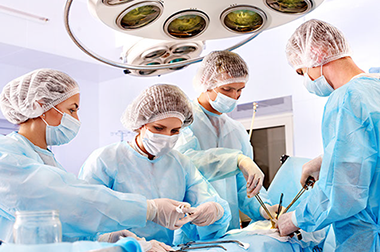
    Image of doctors performing surgery.

    It’s funny. People think of surgery as “major” when it happens to them and “minor” when it’s being done to someone else! In reality, surgery is thought to be major when it involves any vital organs and/or requires a long time period to perform. The following words classify various surgeries:

    Curative

    A procedure that rids the body of a problem or corrects a condition.

    Diagnostic

    A procedure that helps in making a diagnosis about a suspected problem.

    Elective

    A procedure that may or may not be done, depending upon the patient’s wishes.

    Emergency

    An immediate operation to save a life or maintain the use of a body part.

    Exploratory

    A surgery that explores a body organ or body area for a suspected disorder.

    Palliative

    A surgery that eases bodily pain but doesn’t cure the problem.

    Planned

    A surgery set up well in advance of the actual operation date.

    Urgent

    An operation that must be done within a matter of hours.

    Page from Health at Home book by the American Institute for Preventive Medicine. www.HealthyLife.com. All rights reserved.

    © American Institute for Preventive Medicine

  • Are Payday Loans Worth It?

    FINANCIAL HEALTH

    Person holding open empty wallet.

    When you need money, payday loans may seem like a quick, easy option. But these loans may not be worth the money they cost you.

    Payday loans are also called cash advance loans. They’re a short-term loan. You pay a fee – often a big one – to borrow money for a short amount of time.

    How does a payday loan work?

    *  You give the lender a check for the amount of money you want to borrow plus the fee to borrow it. For instance, if you borrow $500 and their fee is $75, you give the lender a check for $575.

    *  The lender keeps your check and gives you $500 cash.

    *  On your next payday, you pay the lender $575. You can have the lender cash your original check or you can pay in cash.

    If you can’t pay back the $575 on your next payday, you may have to roll over the loan. This means you may pay another fee. The high fees for these loans add up quickly. It can get so expensive that you end up paying back an amount much higher than what you borrowed.

    Other loan options

    Payday loans are often not worth the cost. Consider borrowing money from your bank or credit union or use your credit card instead. Even if your credit card interest rate is 20%, this may still be lower than a payday loan.

    Sometimes you can ask for more time to pay your bills. A credit counselor may be able to help with this.

    Compare loan costs

    If you need a loan, ask about these things before you sign and agree:

    *  What is the annual percentage rate (APR)?

    *  What are the fees?

    *  When do I pay it back?

    *  What happens if I can’t pay it back on time?

    Sometimes things happen and you need some money quickly. If you’re in this situation, try to find a loan with low fees. Think about the amount you need. Only borrow what you know you can pay back with your next paycheck.

    Source: Federal Trade Commission

    © American Institute for Preventive Medicine

  • Fire & Burn Awareness

    First Aid

    Dental hygiene products, tooth brush, tooth paste, mouth wash, etc.

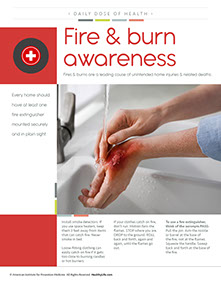
    Fires & burns are a leading cause of unintended home injuries & related deaths.

    Every home should have at least one fire extinguisher mounted securely and in plain sight.

    Install smoke detectors. If you use space heaters, keep them 3 feet away from items that can catch fire. Never smoke in bed.

    Loose-fitting clothing can easily catch on fire if it gets too close to burning candles or hot burners.

    If your clothes catch on fire, don’t run. Motion fans the flames. STOP where you are. DROP to the ground. ROLL back and forth, again and again, until the flames go out.

    To use a fire extinguisher, think of the acronym PASS:

    Pull the pin. Aim the nozzle or barrel at the base of the fire, not at the flames. Squeeze the handle. Sweep back and forth at the base of the fire.

    Health at Home Lifetime book by the American Institute for Preventive Medicine. www.HealthyLife.com. All rights reserved.

    © American Institute for Preventive Medicine

  • General Safety Guidelines

    Student Health

    *  Learn your school’s safety guidelines and follow them. Read your school’s safety handbook. Memorize the telephone number(s) for emergency help, such as 9-1-1. Carry a cell phone with you at all times. Pre-program emergency telephone numbers in the phone to be able to call them quickly.

    *  If you choose to drink, do so responsibly. Don’t use drugs. Be careful around other persons who drink heavily and/or use drugs, too. Designate a sober driver.

    *  Always wear a seatbelt in a motor vehicle. Wear a helmet when riding on a motorcycle, bike, or when rollerblading.

    *  To avoid being robbed, assaulted, etc.

    – When you go out, go with a friend or a group of people, especially at night and to unfamiliar places.

    – Use ATM machines in well-lit areas, preferably while a friend is with you.

    – Keep your doors and windows locked, especially when you are alone.

    – Lock your bike with a U-shaped lock that is hard for someone to remove.

    – Hold your backpack, purse, etc., securely so someone can’t grab it from you. Don’t leave these and other personal items, such as your laptop computer, unattended.

    – Have your car, house, or room keys in your hand, ready to unlock your doors.

    – If you use social networking Web sites, such as facebook, be aware of potential dangers. Find out safety tips fromwww.wiredsafety.org.

    – Report suspicious behaviors and activities to your school’s security or the police.

    – Take a class, etc., to learn how to avoid sexual assault.

    *  To Avoid Fires:

    – Don’t smoke in bed or when you are very tired. Better yet, don’t smoke at all!

    – Follow fire safety precautions when cooking in your dorm room or kitchen.

    – Follow your school’s policy on candle use.

    – Keep a working fire extinguisher in your dorm room or house.

    *  To Manage Conflict Without Violence:

    – Be assertive, not aggressive, when you communicate.

    – Learn to deal with frustration, disappointment, rejection, ridicule, jealousy, and anger.

    – Accept differences in others, including sexual preferences, ethnic and religious backgrounds, etc. You do not need to change your convictions, but don’t expect other persons to change their convictions either.

    – Be an active listener. Pay attention to what the other person is saying and try to understand his or her point of view or simply accept it as an opinion.

    – Take a class or seminar in conflict resolution to gain skills in managing conflict.

    – When you can’t resolve a conflict on your own, get help.

    Resources

    Your school’s Student Health Service, Student Counseling or Mental Health Service, Office of Student Conflict Resolution, Office of the Ombudsman, or Student Affairs

    The National Crime Prevention Council’s Online Resource Center

    www.ncpc.org

    For Sexual Assault/Hate Crimes/Other Crimes: The National Center for Victims of Crime

    www.ncvc.org

    National Domestic Violence Hotline

    800.799.SAFE (799.7233)

    www.ndvh.org

    Student Self-Care book by the American Institute for Preventive Medicine. www.HealthyLife.com. All rights reserved.

    © American Institute for Preventive Medicine

  • Heart Attack

    First Aid

    A heart attack happens when the heart does not get enough blood supply for a period of time. Part or all of the heart muscle dies.

    Signs, Symptoms & Causes

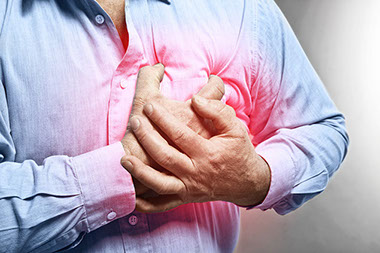
    Close up image of man holding chest in pain.

    A heart attack may have warning signs. It can occur without signs, too. This is called a “silent” heart attack.

    Causes

    *  The most common cause is one or more blood clots that block an artery in the heart. Often, a blood clot forms in an artery already narrowed by plaque.

    *  Having a heart attack in the past increases the risk for another one.

    *  Spasms occur in the large coronary artery. This can be triggered by: Heavy physical exertion, such as shoveling snow; exposure to cold; severe emotional stress; and having a heavy meal. These triggers are more likely to affect persons who are not active.

    *  Cocaine or amphetamine abuse can cause a sudden heart attack. This can happen in persons with no signs of heart disease.

    Warning Signs

    Note: If any of these signs occur, call 9-1-1.

    Common Warning Signs

    *  Feeling of pain (may spread to or be felt in the arm, neck, tooth, jaw, or back), tightness, burning, squeezing, or heaviness in the chest. This lasts more than a few minutes or goes away and comes back.

    *  Chest discomfort with:

    – Fainting

    – Feeling lightheaded.

    – Nausea.

    – Shortness of breath.

    – Sweating.

    Other Warning Signs

    *  Unusual chest, abdominal, or stomach pain.

    *  Dizziness; nausea; trouble breathing; jaw or arm pain without chest pain.

    *  Fast or uneven heartbeat or pulse.

    *  Sweating for no reason, pale, gray, or clammy skin.

    Signs More Likely in Women Than Men

    An uneasy feeling in the chest with: Unexplained or extreme anxiety; unusual fatigue or weakness; fluttering heartbeats; or severe indigestion that doesn’t go away with an antacid.

    Treatment

    A heart attack is a medical emergency! Treatment works best when it is given within 1 to 2 hours after symptoms start. Treatment includes:

    *  Medicine(s) to keep blood from clotting.

    *  “Clot busters” to dissolve blood clots in heart arteries.

    *  Tests to diagnose the status of the heart and arteries.

    *  Angioplasty, stents, or bypass surgery, if needed.

    Prevention

    *  Follow prevention measures in Heart Disease.

    *  Take medications, as prescribed.

    *  Don’t shovel snow or carry heavy objects, especially if you are not physically fit.

    *  Don’t use amphetamines and/or cocaine.

    Questions to Ask

    Self-Care / Prevention

    Call 9-1-1 or your local rescue squad right away! Call when warning signs start. Don’t wait to see if the pain goes away.

    First Aid for a Heart Attack Before Emergency Care

    *  CHECK for a response. Do CPR, as needed.

    *  If the person uses and has nitroglycerin, place one tablet under the tongue. Give as many as 3 tablets in 10 minutes.

    *  Give the person a regular (325 mg.) aspirin or 4 children’s chewable aspirins (81 mg. each) to chew on. Give the aspirin after calling 9-1-1. Ask the 9-1-1 dispatcher if aspirin should be taken.

    {Note: Don’t use aspirin if the person is allergic to it or has a condition that makes using it risky.}

    *  If you can’t call 9-1-1, drive the person to the hospital right away. If you are having heart attack signs, don’t drive yourself unless you have no other choice.

    *  Loosen clothing around the neck, chest, and waist. Don’t let the person lie down, especially if he or she has breathing problems. A half-sitting position is better. Put the legs up. Bend them at the knees. Put a pillow or rolled towel under the knees. Support the back.

    *  Reassure the person that you have called for medical help and will stay with him or her until it arrives.

    *  After a heart attack, follow the doctor’s treatment plan.
    Healthier at Home book by the American Institute for Preventive Medicine. www.HealthyLife.com. All rights reserved.

    © American Institute for Preventive Medicine

  • Signs Of Reye’S Syndrome

    Children’s Health

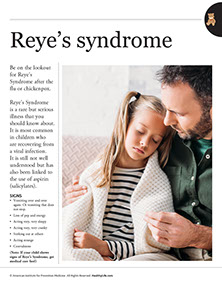
    Be on the lookout for Reye’s Syndrome after the flu or chickenpox. Reye’s Syndrome does not happen very often. But you should know about it. Look for these signs:

    *  Vomiting over and over again. Or vomiting that does not stop.

    *  Loss of pep and energy.

    *  Acting very, very sleepy.

    *  Acting very, very cranky.

    *  Striking out at others.

    *  Acting strange.

    *  Convulsions.

    (Note: If your child shows signs of Reye’s Syndrome, get medical care fast!)

    Children's Self-Care book by the American Institute for Preventive Medicine. www.HealthyLife.com. All rights reserved.

    © American Institute for Preventive Medicine

  • Food Safety Before, During, And After A Power Outage

    HEALTHY EATING

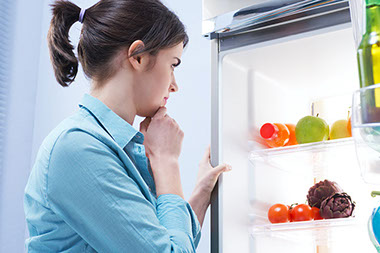
    Image of women looking inside refrigerator.

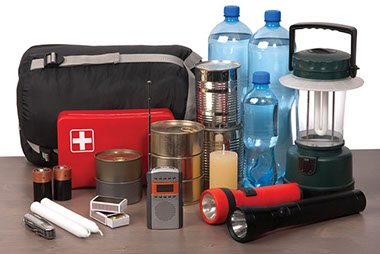
    Snowstorms, summer thunderstorms, and over usage can knock out power. The FDA says power outages can affect the safety of your food. Ensure that food stays safe by having a plan in place and knowing what food safety precautions to take if a power outage does occur.

    BEFORE

    *  Plan ahead. Stock up on supplies in advance or know where to obtain them if needed. Before an outage, check that the refrigerator temperature is at or below 40 degrees F and the one for the freezer is at or below 0 degrees F.

    *  Plan for ice. Know where you can get dry or block ice. Stock plenty of ice cubes and frozen gel packs. Freeze containers of water (plastic milk jugs do well). All of these help keep food cold in the freezer, refrigerator, or coolers. Keep coolers on hand to store refrigerated food in case the power is out for more than 4 hours. Stock your pantry with a few days’ worth of ready-to-eat foods that do not require cooking or refrigeration.

    DURING

    *  Keep refrigerator and freezer doors closed as much as possible to slow the growth of bacteria. The refrigerator will keep food cold for about 4 hours. A full freezer will keep the temperature for approximately 48 hours (24 hours if it is half full) if unopened. Use ice (dry or block, ice cubes, and frozen containers of water or gel packs) to keep your refrigerator and freezer as cold as possible.

    AFTER

    *  When power is restored, check the temperatures inside your refrigerator and freezer before eating any food. If the power was out for no more than 4 hours, refrigerated food should be safe as long as the doors were kept closed. Discard any perishable food (such as meat, poultry, seafood, milk, eggs, or leftovers) that has been above 40 degrees F for 2 hours or longer.

    *  Food is safe and may be refrozen if the freezer thermometer reads 40 degrees F or below. If you did not have a thermometer in the freezer, check each package to determine its safety; you can’t rely on appearance or odor. If the food still contains ice crystals or is 40 degrees F or below, it is safe to refreeze or cook.

    *  Be aware that perishable foods that are not kept adequately refrigerated or frozen may cause foodborne illness if eaten, even after they are thoroughly cooked.

    © American Institute for Preventive Medicine

  • How To Set Up An Emergency Fund

    FINANCIAL HEALTH

    Image of money in savings jar.

    An emergency fund is a great way to save yourself from financial disaster. It gives you peace of mind when unexpected expenses come up. And, it may help keep you out of debt when you need extra money for an emergency. People who don’t have emergency funds may have to turn to high-interest loans or more credit card debt.

    It can be difficult to set money aside when it’s being used for other day-to-day things. But, it is possible to do with a little discipline and planning. Here’s how:

    *Make it automatic.Have some money automatically put in a separate account with each paycheck. Even if the amount is small, it can add up over time. An automatic transfer is more convenient than doing it yourself. You may find that after a while, you don’t miss that extra money. You learn to get by without it.

    *Make it a priority.Pay your emergency fund first, before you use your paycheck for non-necessary items. Make a budget that doesn’t include your emergency money. This will ensure your bills and other necessities get paid without skipping your emergency fund payment.

    *Use a bank or credit union savings account.These are easier to access in an emergency than savings bonds, mutual funds or certificates of deposit (CDs). But, don’t put it in your regular checking account, where you may be tempted to use it for a non-emergency.

    *Keep the account totally separate.Make sure that account is for emergencies only. Make it a savings account instead of checking. Be sure the account doesn’t include fees or penalties.

    *“Do I need this?”Cover your credit card with a savings message to reduce non-essential spending.

    Creative ways to save

    Think of little ways you can change your daily routine to save money. You’ll be surprised how much you can save!

    Put away $.50 a day in loose change.

    Monthly savings: $15

    Yearly savings: $180

    Skip the coffee out and bring your own from home.

    Monthly savings: $80

    Yearly savings: $960

    Bring your own lunch 3 days a week instead of eating out.

    Monthly savings: $96

    Yearly savings: $1,152

    Eat dinner at home 2 more times per month.

    Monthly savings: $40-80

    Yearly savings: $480-960

    Source: Consumer Federation of America

    © American Institute for Preventive Medicine