Tag: empathy

  • Dealing With Difficult Personalities

    WORK LIFE

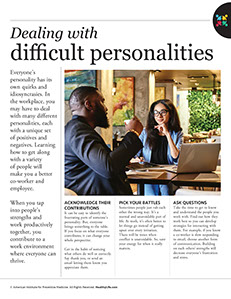
    Two coworkers sitting with laptop, talking and drinking coffee.

    Everyone’s personality has its own quirks and idiosyncrasies. In the workplace, you may have to deal with many different personalities, each with a unique set of positives and negatives. Learning how to get along with a variety of people will make you a better co-worker and employee.

    When you tap into people’s strengths and work productively together, you contribute to a work environment where everyone can thrive.

    Acknowledge their contributions

    It can be easy to identify the frustrating parts of someone’s personality. But, everyone brings something to the table. If you focus on what everyone contributes, it can change your whole perspective.

    Get in the habit of noticing what others do well or correctly. Say thank you, or send an email letting them know you appreciate them.

    Pick your battles

    Sometimes people just rub each other the wrong way. It’s a normal and unavoidable part of life. At work, it’s often better to let things go instead of getting upset over every irritation. There will be times when conflict is unavoidable. So, save your energy for when it really matters.

    Ask questions

    Take the time to get to know and understand the people you work with. Find out how they work best so you can develop strategies for interacting with them. For example, if you know a co-worker is slow responding to email, choose another form of communication. Building on each others’ strengths will decrease everyone’s frustration and stress.
    © American Institute for Preventive Medicine

  • 6 Ways To Cool A Workplace Argument

    WORK LIFE

    Image of co-workers talking.

    No matter where you work, you’re bound to meet coworkers with different personalities and work styles. As a result, there may be times when you need to work through opinions that differ. Sometimes you may be faced with a heated argument. But, this type of situation doesn’t have to get worse.

    Learn how to calm an upset coworker with these tips from the Society for Human Resource Management:

    1.Remain calm.Yelling and unprofessional behavior doesn’t help anyone find a solution. It could escalate and end up out of control.

    2.Try to understand what the other person is saying.Look at them calmly and let them talk. Follow up by asking them to explain more if needed.

    3.Use “I” statements, such as “I feel disappointed that this project isn’t going well.”Rather than, “You aren’t doing a good job on this project.” Focus on behaviors or problems, not people.

    4.Discuss solutions to the problem.Write them down on paper or a white board if needed.

    5.Make sure everyone agrees on the solution.

    6.If an agreement can’t be reached, decide if you can “agree to disagree” on the issue.If that’s not an option, consider involving a neutral third person or a human resources staff member if needed.

    Knowing how to resolve conflict in the workplace is a valuable skill you can use throughout your life. Staying calm and collected in a tense situation gives you the ability to find a productive, positive solution.

    © American Institute for Preventive Medicine

  • Anxious Kids, Anxious Parents

    FAMILY LIFE

    Image of young child.

    How do you manage a child who gets stomachaches every school morning? Or one who refuses to go to after-school activities? Or who is trapped in the bathroom with frequent hand washing?

    One in every 5 kids suffers from a diagnosable anxiety disorder. Experts Reid Wilson, professor of psychiatry at the University of North Carolina School of Medicine, and Lynn Lyons, a social worker and psychotherapist, say anxiety disorders are the number one reason why parents bring a child to a mental health professional.

    “When kids grow and step into new experiences, they should have questions and uncertainties. Worry becomes a problem when a child is consistently avoiding activities or experiences that are a normal part of development,” according to these experts.

    How do you know if your child may have anxiety? Wilson and Lyons, authors of Anxious Kids, Anxious Parents: 7 Ways to Stop the Worry Cycle and Raise Courageous & Independent Children, say to look for the following behaviors and see a mental health professional with your concerns (worry, they say, may run in families):

    *  They cling to you.

    *  They refuse to try new activities.

    *  They continually ask you for reassurance of their “what if” questions.

    *  They feel sick and complain of aches, pains, and nausea.

    *  They avoid school or cry or throw tantrums if you force them to go.

    *  They act shy and don’t talk in class or around others.

    *  They worry about future or past events (“I will look stupid reading this book report” or “Did I make my best friend mad?” or “Something bad is going to happen to my family”).

    Children can learn to manage their uncertainty, but sometimes it takes a professional to help.

    © American Institute for Preventive Medicine

  • Getting Kids To Donate Old Toys

    FAMILY LIFE

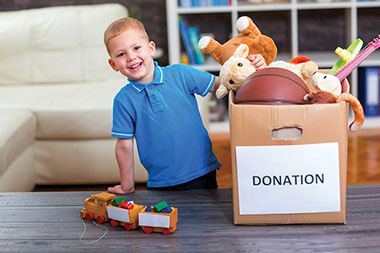
    Image of happy child placing toys in donation box.

    After the holidays, many families find their house overrun with toys. If your kids received new toys as gifts and have old toys they don’t use anymore, consider donating the toys to families in need.

    Unfortunately, it’s not always easy to do this. Many parents find that children struggle to give up old toys. Even if they haven’t touched it in months, they may be unwilling to give the toy away.

    The American Academy of Pediatrics suggests these tips to get kids on board:

    *Make giving a part of family life.Try volunteering for a local charity as a family throughout the year. Talk to the kids about causes you support.

    *Talk to the kids about ways to give.Talk to your child about local charities that could use their old toys. A church nursery, children’s shelters, a child care center, and children’s hospitals are just a few options.

    *Ask for the kids’ help.Take some time to sort through old toys with your child. Try the “give one, keep one” approach so they can decide for themselves what stays and what goes.

    *Only donate toys that are safe, not broken, and clean.

    Tips for teaching gratitude to kids

    *Do small things for friends or neighbors.Have your children bring fresh food to a neighbor who lives alone, or help them rake leaves without asking for anything in return.

    *Talk to them about what they are thankful for each day.This can help parents too.

    *Say “thank you” to others whenever appropriate.This helps them learn by following your example.

    *Send thank-you notesand teach kids to send them after receiving birthday or holiday gifts.

    *Have them do age-appropriate chores.This gives kids an idea of all the work it takes to keep a household running.

    © American Institute for Preventive Medicine

  • Listening: A Skill Well Worth Mastering

    WELL-BEING

    Image of 2 men talking and smiling.

    You’ve heard the saying, “You’re born with two ears, but only one mouth.” According to the Society for Human Resource Management, being a good listener has many advantages at work and at home. You can come up with better ideas, work with others more easily, and connect with people more deeply.

    So how is it done? Try these tips:

    *  Don’t interrupt.

    *  Don’t offer a solution or advice unless the person asks for it.

    *  Don’t think about your response while the other person is still talking. Hear them all the way through.

    *  When the other person is finished, repeat what they said in your own words. “So what I hear you saying is…”

    *  Don’t make it about you. Remember the other person wants to tell you their story first. Stop yourself from turning it into a discussion about yourself or your problem.

    Having this valuable skill can enhance all the professional and personal relationships in your life.

    © American Institute for Preventive Medicine

  • The Greatest Gift

    FAMILY LIFE

    Image of multi-generation family about to have dinner.

    Forget that fancy wrapped gift box. The chance to spend time with loved ones can be more valuable than the most expensive gift, says Sheri Bridges, professor of marketing at Wake Forest University.

    Memories of the occasion will live on long after the contents of a ribbon-wrapped box have been forgotten or discarded.

    How to give the gift of memories this holiday? Bridges offers a few ideas.

    *Take a day trip.Go to the zoo, a favorite restaurant in a nearby city or visit a town with quaint shops. Follow-up by giving the gift of a photo book of the trip, and as the years pass, the pictures become reminders of the feelings and fun of time spent together.

    *Offer tickets to a football or basketball game, a play or a musical performance– anything that isn’t part of the recipient’s normal routine.

    *Do chores.Baking cookies, wrapping gifts, taking down decorations, straightening up the garage, cleaning out closets-any task that seems hard when performed alone can become fun when shared.

    *Relax and recharge.Take a relative or friend to get a massage, pedicure or facial. Spend time together while getting pampered.

    *Time alone, together.Unless you make a special effort, it can be hard to find time to spend with family and friends. Watching a favorite movie, sipping hot chocolate in front of a fire, playing Scrabble-these are things that require a real time commitment and focus, and say, “I am putting you first now.”

    © American Institute for Preventive Medicine