Tag: endurance

  • Get Into Zone 2

    BE FIT

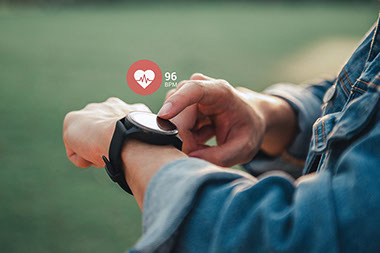
    Close up of man using smart watch with heart beat showing at 96 bpm.

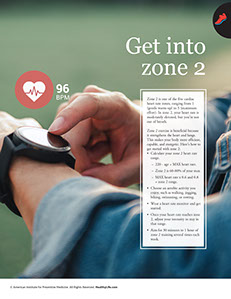
    Zone 2 is one of the five cardiac heart rate zones, ranging from 1 (gentle warm-up) to 5 (maximum effort). In zone 2, your heart rate is moderately elevated, but you’re not out of breath.

    Zone 2 exercise is beneficial because it strengthens the heart and lungs. This makes your body more efficient, capable, and energetic. Here’s how to get started with zone 2:

    *  Calculate your zone 2 heart rate range.

    – 220 – age = MAX heart rate.

    – Zone 2 is 60-80% of your max.

    – MAX heart rate x 0.6 and 0.8 = zone 2 range.

    *  Choose an aerobic activity you enjoy, such as walking, jogging, biking, swimming, or rowing.

    *  Wear a heart rate monitor and get started.

    *  Once your heart rate reaches zone 2, adjust your intensity to stay in that range.

    *  Aim for 30 minutes to 1 hour of zone 2 training several times each week.

    © American Institute for Preventive Medicine

  • Rucking For Beginners

    BE FIT

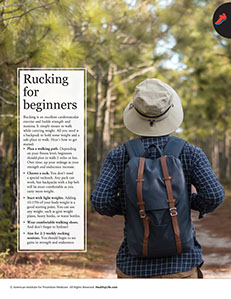
    Rucking is an excellent cardiovascular exercise and builds strength and stamina. It simply means to walk while carrying weight. All you need is a backpack to hold some weight and a safe place to walk. Here’s how to get started:

    *  Plan a walking path. Depending on your fitness level, beginners should plan to walk 2 miles or less. Over time, up your mileage as your strength and endurance increase.

    *  Choose a sack. You don’t need a special rucksack. Any pack can work, but backpacks with a hip belt will be most comfortable as you carry more weight.

    *  Start with light weights. Adding 10-15% of your body weight is a good starting point. You can use any weight, such as gym weight plates, heavy books, or water bottles.

    *  Wear comfortable walking shoes. And don’t forget to hydrate!

    *  Aim for 2-3 weekly rucking sessions. You should begin to see gains in strength and endurance.

    © American Institute for Preventive Medicine

  • Test Your Fitness Level

    Fitness

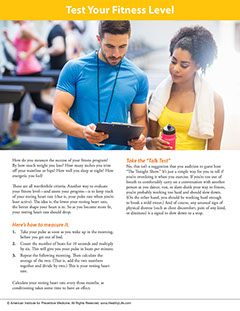
    Image of women talking to her fitness trainer.

    How do you measure the success of your fitness program? By how much weight you lose? How many inches you trim off your waistline or hips? How well you sleep at night? How energetic you feel?

    These are all worthwhile criteria. Another way to evaluate your fitness level-and assess your progress-is to keep track of your resting heart rate (that is, your pulse rate when you’re least active).

    The idea is, the lower your resting heart rate, the better shape your heart is in. So as you become more fit, your resting heart rate should drop.

    Here’s how to measure it.

    1.  Take your pulse as soon as you wake up in the morning, before you get out of bed.

    2.  Count the number of beats for 10 seconds and multiply by six. This will give you your pulse in beats per minute.

    3.  Repeat the following morning. Then calculate the average of the two. (That is, add the two numbers together and divide by two.) This is your resting heart rate.

    Calculate your resting heart rate every three months, as conditioning takes some time to have an effect.

    Take the “Talk Test”

    No, this isn’t a suggestion that you audition to guest host “The Tonight Show.” It’s just a simple way for you to tell if you’re overdoing it when you exercise. If you’re too out of breath to comfortably carry on a conversation with another person as you dance, run, or slam-dunk your way to fitness, you’re probably working too hard and should slow down. (On the other hand, you should be working hard enough to break a mild sweat.) And of course, any unusual sign of physical distress (such as chest discomfort, pain of any kind, or dizziness) is a signal to slow down to a stop.

    Page image from A Year of Health Hints book by the American Institute for Preventive Medicine. www.HealthyLife.com. All rights reserved.

    © American Institute for Preventive Medicine

  • Cardio Training

    Healthylife® Weigh

    Part 5

    Man swimming.

    Short for cardiovascular training, “cardio” helps strengthen your heart and other muscles. Cardio also causes the brain to release natural substances, called endorphins, that give you a natural “high.” Aerobic exercise also promotes brain health and challenges your mind.

    Cardio training uses large movements that involve multiple muscle groups, such as your legs, buttocks, and abdominals, all at once. Popular aerobic activities are brisk walking, running, cycling, swimming, and low-impact aerobic dancing.

    Low-Intensity, Steady-State (LISS) Cardio

    Do this type of cardio at a low-to-moderate intensity level. With LISS cardio, you should be breathing at a rate that still allows you to be able to talk to someone. Some examples are walking around your neighborhood or riding a bike at a moderate pace. This type of cardio is most helpful when maintained for 30-45 minutes. Work up to this length of time.

    Group Exercise Classes (e.g., Zumba®, step, kick-boxing, spin)

    *  Find a class through your local community center, YMCA, or another fitness center. Many classes are offered in the mornings and evenings and on weekends to accommodate busy work schedules.

    *  Find an instructor who teaches in a style and tempo you feel comfortable with.

    *  For your first class, arrive early and let the instructor know it is your first time. They may help you set up your equipment or introduce you to someone else in the class who can help you.

    *  High-impact aerobics can strain the knees, hips, and ankles. Step aerobics is lower-impact but should still be avoided by anyone with knee problems.

    *  Modify exercises to a level that you can do comfortably. Ask the instructor for advice.

    Walking

    *  Find a safe place to walk. Your neighborhood, a large shopping mall, or local park may offer safe options. Many fitness centers also have indoor walking tracks or treadmills.

    *  Hold your head up and keep your back straight.

    *  Bend your elbows as you swing your arms.

    *  Take long, easy strides.

    Swimming

    *  Swim in a pool or lake supervised by a lifeguard. If the area is unsupervised, do not swim alone.

    *  Take lessons to learn to swim safely and to improve your technique.

    *  Rest frequently and drink water. It can be harder to notice that you are sweating in the pool and becoming dehydrated.

    *  Wear goggles to protect your eyes.

    *  Wear a swim cap if you have long hair. This will help keep hair out of your face and reduce drag.

    *  Rinse off after swimming and use lotion to keep your skin from drying out.

    High-Intensity Interval Training (HIIT)

    LISS is a good place to start with cardio training. Within a few weeks, start to incorporate HIIT training as well. This type of cardio is much more effective at boosting your metabolism and helping with fat loss.

    To do HIIT, alternate between longer periods of low-intensity exercise and shorter bursts of high-intensity exercise. The high-intensity parts should be short, such a walking as fast as you can for 30 seconds, to get your heart rate up. You should feel like you are working at 90% of your maximum effort. Immediately switch to low-intensity exercise, like walking at a medium pace, for a minute or two to bring your heart rate down. Repeat this pattern several times. Work up to 15 to 20 minutes of HIIT. You can also do intervals of 30 seconds of high-intensity exercise and 30 seconds of low-intensity exercise.

    HIIT revs up your metabolic furnace and you can burn a lot of calories in a short period of time. This may be more interesting and enjoyable than exercising at the same rate for your entire workout.

    You can use the same types of exercises that you enjoy for LISS (like running or biking). Or, you can use other full-body exercises, such as jumping jacks and push-ups. Search “HIIT ideas” online or download an app that provides workouts on a timer.

    Plan a HIIT Workout with Popsicle Sticks

    1. Get at least a dozen popsicle sticks.

    2. Write one short exercise on each popsicle stick. Write exercises you know how to do and enjoy. Ideas:

    – Jumping jacks – Push-ups

    – Lunges – Bicep curls

    – Squats – Side leg lifts

    – Front leg lifts – Mountain climbers

    – Bicycle kicks  – Tricep dips

    – Reverse lunges – Jumping rope (or pretending to)

    3. Put the sticks in a cup or a jar.

    4. Pull out 4 sticks. You will be doing these activities after a short warm up.

    5. Warm up for 5 minutes by briskly walking or doing jumping jacks. Notice that your heart rate is higher.

    6. Set a timer for 15 minutes.

    7. Do the 1st activity as many times as you can in one minute.

    8. Walk for one minute.

    9. Do the 2nd activity as many times as you can for one minute.

    10. Walk for one minute.

    11. Do the 3rd activity as many times as you can for one minute.

    12. Walk for one minute.

    13. Do the 4th activity as many times as you can for one minute.

    14. Walk for one minute.

    15. Repeat steps 7 through 14.

    Ideas Using Your Popsicle Sticks

    Keep your jar of exercise ideas out where you can see it. Pull a stick:

    *  When a commercial break comes on TV or the radio.

    *  In the morning after you wake up.

    *  While studying or reading and you need a break.

    *  When you feel anxious or overwhelmed.

    Do the activity on the stick for one minute. Or, set a goal to do a certain number of that exercise. For example, 25 jumping jacks. Keep your popsicle sticks fresh! Add new ideas and things you like to do. Remove sticks that you dread pulling.
    © American Institute for Preventive Medicine

  • Be Physically Active

    Healthylife® Weigh

    Part 5

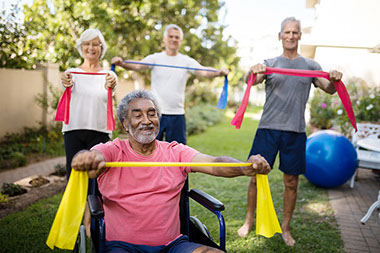
    Group of friends outside exercising.

    All physical activity has benefits for the body and mind. This section will help you find reasons to be active that go beyond weight management. This section will also help you to:

    *  Add variety to the physical activity you already enjoy.

    *  Value different types of activity that have different benefits.

    *  Make a plan to be more physically active.

    *  Manage time and other barriers to do physical activity.

    *  Develop a healthy relationship with your body.

    *  Appreciate what your body is capable of doing.

    HealthyLife® Weigh

    QUICK LINKS: PART 5

    Current Exercise Habits

    Find Reasons to Care About Physical Activity

    Mental Health

    Energy, Learning, Focus

    Physical Health

    Exercise and Sleep

    Reduce Sit-Time

    Do Activities You Enjoy

    Types of Physical Activity

    Cardio Training

    Resistance Training

    Stretching & Rehabilitation

    Yoga

    Massage

    Avoid Injury

    Appreciate the Journey

    Set Fitness Goals

    Plan Physical Activity

    Tackle Limitations

    Injury and Disability

    Manage Your Time

    Set Up for Success

    What Are You Waiting For?

    Responsibility for Change

    Create “If, Then” Plans

    Exercise and Eating

    Eating and Body Image

    How Do You View Your Body?

    Identify Disordered Eating

    Review and Prepare

    © American Institute for Preventive Medicine

  • Physical Health

    Healthylife® Weigh

    Part 5

    Male jogger with earphones.

    Stronger Muscles and Bones

    Muscles let you move, lift, and stretch. When you use your muscles, they get stronger so you can do everything from opening a door to smiling, chewing, and talking! Weight-bearing exercises, in particular, help bones become stronger. This helps prevent osteoporosis and fractures.

    Stronger muscles and bones will help you have good posture and keep your joints and body more naturally aligned.

    Improved Cardiovascular Health

    Heart Strength: Exercise strengthens your heart muscle. This means the heart can pump more blood per stroke and doesn’t require as many heartbeats to pump the same amount of blood. This makes your heart more efficient and lessens your risk of having a heart attack or blood clots.

    Cholesterol Levels: Exercise boosts high-density lipoprotein (HDL), or “good,” cholesterol and decreases unhealthy triglycerides. This helps to keep your blood flowing smoothly, decreasing your risk of cardiovascular disease. The more you exercise, the more your cholesterol levels will improve.

    Blood Pressure Control: Hormones that are released during exercise make blood vessels more elastic. This helps lower blood pressure.

    Improved Breathing

    Exercise improves your body’s ability to take in oxygen and transport and use oxygen throughout the body. This helps your muscles get the oxygen they need to be more efficient during exercise. With improved lung function, your ability to exercise longer (stamina) can increase! You’ll also be able to think more clearly throughout the day.

    Improved Immune System

    Exercise improves the circulation of immune cells in your blood that fight off viruses and bacteria. Exercise also helps combat damage done to cells, tissues, and organs.

    © American Institute for Preventive Medicine

  • The Aerobic Mile

    BE FIT

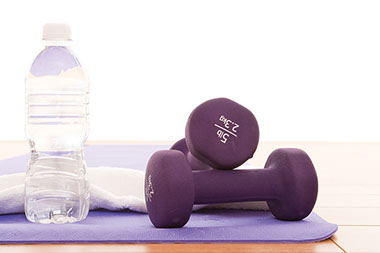
    Image of water bottle, towel and dumb bells on a mat.

    How much exercise do you need? The answer is 30 minutes most days of the week, according to government guidelines. But you can calculate your own fitness level by using the aerobic mile as your guideline.

    An aerobic mile, simply, is how much energy you expend jogging one mile. Okay, you don’t want to jog. But you can burn the same number of calories by doing other exercises. Here are some examples of activities you can do to equal one aerobic mile:

    *  Walking one mile at any pace

    *  Bicycling at a moderate pace for 12 minutes

    *  Vigorous rowing for 12 minutes

    *  Swimming for 24 minutes

    *  Tennis for 20 minutes (11 if your game is vigorous)

    *  Weight training at a moderate pace for 15 minutes

    *  Easy gardening for one hour

    *  Aerobic exercise to music, easy pace for 20 minutes

    Beginning exercisers should strive to achieve the equivalent of 6 aerobic miles a week. Those with good fitness levels can move up to 10 hours a week. High fitness levels are achieved with 15 aerobic miles each week, according to ACSM Guidelines for Exercise Testing.

    © American Institute for Preventive Medicine