
Tag: evidence

  • Gather Facts

    Medical Care

    Image of 4 people sitting and talking.

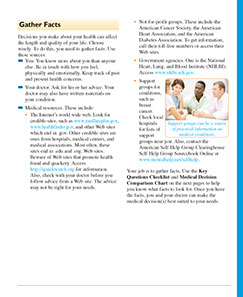
    Decisions you make about your health can affect the length and quality of your life. Choose wisely. To do this, you need to gather facts. Use these sources:

    *  You. You know more about you than anyone else. Be in touch with how you feel, physically and emotionally. Keep track of past and present health concerns.

    *  Your doctor. Ask for his or her advice. Your doctor may also have written materials on your condition.

    *  Medical resources. These include:

    – The Internet’s world wide web. Look for credible sites, such aswww.medlineplus.gov,www.healthfinder.gov, and other Web sites which end in .gov. Other credible sites are ones from hospitals, medical centers, and medical associations. Most often, these sites end in .edu and .org. Beware of Web sites that promote health fraud and quackery. Accesshttp://quackwatch.orgfor information. Also, check with your doctor before you follow advice from a Web site. The advice may not be right for your needs.

    – Not-for-profit groups. These include the American Cancer Society, the American Heart Association, and the American Diabetes Association. To get information, call their toll-free numbers or access their Web sites.

    – Government agencies. One is the National Heart, Lung, and Blood Institute (NHLBI). Accesswww.nhlbi.nih.gov.

    – Support groups for conditions, such as breast cancer. Check local hospitals for lists of support groups near you. Also, contact the American Self-Help Group Clearinghouse Self-Help Group Sourcebook Online atwww.mentalhelp.net/selfhelp.

    Your job is to gather facts. Once you have the facts, you and your doctor can make the medical decision(s) best suited to your needs.
    Page from the Healthier at Home book by the American Institute for Preventive Medicine. www.HealthyLife.com. All rights reserved.

    © American Institute for Preventive Medicine

  • Dispute Unhelpful Thoughts

    Healthylife® Weigh

    Part 4

    Man thinking in front of black chalk board with arrows pointing.

    Thinking in all-or-nothing terms using words like “always,” “never,” and “every” can make it difficult to see options. Avoid thinking about people or situations using absolute terms. Logical thinking looks at more than one option. People can act in different ways. Situations can have many outcomes.

    Have you had any of the unhelpful thoughts below:

    *  Gaining weight and moving less is just part of getting older.

    *  Taking care of myself is selfish.

    *  I weigh less than those around me. At least I am doing better than they are.

    *  My spouse does the grocery shopping and cooking so I have very little control over what I eat.

    *  Eating healthy is too expensive.

    Question your unhelpful thoughts. The strategies on the following pages help to break down thoughts that you may be using as excuses not to change. If you notice you are thinking in absolutes, identify alternatives to your black and white thoughts.

    © American Institute for Preventive Medicine
  • Does Stress Lead To Cancer?

    SUCCESS OVER STRESS

    Image of older female.

    Whether due to work, family or finances, most of us have felt stressed at some point in our lives. And to make matters worse, some studies have shown that stress can lead to depression, anxiety, or a weakened immune system. But can it cause cancer?

    The National Cancer Institute says no. There is no evidence that stress alone can lead to cancer. But, habits such as smoking, drinking, and eating unhealthy foods may be linked to cancer. These are often done in response to high stress events.

    Bottom line:cope with stress in healthy ways, such as exercising, deep breathing, meditation, and getting help from your doctor, if needed. Lowering your overall stress levels will help you feel your best emotionally and physically. And, don’t worry about whether the occasional stressful event may cause cancer. The experts say it won’t.

    © American Institute for Preventive Medicine