Tag: Exercise Trends

  • Crossfit Faq

    BE FIT

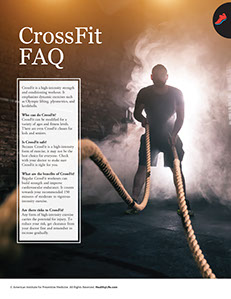
    Man in gym working out.

    CrossFit is a high-intensity strength and conditioning workout. It emphasizes dynamic exercises such as Olympic lifting, plyometrics, and kettlebells.

    Who can do CrossFit?

    CrossFit can be modified for a variety of ages and fitness levels. There are even CrossFit classes for kids and seniors.

    Is CrossFit safe?

    Because CrossFit is a high-intensity form of exercise, it may not be the best choice for everyone. Check with your doctor to make sure CrossFit is right for you.

    What are the benefits of CrossFit?

    Regular CrossFit workouts can build strength and improve cardiovascular endurance. It counts towards your recommended 150 minutes of moderate to vigorous-intensity exercise.

    Are there risks to CrossFit?

    Any form of high-intensity exercise carries the potential for injury. To reduce your risk, get clearance from your doctor first and remember to increase gradually.

    © American Institute for Preventive Medicine

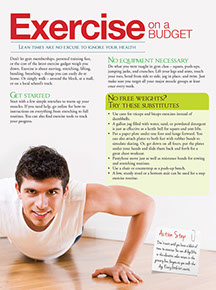
  • Exercise On A Budget 2

    Fitness

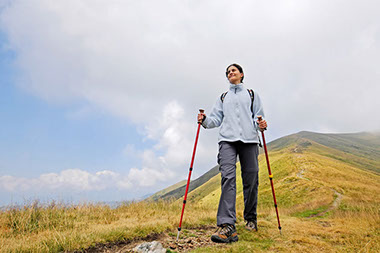
    Image of women hiking.

    Lean times are no excuse to ignore your health.

    Don’t let gym memberships, personal training fees, or the cost of the latest exercise gadget weigh you down. Exercise is about moving, stretching, lifting, bending, breathing – things you can easily do at home. Or simply walk – around the block, at a mall, or on a local school’s track.

    Get started.

    Start with a few simple stretches to warm up your muscles. If you need help, go online for how-to instructions on everything from stretching to full routines. You can also find exercise tools to track your progress.

    No equipment necessary

    Do what you were taught in gym class – squats, push-ups, jumping jacks, and crunches. Lift your legs and arms, touch your toes, bend from side to side, jog in place, and twist. Just make sure you target all your major muscle groups at least once every week.

    No free weights? Try these substitutes.

    *  Use cans for triceps and biceps exercises instead of dumbbells.

    *  A gallon jug filled with water, sand, or powdered detergent is just as effective as a kettle bell for squats and arm lifts.

    *  Put a paper plate under one foot and lunge forward. You can also attach plates to both feet with rubber bands to simulate skating. Or, get down on all fours, put the plates under your hands and slide them back and forth for a great chest workout.

    *  Pantyhose move just as well as resistance bands for rowing and stretching routines.

    *  Use a chair or countertop as a push-up bench.

    *  A low, sturdy stool or a bottom stair can be used for a step exercise routine.

    Action Step

    Don’t wait until you have a block of time to exercise. You can do leg lifts in the elevator, calve raises in the grocery line, lunges as you walk the dog. Every little bit counts.

    Page image from Ways to Well-Being book by the American Institute for Preventive Medicine. www.HealthyLife.com. All rights reserved.

    © American Institute for Preventive Medicine

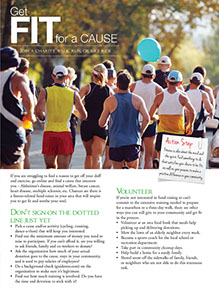
  • Get Fit For A Cause

    Fitness

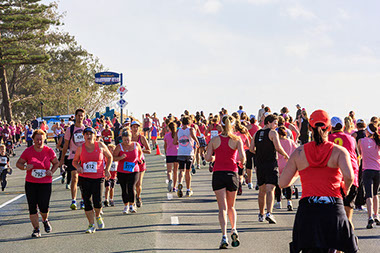
    People running a marathon for charity.

    Join a charity walk, run, or bike ride.

    If you are struggling to find a reason to get off your duff and exercise, go online and find a cause that interests you – Alzheimer’s disease, animal welfare, breast cancer, heart disease, multiple sclerosis, etc. Chances are there is a fitness-related fund-raiser in your area that will inspire you to get fit and soothe your soul.

    Don’t sign on the dotted line just yet.

    *  Pick a cause and/or activity (cycling, running, dance-a-thon) that will keep you interested.

    *  Find out the minimum amount of money you need to raise to participate. If you can’t afford it, are you willing to ask friends, family and co-workers to donate?

    *  Ask the organization how much of your actual donation goes to the cause, stays in your community, and is used to pay salaries of employees?

    *  Do a background check (www.guidestar.com) on the organization to make sure it’s legitimate.

    *  Find out how much training is involved. Do you have the time and devotion to stick with it?

    Volunteer.

    If you’re not interested in fund-raising or can’t commit to the extensive training needed to prepare for a marathon or a three-day walk, there are other ways you can still give to your community and get fit in the process.

    *  Volunteer at an area food bank that needs help picking up and delivering donations.

    *  Mow the lawn of an elderly neighbor every week.

    *  Become a sports coach for the local school or recreation department.

    *  Take part in community cleanup days.

    *  Help build a home for a needy family.

    *  Shovel snow off the sidewalks of family, friends, or neighbors who are not able to do this strenuous task.

    Action Step

    Fitness is also about the mind and the spirit. Find something to do that satisfies your desire to be fit, as well as your passion to make a positive difference in your community.

    Page image from Ways to Well-Being book by the American Institute for Preventive Medicine. www.HealthyLife.com. All rights reserved.

    © American Institute for Preventive Medicine

  • Give Water Exercise A Try

    Fitness

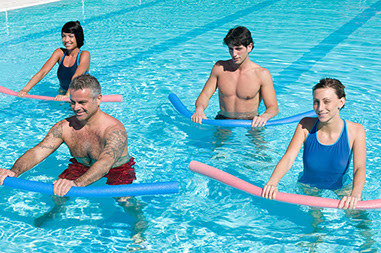
    Water exercise class in session.

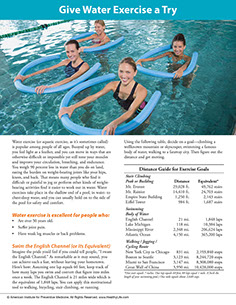
    Water exercise (or aquatic exercise, as it’s sometimes called) is popular among people of all ages. Buoyed up by water, you feel light as a feather, and you can move in ways that are otherwise difficult or impossible yet still tone your muscles and improve your circulation, breathing, and endurance. You weigh 90 percent less in water than you do on land, easing the burden on weight-bearing joints like your hips, knees, and back. That means many people who find it difficult or painful to jog or perform other kinds of weight-bearing activities find it easier to work out in water. Water exercises take place in the shallow end of a pool, in waist- to chest-deep water, and you can usually hold on to the side of the pool for safety and comfort.

    Swim the English Channel (or Its Equivalent)

    Imagine the pride you’d feel if you could tell people, “I swam the English Channel.” As remarkable as it may sound, you can achieve such a feat, without leaving your hometown. Here’s how: Assuming one lap equals 60 feet, keep track of how many laps you swim and convert that figure into miles once a week. The English Channel is 21 miles wide which is the equivalent of 1,848 laps. You can apply this motivational tool to walking, bicycling, stair climbing, or running. Using the following table, decide on a goal-climbing a well-known mountain or skyscraper, swimming a famous body of water, walking to a faraway city. Then figure out the distance and get moving.

    Water exercise is excellent for people who:

    *  Are over 50 years old.

    *  Suffer joint pain.

    *  Have weak leg muscles or back problems.

    Page image from A Year of Health Hints book by the American Institute for Preventive Medicine. www.HealthyLife.com. All rights reserved.

    © American Institute for Preventive Medicine

  • Are Fitness Trackers Worth The Hype?

    BE FIT

    Image of women with a fitness tracker.

    Fitness bands, also called wearable health trackers, have become a popular trend in the last few years. Millions of these devices have been sold, but can they help you get healthy?

    What they do

    Most fitness trackers have features that act like a pedometer, counting your steps and other physical activity. Their features vary widely, however. Some trackers simply tell you how many steps you take in a day. Others are designed to be worn during exercise, such as running, and may track your distance and show your route. Other trackers are waterproof and designed to be worn when swimming.

    Many trackers also record quality and length of sleep. Because they have a movement sensor, they can determine how many times you woke and when you were in deep sleep.

    Most of them are designed to be used with an app on your smartphone, where you can see how you’re doing and make improvements where needed.

    Improving health with a tracker

    It can be helpful to know how many steps you take and how well you’ve slept. But keep in mind that these devices aren’t perfect. For instance, if you walk while pushing a stroller, a tracker worn on your wrist may not count your steps because your arms aren’t swinging.

    Sleep tracking can also be helpful, but won’t be a magic fix. Some trackers assume you’re in a deep sleep because you don’t move around. But, some people just naturally move less during the night, even if their sleep quality isn’t great. This may lead to incorrect information that makes you think you’re sleeping better than you actually are.

    Your body may be the best gauge when it comes to your health. When you don’t sleep well, you’ll feel sluggish. And you can easily keep track of any exercise you do with a fitness diary or a simple notebook. As for step counting, these devices are helpful, but an old-fashioned pedometer can work just as well.

    Alternatives to fitness trackers

    If you don’t have – or want – one of these devices, there are still ways you can get healthy with technology. Many apps that work with a smartphone can help you track movements and sleep, and others help you manually record things like mood, stress levels, and menstrual cycles. These require you to carry your smartphone with you, but don’t use any wearable devices.

    © American Institute for Preventive Medicine

  • Exercise On A Budget

    BE FIT

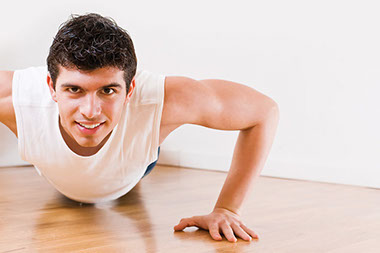
    Image of young man doing push-ups.

    Don’t let gym memberships, personal training fees, or the cost of the latest exercise gadget weigh you down. Exercise is about moving, stretching, lifting, bending, breathing – things you can easily do at home. Or simply walk – around the block, at a mall, or on a local school’s track.

    Get started

    Start with a few simple stretches to warm up your muscles. If you need help, go online for how-to instructions on everything from stretching to full routines. You can also find exercise tools to track your progress.

    No equipment necessary

    Do what you were taught in gym class – squats, push-ups, jumping jacks, and crunches. Lift your legs and arms, touch your toes, bend from side to side, jog in place, and twist. Just make sure you target all your major muscle groups at least once every week.

    No free weights? Try these substitutes

    *  Use cans instead of dumbbells to exercise biceps and triceps.

    *  A gallon jug filled with water, sand, or powdered detergent is just as effective as a kettle bell for squats and arm lifts.

    *  Put a paper plate under one foot and lunge forward. You can also attach plates to both feet with rubber bands to simulate skating. Or, get down on all fours, put the plates under your hands and slide them back and forth for a great chest workout.

    *  Pantyhose stretch just as well as resistance bands for rowing and stretching routines.

    *  A low, sturdy stool or a bottom stair can be used for a step exercise routine.

    © American Institute for Preventive Medicine

  • Get Your Game On

    BE FIT

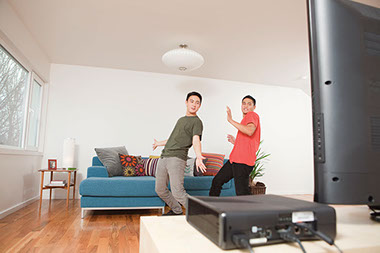
    Image of two males playing active video game, such as the Wii.

    Active video games, also known as “exergames,” are not the perfect solution to getting the nation moving, but they can play a role in getting some people up off the couch and moving right in front of it.

    Michigan State University researchers reviewed published research of studies of these games and say that most of the games provide only “light-to-moderate” intensity physical activity.

    And that, they say, is not nearly as good as what would be real exercise, but video gaming may be a step in the right direction. They generally do not provide the recommended 30 minutes of moderate activity per day, but for some people, the researchers said, light activity can sometimes be enough.

    The researchers named the three video gaming systems that offer active video games as ways to increase physical activity: Nintendo’s Wii, Xbox 360 (Kinect), and PlayStation 3 (Move). The study was published in Health Education and Behavior.

    © American Institute for Preventive Medicine

  • Wallet-Friendly Workouts

    BE FIT

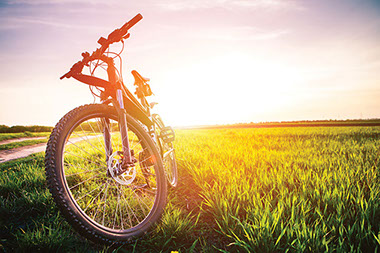
    Image of bike in the field.

    Finances are one of the biggest reasons people don’t join a gym. A monthly gym membership fee can take a big bite out of a budget, but that doesn’t mean you should throw in the towel on exercise.

    You can get all of the benefits of exercise at little to no cost with these tips:

    *  Use home items as workout tools. Instead of buying weights, use canned goods or fill used gallon jugs with water or sand.

    *  Put gravity to work for you. Many resistance exercises use only your body weight and gravity to help you get stronger. Think push-ups, squats, crunches, leg lifts, and arm raises.

    *  Use the stairs in your home for a step training workout. Or, use a low, sturdy step stool. Play music while stepping.

    *  Borrow fitness DVDs from your library, or look for used ones at garage sales.

    *  Utilize community resources. Some fitness centers, senior centers, and community programs offer free or low-cost fitness classes. Local hotels or schools may have a minimal fee to swim in the pool at select times. Walk a local walking path or step through a scenic park for fresh air and fitness.

    *  Consider used items. Many people will sell their used bikes, weight machines, treadmills, and other equipment at a fraction of the cost of a new item. Stop by local yard sales or look for local “yard sale” groups on social media.

    *  Try just shoes and an app. If you already have a smart phone, there are many free or low-cost fitness apps available to keep you motivated. Lace up your walking shoes and start tracking your progress with the app to keep you motivated and on track. YouTube also offers a variety of workout programs that allow you to exercise at home.

    © American Institute for Preventive Medicine