Mental Health
A phobia is an irrational fear of a specific situation, activity or object. The phobia compels the sufferer to avoid whatever is feared because with it comes a number of troubling symptoms such as:
* Anxiety
* Rapid heartbeat
* Sweating
* Hot or cold flashes
* Choking, smothering feelings
* Shaking
* Dizziness, faintness
* The need to flee the situation
* Panic attack, sometimes
Children may express their anxiety by:
* Crying
* Clinging
* Tantrums
* Freezing in place
3 Basic Types
Specific Phobias
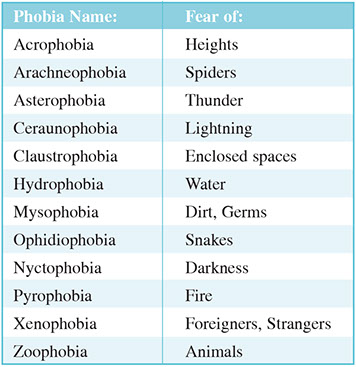
These are sometimes called simple phobias. The irrational fear is of specific objects, such as snakes, dogs, closed spaces or heights. (See box below for some common phobias and their uncommon names.)
Most of the time, simple phobias develop during childhood and often go away with time. Those that continue into adulthood rarely go away without treatment.
Social Phobia
The irrational fear is of being embarrassed or humiliated in public. Examples of situations leading to this include:
* Public speaking (this is the most common social phobia)
* Stage fright
* Eating in public
* Talking to co-workers
* Asking someone out on a date
Agoraphobia
The irrational fear is of being alone in public places from which the person:
* Feels trapped with no way to escape (or thinks it would be difficult to escape)
* Would be very embarrassed or helpless when phobic symptoms occur
* Fears being totally unable to take care of himself or herself if help was not around
Agoraphobia can occur with or without panic disorder. It most often comes after having panic attacks because the sufferer avoids the places where panic attacks occurred. He or she fears that something about the location caused the panic attack. The fear of having another panic attack can result in avoiding going out in public. In severe cases, persons with agoraphobia don’t leave their home at all.
Treatment
* Behavior therapy. One type is called exposure therapy. This type exposes the person to the feared situation or object in one of two ways:
– Gradual exposure. This is called “Systematic Desensitization.” A therapist works with the person in gradual steps. First the person learns relaxation methods to deal with the physical responses to his or her phobia. Second, the person imagines the source of the phobia. Next, the person looks at pictures of the feared object or ones that depict the feared situation. Finally, the person is gradually exposed to the situation or feared object.
– Direct exposure. This is known as “Flooding.” The person is exposed to the feared object or situation all at once (in the presence of a therapist). The person stays in that situation until his or her anxiety is markedly less than its previous level. Sessions doing this are repeated until the person can handle the phobic situation alone.
* Eye Movement Desensitization and Reprocessing (EMDR). This treatment method integrates elements of many effective psychotherapies in combination with eye movements or other forms of rhythmical stimulation. It stimulates the brain’s information processing system to help clients identify, neutralize, adapt to or resolve upsetting memories of a traumatic event.
* Group therapy and/or self-help support group therapy such as Agoraphobics in Motion (A.I.M.).
* Medication. Types include certain anti-depressants, anti-anxiety medicines, tranquilizers and ones known as beta-blockers. These medicines block or reduce the panic symptoms that come with phobic situations. In so doing, they help a person confront the feared situation when they might have been too afraid to do so otherwise.
Medications are especially helpful for persons with agoraphobia with panic disorder. Certain beta-blockers can be useful for persons who suffer from stage fright.
Questions to Ask
Self-Help
The following tips are ways to deal with phobias that do not disrupt your daily life. They may also be used with or after professional treatment.
* List your irrational fears. Writing them down helps you to identify them. Try to figure out why you have the fears, what you think they mean, what they might symbolize and what you can do to deal with them. Doing these things can give you some control over your fears.
* Learn and practice relaxation techniques. These allow you to feel more comfortable and show that you can control the physical symptoms which result from your phobia. They also help you to overcome your phobia by allowing you to remain in the situation long enough to realize that you are not in any danger. Two important relaxation techniques to use are:
– Controlled Breathing. When you panic, you over-breathe or hyperventilate which makes you dizzy. This causes your heart to race and makes you feel weak and tremble. Take a few deep breaths and hold each one to the count of 3, then exhale slowly to the count of 3. This will help restore normal breathing, slow your pulse and remedy your dizziness and shakiness.
– Tension Control. When you panic, you tense your muscles making them feel hard and uncomfortable. Concentrate on each muscle group (arms, legs, neck, shoulders) and consciously relax them until you feel the tension subside. Practice this technique until you can relax your muscles simply by “thinking” about relaxing them.
* If you have a fear of speaking in public, enroll in a public speaking course, such as Dale Carnegie or Toastmasters.
* The “Now Awareness Technique” can be used to overcome a phobic reaction.
* If you are afraid of flying, take a course designed to help people conquer this fear.
* See a counselor if Self-Help do not help you deal with your phobia on your own.
What You Can Do to Help Someone
* Be supportive. Take their phobia seriously. A phobic person suffers an intense fear of something you most likely find harmless. Telling them they are being “silly” or “childish” will not help them. It will only serve to increase their feelings of anxiety and alienation.
* Do not attempt “flooding” on your friend or relative. Forcing your friend or relative into a direct, sudden confrontation with their feared object, person, situation, etc. will only intensify their panic and physical distress. Only a trained professional should use this method.
© American Institute for Preventive Medicine