Tag: Eye Conditions

  • Macular Degeneration

    Eye Conditions

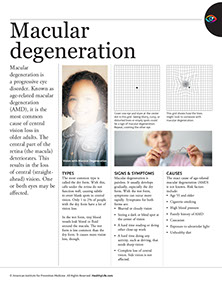
    Macular degeneration is a progressive eye disorder. Known as age-related macular degeneration (AMD), it is the most common cause of central vision loss in older Americans. The central part of the retina (the macula) deteriorates. This results in the loss of central (straight-ahead) vision. One or both eyes may be affected. The most common type is called the dry form. With this, cells under the retina do not function well, causing subtle to overt blank spots in central vision. Only 1 to 2% of people with the dry form have a lot of vision loss. In the wet form, tiny blood vessels leak blood or fluid around the macula. The wet form is less common than the dry form. It causes more vision loss, though.

    Signs & Symptoms

    Macular degeneration is painless. It usually develops gradually, especially the dry form. With the wet form, symptoms can occur more rapidly. Symptoms for both forms are:

    *  Blurred or cloudy vision.

    *  Seeing a dark or blind spot at the center of vision.

    *  A hard time reading or doing other close-up work.

    *  A hard time doing any activity, such as driving, that needs sharp vision.

    *  Complete loss of central vision. Side vision is not affected.
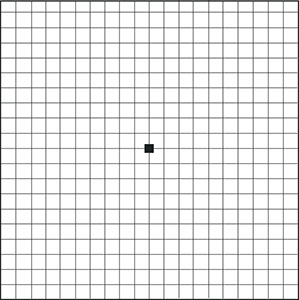
    Cover one eye and stare at the center dot in this grid. Seeing blurry, curvy, or distorted lines or empty spots could be a sign of macular degeneration. Repeat, covering the other eye.
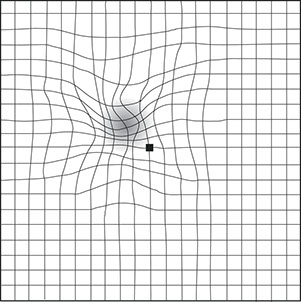
    This grid shows how the lines might look to someone with macular degeneration.

    Causes

    The exact cause of age-related macular degeneration (AMD) is not known. Risk factors are:

    *  Advancing age.

    *  Cigarette smoking. High blood pressure.

    *  Family history of AMD.

    *  Having light-colored eyes.

    *  Exposure to ultraviolet light.

    *  Poor diet.

    Treatment

    Treatment for the wet form includes photodynamic therapy and laser therapy. Medicine called “anti-VEGF therapy” can also be given. Most dry form cases are not treatable. Your eye doctor may prescribe special eyeglasses and low vision aids. He or she may also prescribe a specific high dose vitamin and mineral to reduce the risk of advanced AMD.

    Questions to Ask

    Self-Care / Prevention

    To Reduce the Risk for AMD

    *  Don’t smoke. If you smoke, quit.

    *  Follow a healthy diet. Include green leafy vegetables and fish.

    *  Protect your eyes from the sun’s ultraviolet rays. Wear sunglasses with UV block. Wear a hat with a wide brim.

    *  Use Self-Care / Prevention measures to control high blood pressure and heart disease.

    To Treat AMD

    *  Wear the special eyeglasses and use other vision aids, such as magnifying devices, as advised by your doctor.

    *  Talk to your doctor before taking vitamin and mineral supplements.

    Resources
    Macular Degeneration Foundation

    www.eyesight.org

    National Eye Institute (NEI)

    www.nei.nih.gov

    Healthier at Home book by the American Institute for Preventive Medicine. www.HealthyLife.com. All rights reserved.

    © American Institute for Preventive Medicine

  • What Do You Do 100 Times A Day?

    WELL-BEING

    Image of man on his smart phone.

    You check your smartphone 100 times a day, or spend 2 or more hours every day on a digital device, says The Vision Council. The result: digital eye strain.

    Digital eye strain-experienced by a majority of American adults-is characterized as temporary physical discomfort such as redness, irritation or dry eyes, blurred vision, eye fatigue, back and neck pain, and headaches.

    Several environmental factors can contribute to the condition, including the size of the text on screens, time spent at devices, posture, computer setup, existing vision issues, and the blue light emitted from digital screens and lighting.

    Relieve digital eye strain this way:

    *  Remember the 20/20/20 rule: every 20 minutes, take a 20-second break and look at something 20 feet away.

    *  Build an optimal workspace to lessen stressors-this includes adjusting lighting, computer screen height, and your posture.

    *  Increase the text size on your devices to better define the content on your screen.

    *  Visit an eye care provider to learn more about computer eyewear and lens options that can help reduce symptoms of digital eye strain and improve vision

    © American Institute for Preventive Medicine

  • Pink Eye (Conjunctivitis)

    Eye Conditions

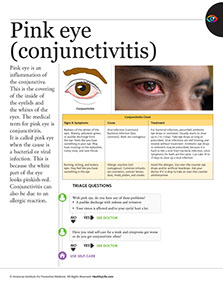
    Pink eye is an inflammation of the conjunctiva. This is the covering of the inside of the eyelids and the whites of the eyes. The medical term for pink eye is conjunctivitis. It is called pink eye when the cause is a bacterial or viral infection. This is because the white part of the eye looks pinkish-red. Conjunctivitis can also be due to an allergic reaction.

    Signs & Symptoms

    Questions to Ask

    Self-Care / Prevention

    For Pink Eye

    *  Wash your hands often. Don’t share towels, washcloths, etc.

    *  Avoid contact with other people as much as you can until you have used the prescribed antibiotic eye drops, etc. for 24 hours. Follow the rules of your workplace about pink eye. For children, follow the rules of their school.

    *  With your eyes closed, apply a cotton ball soaked in warm (not hot) water to the affected eye 3 to 4 times a day. Do this for at least 5 minutes at a time. Use a clean cotton ball each time.

    *  Throw away any makeup that could be contaminated. Don’t wear eye makeup until the infection is all cleared up. Don’t share makeup with others.

    *  Don’t share eye drops with others.

    *  Don’t put a cover or patch over the eye. This can make the infection grow.

    *  Don’t wear contact lenses while your eyes are infected. Replace contact lenses or disinfect them twice before re-using.

    For Allergic Conjunctivitis

    *  Avoid things you know you are allergic to.

    *  Use over-the-counter eye drops. These soothe irritation and help relieve itching.

    *  Apply a washcloth rinsed in cold water to the eyes. Do this several times a day.

    *  Use protective eyewear when you work with chemicals and fumes.

    Healthier at Home book by the American Institute for Preventive Medicine. www.HealthyLife.com. All rights reserved.

    © American Institute for Preventive Medicine