Tag: Fall Prevention

  • Find Your Balance

    SELF-CARE CORNER

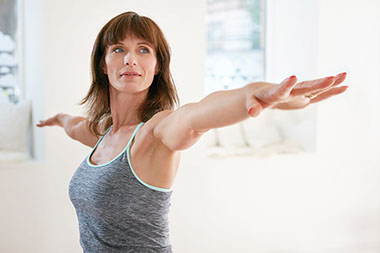
    Women with arms streched out, balancing.

    Good balance is essential for healthy aging. The ability to maintain and recover your equilibrium as you move helps protect you from injury and falls.

    Your independence depends on your ability to balance. Almost every activity necessary for daily life relies on safe movement. As people age, preserving balance protects quality of life and their confidence to move without fear.

    Activities that require balance

    Balance is a foundational skill that impacts almost every type of movement:

    *  Walking

    *  Housework

    *  Picking up kids or pets

    *  Getting up and down from the floor, bed, couch, or commode

    *  Cooking

    *  Navigating uneven or unexpected surfaces

    *  Shopping and carrying groceries

    *  Lifting, moving, and reaching for items

    Factors that impact balance

    Your brain uses information from your eyes, ears, and other body parts to constantly adjust your position in space. Anything that impacts these systems may negatively affect balance:

    *  Lack of physical activity

    *  Inner ear problems

    *  Lack of sleep

    *  Lack of strength

    *  Decline in coordination

    *  Vision changes due to cataracts, glaucoma, etc.

    *  Cognitive conditions such as dementia or Alzheimer’s disease

    If you are concerned about your balance, talk to your doctor. It may be a sign of a more serious condition.

    Improve balance

    *  Practice standing on one foot. Stay near a wall for support, but gradually challenge yourself to balance longer and with less support as you are able.

    *  Try walking heel to toe along a straight line.

    *  Use a wobble board. This strengthens your balance, muscles, and coordination.

    *  Go up and down stairs.

    *  Side step back and forth across a room.

    *  Do calf raises. Using a wall or chair for support, rise up on the ball mounds of your feet and slowly lower back down. Do 2-3 sets of 10-15 repetitions.

    *  Take yoga or tai chi classes.

    *  Lift weights to increase strength and preserve the muscle necessary to balance well.
    © American Institute for Preventive Medicine

  • A Matter Of Balance

    WELL-BEING

    Illustration of 3 people figures with one of them falling.

    A fall for a senior is not simply a matter of shaking it off and standing back up. A fall could mean a broken hip or a bruise, and some seniors really “can’t get up.” Falls are a major threat to the health and independence of older adults.

    The best solution is preventing falls in the first place. And a recent study in the British Medical Journal pointed to the success of exercise programs in reducing falls that cause injuries and broken bones.

    Risk factors for falls include muscle weakness, especially in the legs, and poor balance-all linked to lack of exercise or certain medical conditions. Poor vision and confusion can also lead to falls. Even some medications can cause dizziness. To lower your risk for falls, CDC recommends you do four things:

    1. Exercise to improve balance and strength.

    Walking, using a stretch band and lifting weights increase muscle strength. Yoga and tai chi improve balance. Follow your doctor’s advice for exercise.

    2. Have your doctor or pharmacist review all prescribed and over-the-counter medications you take.

    Some, when taken alone or with other medications or alcohol can make you dizzy or sleepy and raise your risk for falls. Also, let your doctor know if you feel lightheaded when you get up from sitting in a chair or out of bed. Before you get out of bed, sit on the edge of it for a minute or two and get up slowly.

    3. Get an eye exam from an eye doctor at least once a year.

    Follow his or her advice for wearing corrective lenses and/or using low-vision aids. Get treatment for cataract, glaucoma, macular degeneration and other eye conditions as needed.

    4. Make your house safer.

    *  Keep the inside of your house well lit. Use night lights.

    *  Have secure handrails on both sides of  all stairs.

    *  Keep stairs and walk paths clear from clutter and tripping hazards.

    *  Install grab bars in the tub/shower and next to the toilet. If needed, use a shower chair that has rubber tips on the legs and a hand-held shower.

    *  If you use throw rugs, use ones with nonskid backs. Or, put nonslip rug pads or carpet tape underneath rugs.

    *  Wear sturdy shoes with thin, nonslip soles. Avoid going barefoot.

    *  Avoid using a step ladder or a chair to stand on. Keep items you use often in easy-to-reach places.

    *  Be mindful of where your pet and his or her toys are to avoid tripping over them.

    © American Institute for Preventive Medicine

  • Hey, Want To Improve Your Balance?

    SELF-CARE CORNER

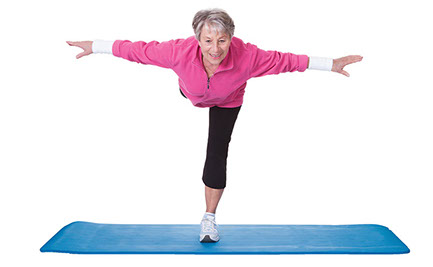
    Image of older women balancing on one leg while bending over half way.

    Everyone wants to prevent falls and improve balance, at any age. NIH in Health offers these daily exercises to steady your balance (and you could do these while talking on the phone or at work too):

    *  Stand on one leg at a time for a minute. Slowly increase the time. Try to balance with your eyes closed or without holding on to anything.

    *  Stand on your toes for a count of 10, and then rock back on your heels for a count of 10.

    *  Move your hips in a big circle to the left, and then to the right. Do not move your shoulders or feet. Repeat 5 times.

    © American Institute for Preventive Medicine