Tag: Family Life

  • Colic

    Children’s Health

    Babies cry when they are hungry, sick, too hot, etc. In general, babies start to have colic when they are about three weeks old. The colic worsens at around six weeks of age and stops by 3 months of age. Colic does not harm babies, but is very hard on parents and caretakers.

    Signs & Symptoms

    *  Fussy crying occurs for no known reason. The baby is not hungry, sick, in pain, etc. The crying lasts for minutes to hours at a time.

    *  The baby may pull his or her knees up to the stomach.

    *  Colic episodes often occur in the evening.

    Causes

    The exact cause is not known. Babies with colic are very, very sensitive to stimulation. Noises in the house bother them. Also, they may need to be cuddled more than babies without colic.

    Bottle feeding too fast (less than 20 minutes) or giving too much formula can trigger colic episodes. So can foods the breast-feeding mother eats (e.g., caffeine, dairy products, and nuts).

    Treatment

    After other medical problems are ruled out, colic is treated by finding out and getting rid of colic triggers and giving comfort to the baby.

    Questions to Ask

    Self-Care / Prevention

    *  Be sure the baby has enough to eat. Check with the baby’s doctor about trying a new formula.

    *  Try different bottle nipples. Make the hole bigger if it is too small. Cut across the hole that is already there. (You will make an X- shaped hole.) Here’s how to find out if the hole is too small:

    –  Put cold formula in the bottle.

    –  Turn the bottle upside down.

    –  Count the drops of formula that fall out. If the drops come out slower than 1 drop per second, the hole is too small.

    *  Don’t allow smoking in your home.

    *  Do not give fruit juice (e.g., apple juice, pear juice) to infants younger than 6 months old.

    *  Hold the baby up for feeding. Keep holding the baby up for awhile after feeding.

    *  Burp the baby after each ounce of formula or every few minutes when breast-feeding.

    *  Use a pacifier, but never put a pacifier on a string around the baby’s neck.

    *  Give the baby a warm bath and a massage.

    *  Wrap or swaddle the baby snugly in a soft blanket. Rock him or her or use a baby swing.

    *  Try the “colic carry.” Lay the baby on his or her stomach across your arm. Put the baby’s face in your hand and let the legs straddle your inner elbow. Hold the baby’s back with your other hand so he or she won’t fall. Walk around like this for awhile.

    *  Carry the baby while you vacuum. Use a baby carrier that you wear on your back or chest.

    *  Play soft, gentle music.

    *  Take your baby for a stroller or car ride.

    *  Run the dryer or dishwasher. Buckle your baby in a baby seat. Lean the seat against the side of the dryer or on the counter near the dishwasher. The sounds from these machines may help the baby fall asleep. Stay with your baby. Make sure the heat or steam won’t hurt the baby.

    *  Don’t give the baby antacids like Maalox or simethicone drops unless a doctor tells you to.

    *  Let your baby cry himself or herself to sleep if nothing else helps and your baby has been fed within 2-1/2 hours. Do call the doctor if the baby cries for more than 2 hours without stopping.

    *  Get someone else to take care of your baby if you get too stressed. Get some rest.

    Resources

    American Academy of Pediatrics

    www.aap.org

    Healthier at Home book by the American Institute for Preventive Medicine. www.HealthyLife.com. All rights reserved.

    © American Institute for Preventive Medicine

  • Banish Biting Bugs

    SELF-CARE CORNER

    Image of female spraying insect repellent on arm.

    Insects like mosquitoes and ticks may annoy you during a summer barbeque or camping trip. But an effective bug repellent does more than avoid an itchy inconvenience. It may help prevent you from getting sick. Mosquitoes and ticks may carry diseases that are dangerous to humans. Many ticks carry Lyme disease and mosquitoes may spread the West Nile and Zika viruses.

    To help keep mosquitoes away, use a repellent that’s been proven safe and effective by the CDC. Look at the label and choose a repellent with one of these active ingredients:

    *  DEET

    *  Picaridin

    *  IR3535

    *  Oil of lemon eucalyptus

    *  Para-menthane-diol

    The CDC recommends tick repellents that have one of the following active ingredients:

    *  DEET (20 to 30 percent): use on skin and clothing, but not under clothing.

    *  Permethrin: use on clothing and gear only.

    In addition to a repellent, there are other ways to avoid bugs:

    *  Avoid wooded and brushy areas when possible.

    *  Walk in the center of trails.

    *  Wear clothing that covers arms and legs.

    *  Minimize time outside at dawn and dusk, when mosquitoes are most active.

    *  Throw out standing water in tires, buckets, birdbaths or other outdoor items at least once a week.

    *  Do a full-body check for ticks after spending time outside.

    What to do if you spot a tick

    If you find a tick on your skin, it should be removed as soon as possible. Here’s what to do:

    *  Don’t panic.

    *  Use fine-tipped tweezers to grasp the tick as close to the skin’s surface as possible.

    *  Pull upward on the tick slowly and evenly. Don’t twist the tick or try to yank it out quickly.

    *  If parts of the mouth remain after you’ve tried to remove it, use the tweezers to try and get them out. If you can’t get them out, leave it alone so the skin can heal.

    *  After you’ve removed the tick, clean the bite area and your hands with soap and water, rubbing alcohol or an iodine scrub.

    *  If the tick is alive, don’t try to crush it. Instead, put it in alcohol or an airtight bag or container. You can also wrap it tightly in tape or flush it down the toilet.

    *  Ticks can also be removed by your doctor if you can’t get it out yourself.

    *  If you’ve been bitten by a tick, contact your doctor for follow-up care.

    © American Institute for Preventive Medicine

  • Family Matters

    FAMILY LIFE

    Image of family sitting on a couch with their pet dog.

    Your family is where you learn who you are and how to relate to others. It plays a vital role in fulfilling the human need to belong and have close, long-term relationships. Whether you are a child, teen, or adult, family experiences can promote or hinder your well-being.

    Tips to foster family well-being

    *  Live a healthy lifestyle together.

    – Plan for, shop, and eat healthy foods.

    – Exercise as a family if you can. Or, promote physical activity suited for each family member.

    – Get enough sleep.

    *  Plan to eat at least one meal a day together. Have each person talk about his or her day, such as stating the best part and worst part.

    *  Spend time together. Attend important events for each family member.

    *  Express care and concern. Be available to help each other out. Listen, listen, listen.

    *  Practice good manners. Say, “Thank you” and “You’re welcome.” Make it a practice to send thank you calls, notes, letters, or emails to others for gifts and other acts of kindness.

    *  Express affection. Say, “I love you,” “I care about you,” and “You mean a lot to me.”

    *  Discuss the value of the family as a whole. Encourage individual expression and development.

    *  Define clear, yet flexible roles for family members. Assign family chores.

    *  Keep the house as organized as possible.

    *  Discuss the need to adapt to changes and deal with stressful events.

    *  Seek professional help for problems the family cannot deal with on its own.

    © American Institute for Preventive Medicine

  • Is Your Relationship In Trouble?

    SUCCESS OVER STRESS

    Image of couple not getting along.

    Is your relationship stormy? Indifferent? One-sided? According to Pennsylvania psychologist, Dr. Michael S. Broder, these are the three types of troubled relationships. They account for the high divorce rate, as well as the much higher percentage of non-married relationships that end.

    Stormy Relationship:

    This type has plenty of passion, but it may not be the positive kind. Positive passion is a relationship at its best. Too much negative passion results in a great amount of anger and discomfort. At the extreme, these relationships can become abusive and even dangerous. A relationship with a lot of passion and little or no comfort can still be highly charged romantically and sexually. In some cases the most passionate sex actually occurs after the meanest and volatile arguments. The sad part is that the cause of the anger is never dealt with or resolved. Thus, the pattern can continue indefinitely.

    Indifferent Relationship:

    With this type, most-if not all-of the passion is missing. There can be a very comfortable living arrangement, but partners may have little feeling or sexual desire for each other. Sometimes partners simply grow apart without anger, or there can be as much anger as there is in the typical stormy relationship. The main difference is that there’s just not the tendency to argue or do battle with each other. This may be a result of the partners’ personality styles, or the absence of passion-including negative passion. Instead, the relationship merely begins to die a slow and quiet death. In other words, it may be brain alive but heart dead.

    One-Sided Relationships:

    In this type, one person usually puts out much more effort and energy to maintain and nurture the relationship than does the other. One partner can be quite content, having all the passion and comfort he or she needs. Yet the other partner feels somewhat to totally unfulfilled.

    In all types of troubled relationships it is important to ask: “What is the potential for change?” If the answer is none, the next question to ask yourself is, “Is this where I still want to be?”

    Adapted from Can Your Relationship Be Saved? How to Know Whether to Stay or Go by Dr. Michael S. Broder.

    © American Institute for Preventive Medicine

  • Prevent Ear Infections

    FAMILY LIFE

    Image of doctor looking into a child's ear.

    “Most children will have at least one ear infection by the time they are 2 years old,” said Dr. Heather Gomes of the Boys Town National Research Hospital. “For those children who have recurring ear infections, further evaluation and treatment by an ear, nose and throat physician is recommended to avoid delays in speech and language skills.”

    The top 5 tips to prevent ear infections –

    1. Protect your child from secondhand tobacco smoke.

    2. Reduce your child’s exposure to colds during the first 2 years of life as much as possible.

    3. Breast-feed your baby during the first 6 to 12 months of life.

    4. Bottle-feed your child by holding the bottle at a 45-degree angle.

    5. Discuss with your doctor any significant symptoms such as excessive spitting up or stomach pain because this is a risk factor.

    © American Institute for Preventive Medicine

  • Strike The Right Cord

    FAMILY LIFE

    Image of young smiling family.

    Children can be strangled by window cords on blinds and curtains. In fact, such tragedies are among the top hazards in American homes. Infants and children die each year from accidental strangling in the cords.

    The Consumer Product Safety Commission recommends that only cordless window coverings or those with unreachable cords be used in homes with young children. They are available today in the marketplace and will prevent window blind strangulations.

    In addition, the Window Covering Safety Council encourages parents, grandparents and caregivers to follow these basic cord-safety precautions:

    *  Move all furniture, cribs, beds, and climbable surfaces away from windows.

    *  Keep all window shades, blinds, and drapery cords well out of the reach of children.

    *  Install only cordless window coverings in homes with young children.

    © American Institute for Preventive Medicine

  • Video Warfare

    FAMILY LIFE

    Image of two kids playing video games.

    Children learn from video games, say Iowa State University psychology professors. So parents may want to shop smart when choosing games for their children. Even if the content is unrealistic or cartoonish, kids learn good behaviors (playing drums) or bad behaviors (aggressive tactics) by practicing.

    Professors Craig Anderson and Doug Gentile-leading experts on the effects of video games on young people and authors of the book Violent Video Game Effects on Children and Adolescents, say, “Parents and researchers initially believed that what mattered most about violent games was how realistic and bloody they were. Our research now suggests that what matters most is whether you have to harm other characters to advance in the game.”

    Follow their advice to parents before making a video game purchase for children:

    *  Play the game, have someone else demonstrate it for you, or look at clips from the game on the game’s website.

    *  Then ask yourself the following questions: Does the game involve some characters trying to harm others? Does this happen frequently, more than once or twice in 30 minutes? Is the harm rewarded in any way? Is the harm portrayed as humorous? Are nonviolent solutions absent or less “fun” than the violent ones? Are realistic consequences of violence absent from the game?

    Two or more yes answers should cause parents to think carefully about the lessons being taught before purchasing that game for children. Some sports and fun music games may be better choices than warfare games.

    © American Institute for Preventive Medicine

  • Croup

    Children’s Health

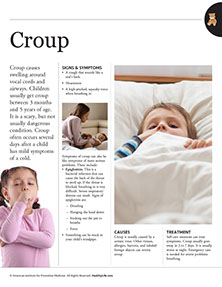
    Croup causes swelling around vocal cords and airways. Children usually get croup between 3 months and 5 years of age. It is a scary, but not usually dangerous condition. Croup often occurs several days after a child has mild symptoms of a cold.

    Signs & Symptoms

    *  A cough that sounds like a seal’s bark.

    *  Hoarseness.

    *  A harsh, crowing noise with breathing in.

    Symptoms of croup can also be like symptoms of more serious problems. These include:

    *  Something can be stuck in your child’s windpipe.

    *  Epiglottitis. This is a bacterial infection that can cause the back of the throat to swell up. If the throat is blocked, breathing in is very difficult. Severe respiratory distress can result. Signs of epiglottitis are:

    – Drooling.

    – Hanging the head down.

    – Sticking out the jaw to breathe.

    – Fever.

    Causes

    Croup is usually caused by a certain virus. Other viruses, allergies, bacteria, and inhaled foreign objects, can mimic croup.

    Treatment

    Self-care measures can treat symptoms. Croup usually goes away in 3 to 7 days. It is usually worse at night. Emergency care is needed for severe problems breathing.

    Questions to Ask

    Self-Care / Prevention

    *  Don’t panic. You can help your child stay calm if you stay calm. Hold your child to comfort him or her. The windpipe may open up a little if your child relaxes. Call your child’s doctor or get immediate care if you are not sure what to do.

    *  Go into the bathroom with your child and close the door.

    –  Turn on the hot water in the sink and shower. Let the steam fill the room.

    –  Don’t put your child in the shower. Sit with your child. (Don’t sit on the floor.) Read a book or play a game with your child. This will help pass the time.

    –  Open the window to let cool air in. This helps make more steam.

    –  Stay in the bathroom about 10 to 15 minutes.

    *  If it is cold outside, instead of using the bathroom to make steam, put a coat, etc. on your child and take him or her outside to breathe the cold night air.

    *  Use a humidifier in your child’s room. Use warm, distilled water, not tap water. Clean the humidifier every day. Put a humidifier on your furnace. Change the filter often.

    *  Give your child a clear liquid. Warm it first. Warm liquids may help loosen the mucus. Give babies under 6 months old water or electrolyte water, such as Pedialyte, if okay with your child’s doctor. Give water, apple juice, etc. to a child who is 6 months old or older.

    *  Try to keep your child calm. Croup symptoms tend to get worse if your child is crying and upset.

    To Help Prevent Croup and Other Infections

    *  See that your child’s immunizations for diphtheria (DTaP), measles (MMR), and H. influenzae type b (Hib) are up-to-date.

    *  Follow prevention measures inColds & Flu.

    Resources

    The American Academy of Pediatrics

    www.aap.org

    Healthier at Home book by the American Institute for Preventive Medicine. www.HealthyLife.com. All rights reserved.

    © American Institute for Preventive Medicine

  • Bounce House Dangers

    FAMILY LIFE

    Image of a bounce house.

    If your kids like to moonwalk and jump in those ever-present birthday-party experiences called bounce houses, know about these dangers. A child goes to the ER every 45 seconds because of bouncing injuries.

    Researchers at Nationwide Children’s Hospital say inflatable bouncers are the cause of a 15-fold increase in injuries to kids-mostly broken bones, strains and sprains but also head and neck injuries. The findings were published in Pediatrics.

    Injury patterns for inflatable bouncers are similar to those the docs see on trampolines, which have national safety guidelines. Bounce houses have no guidelines. So set your own rules.

    The researchers suggest parents should consider the risks before allowing their children to use an inflatable bouncer.If you allow your child to use an inflatable bouncer, limit use to children 6 years of age and older. Make sure an adult is there to supervise while the bouncer is in use and allow only one child on the bouncer at a time. If more than one child will be on the bouncer at the same time, the children should be about the same age and size.

    © American Institute for Preventive Medicine

  • Forget Shouting

    WELL-BEING

    Image of 2 men talking.

    While many people try to steer clear of arguments with family members, two Vanderbilt University philosophy professors offer a better solution.

    Scott F. Aikin and Robert B. Talisse co-wrote Why We Argue (and How We Should): A Guide to Political Disagreement. The trend to avoid arguments with loved ones has more to do with how bad we are at arguing than how strong our beliefs are, according to Aikin. “The better solution would be to improve our skill at making arguments in ways that allow for better, more reasoned exchange.”

    Aikin and Talisse suggest the following:

    *  Remember that reasonable and intelligent people disagree about important matters. Keep this in mind even when your relative says something appalling.

    *  When arguing, be sure to acknowledge your family member’s good points.

    *  Be prepared to say what it would take for you to change your mind. Consider what evidence would make your view wrong.

    *  Know the weak points about your view. Be able to articulate what the best arguments against your view are.

    “Acknowledging the opposition’s good points and seeing troubles for your own side are too often taken to be a sign of weakness,” Aikin said. “But it’s that attitude that actually makes us bad at argument and makes argumentative exchange so unpleasant and dogmatic. Instead, these habits make exchanges more reasonable and productive.”

    © American Institute for Preventive Medicine