Tag: Family Life

  • Kids And Concussions: What To Know

    WELL-BEING

    Image of mom holding child with a bump on the head.

    Many kids get a bump or blow to the head while playing sports or other activities. If the hit is hard enough, a child can have a concussion, which is a type of traumatic brain injury. During a concussion, the brain bumps against the inside of the skull. This can cause changes in the way the brain works and can lead to long-term problems.

    How do I know if my child had a concussion?

    Many people mistakenly think that if the child doesn’t “black out,” then they’re okay. Although losing consciousness is a sign that a concussion is likely, it’s not the only way to know. A concussion can happen even if the child never loses consciousness. Look for:

    *  Nausea and vomiting

    *  Dizziness

    *  Blurred vision

    *  Sensitivity to light

    *  Tiredness

    Some kids don’t show symptoms right away. If your child suffered a hit to the head, look for these problems that can occur days or weeks after a concussion:

    *  Trouble concentrating or problems with schoolwork

    *  Headaches

    *  Memory problems

    *  Confusion or changes in behavior

    *  Changes in their movement, coordination or walking

    Anything that seems unusual after a blow to the head should be checked by a doctor.

    What to do after a concussion

    Right after the injury, the child should:

    *  Stop the sport or activity.

    *  Get medical help immediately.

    *  Lie down on back with head and shoulders slightly raised while waiting for help to arrive.

    Parents or adults should watch the child’s breathing and whether they stay awake. If the child isn’t breathing or doesn’t have a pulse, begin CPR.

    Returning to sports or activities

    The brain needs time to heal after a concussion. If the child starts activities too soon, they are more likely to have another concussion and to suffer more serious brain damage. Ask the child’s doctor when they can gradually begin physical and mental activities again.

    Preventing concussions

    To prevent a brain injury like a concussion, make sure your child:

    *  Wears a helmet during all contact sports, such as football, or in cases where a fall could happen, such as while biking, skating, horseback riding, and skiing.

    *  Wears a seatbelt and/or has the right car seat for riding in a vehicle.

    Concussions can happen to the best athletes with the most careful parents. If it happens to your child, remember to give the child’s brain plenty of time to rest and recover. This can help avoid long-term problems down the road.

    Source: National Institutes of Health

    © American Institute for Preventive Medicine

  • Prevent Kids From Choking

    FAMILY LIFE

    Image of father and daughter eating oranges.

    Food-not toys-are the most common culprit of choking accidents in kids under 5. The reasons have a lot to do with a child’s anatomy.

    “Young children have underdeveloped swallowing mechanisms, immature teeth and narrow airways, which put them at a higher risk for choking on food,” said Dr. Nina Shapiro, a professor of head and neck surgery at the UCLA School of Medicine. “Plus, the diameter of a child’s airway is about the size of their pinky, so high-risk foods can easily block their tiny airways and prevent their ability to breathe.”

    The list of high-risk foods for children under age 5 years includes many kid favorites:

    *  Cheese sticks

    *  Chewing gum

    *  Chunks of meat or cheese

    *  Chunks of peanut butter

    *  Chunks of raw vegetables

    *  Dried fruit

    *  Grapes

    *  Hard or sticky candy and lollipops

    *  Hot dogs

    *  Nuts

    *  Popcorn

    *  Seeds such as pumpkin seeds and sunflower seeds

    Here are some tips:

    *  Vegetables should be cooked and cut into small pieces.

    *  Hot dogs and cheese sticks should be cut lengthwise, then widthwise, and then into the shape of small moons.

    *  Grapes should be peeled and cut in half or quarters.

    *  Nut butters should be spread thinly onto crackers or bread.

    *  Young children should always be attended to by an adult when they eat and only eat developmentally appropriate foods.

    *  Children should sit up straight and not play or run while eating.

    If a child does choke and is unable to breathe, call 911 and perform the Heimlich maneuver. Even if the child seems to choke but then coughs and appears fine, the object may have become lodged, and the child should see a doctor.

    © American Institute for Preventive Medicine

  • Summer With Less Screens

    FAMILY LIFE

    Image of grandparents playing basketball with grandkids.

    When the kids are home from school for the summer, it can be hard to avoid technology. Kids (and adults) are used to constant entertainment from the television, computer, smartphones and tablets. But, reducing screen time can have many benefits for families:

    *  Boredom is a great way for kids to learn to be creative. If they’re always entertained by a screen, kids don’t have a chance to be bored and to learn how to entertain themselves.

    *  Sitting in front of a screen means time not spent getting exercise.

    *  Some studies suggest that too much screen time can lead to behavior problems, lack of good thinking skills, and sleep problems.

    It’s not always realistic to avoid screens completely. If you can’t, look for ways to limit screen time. Try these tips:

    *  Choose certain times of day to be screen-free. For instance, you can choose to let kids have 30 minutes of screens after lunch, but morning is for screen-free play.

    *  Watch the clock. Decide on a daily limit of screen time, such as two hours, and stick with it. Consistent rules help kids know what they can expect each day, so there is less complaining.

    *  Visit the library. If you can get kids to read books they like, they won’t miss screens as much.

    *  When you do watch TV, watch shows together as a family. Choose educational shows when possible.

    Have a plan

    A family media plan can help you stay on track with screen time. Create yours atwww.healthychildren.org/English/media.

    © American Institute for Preventive Medicine

  • Water Safety Tips You Need To Know

    SELF-CARE CORNER

    Image of mother and young child in the pool.

    When the summer sun beats down, many people flock to water for cooling relief and fun. Swimming, boating and water activities are a favorite pastime for many Americans. But, it’s important to know the dangers of water and how to keep yourself and your loved ones safe.

    The Centers for Disease Control and Prevention says more than 3,500 people DROWN in the U.S.  each year in swimming (non-boating) related accidents.

    Most of these are children under the age of 14.

    And according to the U.S. Coast Guard,

    hundreds more die in boating-related accidents

    each year – and the majority of them are DUE TO DROWNING.

    Most drownings are preventable –

    so here’s what you should do any time you’re around water:

    *Keep pools gated and locked.Home pools should be enclosed with a locked fence that’s at least 4 feet high.

    *Always supervise.Children drown within seconds, not minutes. And, there’s typically no screaming, splashing, or other noise. Keep your eyes on children in the water at all times. Don’t turn your back, even for “just a minute.”

    *Wear life jackets.Many boating-related deaths could be avoided if all passengers wore U.S. Coast Guard-approved life jackets. Children should also wear them when swimming.

    *Consider swimming lessons.Children and adults can benefit from knowing how to swim, and it can reduce the risk of drowning.

    *Learn CPR.Giving cardiopulmonary resuscitation (CPR) can save lives if given quickly after a water accident.

    *Stay sober.Alcohol and water don’t mix – so don’t drink if you’re boating, swimming or supervising children in the water.

    *Watch the weather.If there’s a chance of strong winds or a thunderstorm, stay out of the water.

    *Watch for rip currents in natural bodies of water.A rip current is a powerful current that you can’t see, but can quickly take even a grown adult underwater. If you feel one pull you down, swim parallel to the shore until you get free. Don’t try to fight it or swim toward the shore.

    *Know the boating laws.There are state and federal laws that boaters must follow. Learn about them atwww.uscgboating.org. You can also look into boating safety courses and safety checks for your boat on this website.

    © American Institute for Preventive Medicine

  • Eye Problems

    Children’s Health

    Signs, Symptoms & Causes

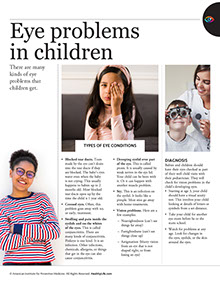
    There are many kinds of eye problems that children get. Here are some of them:

    *  Blocked tear ducts. Tears made by the eye can’t drain into the tear ducts if they are blocked. The baby’s eyes water even when the baby is not crying. This usually happens to babies up to 2 months old. Most blocked tear ducts open up by the time the child is 1 year old.

    *  Crossed eyes. Often, this problem goes away with no treatment.

    *  Swelling and pain inside the eyelids and on the whites of the eyes. This is called conjunctivitis. There are many kinds of conjunctivitis. Pinkeye is one kind. It is an infection. Other infections, chemicals, allergens, or things that get in the eye can also cause conjunctivitis.

    *  Drooping eyelid over part of the eye. This is called ptosis. It is usually caused by weak nerves in the eye lid. Your child can be born with it. Or it can happen with another muscle problem.

    *  Sty. This is an infection on the eyelid. It looks like a pimple. Most sties go away with home treatments.

    *  Vision problems. Here are a few examples:

    – Nearsightedness (can’t see things far away).

    – Farsightedness (can’t see things close up).

    – Astigmatism (blurry vision from an eye that is not shaped right, or from losing an eye).

    It’s hard to know if your child has vision problems until he or she is 3 years old. (The eye is still developing until then.)

    *  Take your child for their first  eye exam at 3 years old.

    *  Take your child for another eye exam before he or she starts school.

    *  Watch for problems at any age. Look for changes in the eyes, eyelids, or the skin around the eyes.

    Questions to Ask

    Self-Care

    A doctor should treat a hurt or infected eye. But you can treat some eye problems at home.

    *  For a blocked tear duct:

    1. Wash your hands.

    2. Press gently on the inner corner of the eye with a cotton swab. Press up, not down, for a few seconds to a few minutes.

    *  For dry eyes, try over-the-counter “tears.” Some kinds are Ocu-Lube®, Refresh®, or Liquifilm®. Wash your hands before you put drops in the eyes. If your child’s eyes don’t get better, take him or her to the doctor.

    *  To help with an insect bite, gently wash the eyes with warm water.

    *  To help the pain of a hurt eye that is not infected:

    – Put a warm (not hot), wet wash cloth on the eye for 5 minutes. Do this 2 or 3 times a day.

    – Use over-the-counter eye drops.

    – Don’t  let your child wear contact lenses or makeup until the eye is better.

    *  If the eye is infected:

    – Wash your hands and your child’s hands every time you touch the eye. (Pinkeye is very easy to catch.)

    – Don’t  share a towel with someone who has pinkeye.

    – Keep your child away from light if he or she got pinkeye from the measles.

    – Don’t  cover the eye. This can make the infection worse.

    *  Here’s how to get something out of your child’s eye: (Make sure you can see the speck before you try to get it out.)

    1. Wash your hands.

    2. Drip clean water into the eye to rinse it.

    3. Twist a piece of tissue at each end. Wet the tip with tap water, not spit. Gently touch the speck with the tip. The speck should stick to the tip.

    – Tell your child to look down if the speck is under the upper lid. Pull the upper lid away from the eye. Do this by gently pulling on the eyelashes. When you can see the speck, try to touch it with the tissue.

    – Don’t  rub the eye. And never use anything sharp to touch your child’s eye.

    4. Gently wash the eye with cool water.

    *  To help with pain from a sty:

    – Put a warm (not hot), wash cloth on the sty 3 or 4 times a day for 5 or 10 minutes each time.

    – Keep your child away from dust and dirt that can get in his or her eyes.

    – Don’t poke or squeeze the sty!

    Children's Self-Care book by the American Institute for Preventive Medicine. www.HealthyLife.com. All rights reserved.

    © American Institute for Preventive Medicine

  • Bullying: How To Take Action

    FAMILY LIFE

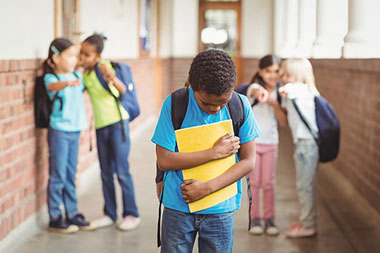
    Image of kids wispering and pointing towards a classmate whose head is down.

    Bullying can be hard to address, especially if it’s happening to your child. Knowing how to deal with bullying can help you support your child and stay calm about it. This is important because bullying can happen more than once.

    Dealing with bullying in the right way can help you (and your child) put a stop to it. If your child is being bullied, take the following steps:

    *  Talk to your child about what happened. Without interrupting or giving your opinion, let your child openly talk about what was said or done in the bullying situation. Be sure you understand the whole story. Support them as they talk by telling them you want to help, and by keeping your actions as calm as possible.

    *  Tell the child that bullying is not their fault. No one deserves to be bullied.

    *  When giving advice, use clear examples. Role playing can be very helpful in teaching a child what to do. Never tell them to fight back or use violence. This doesn’t help the situation and can get your child in trouble or hurt.

    *  Ask your child how you can help them feel safe again. Try not to single him or her out by making changes in their routine, such as switching classes or buses. Instead, try taking other steps, such as changing seating arrangements in school or on the bus.

    *  Talk with the school or organization. State your concerns and ask them how they feel it can be addressed. Remember that the school staff cannot “discipline” other kids. Even if you want to, avoid talking with the bullying child’s parents. School officials can talk with them and be a neutral moderator.

    *  Consider getting professional support for your child. Sometimes a school counselor or mental health expert can help a child who has been bullied.

    Bullying should never be ignored. Kids who are bullied may be at higher risk for health problems like:

    *  Depression

    *  Anxiety

    *  Sleep problems

    *  Loss of interest in activities

    Their grades may also suffer. Kids who are bullied are more likely to miss school or drop out.

    Source: Stopbullying.gov

    © American Institute for Preventive Medicine

  • Forget The Ipad, Let Kids Play In Sand Or With Blocks

    FAMILY LIFE

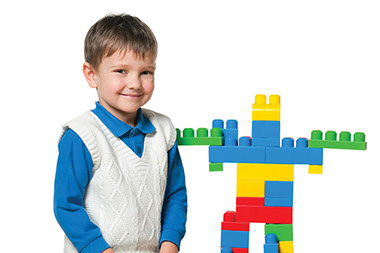
    Image of young boy playing with blocks.

    When it comes to finding toys to encourage a child’s interest in science, sometimes simpler can be better and yet more sophisticated.

    Creighton University professor of physics Dr. Gintaras Duda suggests looking at toys with a tactile, kinesthetic component that can help illustrate scientific principles while allowing a child to come up with new ways to play.

    “If you can get kids to be creative, that’s the main thing,” Dr. Duda said. “Let them sort of figure out how these things work. It’s great scientific learning. Yes, kids love to play with the iPad, but if you dump a bin of Legos out in front of them and let them go, you’ll always be surprised at what they come up with.”

    Hands-on building blocks, tower sets, and a strangely behaving substance known as kinesthetic sand, which shares certain properties with regular sand but performs differently as it’s being molded, have all captured children’s attention and imagination.

    © American Institute for Preventive Medicine

  • Life After Stroke: 9 Tips For Caregivers

    MEDICAL NEWS

    Image of older women in wheelchair being helped by relative.

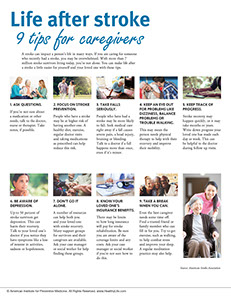
    A stroke can impact a person’s life in many ways. If you are caring for someone who recently had a stroke, you may be overwhelmed. With more than 7 million stroke survivors living today, you’re not alone. You can make life after a stroke a little easier for yourself and your loved one with these tips.

    1. Ask questions. If you’re not sure about a medication or other needs, talk to the doctor, nurse or therapist. Take notes, if possible.

    2. Focus on stroke prevention. People who have a stroke may be at higher risk of having another one. A healthy diet, exercise, regular doctor visits and taking medications as prescribed can help reduce this risk.

    3. Take falls seriously. People who have had a stroke may be more likely to fall. Seek medical care right away if a fall causes severe pain, a head injury, bruising or bleeding. Talk to a doctor if a fall happens more than once, even if it’s minor.

    4. Keep an eye out for problems like dizziness, balance problems or trouble walking. This may mean the person needs physical therapy to help with their recovery and improve their mobility.

    5. Keep track of progress. Stroke recovery may happen quickly, or it may take months or years. Write down progress your loved one has made each day or week. This can be helpful to the doctor during follow up visits.

    6. Be aware of depression. Up to 50 percent of stroke survivors get depression. This can harm their recovery. Talk to your loved one’s doctor if you notice they have symptoms like a loss of interest in activities, sadness or hopelessness.

    7. Don’t go it alone. A number of resources can help both you and your loved one with stroke recovery. Many support groups for survivors and their caregivers are available. Ask your case manager or social worker for help finding these groups.

    8. Know your loved one’s insurance benefits. There may be limits to how long insurance will pay for stroke rehabilitation. Be sure you are aware of the coverage limits and any costs. Ask your case manager or social worker if you’re not sure how to do this.

    9. Take a break when you can. Even the best caregiver needs some time off. Find a trusted friend or family member who can fill in for you. Try to get exercise, such as walking, to help combat stress and improve your sleep. A regular meditation practice may also help.

    Source: American Stroke Association

    © American Institute for Preventive Medicine

  • Preventing Falls In The Winter

    SELF-CARE CORNER

    Image of family walking outside in the snow.

    Most of us can recall a time when we slipped in the winter snow or on an icy sidewalk. You may have gotten away with just a bruise or a sore spot for a few days.

    But, slips and falls can be serious – especially for older adults and those with health problems. In fact, falls are the leading cause of injuries in older adults. Some falls can even be fatal.

    Colder temperatures mean slick surfaces –  and dangerous falls. Follow these suggestions to help avoid falls in the winter, and share them with the older adults in your life.

    Vehicle safety

    Getting in and out of a car is a prime time for slips and falls.

    *  Look at the surface before you step out of your car.

    *  Keep three or four “points of contact” when getting in and out. This means put both feet on the ground, and have one or two hands on a stable part of the car before you try to move.

    Walk safely

    People who have a high fall risk may need to avoid walking outdoors when it’s icy. But for those who can’t avoid walking in the winter weather, follow these tips:

    *  Get rid of old footwear. Shoes and boots that have worn soles are more likely to lose their grip and slip.

    *  Wear boots with deep cleats or use ice cleats on the outside of boots. These are available at most sporting goods stores.

    *  If you use a cane for walking, consider getting an ice grip that attaches to the tip of your cane.

    *  Wear warm gloves or mittens. Don’t keep hands in pockets, as this makes it harder to keep your balance.

    *  Keep hands free by using a backpack or cross-body purse in place of a handbag.

    *  When possible, choose surfaces that have been salted and that are in direct sunlight.

    *  Keep a small bag of kitty litter in your purse or pocket. If a surface looks icy, scatter some of the litter in front of you before walking.

    *  Don’t be afraid to go “off road.” If a sidewalk looks icy, consider walking on the grass next to it. This can work if you can see that the ground doesn’t have hazards like holes or uneven surfaces.

    *  Use ice melting salt or sand on your sidewalks and around entries to your home. Older adults may need a loved one or a neighbor to help apply this every time it snows or gets icy.

    Source: National Council on Aging

    © American Institute for Preventive Medicine

  • Surprisingly Simple Ways To Prevent Disease

    MEDICAL NEWS

    Image of happy man with thumbs up as he weighs himself.

    Five new studies support simple steps to prevent illness and improve overall health. The American Journal of Medicine reports the following based on multiple studies in several countries:

    *  Eating fresh fish regularly may reduce your risk of colorectal cancer.

    *  Still trying to stop smoking? Try acupuncture and hypnosis. Several studies found smokers had good success.

    *  Have your teeth cleaned regularly. Scaling removes harmful bacteria. You can reduce your risk for heart attack and stroke.

    *  Talk to your doctor about weight loss. People who were moderately obese, followed a diet plan from their doctors (not a weight loss clinic), and stuck with it at least 12 weeks, lost over 10% of their body weight.

    *  Low-dose aspirin, for people who can take it, offers preventive cancer benefits along with heart healthy help.

    © American Institute for Preventive Medicine