Tag: feedback

  • How To Handle Criticism

    WORK LIFE

    Women at the office sitting in chair, smiling.

    No one likes to be criticized. It’s not an enjoyable experience to have your work, speech, or actions critiqued by those around you. However, handled well, criticism can be helpful. If you learn to listen and discern when a critique is valid, you can leverage the discomfort as a tool for growth.

    Steps to handle criticism

    Listen

    Resist the urge to shut down and shield yourself from the uncomfortable feeling of being criticized. Pause and listen to what is being shared.

    Don’t make it personal

    While sometimes you may experience a personal attack disguised as critique, try to separate yourself from the criticism. You’re not a bad person for having room to improve.

    Ask for clarification

    Not everyone is skilled at giving constructive criticism. You, as the receiver, may need to ask questions to determine how to improve.

    Take time to reflect

    Criticism that stings in the moment may be easier to learn from after your initial emotions fade. Take time to digest criticism to see how you can improve.

    Follow-up

    Make a follow-up plan to ensure you’ve made the necessary changes. This demonstrates your commitment to personal growth.

    If necessary, let it go

    Criticism shouldn’t hang over your head. Learn what you can and then move on. This is especially important in the face of criticism that is not helpful.

    © American Institute for Preventive Medicine

  • Rate Your Aerobics Class

    Fitness

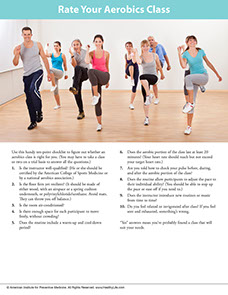
    Image of an aerobic class.

    Use this handy ten-point checklist to figure out whether an aerobics class is right for you. (You may have to take a class or two on a trial basis to answer all the questions.)

    1.  Is the instructor well-qualified? (He or she should be certified by the American College of Sports Medicine or by a national aerobics association.)

    2.  Is the floor firm yet resilient? (It should be made of either wood, with an airspace or a spring cushion underneath, or polyvinylchloride / urethane. Avoid mats. They can throw you off balance.)

    3.  Is the room air-conditioned?

    4.  Is there enough space for each participant to move freely, without crowding?

    5.  Does the routine include a warm-up and cool-down period?

    6.  Does the aerobic portion of the class last at least 20 minutes? (Your heart rate should reach but not exceed your target heart rate.)

    7.  Are you told how to check your pulse before, during, and after the aerobic portion of the class?

    8.  Does the routine allow participants to adjust the pace to their individual ability? (You should be able to step up the pace or ease off if you need to.)

    9.  Does the instructor introduce new routines or music from time to time?

    10. Do you feel relaxed or invigorated after class? If you feel sore and exhausted, something’s wrong.

    “Yes” answers mean you’ve probably found a class that will suit your needs.

    Page image from A Year of Health Hints book by the American Institute for Preventive Medicine. www.HealthyLife.com. All rights reserved.

    © American Institute for Preventive Medicine

  • Rate Your Doctor

    Medical Care

    In order to feel good about your medical care, you should feel good about your doctor, too. Use this checklist when evaluating your physician.

    *  Is your doctor ‘board certified” or ‘board eligible?” To check, contact the American Board of Medical Specialists (ABMS) at 1.866.ASK.ABMS (275.2267) or accesswww.abms.org. Board certified means that he or she has two or more years of training in a specialty after medical school graduation and has passed a national examination certifying competence in the specialty. Board eligible means that the training has been completed, but not the exam. Please note, however, that credentials do not guarantee competency.

    *  Does your doctor listen to you and answer all your questions about the causes and treatment of your medical problems, or is he or she vague, impatient, or unwilling to answer?

    *  Are you comfortable with your doctor? Can you openly discuss your feelings and talk about personal concerns, including sexual and emotional problems?

    *  Does your doctor take a thorough history, asking about past physical and emotional problems, family medical history, drugs you are taking, and other matters affecting your health?

    *  Does your doctor address the root causes of your medical problems or simply prescribe drugs to treat the symptoms?

    *  Does your doctor have an associate to whom you can turn should he or she be unavailable?

    *  Do you feel at ease asking your doctor questions that may sound

    Page from A Year of Health Hints book by the American Institute for Preventive Medicine. www.HealthyLife.com. All rights reserved.

    © American Institute for Preventive Medicine