
Tag: Financial Wellness

  • Know Your Rights With Rebates

    FINANCIAL HEALTH

    Person holding a bag of gifts.

    The holiday shopping season is here, and with it comes big sales and big purchases. Some stores and companies advertise big rebate offers to get you to buy. These offers may promise you a certain amount of money back, either immediately or after you send in a form.

    Usually, you buy the item, fill out and send in some paperwork, and wait for the rebate money to come in the mail. You probably need the sales receipt, a form and the packaging from the item. Sometimes you get a rebate within a month, but many rebates take longer – up to 12 weeks.

    The Federal Trade Commission says people should beware of rebates that take too long to show up – or never come at all. Companies are required by law to send the rebate within the promised timeframe. If there’s no timeframe listed, the timeframe is usually 30 days.

    Follow these tips if you buy a product with a rebate:

    *  Make sure you follow all the steps on the rebate form. Enclose all of the required paperwork.

    *  Make a copy of all your paperwork. You’ll want these records if your rebate doesn’t show up or if there’s a problem.

    *  Keep track of the date you sent the rebate. Contact the company if your rebate doesn’t show up when they promised it.

    If your rebate is late or never shows up, you can file a complaint. Contact the Federal Trade Commission, your state Attorney General or your local Better Business Bureau.

    © American Institute for Preventive Medicine

  • Prevent Burnout

    Stress Management

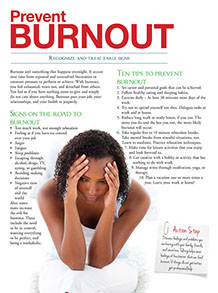
    Image of women with head in her hands.

    Recognize and treat early signs.

    Burnout isn’t something that happens overnight. It occurs over time from repeated and unresolved frustration or constant pressure to perform or achieve. With burnout, you feel exhausted, worn out, and detached from others. You feel as if you have nothing more to give and simply do not care about anything. Burnout puts your job, your relationships, and your health in jeopardy.

    Ten tips to prevent burnout:

    1.  Set career and personal goals that can be achieved.

    2.  Follow healthy eating and sleeping habits.

    3.  Exercise daily – At least 30 minutes most days of the week.

    4.  Try not to spread yourself too thin. Delegate tasks at work and at home.

    5.  Reduce long work or study hours, if you can. The more you do and the less you rest, the more likely burnout will occur.

    6.  Take regular five to 10 minute relaxation breaks. Take mental breaks from stressful situations, too. Learn to meditate. Practice relaxation techniques.

    7.  Make time for leisure activities that you enjoy and look forward to.

    8.  Get creative with a hobby or activity that has nothing to do with work.

    9.  Manage stress through meditation, yoga, or therapy.

    10. Plan a vacation one or more times a year. Leave your work at home!

    Signs on the road to burnout:

    *  Too much work, not enough relaxation

    *  Feeling as if you have no control over your job

    *  Anger

    *  Fatigue

    *  Sleep problems

    *  Escaping through alcohol, drugs, TV, eating, or gambling

    *  Avoiding making decisions

    *  Negative view of yourself and the world

    Also, some traits increase the risk for burnout. These include the need to be in control, wanting everything to be perfect, and being a workaholic.

    Action Step

    Discuss feelings and problems you are having with your family, friends, and coworkers. Talking helps ease feelings of frustration that can feed burnout. If things do not get better, get professional help.

    Page from Ways to Well-Being book by the American Institute for Preventive Medicine. www.HealthyLife.com. All rights reserved.

    © American Institute for Preventive Medicine
  • Resolve To Get Ready For Retirement

    Financial Health

    It’s never too early or too late.

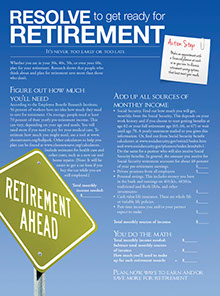
    Whether you are in your 30s, 40s, 50s, or even your 60s, plan for your retirement. Research shows that people who think about and plan for retirement save more than those who don’t.

    Add up all sources of monthly income.

    *  Social Security. Find out how much you will get, monthly, from the Social Security. This depends on your work history and if you choose to start getting benefits at age 62 or your full retirement age (65, 66, or 67) or wait until age 70. A yearly statement mailed to you gives this information. Or, find out from Social Security benefit calculators atwww.socialsecurity.gov/retire2/index.htmandwww.socialsecurity.gov/planners/index.htm#a0=1. Do the same for a partner who will also receive Social Security benefits. In general, the amount you receive for Social Security retirement accounts for about 40 percent of your pre-retirement earnings.  $____

    *  Private pensions from all employers  $____

    *  Personal savings. This includes money you have  in the bank and earnings on 401(k)s, 403(b)s,  traditional and Roth IRAs, and other investments:  $____

    *  Cash value life insurance. These are whole life or variable life policies.  $____

    *  Part-time income you and/or your partner expect to make.   $____

    Total monthly sources of income:   $____

    You do the math:

    Total monthly income needed:  $______

    Subtract total monthly sources of income:  – $______

    How much you’ll need to make up for each retirement month:  = $______

    Plan, now, ways to earn and/or save more for retirement.

    Figure out how much you’ll need.

    According to the Employee Benefit Research Institute, 56 percent of workers have no idea how much they need to save for retirement. On average, people need at least 70 percent of their yearly pre-retirement income. This can vary, depending on your age and needs. You will need more if you need to pay for your medical care. To estimate how much you might need, use a tool atwww.choosetosave.org/ballpark. Other calculators to help you plan can be found atwww.choosetosave.org/calculators. Include estimates for health care and other costs, such as a new car and home repairs. {Note: It will be easier to get a car loan if you buy the car while you are still employed.}

    Total monthly income needed:  $____

    Action Step

    Make an appointment with a financial planner at work or on your own to discuss retirement saving options that best meet your needs.

    Ways to Well-Being book by the American Institute for Preventive Medicine. www.HealthyLife.com. All rights reserved.

    © American Institute for Preventive Medicine
  • Be Kind To Your Voice

    WORK LIFE

    Man smiling.

    Your voice is unique to you. You probably use it every day for work. But do you give it the TLC it needs to stay healthy and clear?

    Do you have a job where you use your voice often?

    Attorneys, teachers, sales people, human resources and customer service rely heavily on their voice for work.

    If you need your voice for work, avoid misusing it. If you misuse it, you may lose it!

    You can overuse or misuse your voice by talking in a large meeting room or noisy place by shouting or talking for long periods. You may have a sore throat or hoarseness afterward.

    Prepare your voice for long talks or loud meetings.

    Before a presentation or meeting, get plenty of rest. Drink water before, during and after your meeting. Use throat lozenges if needed. Use a microphone to help you avoid shouting.

    © American Institute for Preventive Medicine

  • Medical Loans: The Good, Bad, And The Alternatives

    FINANCIAL HEALTH

    Wallet with stethoscope.

    A medical loan is a specific type of personal loan that can only be used to cover healthcare expenses. For people facing significant out-of-pocket medical expenses, this type of loan can seem ideal. However, there are a few things you should know.

    The Good

    *  No collateral is required to secure the loan.

    *  Can be easy to qualify for if you have good credit.

    *  Enables you to undergo elective procedures quickly.

    The Bad

    *  Hard to get if you have poor credit.

    *  High interest rates can mean a very high monthly payment.

    *  May involve expensive initiation fees upfront.

    The Alternatives

    *  Talk to your doctor’s office or hospital about a payment plan.

    *  Find help through a medical charity or hospital program.

    *  Talk to your doctor about cost-effective treatment options.

    © American Institute for Preventive Medicine

  • 4 Financial Health Steps

    Financial Health

    Couple going over finances.

    1.  Track your monthly expenses.

    –  List fixed costs. These include mortgage or rent, car payment, phones and child care.

    –  List costs that vary, such as clothing, eating out, personal care, and entertainment.

    2.  Make and follow a plan to pay down debt. Do this on your own or with professional help.

    3.  Plan a budget. From your net income, aim for:

    –  50% for basics (house, food, transportation)

    –  30% for lifestyle choices (hobbies, phone and cable, personal care, pets, eating out)

    –  20% for short-term savings and retirement

    4.  Get tools to help you manage your financial health frommymoney.gov.

    Take Action: Keep Your Numbers Safe

    1.  Protect your bank account, credit card, driver’s license, social security, and other personal ID numbers.

    2.  Use secure websites, passwords, and PIN numbers. Change passwords often, using upper and lower case numbers and symbols. Consider using multi-factor authentication (MFA). This is an added layer of security to your information where a system requires you to present a combination of two or more credentials to verify your identity.

    ays to Well-Being book by the American Institute for Preventive Medicine. www.HealthyLife.com. All rights reserved.

    © American Institute for Preventive Medicine

  • Save For More Than Just A Rainy Day

    Financial Health

    Invest in your future.

    Money doesn’t grow on trees, but it can grow when you save and invest it wisely. First, identify what you want to save for:

    *  Emergency funds? (Plan for three to six months of expenses.) Holiday expenses? Vacations? A house? College for your kids? Retirement?

    *  Rank order your goals.

    Invest, but do not put all your eggs in one basket.

    Diversify with stocks, bonds, mutual funds, IRAs, real estate, and commodities, such as gold and silver. Find out more about investing fromwww.mymoney.gov. Things you can do on your own:

    *  If your employer has a retirement plan, such as a 401(k), have as much deducted from your pay as possible, especially if your employer matches some or all of the amount you contribute.

    *  Get resources on planning for retirement and long-term care fromwww.csrees.usda.gov/fsll.

    *  Check out “529” prepaid tuition and savings plans for college fromwww.collegesavings.org. These offer tax-saving advantages.

    *  Get professional investment advice from employer sponsored programs or from your financial planner. Find a certified professional from the Association for Financial Counseling and Planning Education atwww.afcpe.org.

    Revisit your budget:

    *  Pay off credit card or high interest debts first. Then use some or all of the payment money for your savings plan.

    *  Put aside whatever you can in savings accounts, checking accounts, and certificates of deposit.

    *  Look for additional ways to save fromhttp://investor.gov/sites/default/files/Saving-and-Investing.pdf

    *  Decide the best ways you are likely to save money.

    – Have your paycheck automatically deposited in your bank and have some go directly into one or more savings accounts.

    – Save money you get from tax refunds, work bonuses, and extra income.

    Action Step

    Beware of investments that promise high returns with little or no risk. If it sounds too good to be true, it usually is.

    Ways to Well-Being. Published by the American Institute for Preventive Medicine.

    © American Institute for Preventive Medicine

  • Be More Tech-Savvy

    WORK LIFE

    Man on laptop with thumbs up.

    Keeping up with the latest technology can be daunting. Being tech-savvy means being proficient in the use of technology, especially computers.

    While you may not need to be able to write complex codes, feeling confident and comfortable with modern technology makes you a valuable employee and helps you connect with family and friends. Here are some easy ways to boost your tech-savvy.

    Google it

    If you don’t know how to use a platform, software, or device, use a search engine like Google. The answer to most questions can be found online if you’re willing to take the time. Be as specific with your search terms as possible to find the best answer.

    Search YouTube

    A video with step-by-step instructions will get you in the know fast. There are videos out there on most devices, apps, programs, and even video games. Not all videos are equal, so take a few minutes to find one that provides the information you need.

    Take a class at the library

    Your local library likely offers classes that provide hands-on instruction on many new forms of technology. Plus, you get to learn in a supportive environment with others committed to broadening their horizons.

    Troubleshoot

    Impatience and frustration are barriers to learning. Take the time to explore new technology with a mindset of curiosity. Slow down and see what you can learn by clicking through menus and using the “help” function.

    Learn about cyber security

    Anyone who uses modern technology needs to know how to keep their personal information safe online. Password managers, updated software, and email security are some of the most essential tech-savvy tools out there.

    Update your technology

    While you don’t need to jump on every new gadget or device available, keeping your technology current will naturally keep you up-to-date. Newer technology is more user-friendly and offers a chance to gain new skills.

    © American Institute for Preventive Medicine

  • Own Your Work From Home

    WORK LIFE

    Man working on laptop.

    Are you working from home or considering doing so? While working from home has advantages, it can also be a challenge. Set yourself up for success with these tips.

    Talk with your supervisor.

    Be sure you know what your supervisor wants you to get done each day. If you don’t know, ask.

    Keep in touch with others.

    Maintain contact with your peers, colleagues and/or customers. Check in with them often. Don’t allow yourself to “fall of the radar.”

    Have a space for work.

    A desk or table for your computer and papers is important. Don’t simply use a bed or couch.

    © American Institute for Preventive Medicine

  • Aim High For Your Career Well-Being

    Work Life

    Man reaching out his hand.

    *  “Career” includes your line of work and how you spend non-work hours.

    *  Choose career goals that suit your personality, skills, talents, and interests.

    *  Take education and training steps needed to achieve your goals. Gain experience as a volunteer.

    *  Find your passion in life. Do something you enjoy every day, week, or month.

    Dos

    *  Do the work you love and work at loving what you do.

    *  Be with people who understand the challenges you face to reach your goals.

    Don’ts

    *  Don’t get stuck in the same routines that prevent you from pursuing your goals.

    *  Don’t spend time with friends and coworkers who criticize your values and interests.

    ays to Well-Being book by the American Institute for Preventive Medicine. www.HealthyLife.com. All rights reserved.

    © American Institute for Preventive Medicine