Tag: Financial Wellness

  • Talk Smart About Finances

    FINANCIAL HEALTH

    Image of young couple with laptop and piggy bank.

    Economic flux hurts more than our wallets. Financial woes can lead to emotionally damaging arguments among couples and put unnecessary strain on the family, said Josh Klapow, PhD, a clinical psychologist and professor at the University of Alabama at Birmingham. Dr. Klapow is the author of Living Smart:  5 Essential Skills to Change Your Health Habits Forever.

    He said financial discussions, and even disagreements, can have a positive impact on families struggling through uncertainty. The key is to make those discussions productive, not destructive. Dr. Klapow offers 5 talking tips:

    1.Keep a cool head.When your emotions are high-be it anger, sadness, frustration-thoughts get cloudy. Relax, breathe, wait 2-10 minutes, then start to talk.

    2.Start easy.Arguments often start because of a critical remark or an angry tone. Try to bring up problems and mistakes gently and without blame.

    3.Don’t assume.Talk about your feelings, not what you think your spouse or partner is feeling. Describe your feelings in first person with “I” and explain why.

    4.Think then speak.The goal of the conversation should be to problem-solve, not to win. Remember, once the words are out, you cannot take them back.

    5.Repair and recover.Don’t let the discussion get out of control. End on a positive, or at least neutral, note. Lean on patience, change the topic, or offer a positive comment to let the other person know you’re part of the same team.

    © American Institute for Preventive Medicine

  • 6 Ways To Boost Productivity

    WORK LIFE

    Three co-workers sitting at table working.

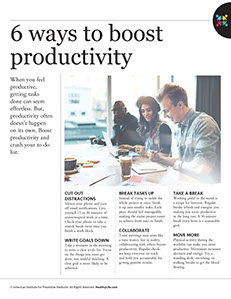
    When you feel productive, getting tasks done can seem effortless. But, productivity often doesn’t happen on its own. Boost productivity and crush your to-do list.

    Cut out distractions

    Silence your phone and turn off email notifications. Give yourself 15 to 30 minutes of uninterrupted work at a time. Check your phone or take a stretch break every time you finish a work block.

    Write goals down

    Take a moment in the morning to write a clear to-do list. Focus on the things you must get done, not wishful thinking. A clear goal is more likely to be achieved.

    Break tasks up

    Instead of trying to tackle the whole project at once, break it up into smaller tasks. Each piece should feel manageable, making the entire project easier to achieve from start to finish.

    Collaborate

    Team meetings may seem like a time-waster, but in reality, collaborating with others boosts productivity. Regular check-ins keep everyone on track and hold you accountable for getting positive results.

    Take a break

    Working pedal to the metal is a recipe for burnout. Regular breaks refresh and energize you making you more productive in the long run. A 10-minute break every hour is a reasonable goal.

    Move more

    Physical activity during the workday can make you more productive. Movement increases alertness and energy. Try a standing desk, stretching, or walking breaks to get the blood flowing.

    © American Institute for Preventive Medicine
  • Are You Addicted To Shopping?

    WELL-BEING

    Image of couple holding shopping bags.

    Whether you like to look at clothing, housewares, tools, or electronics, shopping is a favorite pastime for many people. As the holidays approach, shopping becomes even more popular. Big sales, special deals, and promotions all seek to get more people to buy, buy, buy.

    But for some people, shopping is more than just fun around the holidays. It can actually be an addiction, according to the National Institute on Alcohol Abuse and Alcoholism.

    Signs of Shopping Addiction

    Many people think addiction is only for drugs and alcohol. But many behaviors including shopping can become an addiction. Access to online shopping can make the problem worse. You can buy whatever you want from the privacy of your home and just a few mouse clicks.

    It can be difficult to know if you just like to shop, or if it’s really a problem. If three or more of these statements apply to you, you may be addicted to shopping:

    *  You frequently buy things you don’t need.

    *  You have many unopened packages of items or clothing with the tags still on.

    *  You purchase things you can’t afford by using credit cards.

    *  You hide your purchases from your spouse or family.

    *  You feel a strong need to shop when you’re sad, angry, or anxious.

    *  You have secret credit cards or open new cards when others ones are maxed out.

    *  You think obsessively about shopping and money.

    *  You buy much more than planned, and feel guilty or ashamed afterward.

    *  Your relationships with family or friends have been affected by your shopping.

    © American Institute for Preventive Medicine

  • How To Make The Most Of Your Lunch Break

    WORK LIFE

    Image of co-workers having lunch.

    It can be tempting to skip your lunch break if you’re swamped. But taking a midday break can renew your energy and productivity through the afternoon and into the evening. Try these tips to make the most of your break:

    *Plan your afternoon.If you’re stressed about work, make a quick list of what you want to accomplish. If there’s too much to do and not enough time, determine which things are top priority and which can wait.

    *Get up from your workspace.A change of scenery can refresh you, even if it’s only for a few minutes. Staying in the same place all day can leave you feeling burned out.

    *Stop thinking about work.Take a few moments, if you can, to take a deep breath and do something you enjoy. That might be listening to a song, a quick walk outside, or having lunch with a friend.

    Lunch break naps: good or bad?

    If you get a 30 or 60 minute lunch break, should you nap during this time? The National Sleep Foundation says you can consider it. Be sure you:

    *  Keep the midday nap to 20 minutes or less.

    *  Keep it early in the day. Late afternoon or early evening naps could make it hard to fall asleep at night.

    If you find that napping interferes with your nighttime sleep, skip it. It’s more important to get good sleep at night.

    © American Institute for Preventive Medicine

  • Questions To Ask Before Choosing A Financial Planner

    FINANCIAL HEALTH

    Image of women writing different types of investments.

    1. How are you paid? Is it by a fee and commission? Do you fully disclose the fees and the commissions you earn on every investment you make or service you offer? If paid by fees, what is the average fee your clients pay?

    2. How many years have you been in the business? How long have you been a financial planner?

    3. Can you give me some references of people you have worked with for more than two years?

    4. What is your typical client like? Income levels, issues, investment amounts?

    5. What training did you have to be a planner? What requirements were needed to attain this degree or title?

    6. How many hours of continuing education must you have to keep your degree/designation?

    7. What does a completed financial plan look like?

    8. What is the most important difference your work made in someone’s life?

    9. How many clients do you have?

    10. How many support staff do you have? What are their credentials?

    11. Do you have a privacy statement?  May I have a copy?

    12. Is there an agreement among you and your staff to keep information confidential? Have there ever been any violations of that agreement?

    13. Do you have a copy of your Form ADV (a required disclosure form from the securities authorities)? Have you been responsible for any securities violations?

    14. Do you have a formal contract to define the responsibilities of the clients and those of the planners? Does it also address a protocol to settle differences and to terminate the relationship? How long does the contract last?

    Answers you will get to these questions can vary suggests Lynn S. Evans, CFP, author of Power of the Purse: Fear-Free Finances for Baby Boomer Women. You may have other questions that are important to you. Examples include if the offices are nearby and if you can communicate by email).

    A question regarding the planner’s investment performance is absent. For good reason: the planner’s average return on an investment is not the key to his or her success. The ability to meet the clients’ goals is what really counts.

    Lost without cyberspace?

    What if you couldn’t get a Wi-Fi signal on your smartphone? How anxious would you be if you forgot your phone or lost it? Worry about not being able to see instant news and weather? Or freak about a low battery? If you say yes, you may be a nomophobe (that’s having no mobile phone phobia), according to Iowa State University researchers, in the journal Computers in Human Behavior. Take the 20-question test and judge for yourself atwww.news.iastate.edu/news/2015/08/26/nomophobia. It’s not an addiction but an obsession, they say.

    © American Institute for Preventive Medicine

  • Teaching Kids To Manage Money

    FINANCIAL HEALTH

    Image of boy holding money in one hand and thumbs up with the other hand.

    Good money management habits start early. In fact, even preschool age children can begin to learn about money and how to use it responsibly. Parents and caregivers have the power to teach children about proper spending, saving and sharing from a young age.

    Preschool age

    *  Use play money to “buy” items.

    *  Teach children about work. Tell them how your job helps you pay for things like food and clothes.

    *  Take them to the grocery store and talk about what items cost.

    *  If children get money for a birthday or holiday, have them put it in their piggy bank instead of spending it right away.

    School age

    *  Discuss the prices of items while shopping. Show your kids your shopping receipts and explain how much items cost.

    *  Have kids help you clip coupons and talk about how much you can save.

    *  Open a savings account for your child.

    *  Consider giving an allowance for chores. Talk to them about saving their allowance to buy something later, rather than spending it all now.

    Teenagers

    *  Show your teen how to balance a checkbook.

    *  Discuss responsible credit card spending and avoiding credit card debt.

    *  If your teen has a job, talk about taxes and help them fill out their income tax form.

    *  Explain how automobile and health insurance works.

    Don’t feel pressured to give your child a complete course in finances. Children learn by watching others, so setting a positive example for spending and saving is a great way to teach.

    Source: University of Minnesota Extension

    © American Institute for Preventive Medicine

  • An Annual Financial Review

    FINANCIAL HEALTH

    Women writing on paper with laptop next to her.

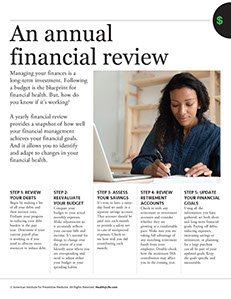
    Managing your finances is a long-term investment. Following a budget is the blueprint for financial health. But, how do you know if it’s working?

    A yearly financial review provides a snapshot of how well your financial management achieves your financial goals. And it allows you to identify and adapt to changes in your financial health.

    Step 1: Review your debts

    Begin by making a list of all your debts and their interest rates. Evaluate your progress in reducing your debt burden in the past year. Determine if your current payoff plan is working or if you need to allocate more resources to reduce debt.

    Step 2: Reevaluate your budget

    Compare your budget to your actual monthly expenses. Make adjustments so it accurately reflects your current bills and income. It’s normal for things to change over the course of a year. Identify areas where you are overspending and need to adjust either your budget or your spending habits.

    Step 3: Assess your savings

    It’s wise to have a rainy-day fund set aside in a separate savings account. That account should be paid into each month to provide a safety net in case of unexpected expenses. Check to see how well you did contributing each month.

    Step 4: Review retirement accounts

    Check in with any retirement or investment accounts and consider whether they are growing at a comfortable pace. Make sure you are taking full advantage of any matching retirement funds from your employer. Double-check how the maximum IRA contribution may affect you in the coming year.

    Step 5: Update your financial goals

    Using all the information you have gathered, set both short and long-term financial goals. Paying off debts, reducing expenses, increasing savings or retirement, or planning for a large purchase can all be part of your updated goals. Keep the goals specific and measurable.

    © American Institute for Preventive Medicine

  • Are You Driving Yourself To Burnout?

    SUCCESS OVER STRESS

    Image of elevated train and cars on road.

    Commuting length, distance, and means are stress factors that can lead to burnout, said Annie Barreck of the University of Montreal’s School of Industrial Relations.

    By car:

    No surprises: the bigger the city, the more stressful the commute, at least for people traveling by car. Passengers are more likely to be stressed out than drivers because carpooling reduces the passenger commuters’ sense of control, which causes them more stress before they’ve even arrived at work.

    By public transit:

    People with long commutes from rural areas via bus or train connections are stressed about uncontrollable delays. The stress carries over into the workplace. But transit users in major urban areas are less likely to have symptoms of burnout.

    By bike or on foot:

    Biking is also a mixed bag that is determined by the area the commuter is working in. Commuting by bike in the suburbs is more stressful than biking in the city where cyclists and walkers have access to safety features such as cycle paths and pedestrian crossings, which increase their sense of control over their commute.

    Study findings show that the risk of burnout increases significantly when a commute lasts more than 20 minutes. Above 35 minutes, all employees are at increased risk of cynicism toward their job. Barreck believes this should lead employers to adopt flexible commuting arrangements.

    © American Institute for Preventive Medicine

  • How To Reduce Stress At Work

    WORK LIFE

    Image of smiling employee.

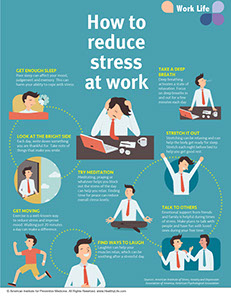
    Get enough sleep:Poor sleep can affect your mood, judgement and memory. This can harm your ability to cope with stress.

    Look at the bright side:Each day, write down something you are thankful for. Take note of things that make you smile.

    Get moving:Exercise is a well-known way to reduce stress and improve mood. Walking just 20 minutes a day can make a difference.

    Try meditation:Meditating, praying or whatever helps you block out the stress of the day can help you relax. Finding time for peace can reduce overall stress levels.

    Find ways to laugh:Laughter can help your muscles relax, which can be soothing after a stressful day.

    Take a deep breath:Deep breathing activates a state of relaxation. Focus on deep breaths in and out for a few minutes each day.

    Stretch it out:Stretching can be relaxing and can help the body get ready for sleep. Stretch each night before bed to help you get good rest.

    Talk to others:Emotional support from friends and family is helpful during times of stress. Make plans to talk with people and have fun with loved ones during your free time.

    Sources: American Institute of Stress, Anxiety and Depression Association of America, American Psychological Association

    © American Institute for Preventive Medicine

  • Recognize And Treat Early Signs Of Burnout

    SUCCESS OVER STRESS

    Image of business man with a notebook over his head.

    Burnout isn’t something that happens overnight. It occurs over time from repeated and unresolved frustration or constant pressure to perform or achieve. With burnout, you feel exhausted, worn out, and detached from others. You feel as if you have nothing more to give and simply do not care about anything. Burnout puts your job, your relationships and your health in jeopardy.

    Signs on the road to burnout

    *  Too much work, not enough relaxation

    *  Feeling as if you have no control over your job

    *  Anger

    *  Fatigue

    *  Sleep problems

    *  Escaping through alcohol, drugs, TV, eating or gambling

    *  Avoiding making decisions

    *  Negative view of yourself and the world

    Also, some traits increase the risk for burnout. These include the need to be in control, wanting everything to be perfect and being a workaholic.

    Ten tips to prevent burnout

    1. Set career and personal goals that can be achieved.

    2. Follow healthy eating and sleeping habits.

    3. Exercise daily – At least 30 minutes most days of the week.

    4. Try not to spread yourself too thin. Delegate tasks at work and at home.

    5. Reduce long work or study hours, if you can. The more you do and the less you rest, the more likely burnout will occur.

    6. Take regular five to 10 minute relaxation breaks. Take mental breaks from stressful situations, too.

    7. Make time for leisure activities that you enjoy and look forward to.

    8. Get creative with a hobby or activity that has nothing to do with work.

    9. Manage stress through meditation, yoga, or therapy.

    10. Plan a vacation one or more times a year. Leave your work at home!

    Discuss feelings and problems you are having with your family, friends, and coworkers. Talking helps ease feelings of frustration that can feed burnout. It things do not get better seek professional help.

    © American Institute for Preventive Medicine