Tag: Financial Wellness

  • The Right Work Posture For You

    WORK LIFE

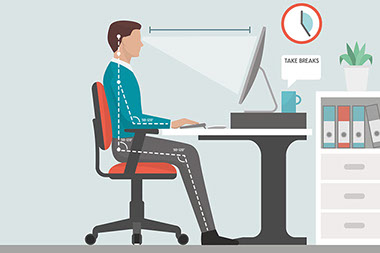
    Illustration of correct posture while sitting at a desk.

    Many people sit at a computer as part of their daily job. If a chair, desk or workstation isn’t working for you, it can cause sore muscles and joints and even an injury. To stay safe and healthy at the computer, follow these ergonomics guidelines.

    Remember to get up and move whenever possible! A walk during your lunch break, taking the stairs or doing stretches at your desk can help you feel energized and burn a few extra calories. Look for ways to get your body moving, even if it’s only for five to 10 minutes. A little exercise is better than none at all.

    Monitor:Monitor should be at eye level or slightly below. Monitor to eye distance:  20 to 40 inches

    Arms:Armrests should allow shoulders to relax. Elbows should be close to the body. Minimal bend at the wrist.

    Chair:Backrest should conform to the spine. Chair should have lumbar (lower back) support.

    Legs:Thighs parallel to the floor.

    Feet:Feet should be flat on the floor. Use a footrest if needed.

    Take breaks:Every 20-25 minutes

    Source: Occupational Safety and Health Administration

    © American Institute for Preventive Medicine

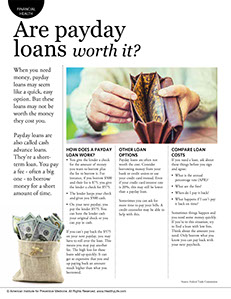
  • Are Payday Loans Worth It?

    FINANCIAL HEALTH

    Person holding open empty wallet.

    When you need money, payday loans may seem like a quick, easy option. But these loans may not be worth the money they cost you.

    Payday loans are also called cash advance loans. They’re a short-term loan. You pay a fee – often a big one – to borrow money for a short amount of time.

    How does a payday loan work?

    *  You give the lender a check for the amount of money you want to borrow plus the fee to borrow it. For instance, if you borrow $500 and their fee is $75, you give the lender a check for $575.

    *  The lender keeps your check and gives you $500 cash.

    *  On your next payday, you pay the lender $575. You can have the lender cash your original check or you can pay in cash.

    If you can’t pay back the $575 on your next payday, you may have to roll over the loan. This means you may pay another fee. The high fees for these loans add up quickly. It can get so expensive that you end up paying back an amount much higher than what you borrowed.

    Other loan options

    Payday loans are often not worth the cost. Consider borrowing money from your bank or credit union or use your credit card instead. Even if your credit card interest rate is 20%, this may still be lower than a payday loan.

    Sometimes you can ask for more time to pay your bills. A credit counselor may be able to help with this.

    Compare loan costs

    If you need a loan, ask about these things before you sign and agree:

    *  What is the annual percentage rate (APR)?

    *  What are the fees?

    *  When do I pay it back?

    *  What happens if I can’t pay it back on time?

    Sometimes things happen and you need some money quickly. If you’re in this situation, try to find a loan with low fees. Think about the amount you need. Only borrow what you know you can pay back with your next paycheck.

    Source: Federal Trade Commission

    © American Institute for Preventive Medicine

  • Avoid The Aches And Pains Of Technology

    SELF-CARE CORNER

    Image of business man with laptop and smart phone.

    You can prevent BlackBerry thumb and text neck-new ailments that came with devices such as smartphones and BlackBerries and their small keyboards, advises the American Chiropractic Association.

    *  Avoid typing for more than 3 minutes without a break.

    *  Keep messages short and simple; abbreviate.

    *  Practice using other fingers for typing, especially when thumbs hurt.

    *  Don’t slouch when texting.

    *  Keep wrists upright, straight and close to the body when holding a device.

    *  Don’t bend your neck excessively when texting; tuck your chin in instead and look down.

    *  Turn your devices off on the weekends (or at least on Sunday).

    *  Get outside, exercise and enjoy nature too. Balance is key to staying healthy.

    For more tips on proper use of technology and good health, visitwww.TechnoHealthy.com.

    © American Institute for Preventive Medicine

  • How To Set Up An Emergency Fund

    FINANCIAL HEALTH

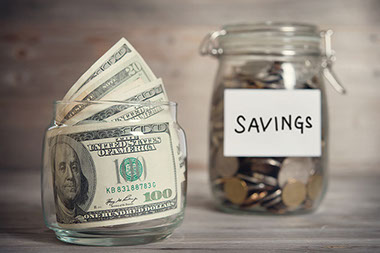
    Image of money in savings jar.

    An emergency fund is a great way to save yourself from financial disaster. It gives you peace of mind when unexpected expenses come up. And, it may help keep you out of debt when you need extra money for an emergency. People who don’t have emergency funds may have to turn to high-interest loans or more credit card debt.

    It can be difficult to set money aside when it’s being used for other day-to-day things. But, it is possible to do with a little discipline and planning. Here’s how:

    *Make it automatic.Have some money automatically put in a separate account with each paycheck. Even if the amount is small, it can add up over time. An automatic transfer is more convenient than doing it yourself. You may find that after a while, you don’t miss that extra money. You learn to get by without it.

    *Make it a priority.Pay your emergency fund first, before you use your paycheck for non-necessary items. Make a budget that doesn’t include your emergency money. This will ensure your bills and other necessities get paid without skipping your emergency fund payment.

    *Use a bank or credit union savings account.These are easier to access in an emergency than savings bonds, mutual funds or certificates of deposit (CDs). But, don’t put it in your regular checking account, where you may be tempted to use it for a non-emergency.

    *Keep the account totally separate.Make sure that account is for emergencies only. Make it a savings account instead of checking. Be sure the account doesn’t include fees or penalties.

    *“Do I need this?”Cover your credit card with a savings message to reduce non-essential spending.

    Creative ways to save

    Think of little ways you can change your daily routine to save money. You’ll be surprised how much you can save!

    Put away $.50 a day in loose change.

    Monthly savings: $15

    Yearly savings: $180

    Skip the coffee out and bring your own from home.

    Monthly savings: $80

    Yearly savings: $960

    Bring your own lunch 3 days a week instead of eating out.

    Monthly savings: $96

    Yearly savings: $1,152

    Eat dinner at home 2 more times per month.

    Monthly savings: $40-80

    Yearly savings: $480-960

    Source: Consumer Federation of America

    © American Institute for Preventive Medicine

  • Retirement: How Are You Going To Do That?

    FINANCIAL HEALTH

    Image of middle-aged women.

    A secure and worry-free retirement is a cherished dream for millions of us. What will it take for you to achieve that dream? The experts say –

    Save more than you think.Most people have not tried to estimate how much money they will need for retirement. And those who have, usually underestimate the amount they need.

    Know when you will retire.Many working Americans will retire before they expect to, and before they’re ready.

    Plan to live a long life and spend accordingly.Some retirees will live well beyond their life expectancy, with a great risk of outliving their savings.

    Face facts about long-term care.Many people underestimate their chances of needing long-term care. Explore lower-cost plans now.

    Understand your options.Should you take a pension in a lump sum or as a lifetime annuity? Talk with a financial planner (and your doctor) to decide the best option for you.

    Understand your investments.Due to the growth of workplace retirement savings plans, employees are now managing investments for retirement. Need help? Get it from a trusted financial adviser.

    Seek sound advice.Many retirees and pre-retirees do not seek the help of a “qualified professional.” Yet they indicate a strong desire to work with one.

    Know where your retirement income is coming from.You may be disappointed in retirement if you try to live on the income that’s available.

    Deal with inflation.Inflation is a fact of life. After retirement, you won’t be getting pay increases.

    Provide for a surviving spouse.Many married couples fail to plan for the eventual death of one spouse before the other. This can have serious consequences, especially when the survivor is the wife.

    Source: Report from LIMRA International, the Society of Actuaries and Matthew Greenwald & Associates, with research sponsored by the Society of Actuaries Committee on Post-Retirement Needs and Risks

    © American Institute for Preventive Medicine

  • Thinking About A New Job?

    WORK LIFE

    Concept image of women writing a career outline.

    Boredom. Anxiety. Restlessness. If these terms describe your feelings at work, don’t be afraid to make a change, said Amy Gregor, coordinator of career services at Indiana University.

    “Career change is a natural life progression. Most studies show that the average job seeker will change careers-not just jobs-several times over the course of his or her lifetime,” she said.

    But before you turn in your resignation, take some time to carefully assess the situation. It is very difficult to find satisfaction if you don’t know what you need. Gregor offers the following suggestions:

    *  Take a hard look. Start with a self-assessment of likes and dislikes about your current position. Are there certain aspects that you do enjoy? Get specific about your list of grievances. Are the hours too long? Are you bored? Is the pay too low? Do you wish you had a healthier balance between work and family life? You might find that some of the negatives can be addressed within your current position. “It is possible that your boss has no idea you are unhappy and would be perfectly willing to change things if you propose a new plan,”  Gregor said.

    *  Bad habits? Certain habits tend to make people unhappy at their jobs regardless of the circumstances. “If you never take a lunch, have poor time management skills, and never use your vacation time, most people will burn out. If you bring that approach to another job or career you may continue to have the same levels of dissatisfaction,” she said.

    *  Don’t put it off. Once you’re certain you need to leave, start taking steps to transition as soon as possible, Gregor said. “Don’t wait until you are at the point where you are so frustrated you’re willing to burn bridges,” she said.

    *  Rediscover your passion. Think of times when you felt most successful. Ask yourself what you really love to do. What do you do for fun? Answering these questions can help you get a sense of what career path to pursue.

    *  Still not sure? “If you’ve analyzed your likes and dislikes, but you’re still not sure what career path to take, consider taking a career assessment. The key is investing in the time to rediscover yourself, and using your self-assessment to steer your new career search,” Gregor said.

    *  Network. Don’t just dive into the help wanted ads. Test the waters by talking with people who work in various career fields. Talk about your dreams. “During this time it may be helpful to talk about your plan with the people you trust most, such as your family, friends, alumni contacts, pastor, trusted counselor, financial advisors, and maybe even your doctor,” Gregor said. “It will be important to gain support during any times of transition.”
    © American Institute for Preventive Medicine

  • Avalanche Your Debt

    FINANCIAL HEALTH

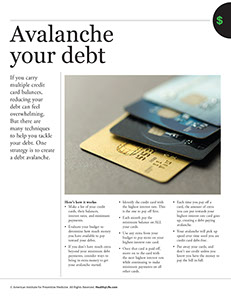
    Four credit cards layed on top of eachother.

    If you carry multiple credit card balances, reducing your debt can feel overwhelming. But there are many techniques to help you tackle your debt. One strategy is to create a debt avalanche.

    Here’s how it works:

    *  Make a list of your credit cards, their balances, interest rates, and minimum payments.

    *  Evaluate your budget to determine how much money you have available to pay toward your debts.

    *  If you don’t have much extra beyond your minimum debt payments, consider ways to bring in extra money to get your avalanche started.

    *  Identify the credit card with the highest interest rate. This is the one to pay off first.

    *  Each month pay the minimum balance on ALL your cards.

    *  Use any extra from your budget to pay more on your highest interest rate card.

    *  Once that card is paid off, move on to the card with the next highest interest rate while continuing to make minimum payments on all other cards.

    *  Each time you pay off a card, the amount of extra you can put towards your highest interest rate card goes up, creating a debt-paying avalanche.

    *  Your avalanche will pick up speed over time until you are credit card debt-free.

    *  Put away your cards, and don’t use credit unless you know you have the money to pay the bill in full.

    © American Institute for Preventive Medicine