Tag: fire

  • Take The Hazard Out Of Halloween

    Child Safety

    Image of children in halloween customs.

    Dressing up to go trick-or-treating is a traditional childhood ritual. But wandering the streets in the dark dressed in bizarre costumes and knocking on strangers’ doors to ask for food can pose hazards. To be sure your children have a Halloween that’s fun and safe, take these precautions.

    *  Choose white or bright costumes, preferably of flame-retardant fabric and marked with reflective tape.

    *  Be sure a costume is short enough so that your child won’t trip.

    *  Don’t let your trick-or-treaters wear masks, which can interfere with their vision. Instead, apply makeup to their faces.

    *  Trick-or-treaters should carry flashlights, not candles. Small children should be accompanied by an adult.

    *  Avoid trick-or-treating at homes on dark streets or in unfamiliar neighborhoods.

    *  Check all treats before your children eat them. Don’t let children eat candy or other treats that aren’t commercially wrapped or look as though they’ve been tampered with.

    *  Keep carved, candlelit pumpkins out of reach of young children. And be sure to set your jack-o’- lantern on a nonflammable surface.

    A Year of Health Hints book by the American Institute for Preventive Medicine. www.HealthyLife.com. All rights reserved.

    © American Institute for Preventive Medicine
  • Know How To Use A Fire Extinguisher

    Home Safety

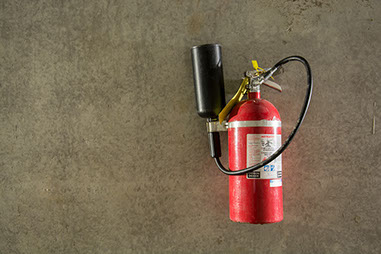
    Image of fire extinguisher.

    Every home should have at least one fire extinguisher. Extinguishers should be mounted in plain sight and be simple for all family members (except small children, of course) to use in an emergency. Show the babysitter how it works, too.

    *  Buy a multipurpose extinguisher rated 2A10BC or higher. The letters indicate the type of fire the extinguisher will douse. “A” units are for combustible materials like paper or wood, “B” units are for flammable liquids like gasoline, and “C” units are for electrical fires. The numbers relate to the size of the fire. The higher the number, the greater the capacity to extinguish that fire.

    *  Check for a UL (Underwriters Laboratory) or FM (Fire Mutual) code. They tell you the product is effective, safe, and reliable.

    *  Be sure the directions are simple to understand. Mount the fire extinguisher securely, in plain sight.

    *  Be sure you understand how the firing mechanism works. Check to see whether you need to push a button or pull a lever. Don’t activate the extinguisher, though. Once you do, it must be serviced and recharged, even if you only use it for a few seconds and the gauge indicates it’s full.

    *  Check the pressure indicator once a month to be sure the extinguisher works.

    To use a fire extinguisher, remember the acronym PASS.

    *  Pull the pin.

    *  Aim the nozzle or barrel at the base of the fire, not at the flames.

    *  Squeeze the handle.

    *  Sweep back and forth at the base of the fire.

    A Year of Health Hints book by the American Institute for Preventive Medicine. www.HealthyLife.com. All rights reserved.

    © American Institute for Preventive Medicine
  • What To Do If Clothing Catches Fire

    Home Safety

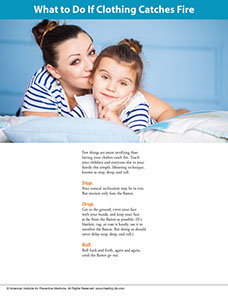
    Image of mother and daughter.

    Few things are more terrifying than having your clothes catch fire. Teach your children and everyone else in your family this simple, lifesaving technique, known as stop, drop, and roll.

    Stop. Your natural inclination may be to run. But motion only fans the flames.

    Drop. Get to the ground, cover your face with your hands, and keep your face as far from the flames as possible. (If a blanket, rug, or coat is handy, use it to smother the flames. But doing so should never delay stop, drop, and roll.)

    Roll. Roll back and forth, again and again, until the flames go out.

    A Year of Health Hints book by the American Institute for Preventive Medicine. www.HealthyLife.com. All rights reserved.

    © American Institute for Preventive Medicine

  • Fire & Burn Awareness

    First Aid

    Dental hygiene products, tooth brush, tooth paste, mouth wash, etc.

    Fires & burns are a leading cause of unintended home injuries & related deaths.

    Every home should have at least one fire extinguisher mounted securely and in plain sight.

    Install smoke detectors. If you use space heaters, keep them 3 feet away from items that can catch fire. Never smoke in bed.

    Loose-fitting clothing can easily catch on fire if it gets too close to burning candles or hot burners.

    If your clothes catch on fire, don’t run. Motion fans the flames. STOP where you are. DROP to the ground. ROLL back and forth, again and again, until the flames go out.

    To use a fire extinguisher, think of the acronym PASS:

    Pull the pin. Aim the nozzle or barrel at the base of the fire, not at the flames. Squeeze the handle. Sweep back and forth at the base of the fire.

    Health at Home Lifetime book by the American Institute for Preventive Medicine. www.HealthyLife.com. All rights reserved.

    © American Institute for Preventive Medicine
  • Prevent Clothes Dryer Fires

    WELL-BEING

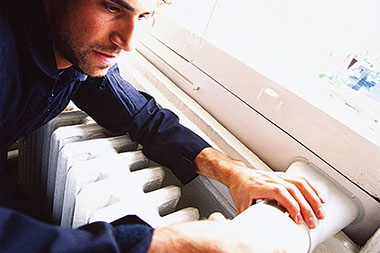
    Image of a man cleaning dryer duct.

    Built-up lint blocks air flow in your clothes dryer, which leads to high heat and a potential fire. Thousands of fires occur each year, according to the U.S. Fire Administration.

    Take these simple steps to keep your home safe:

    *  Clean the lint screen every time you use the dryer.

    *  If you use fabric softener, wash the screen in warm soapy water periodically to get rid of film build-up that restricts air flow.

    *  Make sure the lint screen has no tears (otherwise lint gets into the duct system and restricts air flow).

    *  Inspect the duct, dampers, and access covers for damage every 3 months. Clean all removable parts. Vacuum the duct to remove excess lint build-up.

    Don’t dry items that have been cleaned or soaked in gasoline, dry cleaning solvents, vegetable or cooking oil, machine oil, or other chemicals such as mop heads, which can be explosive when heated.

    © American Institute for Preventive Medicine
  • This Home Fix Can Save Your Life

    WELL-BEING

    Illustration of a house.

    It’s odorless, colorless, and causes lung cancer. You could be breathing it every day and not know it. It’s radon, and it’s a major health threat in nearly all areas of the country.

    What is radon?

    Radon is a naturally occurring gas that is found in soil. It makes its way into buildings through cracks, joints, and gaps in the basement or foundation. Once inside, it can build up and result in dangerously high levels. High levels of radon can cause lung cancer. The Surgeon General has warned that radon is the second leading cause of lung cancer in the U.S. today. Only smoking causes more deaths from lung cancer.

    The CDC estimates that more than 20,000 people die every year from lung cancer caused by radon. Even people who have never smoked can get lung cancer from radon. But, if you smoke, your chance of lung cancer is even higher.

    How do I know if my house has radon?

    The only way to detect radon in your house is through a radon test. Many hardware stores carry these tests, or you can get a test through your state’s radon office. Follow the instructions exactly as listed on the test. The tests are not expensive and are easy to use. Usually you need to leave the test in your house for a set amount of time. Then, you’ll follow instructions to mail it to a lab to get your results.

    No level of radon is safe. But, if your test shows a level of 4 or higher, you need to fix your house.

    How do I get rid of radon?

    There is an effective way to get radon out of your house and keep it from coming back. A radon mitigation system involves putting a special pipe device in your basement. The pipe has a fan inside that blows the radon back outside.

    Every state has radon removal companies who can install these systems. The Environmental Protection Agency says you should use a company that is accredited by the National Radon Safety Board or the National Radon Proficiency Program.

    Radon is one health problem no one should live with. Get a radon testing kit today. Your health and life are worth it.

    Take action against radon

    To order a radon test kit, call: 1-800-SOS-RADON

    (1-800-767-7236)

    For answers to radon questions, call: 1-800-55-RADON (557-2366)

    For questions about fixing radon levels in your house, call: 1-800-644-6999.

    © American Institute for Preventive Medicine