Tag: First Aid

  • First Aid Kits: Stay Up To Date

    SELF-CARE CORNER

    Women helping wrap man's foot and ankle with sprain wrap.

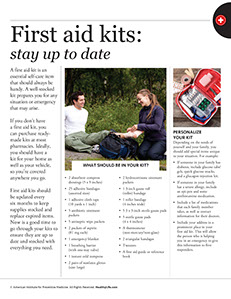
    A first aid kit is an essential self-care item that should always be handy. A well-stocked kit prepares you for any situation or emergency that may arise.

    If you don’t have a first aid kit, you can purchase ready-made kits at most pharmacies. Ideally, you should have a kit for your home as well as your vehicle, so you’re covered anywhere you go.

    First aid kits should be updated every six months to keep supplies stocked and replace expired items. Now is a good time to go through your kits to ensure they are up to date and stocked with everything you need.

    What should be in your kit?

    *  2 absorbent compress dressings (5 x 9 inches)

    *  25 adhesive bandages (assorted sizes)

    *  1 adhesive cloth tape (10 yards x 1 inch)

    *  5 antibiotic ointment packets

    *  5 antiseptic wipe packets

    *  2 packets of aspirin (81 mg each)

    *  1 emergency blanket

    *  1 breathing barrier (with one-way valve)

    *  1 instant cold compress

    *  2 pairs of nonlatex gloves (size: large)

    *  2 hydrocortisone ointment packets

    *  1 3-inch gauze roll (roller) bandage

    *  1 roller bandage (4 inches wide)

    *  5 3 x 3-inch sterile gauze pads

    *  5 sterile gauze pads (4 x 4 inches)

    *  A thermometer (non-mercury/non-glass)

    *  2 triangular bandages

    *  Tweezers

    *  A first aid guide or reference book

    Personalize your kit

    Depending on the needs of yourself and your family, you should add special items unique to your situation. For example:

    *  If someone in your family has diabetes, include glucose tabs/gels, quick glucose snacks, and a glucagon injection kit.

    *  If someone in your family has a severe allergy, include an epi-pen and some antihistamine medication.

    *  Include a list of medications that each family member takes, as well as contact information for their doctors.

    *  Include your address in a prominent place in your first aid kit. This will allow the person who is helping you in an emergency to give this information to first responders.

    © American Institute for Preventive Medicine

  • How To Treat Cat & Dog Bites

    SELF-CARE CORNER

    Aggrestive dog barking while owner is holding it back.

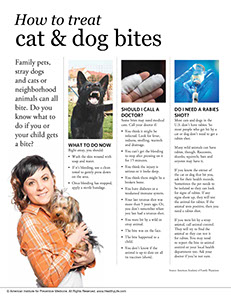
    Family pets, stray dogs and cats or neighborhood animals can all bite. Do you know what to do if you or your child gets a bite?

    What to do now

    Right away, you should:

    *  Wash the skin wound with soap and water.

    *  If it’s bleeding, use a clean towel to gently press down on the area.

    *  Once bleeding has stopped, apply a sterile bandage.

    Should I call a doctor?

    Some bites may need medical care. Call your doctor if:

    *  You think it might be infected. Look for fever, redness, swelling, warmth and drainage.

    *  You can’t get the bleeding to stop after pressing on it for 15 minutes.

    *  You think the injury is serious or it looks deep.

    *  You think there might be a broken bone.

    *  You have diabetes or a weakened immune system.

    *  Your last tetanus shot was more than 5 years ago. Or, you don’t remember when you last had a tetanus shot.

    *  You were bit by a wild or stray animal.

    *  The bite was on the face.

    *  The bite happened to a child.

    *  You don’t know if the animal is up to date on all its vaccines (shots).

    Do I need a rabies shot?

    Most cats and dogs in the U.S. don’t have rabies. So most people who get bit by a cat or dog don’t need to get a rabies shot. Many wild animals can have rabies, though. Raccoons, skunks, squirrels, bats and coyotes may have it.

    If you know the owner of the cat or dog that bit you, ask for their health records. Sometimes the pet needs to be isolated so they can look for signs of rabies. If any signs show up, they will test the animal for rabies. If the animal tests positive, then you need a rabies shot.

    If you were bit by a stray animal, call animal control. They will try to find the animal so they can test it for rabies. You may need to report the bite to animal control or your local health department too. Ask your doctor if you’re not sure.

    Source: American Academy of Family Physicians
    © American Institute for Preventive Medicine

  • Make A Cold Care Kit

    SELF-CARE CORNER

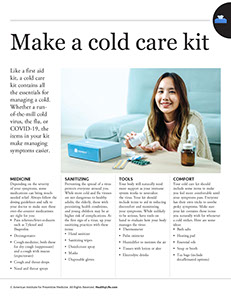
    Women siting at table with a box and medicine.

    Like a first aid kit, a cold care kit contains all the essentials for managing a cold. Whether a run-of-the-mill cold virus, the flu, or COVID-19, the items in your kit make managing symptoms easier.

    Medicine

    Depending on the severity of your symptoms, some medications can bring much-needed relief. Always follow the dosing guidelines and talk to your doctor to make sure these over-the-counter medications are right for you:

    *  Pain relievers/fever-reducers such as Tylenol and Ibuprofen

    *  Decongestants

    *  Cough medicine, both those for dry cough (suppressant) and a cough with mucus (expectorant)

    *  Cough and throat drops

    *  Nasal and throat sprays

    Sanitizing

    Preventing the spread of a virus protects everyone around you. While most cold and flu viruses are not dangerous to healthy adults, the elderly, those with preexisting health conditions, and young children may be at higher risk of complications. At the first sign of a virus, up your sanitizing practices with these items:

    *  Hand sanitizer

    *  Sanitizing wipes

    *  Disinfectant spray

    *  Masks

    *  Disposable gloves

    Tools

    Your body will naturally need more support as your immune system works to neutralize the virus. Your kit should include items to aid in reducing discomfort and monitoring your symptoms. While unlikely to be serious, have tools on hand to evaluate how your body manages the virus:

    *  Thermometer

    *  Pulse oximeter

    *  Humidifier to moisten the air

    *  Tissues with lotion or aloe

    *  Electrolyte drinks

    Comfort

    Your cold care kit should include some items to make you feel more comfortable until your symptoms pass. Everyone has their own tricks to soothe pesky symptoms. Make sure your kit contains those items you naturally wish for whenever a cold strikes. Here are some ideas:

    *  Bath salts

    *  Heating pad

    *  Essential oils

    *  Soup or broth

    *  Tea bags (include decaffeinated options)

    © American Institute for Preventive Medicine
  • Be Ready To Donate Blood

    WELL-BEING

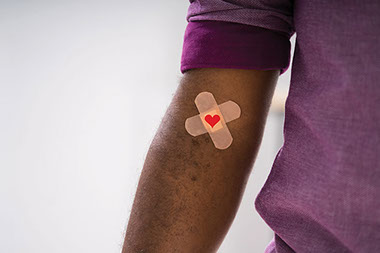
    Arm with bandaid and heart where he gave blood.

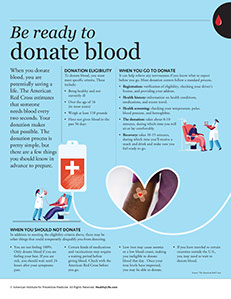
    When you donate blood, you are potentially saving a life. The American Red Cross estimates that someone needs blood every two seconds. Your donation makes that possible. The donation process is pretty simple, but there are a few things you should know in advance to prepare.

    Donation eligibility

    To donate blood, you must meet specific criteria. These include:

    *  Being healthy and not currently ill

    *  Over the age of 16 (in most states)

    *  Weigh at least 110 pounds

    *  Have not given blood in the past 56 days

    When you go to donate

    It can help relieve any nervousness if you know what to expect before you go. Most donation centers follow a standard process.

    *Registration:verification of eligibility, checking your driver’s license, and providing your address.

    *Health history:information on health conditions, medications, and recent travel.

    *Health screening:checking your temperature, pulse, blood pressure, and hemoglobin.

    *The donation:takes about 8-10 minutes, during which time you will sit or lay comfortably.

    *Recovery:takes 10-15 minutes, during which time you’ll receive a snack and drink and make sure you feel ready to go.

    When You Should Not Donate

    In addition to meeting the eligibility criteria above, there may be other things that could temporarily disqualify you from donating.

    *  You are not feeling 100%. Only donate blood if you are feeling your best. If you are sick, you should wait until 24 hours after your symptoms pass.

    *  Certain kinds of medications and vaccinations may require a waiting period before giving blood. Check with the American Red Cross before you go.

    *  Low iron may cause anemia or a low blood count, making you ineligible to donate blood that day. Once your iron levels have improved, you may be able to donate.

    *  If you have traveled to certain countries outside the U.S., you may need to wait to donate blood.

    Source: The American Red Cross

    © American Institute for Preventive Medicine
  • Be Smart About Seizures

    MEDICAL NEWS

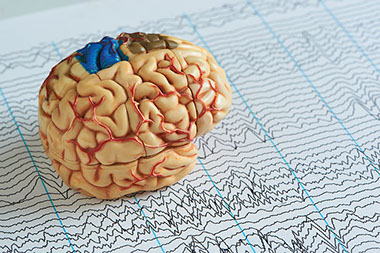
    A brain model.

    A seizure is a sudden surge of electrical activity in the brain. It can cause a person to have uncontrolled movements. A grand mal seizure or tonic-clonic seizure is the most serious. It usually involves jerking movements, shaking and the inability to talk or communicate.

    When it comes to seizures, there are plenty of myths. Knowing the truth about seizures could save someone’s life.

    Myth:A person having a seizure could swallow their tongue.

    Truth:This is not possible. Never put something in a person’s mouth if they are having a seizure.

    Myth:You should hold the person down.

    Truth:Do not try to hold or move the person unless they are in immediate danger of getting hurt. You can help get them on the floor and turn on their side. This keeps the person from injuring themselves or falling.

    Myth:You should always give mouth-to-mouth or CPR during a seizure.

    Truth:People usually start breathing normally after the seizure is over. But if the patient stops breathing for more than 30 seconds, call 911 and begin CPR.

    Should you call 911?

    Call 911 if:

    *  The person has never had a seizure before.

    *  The person stops breathing for more than 30 seconds, or has trouble breathing after the seizure.

    *  The seizure happened in the water.

    *  The person is pregnant.

    *  The person doesn’t wake up after the seizure.

    *  The person has a health condition like heart disease or diabetes.

    *  The seizure lasts longer than five minutes.

    *  The person is hurt.

    Source: Centers for Disease Control and Prevention

    © American Institute for Preventive Medicine
  • Caring For Toe Injuries

    SELF-CARE CORNER

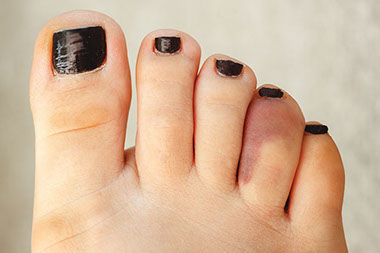
    Close up of injured toe.

    Toes are an important part of walking and balance. And their bones and ligaments are small, so they can be easily injured.

    Many people think doctors won’t do anything about an injured toe. This is not true. A broken or sprained toe may need medical attention. But minor toe injuries may get better with some simple home care.

    What to do if you hurt your toe

    *  If the pain is not severe, try putting ice on it for 10 minutes at a time. Be careful not to get the toe too cold.

    *  If needed, take an over-the-counter pain medicine.

    *  Stay off the foot if possible. Try to elevate it when sitting down.

    *  Look for signs of bruising and swelling, which could mean a possible sprain or broken toe.

    *  If the pain is severe, contact your doctor or seek urgent medical care.

    *  If pain and swelling don’t get better within two days, see a health care provider.

    *  Elevate the affected toe to help with swelling.

    Sprained vs. broken toe

    A sprain means that the ligaments in the toe have been injured. You can usually walk on a sprained toe, but it may still be very sore from swelling and bruising.

    Sprains may happen when you overstretch the toe during sports, running or jumping. “Turf toe” is a sprain of the big toe that is quite common in athletes.

    If you have a broken toe, you may not be able to move the toe or put weight on it. It may have a lot of swelling and bruising. The pain may not get better, even after a couple of days. Broken toes can happen during sports and activities. They also occur with falls and accidents or when you drop something heavy on your foot.

    Should you get medical care?

    Some minor toe injuries can be treated at home. But toe sprains and breaks can be more serious. Don’t ignore toe pain that lasts more than two days. See a health care provider if you think your toe is sprained or broken.

    If you have diabetes

    Always see a health care provider for any kind of foot or toe injury.

    Sources: American College of Foot and Ankle Surgeons, American Podiatric Medical Association

    © American Institute for Preventive Medicine
  • Fire & Burn Awareness

    First Aid

    Dental hygiene products, tooth brush, tooth paste, mouth wash, etc.

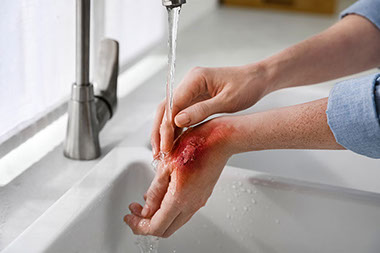
    Fires & burns are a leading cause of unintended home injuries & related deaths.

    Every home should have at least one fire extinguisher mounted securely and in plain sight.

    Install smoke detectors. If you use space heaters, keep them 3 feet away from items that can catch fire. Never smoke in bed.

    Loose-fitting clothing can easily catch on fire if it gets too close to burning candles or hot burners.

    If your clothes catch on fire, don’t run. Motion fans the flames. STOP where you are. DROP to the ground. ROLL back and forth, again and again, until the flames go out.

    To use a fire extinguisher, think of the acronym PASS:

    Pull the pin. Aim the nozzle or barrel at the base of the fire, not at the flames. Squeeze the handle. Sweep back and forth at the base of the fire.

    Health at Home Lifetime book by the American Institute for Preventive Medicine. www.HealthyLife.com. All rights reserved.

    © American Institute for Preventive Medicine
  • Self-Care Medicines & Supplies For Children

    Children’s Health

    Here is a list of medicines and other things you should keep at home.

    *  Store items in a handy, dry place, but out of children’s reach.

    *  Check the expiration dates often. Throw away and replace outdated items.

    *  Find out what kind and how much of each medicine you can give your child. Ask your child’s doctor. Ask the pharmacist. Read and understand the medicine’s label. Brand names are often listed. Store brands are just as good.

    Over-the-Counter Medicines

    *  Acetaminophen. An example is Children’s Tylenol®. Or have ibuprofen. Examples are Children’s Advil® and Children’s Motrin®. Stock the right kind for your child’s weight.

    *  Antihistamine tablets or syrup. An example is Benadryl®.

    *  Cough medicine. Ask your child’s doctor which one(s) you should stock.

    *  Decongestant tablets or liquid. Do not give to children under 2 years old. An example is Dimetapp®.

    Basic Supplies

    *  Antibiotic ointment.

    *  Antiseptic ointment or wipes.

    *  Bandages of different sizes.

    *  Eye dropper.

    *  Medicine spoon & dropper.

    *  Cold pack.

    *  Cotton-tipped swabs.

    *  Elastic wrap and closures.

    *  Flashlight.

    *  Roll of adhesive tape.

    *  Rubbing alcohol.

    *  Sterile gauze pads and a roll of gauze.

    *  Sunscreen with an SPF of 15 or higher.

    *  Thermometer (digital or ear).

    *  Tongue depressor.

    *  Toothache medicine. An example is Anbesol®.

    *  Tweezers.

    *  Vaporizer (cool mist).

    Children's Self-Care book by the American Institute for Preventive Medicine. www.HealthyLife.com. All rights reserved.

    © American Institute for Preventive Medicine

  • First Aid For Choking

    First Aid

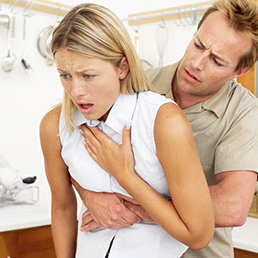
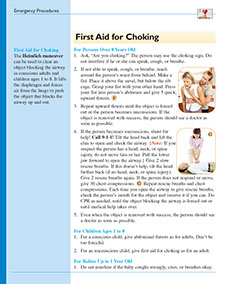
    The Heimlich maneuver can be used to clear an object blocking the airway in conscious adults and children ages 1 to 8. It lifts the diaphragm and forces air from the lungs to push the object that blocks the airway up and out.

    Persons Over 8 Years Old

    1. Ask, “Are you choking?”

    The person may use the choking sign. Do not interfere if he or she can speak, cough, or breathe.

    2. If not able to speak, cough, or breathe, reach around the person’s waist from behind.

    Make a fist. Place it above the navel, but below the rib cage. Grasp your fist with your other hand. Press your fist into person’s abdomen and give 5 quick, upward thrusts. See image A.

    Image of giving a person first aid for choking.

    Image A

    3. Repeat upward thrusts until the object is forced out or the person becomes unconscious.

    If the object is removed with success, the person should see a doctor as soon as possible.

    4. If the person becomes unconscious, shout for help! Call 9-1-1!

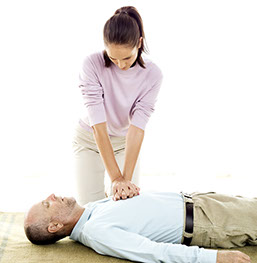
    Tilt the head back and lift the chin to open and check the airway. {Note: If you suspect the person has a head, neck, or spine injury, do not move him or her. Pull the lower jaw forward to open the airway.} Give 2 slow rescue breaths. If this doesn’t help, tilt the head further back (if no head, neck, or spine injury). Give 2 rescue breaths again. If the person does not respond or move, give 30 chest compressions. See image B. Repeat rescue breaths and chest compressions. Each time you open the airway to give rescue breaths, check the person’s mouth for the object and remove it if you can. Do CPR as needed, until the object blocking the airway is forced out or until medical help takes over.

    Image of adult chest compressions.

    Image B

    5. Even when the object is removed with success, the person should see a doctor as soon as possible.

    Children Ages 1 to 8

    1.  For a conscious child, give abdominal thrusts as for adults. Don’t be too forceful.

    2.  For an unconscious child, give first aid for choking as for an adult.

    Babies Up to 1 Year Old

    1.  Do not interfere if the baby coughs strongly, cries, or breathes okay.

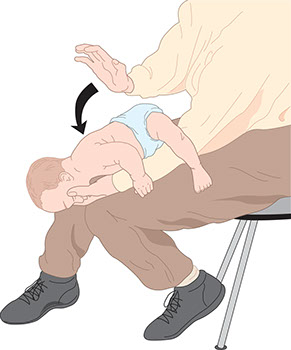
    2.  If the baby is conscious, hold the baby’s head (face down) in one hand. Straddle the baby over your forearm. Rest your forearm on your leg for support. Keep the baby’s head lower than the rest of his or her body.

    3.  With the heel of your free hand, give up to 5 quick, forceful blows on the baby’s back between the shoulder blades. See image C. If the object still blocks the airway, go to step 4.

    4.  Turn the baby over (face up). Cradle the baby on your forearm. Support the head with one hand. Keep the baby’s head lower than the rest of his or her body. Rest your arm on your leg for support. Place 2 fingers 1/2 inch below and in between the nipples on the baby’s chest. Give 5 quick downward thrusts. Depress the sternum about 1-1/2 inches with each thrust.

    5.  Repeat steps 3 and 4 until the object is removed or the baby is unconscious.

    6.  If the baby is unconscious, shout for help. Have someone call 9-1-1! If no one calls 9-1-1, give first aid for 1 minute, stop to call 9-1-1, then resume rescue efforts.

    7.  Put the baby on his/her back. Keep the head tilted back with one hand and give 30 chest compressions using 2 fingers on your other hand. Give 2 slow rescue breaths. If the object is expelled, stop. If not, give cycles of 30 compressions and 2 slow rescue breaths until the object is removed or help arrives.

    8.  Check for and remove the object in the airway, if visible. Repeat steps 7 and 8 as needed.

    9.  Don’t give up! Give CPR until medical help takes over or until the object is removed. Even if it is, get medical care right away.

    Illustration on giving a baby first aid when choking.

    Image C

    Healthier at Home book by the American Institute for Preventive Medicine. www.HealthyLife.com. All rights reserved.

    © American Institute for Preventive Medicine
  • Shock

    First Aid

    Shock occurs when the circulation system fails to send blood to all parts of the body. With shock, blood flow or blood volume is too low to meet the body’s needs. Areas of the body are deprived of oxygen. The result is damage to the limbs, lungs, heart, and brain.

    Signs & Symptoms

    *  Weakness. Trembling.

    *  Feeling restless. Confusion.

    *  Pale or blue-colored lips, skin, and/or fingernails. Cool and moist skin.

    *  Rapid, shallow breathing. Weak, but fast pulse.

    *  Nausea. Vomiting. Extreme thirst.

    *  Enlarged pupils.

    *  Loss of consciousness.

    Causes

    *  A heart attack.

    *  Severe or sudden blood loss from an injury or serious illness. Bleeding can occur inside or outside the body.

    *  A large drop in body fluids, such as following a severe burn.

    Treatment

    Shock requires emergency medical care.

    Questions to Ask

    Self-Care / Prevention

    First Aid for Shock Before Emergency Care

    *  CHECK for a response. Give Rescue Breaths or CPR as needed.

    *  Lay the person flat, face-up, but do not move him or her if you suspect a head, back, or neck injury.

    *  Raise the person’s feet about 12 inches. Use a box, etc. Do not raise the feet or move the legs if hip or leg bones are broken. Keep the person lying flat.

    *  If the person vomits or has trouble breathing, raise him or her to a half-sitting position (if no head, back, or neck injury). Or, turn the person on his or her side to prevent choking.

    *  Loosen tight clothing. Keep the person warm. Cover the person with a coat, blanket, etc.

    *  Monitor for a response. Repeat the steps listed above, as needed.

    *  Do not give any food or liquids. If the person wants water, moisten the lips.

    *  Reassure the person. Make him or her as comfortable as you can.

    Healthier at Home book by the American Institute for Preventive Medicine. www.HealthyLife.com. All rights reserved.

    © American Institute for Preventive Medicine