Tag: First Aid

  • Head/Neck/Spine Injuries

    First Aid

    Signs & Symptoms

    For a Severe Injury

    *  The scalp, neck, or back bleeds.

    *  It looks like the head, neck, or back is in an odd position.

    *  Pain is felt in the back, neck, and/or head. The pain can be severe.

    *  Stiff neck.

    *  Abdominal pain. Vomiting.

    *  Blood or fluid comes from the mouth, nose, or an ear.

    *  Loss of vision. Blurred or double vision. Pupils of uneven size.

    *  Inability to move any part of the body. Weakness in an arm or leg. Walking is difficult.

    *  New feelings of numbness occur in the legs, arms, shoulders, or any other part of the body.

    *  New loss of bladder or bowel control occurs.

    *  Confusion. Drowsiness. Personality changes.

    *  Convulsions.

    *  Loss of consciousness.

    Watch for signs and symptoms for the first 24 hours after the injury. Symptoms may not occur for as long as several weeks, though. Problems can occur even if no injury is seen on the outside.

    For a Whiplash Injury

    *  Neck pain and stiffness.

    *  Having a hard time raising the head off of a pillow.

    Causes

    Anything that puts too much pressure or force on the head, neck, or back can result in injury. Common causes are falls, accidents, and hard blows. A concussion occurs when the brain is shaken. A contusion occurs when the brain is bruised.

    Treatment

    If you suspect a head, neck, or back injury, you must keep the head, neck, and back perfectly still until EMS arrives. Any movement of the head, neck, or back could result in paralysis or death.

    Questions to Ask

    Self-Care / Prevention

    First Aid for a Severe Injury

    *  Do not move the person unless his or her life is in danger. If so, log roll the person, place tape across the forehead, and secure the person to a board to keep the head, neck, and back areas from moving at all.

    *  Call 9-1-1!

    *  CHECK for a response. If giving rescue breaths, do not tilt the head backward. Pull the lower jaw open instead.

    To Immobilize the Head, Neck, and/or Back

    *  Tell the person to lie still and not move his or her head, neck, back, etc.

    *  Log roll as listed above or place rolled towels, etc. on both sides of the neck and/or body. Tie in place, but don’t interfere with the person’s breathing. If necessary, use both of your hands, one on each side of the person’s head to keep the head from moving.

    *  Monitor for Bleeding and Shock. Keep the person warm with blankets, coats, etc.

    Move Someone You Suspect Has Injured His or Her Neck in a Diving or Other Water Accident

    Before emergency care arrives:

    *  Protect the neck and/or spine from bending or twisting. Place your hands on both sides of the neck. Keep it in place until help arrives.

    *  If the person is still in the water, help the person float until a rigid board can be slipped under the head and body, at least as far down as the buttocks.

    *  If no board is available, get several people to take the person out of the water. Support the head and body as one unit. Make sure the head does not rotate or bend in any way.

    First Aid For Traffic Accidents

    *  If the person was in a motorcycle accident, do not remove the helmet. Call 9-1-1 to do this.

    *  Don’t move the person. He or she may have a spinal injury. Call 9-1-1 to do this.

    First Aid for Minor Head Injuries

    *  Put an ice pack or bag of frozen vegetables in a cloth. Apply this to the injured area. Doing this helps reduce swelling and bruising. Change it every 15 to 20 minutes for 1 to 2 hours. Do not put ice directly on the skin. Cover an open, small cut with gauze and first- aid tape or an adhesive bandage.

    *  Once you know there is no serious head injury, do normal activities again. Avoid strenuous ones.

    *  Take an over-the-counter medicine for pain as directed.

    *  Don’t drink alcohol or take any other sedatives or sleeping pills.

    *  During the next 24 hours, monitor the person. While asleep, wake the person every 2 hours to check alertness. Ask something the person should know, such as a pet’s name, an address, etc. If the person can’t be roused or respond normally, get immediate medical care.

    First Aid for Bleeding from the Scalp

    *  To control bleeding, put pressure around the edges of the wound. Make a ring pad (shaped like a doughnut) out of long strips of cloth to apply pressure around the edges of the wound. If this doesn’t control bleeding, put direct pressure on the wound. Don’t poke your hand into the person’s brain, though.

    *  Don’t wash the wound or apply an antiseptic or any other fluid to it.

    *  If blood or pink-colored fluid is coming from the ear, nose, or mouth, let it drain. Do not try to stop its flow.

    If You Suspect a Whiplash Injury

    *  See your doctor, as soon as you can, to find out the extent of injury. If your arm or hand is numb, tell your doctor.

    *  For the first 24 hours, apply ice packs to the injured area for up to 20 minutes every hour.

    *  After 24 hours, use ice packs or heat, whichever works best, to relieve the pain. There are many ways to apply heat. Take a hot shower for 20 minutes a few times a day. Use a hot-water bottle, heating pad (set on low), or heat lamp directed to the neck for 10 minutes, several times a day. (Use caution not to burn the skin.)

    *  Wrap a folded towel around the neck to help hold the head in one position during the night.

    Concussion

    This is a mild traumatic brain injury (TBI) from a blow or jolt to the head. Signs and symptoms are:

    *  Altered level of alertness. May have brief fainting spell. Feeling confused, dazed, and/or dizzy.

    *  Can’t remember events right before or right after the injury.

    *  Nausea and vomiting.

    *  Headache.

    A concussion needs a medical assessment.

    Healthier at Home book by the American Institute for Preventive Medicine. www.HealthyLife.com. All rights reserved.

    © American Institute for Preventive Medicine

  • Caring For Minor Burns

    SELF-CARE CORNER

    Image of first aid on a burn to the arm.
    Chart of degree of burns.

    Many people have experienced the pain that even a minor burn can cause. The home can have many burn hazards, such as touching a hot stove, getting splashed with hot water, or even biting into food with hot spots. Children, especially, can be prone to burns when they accidentally touch something hot. Adults need to be careful too: burns are painful – and possibly dangerous –  at any age.

    What to do after a burn

    If you do get a minor (first-degree) burn, know how to care for it at home so it heals as quickly as possible. If the skin isn’t broken, you should:

    *  Run cool water over the burn or soak it in cool water. Do not use ice: it’s too harsh. Keep the area under water for at least 5 minutes. You may also use a clean towel or cloth soaked in cold water.

    *  After soaking or rinsing the burn, cover it with a clean, dry bandage or gauze pad.

    *  Pain relievers like ibuprofen (e.g., Advil®) or acetaminophen (e.g., Tylenol®) can help if advised by a doctor.

    What not to do

    Treat burns with care. Do NOT:

    *  Use oil, ointment, butter or other greasy substances on the burn.

    *  Breathe or blow on the burn.

    *  Touch or pop blistered or dead skin.

    When it’s an emergency

    Always call 911 or seek emergency medical care if:

    *  You’re not sure how bad the burn is.

    *  A child gets burned.

    *  Burn is caused by chemicals or electricity.

    *  You think it might be a second or third-degree burn.

    *  It covers a large area of skin, bigger than 2 to 3 inches wide.

    *  The burn is on a hand, foot, face or genitals.

    Sources: American Academy of Family Physicians, American Academy of Pediatrics

    © American Institute for Preventive Medicine

  • Bites & Stings

    First Aid

    For Bites

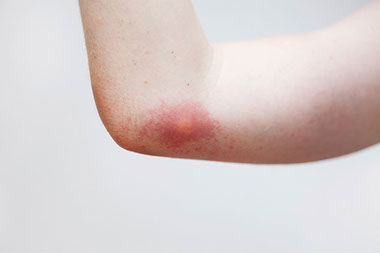
    Image of arm with an insect bite mark.

    Signs & Symptoms

    *  Swelling. Redness. Pain. Itching.

    *  Bleeding.

    *  Tissue loss, if the wound is severe.

    *  Skin rash.

    *  Lockjaw. This is a painful, persistent stiffness of the jaw due to a toxin. Tetanus shots can prevent this.

    *  Allergic reaction, such as with insect bites.

    Causes

    *  Dog, cat, and human bites are the most common animal bites in the U.S.

    *  Deer tick bites can cause Lyme disease, a bacterial infection.

    *  Bed bug bites cause redness, swelling, and large, red welts or raised areas on the skin.

    *  Black widow and brown recluse spider bites can cause severe reactions.

    *  Less common, but more dangerous, are bites from skunks, raccoons, bats, and other animals that live in the wild. These animals can have rabies – a serious viral infection. It can be fatal. Most house pets are vaccinated for rabies. It’s unlikely they carry the virus.

    *  Mosquito bites can cause West Nile virus if the mosquito is infected with it.

    *  Snake bites can be fatal if the bite is from a poisonous snake (e.g., rattlesnakes, cotton mouths, copperheads, and coral snakes).

    *  Shark bites are a potential problem when swimming in shark-infested waters.

    Treatment

    Self-care can be used for dog and cat bites that cause scratches on the skin and for insect bites that do not cause a severe allergic reaction. All human bites that break the skin should be checked by a doctor due to the high risk for infection.

    A series of rabies shots can prevent the spread of rabies to humans. The shots should begin soon after a bite from an infected animal.

    Antivenom can be given for poisonous snake bites at emergency medical facilities. It should be given within 4 hours of the bite.

    For Stings

    Signs & Symptoms

    *  Quick, sharp pain.

    *  Swelling, itching, and redness at the sting site. These can occur beyond the sting site.

    *  Raised bump (with or without pus).

    *  Signs of a severe allergic reaction.

    Causes

    *  Insect stings.

    *  Marine animals that sting include jellyfish, Portuguese Man-of-War, and sea nettles.

    Treatment

    Self-care treats mild reactions to stings. A severe allergic reaction needs immediate care. Symptoms of a severe allergic reaction usually happen soon after or within an hour of the sting.

    Persons with a severe allergic reaction to a sting in the past should carry an emergency kit, prescribed by a doctor. A medical alert tag should be worn to let others know of the allergy. Persons who have had severe reactions to bee or wasp stings should ask their doctors about allergy shots.

    Questions to Ask

    Self-Care / First Aid

    For Poisonous Snake Bites Before Medical Care

    *  Carefully move the person away from the snake. Calm the person. Have him or her rest. Moving about can help spread the venom.

    *  Gently wash the bite area with soap and water. Keep the limb of the bite site level with the heart (or just below this). Apply a splint to the limb of the bite site to keep it from moving.

    *  Being careful, note, if you can, the shape of the snakes eyes, pupils, and head, the colors it is, and if it has rattles.

    *  Don’t try to kill the snake, cut the fang mark, or suck out the venom.

    *  Don’t apply a tourniquet, a bandage, or ice to the bite.

    For Non-Poisonous Snake Bites

    *  Gently wash the site with soap and water.

    *  Treat the bite as a minor wound.

    *  If you notice signs of an infection, call your doctor.

    For Poisonous Spider Bites Until Emergency Care Arrives

    *  Perform rescue breathing, if needed.

    *  If you can, keep the bitten area lower than the level of the heart.

    *  Calm the person and keep him or her warm.

    *  Gently clean the site of the bite with soap and water or rubbing alcohol.

    *  Put an ice pack over the bite site for pain relief.

    *  If you can, catch the spider in a closed container to show what kind it is.

    For Poisonous Spider and Scorpion Bites Before Medical Care

    *  Do rescue breathing, if needed.

    *  If you can, keep the bitten area lower than the level of the heart.

    *  Calm the victim and keep him or her warm.

    *  Gently clean the site of the bite with soap and water or rubbing alcohol.

    *  Put an ice pack over the bite site to relieve pain.

    *  If you can, catch the spider in a closed container to show the doctor. n Get emergency care!

    For Human Bites Before Medical Care

    *  Wash the wound area with soap and water for at least 5 minutes. Don’t scrub hard. Rinse with running water or with an antiseptic solution, such as Betadine.

    *  Cover the wound area with sterile gauze. Tape only the ends of the gauze in place. Then get medical care.

    For Deer Tick Bites

    *  Remove any ticks found on the skin. Use tweezers to grasp the tick(s) as close to the skin as you can. Pull gently and carefully in a steady upward motion at the point where the tick’s mouthpart enters the skin. Try not to crush the tick. The secretions released may spread disease.

    *  After you remove the ticks, wash the wound area and your hands with soap and water. Apply rubbing alcohol to help disinfect the area.

    *  Use an ice pack over the bite area to relieve pain.

    *  Save one tick in a closed jar with rubbing alcohol to show the doctor.

    For Dog and Cat Bites

    *  Wash the bite area right away with soap and warm water for 5 minutes. If the bite is deep, flush the wound with water for 10 minutes. Dry the wound with a clean towel. Then get medical care.

    *  If the wound is swollen, apply ice wrapped in a towel for 10 minutes.

    *  Get a tetanus shot, if needed.

    *  If the bite hurts, take an over-the-counter (OTC) medicine for pain.

    *  Report the incident to the animal control department. If a pet’s immunizations are not current, arrange with the animal control department for the pet to be observed for the next 10 days to check for rabies.

    *  Observe the wound for a few days. Look for signs of infection. Often, cat bite wounds need an antibiotic.

    For a Stingray Bite

    *  Remove the person from the water.

    *  Apply a local pressure bandage for a wound that bleeds a lot.

    *  Immerse the wound area in hot water for 30 to 90 minutes. Make sure the water is not hot enough to burn the skin.

    *  Scrub the wound area well with soap and water.

    *  Unless the wound is a slight one in only one limb, get medical help right away.

    For Stings from Jellyfish or Sea Nettles, etc.

    *  Remove the person from the water. Don’t touch the sting area with bare hands.

    *  Rinse the sting area with salt (not fresh) water right away. Don’t put ice on the skin. If you can, put vinegar or rubbing alcohol on the area several times for 30 or more minutes until the pain is relieved.

    *  Apply dry or moist heat to the sting area until the pain subsides. You can mix one part ammonia with 3 parts salt water and apply this to the sting area.

    *  Wear gloves when you remove stingers. Use a towel to wipe the stingers or the tentacles off. Use tweezers to lift large tentacles. Don’t scrape or rub them.

    *  To relieve itching, apply OTC calamine lotion or 1% hydrocortisone cream to the affected area as directed on the label.

    *  Contact your doctor for any signs of infection.

    Healthier at Home book by the American Institute for Preventive Medicine. www.HealthyLife.com. All rights reserved.

    © American Institute for Preventive Medicine

  • Heat Exhaustion & Heat Stroke

    First Aid

    Sweat evaporates from the skin to cool the body. If this personal cooling system does not work right or fails to work, heat exhaustion or a heat stroke can occur.

    Heat exhaustion is a warning that the body is getting too hot. With a heat stroke, body organs start to overheat. They will stop working if they get hot enough. If it is not treated, a heat stroke can result in death.

    Signs & Symptoms

    For a Heat Stroke

    These signs and symptoms can occur suddenly with little warning:

    *  Very high temperature (104ºF or higher).

    *  Hot, dry, red skin. No sweating.

    *  Deep breathing and fast pulse. Then shallow breathing and weak pulse.

    *  Confusion. Hallucinations.

    *  Convulsions.

    *  Loss of consciousness.

    For Heat Exhaustion

    *  Normal, low, or only slightly elevated body temperature.

    *  Cool, clammy, pale skin. Sweating.

    *  Dry mouth. Thirst.

    *  Fatigue. Weakness. Feeling dizzy.

    *  Headache.

    *  Nausea. Vomiting can occur.

    *  Muscle cramps.

    *  Weak or rapid pulse.

    Causes

    Anything that keeps the body’s natural cooling system from working right can lead to heat exhaustion and heat stroke. This includes:

    *  Extreme heat and humidity.

    *  Being in places without fans or air conditioners during hot, humid weather.

    *  Not being able to get to public air-conditioned places. Waiting for a bus or other type of public transportation in hot, humid weather.

    *  Overdressing.

    *  Changes in the skin due to aging.

    *  Poor circulation. Heart, lung, and/or kidney disease.

    *  Not being able to sweat due to medicines, such as water pills and some used for mental illnesses.

    *  Alcohol or drug use.

    *  Any illness that causes weakness, fever, vomiting, or diarrhea.

    Treatment

    A heat stroke is a medical emergency.

    Heat exhaustion may respond to self-care measures. If not, medical care is needed.

    Prevention

    *  Drink lots of liquids, especially if your urine is dark yellow. Drink water, sport drinks, such as Gatorade, etc.

    *  Do not stay in or leave anyone in a closed, parked car during hot weather.

    *  Don’t have drinks with alcohol or caffeine.

    *  Use caution when you are in the sun. At the first sign of heat exhaustion, get out of the sun. If you can, avoid midday heat. Do not do vigorous activity during the hottest part of the day (11:00 a.m. to 4:00 p.m.).

    *  Wear light, loose-fitting clothing, such as cotton, so sweat can evaporate. Wear a wide-brimmed hat with vents. Use an umbrella for shade.

    *  If you feel very hot, try to cool off. Open a window. Use a fan. Go to an air-conditioned place.

    *  Check with your doctor about sun exposure if you take:

    – Water pills.

    – Mood-altering medicines.

    – Some antibiotics, such as tetracycline.

    Questions to Ask

    Self-Care / First Aid

    First Aid for a Heat Stroke

    Call 9-1-1!

    Before Emergency Care Arrives

    *  Move the person to a cool place indoors or under a shady tree. Place the feet higher than the head to avoid shock.

    *  Remove clothing. Either wrap the person in a cold, wet sheet; sponge the person with towels or sheets that are soaked in cold water; or spray the person with cool water. Fan the person.

    *  Put ice packs or cold compresses on the neck, under the armpits, and on the groin area.

    *  Once the person’s temperature gets to 101ºF, place him or her in the Recovery Position. Do not lower the temperature further.

    *  Don’t give fever reducing medicine.

    *  Don’t use rubbing alcohol.

    First Aid for Heat Exhaustion

    *  Move to a cool place indoors or in the shade. Lie down.

    *  Loosen clothing.

    *  Drink fluids, such as cool or cold water. Add 1/2 teaspoon of salt to 1 quart of water. Sip this. Or, drink sport drinks, such as Gatorade, etc.

    *  Have salty foods, such as saltine crackers, if you tolerate them.

    *  Massage and stretch cramped muscles.
    Healthier at Home book by the American Institute for Preventive Medicine. www.HealthyLife.com. All rights reserved.

    © American Institute for Preventive Medicine
  • How To Stop A Nosebleed

    SELF-CARE CORNER

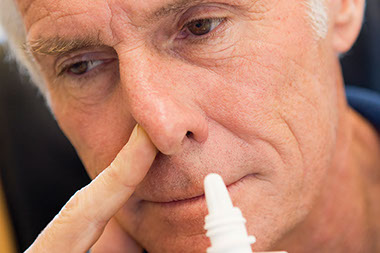
    Image of man using a nasal spray.

    When the furnace fires up and the humidity drops, the nose is most at risk. Nosebleeds can range from a simple, brief annoying amount of bleeding to life-threatening bleeding, according to Dr. Peter Shepard, an ear, nose, and throat expert.

    The nose has a collection of blood vessels called Kiesselbach’s plexus. This area is located at the front of the septum, the cartilage that divides the nose. Vessels from several different main trunks all meet in this spot and are very close to the surface. This is also the area of the nose that tends to dry out the most.

    If the surface cracks, the vessels will bleed. The size of the vessels determines how bad the bleeding is. People are more at risk if they have high blood pressure, take blood thinners, use oxygen, or have a deviated nasal septum.

    The best treatment for nosebleeds is avoiding them in the first place. Unless you can take an extended trip to Hawaii, you’ll want to work on improving the humidity inside your nose.

    Apply Vaseline at the front of your nostril twice a day. Saline spray can be kept with you and used throughout the day.

    If you do have a bleed, a few simple things will usually stop it.

    *  Apply pressure by squeezing the soft part of the nose between your thumb and index finger. Lean forward so you don’t swallow any blood (do not hold your head back, as some suggest).

    *  If that is not enough, oxymetazoline (Afrin) nasal spray can be a miracle drug for nosebleeds. It is a decongestant but works for nosebleeds since it causes blood vessels to tighten. Blow the blood out of the nose, spray twice, and then apply pressure for 15 minutes.

    *  If the bleeding won’t stop, go to the emergency room.

    © American Institute for Preventive Medicine

  • Burns

    First Aid

    Signs & Symptoms

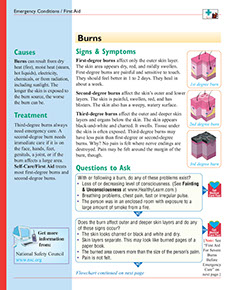
    First-degree burns affect only the outer skin layer. The skin area appears dry, red, and mildly swollen. First-degree burns are painful and sensitive to touch. They should feel better in 1 to 2 days. They heal in about a week.

    Second-degree burns affect the skin’s outer and lower layers. The skin is painful, swollen, red, and has blisters. The skin also has a weepy, watery surface.

    Third-degree burns affect the outer and deeper skin layers and organs below the skin. The skin appears black-and-white and charred. It swells. Tissue under the skin is often exposed. Third-degree burns may have less pain than first-degree or second-degree burns. Why? No pain is felt where nerve endings are destroyed. Pain may be felt around the margin of the burn, though.

    Causes

    Burns can result from dry heat (fire), moist heat (steam, hot liquids), electricity, chemicals, or from radiation, including sunlight. The longer the skin is exposed to the burn source, the worse the burn can be.

    Treatment

    Third-degree burns always need emergency care. A second-degree burn needs immediate care if it is on the face, hands, feet, genitals, a joint, or if the burn affects a large area.Self-Care/First Aidtreats most first-degree burns and second-degree burns.

    Questions to Ask

    Self-Care / Prevention

    For Severe Burns Before Emergency Care

    *  Remove the person from the source of heat. Call 9-1-1! Keep the person’s airway open. Treat for Shock.

    *  Remove hot or burned clothes that come off easily, not if they are stuck to the skin.

    *  Cover the burns loosely with clean cloths. Use direct pressure to control bleeding. Don’t rub.

    *  Stay with the person until medical care arrives.

    *  If lye or a dry chemical gets on the skin, brush off the powder. Then flush with clean water for at least 20 minutes or until EMS arrives. Remove glasses, but not contacts, before treating the eyes.

    For First-Degree and Second-Degree Burns (that are less than 3” in diameter)

    *  Use cold water or cloths soaked in cold water on burned areas for 15 minutes or until the pain subsides. Do not use ice at all. Doing this could result in frostbite.

    *  Cover the area loosely with a dry cloth, such as sterile gauze. Hold it in place by taping only the edges of the gauze. Change the dressing the next day and every 2 days after that.

    *  Don’t use ointments. Aloe vera can be applied over closed skin 3 to 4 times a day. For a more severe burn less than 3” x 2”, use Second Skin Moisture Pads, etc.

    *  Don’t break blisters. If they break on their own, apply an antibacterial spray or ointment or treatment prescribed by your doctor. Keep the area loosely covered with a sterile dressing.

    *  Prop the burned area higher than the rest of the body, if you can.

    Resources

    National Safety Council

    www.nsc.org

    Healthier at Home book by the American Institute for Preventive Medicine. www.HealthyLife.com. All rights reserved.

    © American Institute for Preventive Medicine
  • Heat Illnesses

    First Aid

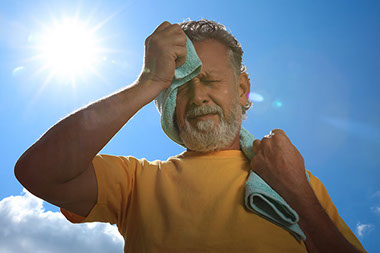
    Man outside in bright sun, wiping forehead with towel.

    Most heat-related deaths occur in the hot summer months. Elderly and very young persons and people with chronic health problems are most at risk.

    Sweating normally cools the body. During hot weather, sweating isn’t enough. Body temperature can rise to dangerous levels and you can develop a heat illness. This includes heat stroke, which can be life-threatening. Heat exhaustion, if not treated, can turn into heat stroke.

    A less serious heat illness is a heat rash. Signs include small red pimples, pink, blotchy skin, and itching. To treat a heat rash, bathe in cool water every couple of hours. Let your skin air dry. Put cornstarch or calamine lotion on itchy areas.

    When the heat starts to rise, slow down. Drink plenty of fluids (ones without alcohol or caffeine). Stay in the shade or indoors. Wear light, loose-fitting clothing and a wide brimmed hat. Do not stay in or leave anyone in a closed, parked car during hot weather.

    Health at Home Lifetime book by the American Institute for Preventive Medicine. www.HealthyLife.com. All rights reserved.

    © American Institute for Preventive Medicine
  • Latex Allergy

    MEDICAL NEWS

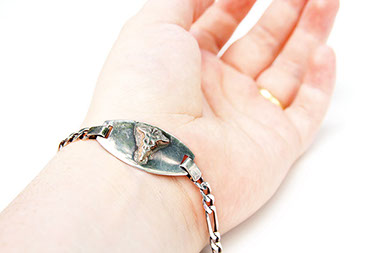
    Close up image of a medical ID.

    If you are allergic to latex, you usually know it. You can react with sneezing or worse symptoms because your body is reacting to proteins in natural rubber latex, which is made from the rubber tree.

    The Asthma and Allergy Foundation of America suggests you do this:

    *  Always wear a medical ID that alerts others about your allergy if you need emergency care.

    *  Ask doctors, dentists, and others who examine you to wear latex-free exam gloves. Carry gloves with you to give your dentist or doctor.

    *  Check labeling. Do not assume a product labeled “hypoallergenic” is latex-free.

    *  Know that latex can be found in some elastic in clothing, rubber bands, condoms, balloons, disposable diapers, and many more products.

    *  If you’re allergic to latex, you may have reactions to bananas, kiwi, and cantaloupe, which contain some of the same allergens found in latex.

    © American Institute for Preventive Medicine
  • Choking

    First Aid

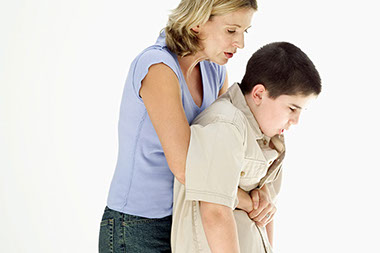
    Image of an adult women giving the heimlich maneuver to a child who's choking.

    With choking, the airway is partly or completely blocked. When it is completely blocked, the brain doesn’t get oxygen. Without oxygen, the brain can begin to die in 4 to 6 minutes.

    Signs & Symptoms

    When a person’s airway is completely blocked, he or she:

    *  Can’t talk.

    *  Can’t breathe.

    *  Can’t cough.

    *  May turn blue.

    When a person’s airway is partly blocked, he or she:

    *  Wheezes.

    *  Coughs.

    *  Has fast and/or labored breathing.

    *  Has chest pain when breathing in.

    Causes

    *  Food goes down the windpipe. Small objects get stuck in the throat and airway.

    *  Fluids, such as mucus or liquids, are swallowed the wrong way and block the airway.

    *  Snoring. Choking can occur when the tongue blocks the airway.

    Treatment

    Emergency action is needed for a person who cannot breathe, speak, or cough forcefully. The Heimlich maneuver can expel an object that blocks the airway. It is used for a person who is conscious. Emergency medical care is needed for a person who loses consciousness. Rescue breaths and chest compressions are needed before medical help arrives. Even if the object is expelled, the person should see a doctor or go to a hospital emergency department.

    Questions to Ask

    Self-Care / First Aid

    First Aid for Choking When Able to Breathe and Speak (or an infant or child can cry)

    *  Cough to clear the airway.

    *  Take a slow, deep breath to get a lot of air into the lungs.

    *  Give a deep, forceful cough. Breathe in deeply enough to be able to cough out 2 or 3 times in a row before taking a second breath.

    *  Don’t slap a person on the back. Doing this can drive the object down deeper.

    *  Have the person sit or stand. Bending forward may cause the object to fall against the vocal cords. Get emergency care right away!

    Prevention

    *  Chew all foods well before swallowing. Eat at a slow pace.

    *  Limit alcoholic drinks before you eat. This lessens the chance of swallowing large pieces of food.

    *  If you wear dentures, make sure they fit well. Since your mouth sensation is lessened, you are at a higher risk of choking. Eat slower. Chew food more thoroughly.

    *  Try not to laugh and eat at the same time. Laughing can draw food into the windpipe.

    *  Don’t run or play sports with objects in the mouth.

    *  For children under 5 years old, cut hot dogs, sausages, seedless grapes, and caramels into small pieces before you give these to them. And don’t give them nuts; popcorn; foods with pits, (e.g., cherries); gum (especially bubble gum); hard candy, throat lozenges, and cough drops.

    *  Don’t let your child chew or suck on rubber balloons or pieces of them.

    *  Keep small, solid objects, such as paper clips, away from children 3 years old and younger. Make sure, too, that they don’t get toys that have small parts, such as eyes on stuffed animals, game pieces, dice, etc. A young child should not play with any object smaller than his or her closed fist.

    *  Put childproof latches on cupboards that have harmful items.

    *  Store all medicines and vitamins out of children’s reach and in containers with childproof lids. Keep these items in locked cabinets, if needed.

    *  Remove plastic labels and decals from baby walkers and other kiddy furniture before children can peel them off.

    Healthier at Home book by the American Institute for Preventive Medicine. www.HealthyLife.com. All rights reserved.

    © American Institute for Preventive Medicine
  • Hyperventilation

    First Aid

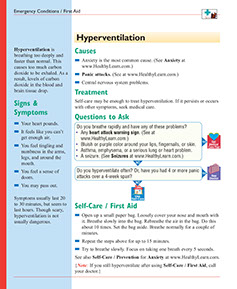
    Hyperventilation is breathing too deeply and faster than normal. This causes too much carbon dioxide to be exhaled. As a result, levels of carbon dioxide in the blood and brain tissue drop.

    Signs & Symptoms

    *  Your heart pounds.

    *  It feels like you can’t get enough air.

    *  You feel tingling and numbness in the arms, legs, and around the mouth.

    *  You feel a sense of doom.

    *  You may pass out.

    Symptoms usually last 20 to 30 minutes, but seem to last hours. Though scary, hyperventilation is not usually dangerous.

    Causes

    *  Anxiety is the most common cause.

    *  Panic attacks.

    *  Central nervous system problems.

    Treatment

    Self-care may be enough to treat hyperventilation. If it persists or occurs with other symptoms, seek medical care.

    Questions to Ask

    Self-Care / Prevention

    *  Open up a small paper bag. Loosely cover your nose and mouth with it. Breathe slowly into the bag. Rebreathe the air in the bag. Do this about 10 times. Set the bag aside. Breathe normally for a couple of minutes.

    *  Repeat the steps above for up to 15 minutes.

    *  Try to breathe slowly. Focus on taking one breath every 5 seconds.

    {Note: If you still hyperventilate after using Self-Care / First Aid, call your doctor.}

    Healthier at Home book by the American Institute for Preventive Medicine. www.HealthyLife.com. All rights reserved.

    © American Institute for Preventive Medicine