Tag: First Aid

  • Pack A Travel First Aid Kit

    WELL-BEING

    Illustration of an airplane and first aid kid.

    Traveling? Make a little room in your luggage for a travel first aid kit. It won’t cost much or take up much space. Once you reach your destination, you won’t need to reach any further than your suitcase to relieve those minor aches and pains that can put a major damper on your plans.

    A basic travel first aid kit should include a handful of over-the-counter remedies you can buy just about anywhere, said Caroline Sullivan, DNP, assistant professor at Columbia University School of Nursing.

    Here’s what should go in the kit:

    *  Tylenol or Advil to ease a headache or fever

    *  Cortisone 10 cream to soothe an itchy, swollen insect bite

    *  Antibiotic ointment like Neosporin or Bacitracin to prevent infection from minor cuts, scrapes, and burns

    *  Band-Aids to cover up blisters, or for those minor cuts and scrapes

    *  Pepto-Bismol tablets to relieve diarrhea, upset stomach, heartburn, indigestion, and nausea after too much food and drink. Note: This is for adults only. Pepto-Bismol has salicylates which have been linked to Reye’s syndrome.

    *  Benadryl to relieve allergies, and also to help you sleep

    *  Hand sanitizer that contains at least 60% alcohol

    *  Tissues to sneeze, dab cuts, and clean hands in a pinch

    *  Pack your prescription medicines in their original bottles in your carry-on bag.

    © American Institute for Preventive Medicine

  • Cpr

    First Aid

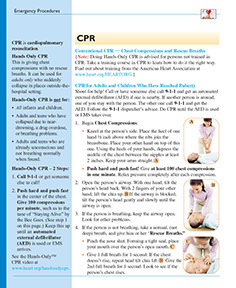
    Conventional CPR ─ Chest Compressions and Rescue Breaths {Note: Doing Hands-Only CPR is advised for persons not trained in CPR. Take a training course in CPR to learn how to do it the right way. Find out about training course in CPR to learn how to do it the right way. Find out about training atwww.cpr.heart.org.} Do CPR when the person is not responsive, is not breathing, and does not have a pulse.

    Hands Only CPR

    This is giving chest compressions with no rescue breaths. It can be used for adults and teens who suddenly collapse.

    Hands-Only CPR is not for:

    *  All infants and children.

    *  Adults and teens who have collapsed due to near-drowning, a drug overdose, or breathing problems.

    *  Adults and teens who are already unconscious and not breathing normally when found.

    Hands-Only CPR – 2 Steps:

    1.  Call 9-1-1 or get someone else to call!

    2.  Push hard and push fast in the center of the chest. Give 100 compressions per minute, such as to the tune of “Staying Alive” by the Bee Gees. Keep this up until an automated external defibrillator (AED) is used or EMS arrives.

    See the Hands-Only™ CPR video atwww.cpr.heart.org.

    CPR for Adults & Teens

    Shout for help! Call or have someone else call 9-1-1 and get an automated external defibrillator (AED) if one is nearby. If another person is around, one of you stay with the person. The other one call 9-1-1 and get the AED. Follow the 9-1-1 dispatcher’s advice. Do CPR until the AED is used or EMS takes over.

    1. Begin Chest Compressions:

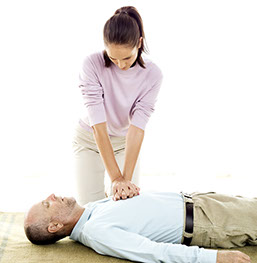
    *  Kneel at the person’s side. Place the heel of one hand ½ inch above where the ribs join the breastbone. Place your other hand on top of this one. Using the heels of your hands, depress the middle of the chest between the nipples at least  2 inches, but not more than 2.4 inches deep. Keep your arms straight. See image A.

    *  Push hard and push fast! Give at least 100 chest compressions in one minute. Relax pressure completely after each compression.

    Image of chest compressions.

    Image A

    2. Open the person’s airway.

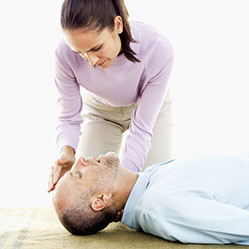
    With one hand, tilt the person’s head back. With 2 fingers of your other hand, lift the chin up. See image B. If the airway is blocked,  tilt the person’s head gently and slowly until the airway is open.

    Image of opening a person's airway.

    Image B

    3. If the person is breathing, keep the airway open.

    Look for other problems.

    4. If the person is not breathing, take a normal, (not deep) breath, and give him or her “Rescue Breaths.”

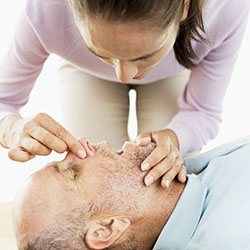
    *  Pinch the nose shut. Forming a tight seal, place your mouth over the person’s open mouth. See image C.

    *  Give 1 full breath for 1 second. If the chest doesn’t rise, repeat head tilt chin lift. See image B. Give the 2nd full breath for 1 second. Look to see if the person’s chest rises.

    Image of Rescue Breaths.

    Image C

    5. Give cycles of 30 chest compressions and 2 rescue breaths, without a break, until the person starts to move, an AED is used, or EMS provides care.

    Children Ages 1 to Puberty

    Shout for help! If you are alone, do CPR for 2 minutes before you call 9-1-1. If the child does not appear to have a serious injury, carry the child to nearest phone and call 9-1-1! Put the phone on speaker mode. Follow the dispatcher’s advice. If you are not alone, someone start CPR; someone else call 9-1-1 and get an AED, if one is nearby.

    1. Place the child on his or her back.

    2. Start Chest Compressions:

    *  Put one hand on the child’s breastbone right between his or her nipples.

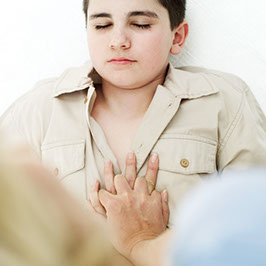
    *  Using the heel of your hand (or both hands like in image A under Adults & Children Who Reached Puberty) push straight down about 2 inches (at least one-third of the depth of the child’s chest). See image D. Let the chest rise back up after each push.

    *  Push hard and push fast! Give at least 100 chest compressions in one minute. Relax pressure completely after each compression.

    Image of child chest compressions.

    Image D

    3. Follow steps 2, 3, 4, and 5 under CPR For Adults and Children who Have Reached Puberty on this page.

    {Note: Chest compressions alone are better than doing nothing, but it is best to give chest compressions plus rescue breaths. Why? Airway problems are the main cause of cardiac arrest in infants and children.}

    Babies Up to 1 Year Old

    1. If you are alone, do CPR for 2 minutes before you call 9-1-1.

    If the child does not appear to have a serious injury, carry the child to nearest cell or other phone and call 9-1-1!  Put the phone on speaker mode. Follow the dispatcher’s advice. If you are not alone, someone start CPR; someone else call 9-1-1!

    2. Start Chest Compressions:

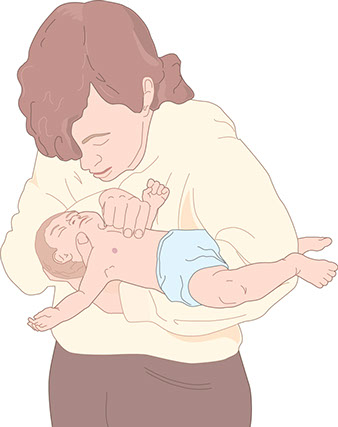
    *  Put the tips of your middle and ring fingers on the baby’s breastbone right between his or her nipples. See image E.

    *  Slip your other hand underneath the baby’s back for support.

    *  Push straight down about 1½ inches (at least one-third of the depth of the baby’s chest). Push at a rate of at least 100 compressions per minute. Let the chest rise back up after each push.

    Illustration of baby chest compressions.

    Image E

    3. If the baby is not breathing, or you are not sure he or she is breathing, give Rescue Breaths:

    *  Cover the infant’s mouth and nose with your mouth, forming a tight seal.

    *  Give 1 full breath for 1 second. Look to see if the chest rises. Give the 2nd full breath for 1 second and look to see if the chest rises.

    *  If the chest does not rise, go back to giving chest compressions. See step 2 listed above. After 30 more compressions, try rescue breaths again. {Note: If you can’t give rescue breaths, just keep giving chest compressions.}

    4. Give cycles of 30 chest compressions and 2 rescue breaths, without a break.

    Do this until the baby starts to move or until EMS provides care.

    Healthier at Home book by the American Institute for Preventive Medicine. www.HealthyLife.com. All rights reserved.

    © American Institute for Preventive Medicine

  • Learn Cpr. It Could Help Save A Life!

    First Aid

    An image of a class learning CPR.

    Knowing how to perform cardiopulmonary resuscitation (CPR) can mean the difference between life and death. CPR can restore the flow of oxygen to the brain if the heart has stopped beating due to heart attack, drowning, electrical shock, suffocation, or a drug overdose. Learn to perform CPR correctly. Take a CPR training course to learn:

    *  How to contact emergency medical help.

    *  How to use an automated external defribrillator (AED).

    *  How to give rescue breaths, compress the person’s chest and when and how to do chest-compression only CPR. (It is important to push hard and push fast, giving 100 compressions a minute in cycles of 30 compressions for every 2 breaths.) {Note: Guidelines for CPR may change. Get updates for CPR and find out where you can learn how to perform it from the American Heart Association atwww.americanheart.org.}

    You can also call your local chapter of the Red Cross or your local hospital to find out where you can learn CPR.

    A Year of Health Hints book by the American Institute for Preventive Medicine. www.HealthyLife.com. All rights reserved.

    © American Institute for Preventive Medicine

  • Prevent Kids From Choking

    FAMILY LIFE

    Image of father and daughter eating oranges.

    Food-not toys-are the most common culprit of choking accidents in kids under 5. The reasons have a lot to do with a child’s anatomy.

    “Young children have underdeveloped swallowing mechanisms, immature teeth and narrow airways, which put them at a higher risk for choking on food,” said Dr. Nina Shapiro, a professor of head and neck surgery at the UCLA School of Medicine. “Plus, the diameter of a child’s airway is about the size of their pinky, so high-risk foods can easily block their tiny airways and prevent their ability to breathe.”

    The list of high-risk foods for children under age 5 years includes many kid favorites:

    *  Cheese sticks

    *  Chewing gum

    *  Chunks of meat or cheese

    *  Chunks of peanut butter

    *  Chunks of raw vegetables

    *  Dried fruit

    *  Grapes

    *  Hard or sticky candy and lollipops

    *  Hot dogs

    *  Nuts

    *  Popcorn

    *  Seeds such as pumpkin seeds and sunflower seeds

    Here are some tips:

    *  Vegetables should be cooked and cut into small pieces.

    *  Hot dogs and cheese sticks should be cut lengthwise, then widthwise, and then into the shape of small moons.

    *  Grapes should be peeled and cut in half or quarters.

    *  Nut butters should be spread thinly onto crackers or bread.

    *  Young children should always be attended to by an adult when they eat and only eat developmentally appropriate foods.

    *  Children should sit up straight and not play or run while eating.

    If a child does choke and is unable to breathe, call 911 and perform the Heimlich maneuver. Even if the child seems to choke but then coughs and appears fine, the object may have become lodged, and the child should see a doctor.

    © American Institute for Preventive Medicine

  • Dehydration

    First Aid

    Image of women drinking a glass of water.

    Dehydration is when the body loses too much water and needed minerals (electrolytes).

    Signs & Symptoms

    For Severe Dehydration

    *  Severe thirst (sometimes).

    *  Sunken and dry eyes. Tearless eyes. (Infants may not show this sign.)

    *  Dry mouth, tongue, and lips.

    *  No urine or a low amount of urine that is dark yellow.

    *  Sunken fontanelle (the soft spot on an infant’s head).

    *  Headache. Feeling lightheaded, especially when getting up quickly.

    *  Dry skin that doesn’t spring back when pinched.

    *  Feeling dizzy. Confusion. Severe weakness.

    *  Increase in breathing and heart rate.

    Causes

    *  The body does not get enough fluids for it’s needs.

    *  Too much water or other body fluids and electrolytes, such as sodium and potassium, are lost. This can result from: Repeated episodes of diarrhea and/or vomiting; heavy sweating; heat exhaustion; or heat stroke.

    Treatment

    Fluids and electrolytes must be replaced. If this can’t be done by mouth, they are given through an IV solution.

    Questions to Ask

    Self-Care / First Aid

    *  If vomiting isn’t present, adults and children over age 12 should drink about 2 cups of fluid per hour. Fluids of choice are: Sports drinks; flat cola; clear sodas; broths; popsicles; and gelatin.

    *  If you have high blood pressure, heart disease, kidney disease, diabetes, or a history of stroke, you should find out what fluids your doctor prefers you take when you need to replace lost fluids.

    *  For children under 2 years old, consult your child’s doctor about the amount and type of fluid to give. Ask your child’s doctor about using over-the-counter products that give fluid and electrolytes. Examples are Pedialyte and Infalyte.

    *  For children over 2 years old, give up to 1-1/2 quarts of fluid per day.

    Healthier at Home book by the American Institute for Preventive Medicine. www.HealthyLife.com. All rights reserved.

    © American Institute for Preventive Medicine

  • Near-Drowning

    First Aid

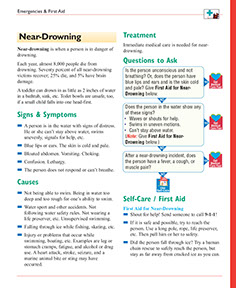
    Near-drowning is when a person is in danger of drowning. Each year, almost 8,000 people die from drowning. Seventy percent of all near-drowning victims recover; 25% die, and 5% have brain damage.

    A toddler can drown in as little as 2 inches of water in a bathtub, sink, etc. Toilet bowls are unsafe, too, if a small child falls into one head-first.

    Signs & Symptoms

    *  A person is in the water with signs of distress. He or she can’t stay above water, swims unevenly, signals for help, etc.

    *  Blue lips or ears. The skin is cold and pale.

    *  Bloated abdomen. Vomiting. Choking.

    *  Confusion. Lethargy.

    *  The person does not respond or can’t breathe.

    Causes

    *  Not being able to swim. Being in water too deep and too rough for one’s ability to swim.

    *  Water sport and other accidents. Not following water safety rules. Not wearing a life preserver, etc. Unsupervised swimming.

    *  Falling through ice while fishing, skating, etc.

    *  Injury or problems that occur while swimming, boating, etc. Examples are leg or stomach cramps, fatigue, and alcohol or drug use. A heart attack, stroke, seizure, and a marine animal bite or sting may have occurred.

    Prevention

    For Children

    *  Never leave an infant or child alone in any type of bathtub. Supervise young children in the bathroom.

    *  Never leave a child alone near water, swimming pools, etc. Lock gates to keep children from getting near swimming pools.

    *  Have a phone near outdoor pools, etc.

    *  Teach children to swim. Tell them not to swim alone and not to swim too far from shore without a lifeguard or other adult swimmer.

    *  Put a personal floatation device on each child when near the water or on a boat.

    *  Tell children to check the depth of water before diving in. It should be at least 9 feet deep.

    *  Do not allow children to go on untested ice.

    *  Take CPR and water safety courses.

    For Adults

    *  Learn to swim. Never swim alone at the beach or in a swimming pool. A lifeguard or other adult swimmer should be nearby in case you suffer a leg cramp or other problem.

    *  Wear a personal floatation device when you are on a boat, when you fish, etc.

    *  Check the depth of the water before diving in. It should be at least 9 feet deep. Never dive into an above-ground pool.

    *  Do not use a hot tub or jacuzzi if you’ve had any alcoholic drinks. You could fall asleep, slip under the surface, and drown.

    *  Take CPR and water safety courses.

    Questions to Ask

    Self-Care / First Aid

    First Aid for Near-Drowning

    *  Shout for help! Send someone to call 9-1-1!

    *  If it is safe and possible, try to reach the person. Use a long pole, rope, life preserver, etc. Then pull him or her to safety.

    *  Did the person fall through ice? Try a human chain rescue to safely reach the person, but stay as far away from cracked ice as you can.

    *  If you must swim to the person, be sure you are strong and capable enough. Take a flotation device with you. Approach the person from behind in a calm manner. Grab a piece of the person’s clothing. Or, cup one hand under the person’s chin.

    *  When getting the person out of the water, support the head and neck. (Suspect a neck injury, especially with diving or water sports.)

    *  CHECK for a response. Give Rescue Breaths and CPR, as needed. If you suspect a spinal injury, use jaw thrust instead of chin-lift for rescue breaths.

    *  Once out of the water, keep checking the person for a response. Give first aid, as needed.

    *  Put the person in the Recovery Position. Immobilize the person as much as possible. If the person is vomiting, clear his or her mouth of it.

    *  Remove cold, wet clothes. Cover the person with a blanket, etc.

    Healthier at Home book by the American Institute for Preventive Medicine. www.HealthyLife.com. All rights reserved.

    © American Institute for Preventive Medicine

  • Ticked Off

    MEDICAL NEWS

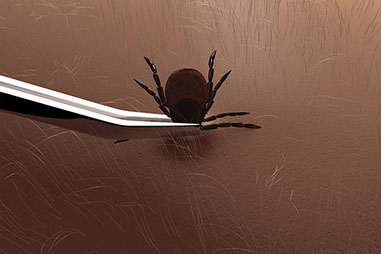
    Close up image of a tick being removed from a person's skin.

    Act fast to lower your risk for problems related to Lyme disease caused by tick bites, urges Time for Lyme, Inc.

    Have I been bitten? Lyme disease can only be transmitted from a bite by an infected deer tick, not from another person or animal, although pets commonly bring ticks into the home. All family members and pets should be inspected immediately and carefully after exposure to tick environments. You’ve been bitten if you find a tick attached to the skin. The longer it has been attached, the greater the risk of disease.

    How should I remove the tick? The proper way to remove a tick is with a set of fine-point tweezers. Do not attempt to burn the tick or use your fingers or soap or any other substance on it, as these may irritate the tick and cause it to inject bodily fluids into the wound.

    Using fine-point tweezers, grasp the tick as close to the skin surface as possible, near the head of the tick. Pull backward gently but firmly, using an even, steady pressure. Do not jerk or twist. Do not squeeze, crush, or puncture the body of the tick, as this may cause transmission of infection-causing organisms. If any mouth parts of the tick remain in the skin, leave them alone; they will come out naturally.

    If the tick is found crawling, a good way to remove it is by using a piece of tape: stick the tape to the tick and then suffocate it by sealing it into the tape. Otherwise, you can dispose of it in alcohol or flush it down the toilet. After removing the tick, wash your skin and hands thoroughly with soap and water.

    Monitor any bite site for redness that might mean a rash of Lyme disease. A bull’s-eye pattern might develop. Other typical symptoms that may develop within a few days of being bitten include headache, stiff neck, swollen glands, fatigue, dizziness, and pains that come and go.

    See your doctor if you have symptoms or concerns. Early Lyme disease is treated with antibiotics. For more information, go towww.LymeResearchAlliance.org.

    © American Institute for Preventive Medicine

  • Electric Shock

    First Aid

    Electric shock occurs when an electric current flows through the body. The human body is made up of 60% to 70% water. This makes it a good conductor of electricity. Burns, damage to internal organs, heart rhythm problems, and death, can result from electric shock.

    Signs & Symptoms

    *  Shocking sensations. Numbness or tingling. A change in vision, speech, or in any sensation.

    *  Burns or open wounds. These occur where the electricity enters and exits the body.

    *  Muscle spasms or contractions.

    *  Sudden immobility or fractures. A body part may look deformed.

    *  Interrupted breathing. Irregular heartbeats or chest pain.

    *  Seizures.

    *  Unconsciousness.

    A small child who bites or sucks on an electric cord can have a facial injury or distinct burn around the rim of the mouth.

    Causes

    *  Touching a high-voltage (more than 1,000 volts) source, such as high-tension wires that fall during a storm. Touching someone who is still touching a live current. Touching a low-voltage (less than 1,000 volts) current source, such as an electric socket or worn cord.

    *  Mixing water and electricity.

    *  Being struck by lightning. A bolt of lightning carries as many as 30 million volts.

    Treatment

    Contact with electricity from a high-voltage wire or being struck by lightning needs emergency medical care. Contact with electricity from a low-voltage current needs emergency medical care if any signs or symptoms are present. A person who does not have any symptoms should still see a doctor to check for possible internal injuries.

    To Avoid Being Harmed by Lightning

    *  Heed weather warnings.

    *  Take shelter in a building, if you can.

    *  Stay in your car (if it is not a convertible) rather than out in the open.

    *  If you are caught outside, avoid tall trees, open water, metal objects, and high ground. Crawl into a low-lying place or curl up on the ground, head to knees with your head touching the ground.

    Questions to Ask

    Self-Care / First Aid

    Beware! Do not put yourself in danger to give first aid. Do not touch the person until power is shut off.

    *  If the source is a high-voltage wire or lightning, call 9-1-1!

    *  It is safe to touch a person struck by lightning.

    *  If the source is a low-voltage current, remove the fuse or switch off the circuit breaker to the electrical outlet.

    *  If you can’t shut off the source, with dry feet and hands, use a board, wooden stick, rope, etc. to get the person away from the source.

    *  If it is safe for you to touch the person, check for a response. Give CPR, as needed.

    *  Unless it is absolutely necessary, don’t move the person. He or she could have a traumatic injury, especially to the head or neck.

    *  Check for burns. Cover burned areas with dry, sterile dressings.

    *  Give first aid for Shock, if needed.

    Prevention

    *  Stay clear of fallen wires. Inform the police, electric company, etc.

    *  Install ground-fault circuit-interrupters (GFCIs) in wall outlets of bathrooms, kitchens, etc. With GFCIs, when an electrical appliance falls into water, the current is instantly cut off.

    *  Don’t turn electrical switches on or off or touch an electric appliance while your hands are wet, while standing in water, or when sitting in a bathtub.

    *  Replace worn cords and wiring.

    *  Cover all electric sockets with plastic safety caps.

    *  Before you do electrical repairs, remove the fuse from the fuse box or switch off the circuit breaker. Don’t just turn off the appliance or light switch.

    Healthier at Home book by the American Institute for Preventive Medicine. www.HealthyLife.com. All rights reserved.

    © American Institute for Preventive Medicine

  • Objects In The Ear Or Nose

    First Aid

    A foreign object stuck in an ear or the nose needs to be removed. If not, an infection could result. Damage to structures in the nose or ear could also occur.

    Signs & Symptoms

    A child may be able to tell if an object was put in a nostril or an ear and didn’t come out. If not, signs and symptoms can help identify this problem.

    For an Object Stuck in an Ear

    *  Feeling of fullness in the ear.

    *  Ear pain or discomfort.

    *  Hearing loss and/or feeling dizzy.

    *  Foul odor from the ear and/or drainage from the ear.

    *  Bleeding from an ear.

    For an Object Stuck in the Nose

    *  Constant nasal discharge from one nostril.

    *  Foul odor. Pus or blood drains from a nostril.

    *  Pain, swelling, and/or tenderness.

    Causes

    *  An object or substance is placed in the ear or nose on purpose and won’t come out.

    *  Objects get stuck in the nose or ear by injury or by accident.

    *  An insect flies or crawls into an ear.

    Treatment

    Medical care is needed for foreign objects that can’t be removed with self-care. After an object is removed, an antibiotic may be needed if an infection is present. Small, button-sized batteries need to be removed to prevent burns.

    Questions to Ask

    Self-Care / Prevention

    To Remove an Insect from an Ear

    *  Kill the insect before you try to remove it. To do this, tilt the person’s head to put the ear with the insect in an upward position. Pour warm (not hot) mineral, olive, or baby oil into the ear. As you pour the oil, straighten the ear canal. In a child, pull the earlobe gently backward and downward; backward and upward in an adult.

    *  The goal is to suffocate the insect and cause it to float out.

    To Remove Objects Other Than Insects

    *  Don’t use oil.

    *  Tilt the head toward the side with the foreign object. Gently shake the head toward the floor to try to get the object out. Do not shake a baby. Gently pull the ear up and back.

    *  Don’t use a sharp tool, cotton swab, etc., to try to locate and remove the object. This risks pushing the object farther into the ear. Doing this could damage the middle ear.

    *  Remove the object with blunt tweezers if it is easily seen and can be grasped and pulled out.

    To Remove Objects in the Nose

    *  Don’t use a sharp tool, cotton swab, etc., to try to locate and remove the object.

    *  Breathe through the mouth until the object is removed.

    *  Apply gentle pressure to close the other nostril and gently try to blow the object out.

    *  Remove the object with blunt tweezers, if it is easily seen and can be grasped and pulled out.

    Healthier at Home book by the American Institute for Preventive Medicine. www.HealthyLife.com. All rights reserved.

    © American Institute for Preventive Medicine

  • When Allergies Get Real Serious

    MEDICAL NEWS

    Image of candy bar with warning "Not suitable for Nut allergy sufferers."

    A severe allergic reaction can be life threatening. It’s called anaphylaxis. The symptoms begin within minutes of eating a trigger food or after a bee sting or touching poison ivy. Some drugs can cause these serious reactions too. The Asthma and Allergy Foundation of America offers this safety advice:

    *  Know the symptoms: flushed skin, rash, tissue swelling, stuffy nose, sweating, panting, nausea, stomach cramps, rapid pulse, wheezing, convulsions, or fainting.

    *  Know what you’re allergic to: check food labels and ingredients. Ask at restaurants if you’re unsure if a menu item contains something you’re allergic to. Skin or blood tests done by a specialist can confirm that you’re sensitive to certain substances that can cause a severe reaction.

    *  Carry an auto-injectable epinephrine device that allows you to use a rescue medication until emergency help arrives.

    *  Wear a medical alert bracelet to let others know of your allergy.

    *  Anaphylaxis is a 9-1-1 medical emergency.

    © American Institute for Preventive Medicine