Tag: First Aid

  • Eye Injuries & Irritation

    First Aid

    Signs & Symptoms

    Signs and symptoms depend on the cause. Common symptoms are:

    *  Pain and/or swelling in or around the eye(s).

    *  The eyes burn, are dry, and/or itch.

    Causes

    For Eye Injuries

    *  A physical blow to the eye.

    *  Harsh chemicals.

    *  A foreign body is stuck in the eye.

    For Eye Irritation

    *  Particles in the eye.

    *  Too much sun exposure.

    *  Low humidity.

    *  Strong wind.

    *  Scratches from contact lenses.

    Other causes are allergies, infections, and conditions that make the eyes dry. With aging, the eyes can get irritated more easily because they make less tears.

    Treatment

    Mild eye irritations and injuries can be treated with self-care. More serious problems need medical care.

    Questions to Ask

    Self-Care / Prevention

    For a Foreign Body Sticking Into the Eye

    *  Do not remove the object.

    *  Don’t press on, touch, or rub the eye.

    *  Cover the injured eye with a clean object, such as a paper cup that will shield, but not touch the eye or the foreign object. Use tape to hold the cup in place without putting pressure on the eye or the foreign object.

    *  Gently cover the uninjured eye with a clean bandage and tape, too. This helps to keep the injured eye still. Get Immediate Care!

    For Harmful Chemicals in the Eye(s)

    *  Flush the eye(s) with water immediately!

    *  Hold the injured eye open with your thumb and forefinger. At the faucet or with a pitcher or other clean container, flush the eye with a lot of water. Start at the inside corner and pour downward to the outside corner. This lets the water drain away from the body and keeps it from getting in the other eye.

    *  Keep pouring the water for 10 to 30 or more minutes. Flush the eye with water until you get medical help.

    *  If both eyes are injured, pour water over both eyes at the same time. Or, flush one eye at a time with water. Switch back and forth quickly to treat both eyes. Or, place the face in a sink or container filled with water. Tell the person to move his or her eyelids up and down and remove the face from the water to take breaths. Use this method if chemicals get in your eyes and you are alone.

    *  Loosely bandage the eye with sterile cloth and tape. Don’t touch the eye. Get Medical Care Right Away!

    For a Bruise from a Minor Injury that Surrounds the Eye, But Does Not Damage the Eye Itself

    *  Put a cold compress over the injured area right away. Do this for 15 minutes, every hour, for 48 hours.

    *  Take an over-the-counter medicine for the pain and swelling.

    *  After 48 hours, put a warm compress over the injured area.

    *  Seek medical care if these measures do not help.

    To Remove a Foreign Particle On the White of the Eye or Inside the Eyelids

    *  Do not remove an object stuck in the eye, a metal chip, or a foreign body over the colored part of the eye.

    *  Wash your hands.

    *  If the foreign object is under the upper lid, look down and pull the upper lid away from the eyeball by gently grabbing the eyelashes. Press a cotton-tipped swab down on the skin surface of the upper eyelid and pull it up and toward the brow. The upper lid will invert.

    *  Twist a piece of tissue. Moisten the tip with tap water (not saliva). Gently try to touch the speck with the tip. Carefully pass the tissue over the speck which should cling to the tip.

    *  Do not rub the eye or use tweezers or anything sharp to remove a foreign object.

    *  Gently wash the eye with cool water.

    For Dry, Irritated Eyes

    With your doctor’s okay, use over-the-counter artificial tear drops, such as Ocu-Lube. Refrigerate the solution, if needed. Wash your hands before using.

    For an Insect Bite Without a Severe Allergic Reaction

    *  Wash the eye(s) with warm water.

    *  Take an antihistamine if okay with your doctor.

    Prevention

    *  Wear safety glasses when your eyes are exposed to sawdust, etc. Wear sunglasses that block UV rays.

    *  When using harsh chemicals, wear rubber gloves and protective glasses. Don’t rub your eyes if you’ve touched harsh chemicals. Turn your head away from chemical vapors.

    *  To help prevent dry eyes, use a humidifier. Limit exposure to smoke, dust, and wind. Don’t drink alcohol.

    *  Use artificial tear drops with your doctor’s okay.

    *  Don’t stare directly at the sun, especially during a solar eclipse.

    *  Don’t use eye makeup when an allergy or chemical irritant bothers your eye(s).

    *  Don’t allow a child to stick his or her head out of the window of a moving car, etc. Sand, insects, and other flying objects can strike the eye and irritate or damage the cornea.

    *  Don’t let children play with or near sparklers, bottle rockets, and other fireworks.

    Healthier at Home book by the American Institute for Preventive Medicine. www.HealthyLife.com. All rights reserved.

    © American Institute for Preventive Medicine

  • Poisoning

    First Aid

    Concept image of smoke forming a skull.

    Poisons are harmful substances that are swallowed, inhaled, or that come in contact with the skin. Each year about 10 million poisonings occur; 80% of them are in children under five years old.

    Signs & Symptoms

    Signs and symptoms depend on the substance. They include a skin rash, upset stomach, and more severe problems. Some poisons can cause death.

    Causes

    Things Not Meant to Be Swallowed or Inhaled

    *  Household cleaners, such as bleach, drain cleaners, ammonia, and lye.

    *  Insecticides. Rat poison.

    *  Gasoline. Antifreeze. Oil. Lighter fluid. Paint thinner.

    *  Lead.

    *  Airplane glue. Formaldehyde.

    *  Rubbing alcohol. Iodine. Hair dye. Mouthwash. Mothballs.

    *  Some indoor and outdoor plants.

    *  Carbon monoxide. This has no color, odor, or taste.

    Things That Are Poisonous in Harmful Amounts

    *  Alcohol. Drugs. Over-the-counter and prescribed medicines.

    *  Medicinal herbs.

    *  Vitamins and minerals. Iron in these can be deadly to a small child.

    Treatment

    Treatment depends on the poison and its effects. Information to give the Poison Control Center, emergency department, etc.:

    *  The name of the substance taken.

    *  The amount and when it was taken.

    *  A list of ingredients on the label.

    *  Age, gender, and weight of the person who took the poison. How the person is feeling and reacting. Any medical problems the person has.

    Prevention

    *  Buy household products, vitamins, and medicines in child-resistant packaging. Keep these and all poisons out of children’s reach.

    *  Put child-resistant latches on cabinet doors. Follow instructions for use and storage of pesticides, household cleaners, and other poisons.

    *  Keep products in original containers. Don’t transfer them to soft drink bottles, plastic jugs, etc.

    *  Teach children not to take medicine and vitamins unless an adult gives it to them. Don’t call these “candy” in front of a child.

    *  Wear protective clothing, masks, etc., when using chemicals that could cause harm if inhaled or absorbed by the skin.

    *  Install carbon monoxide detectors in your home and garage.

    Questions to Ask

    Self-Care / First Aid

    For Swallowed Poisons

    1.  If the person is unconscious, shout for help. Call 9-1-1!

    2.  For a conscious person, call the Poison Control Center (800.222.1222). Follow instructions. Do not give Syrup of Ipecac to induce vomiting unless the Poison Control Center tells you to. {Note: The American Academy of Pediatrics recommends that parents don’t give Syrup of Ipecac to children.}

    3.  Lay the person on his or her left side to keep the windpipe clear, especially if the person vomited. Keep a sample of the vomit and the poison container.

    For Inhaled Poisons

    1.  Protect yourself. Move the person to fresh air (outdoors if you can). Try not to breathe the fumes yourself.

    2.  Follow steps 1 and 2 above for Swallowed Poisons. Get medical care.

    For Chemical Poisons on Skin

    1.  Protect yourself. Flood the skin with water for 5 or more minutes. Remove clothing that was in contact with the person.

    2.  Gently wash the skin with soap and water. Rinse well. Get medical care.

    Healthier at Home book by the American Institute for Preventive Medicine. www.HealthyLife.com. All rights reserved.

    © American Institute for Preventive Medicine

  • Fainting & Unconsciousness

    First Aid

    Signs & Symptoms

    Fainting is a brief loss of consciousness. It can last from seconds to 30 minutes. Just before fainting, a person may feel a sense of dread, feel dizzy, see spots, and have nausea.

    If a person falls and can’t remember the fall itself, he or she has fainted.

    An unconscious person is hard to rouse and can’t be made aware of his or her surroundings. The person is unable to move on his or her own.

    Causes

    Fainting is due to a sudden drop in blood flow or glucose supply to the brain. This causes a temporary drop in blood pressure and pulse rate. Medical reasons for this include:

    *  Low blood sugar (hypoglycemia). This can occur in diabetics, in early pregnancy, in persons on severe diets, etc.

    *  Anemia. Eating disorders.

    *  Conditions which cause rapid loss of blood.

    *  Abnormal heart rhythm. Heart attack. Stroke.

    *  Head injury. Heat stroke. Heat exhaustion.

    Other things that can lead to feeling faint or fainting include:

    *  A sudden change in body position like standing up too fast. This is called postural hypotension.

    *  A side effect of some medicines. Drinking too much alcohol.

    *  Anxiety or sudden emotional stress or fright.

    *  Being in hot, humid weather or in a stuffy room. Standing a long time in one place.

    *  Extreme pain.

    Treatment

    Treatment depends on the cause.

    Questions to Ask

    Self-Care / Prevention

    For Unconsciousness

    *  Check for a response. Call 9-1-1! Give Rescue Breaths and CPR, or treat for Shock, as needed.

    *  Check for a medical alert tag or information. Call the emergency number if there is one. Follow instructions given.

    *  Don’t give the person anything to eat or drink, not even water.

    For Fainting

    *  Catch the person before he or she falls.

    *  Lie the person down with the head below heart level. Raise the legs 8 to 12 inches to promote blood flow to the brain. If the person can’t lie down, have him or her sit down, bend forward, and put the head between the knees.

    *  Loosen any tight clothing.

    *  Don’t slap or shake a person. Don’t give anything to eat or drink.

    *  Check for a medical alert tag. Respond as needed.

    To Reduce the Risk of Fainting

    *  Follow your doctor’s advice to treat any medical problem which may lead to fainting. Take medicines as prescribed. Let the doctor know about any side effects.

    *  Get up slowly from bed or from a chair.

    *  Avoid turning your head suddenly.

    *  Wear loose-fitting clothing around the neck.

    *  Don’t exercise too much when it is hot and humid. Drink a lot of fluids when you exercise.

    *  Avoid stuffy rooms and hot, humid places. When you can’t do this, use a fan.

    *  If you drink alcohol, do so in moderation.

    For a Low Blood Sugar Reaction

    *  Have a sugar source, such as: One half cup of fruit juice or regular (not diet) soda; 6 to 7 regular (not sugar free) hard candies; 3 glucose tablets; or 6 to 8 ounces of milk.

    *  If you don’t feel better after 15 minutes, take the same amount of sugar source again. If you don’t feel better after the second dose, call your doctor.

    Healthier at Home book by the American Institute for Preventive Medicine. www.HealthyLife.com. All rights reserved.

    © American Institute for Preventive Medicine

  • Recovery Position

    First Aid

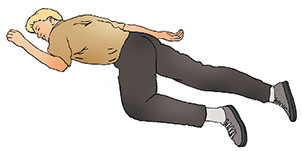
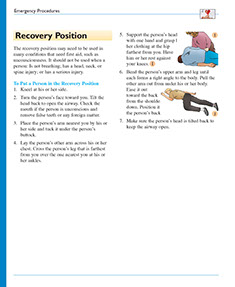
    The recovery position may need to be used in many conditions that need first aid, such as unconsciousness. It should not be used when a person: Is not breathing; has a head, neck, or spine injury; or has a serious injury.

    To Put a Person in the Recovery Position

    1.  Kneel at his or her side.

    2.  Turn the person’s face toward you. Tilt the head back to open the airway. Check the mouth if the person is unconscious and remove false teeth or any foreign matter.

    3.  Place the person’s arm nearest you by his or her side and tuck it under the person’s buttock.

    4.  Lay the person’s other arm across his or her chest. Cross the person’s leg that is farthest from you over the one nearest you at his or her ankles.

    5.  Support the person’s head with one hand and grasp his or her clothing at the hip farthest from you. Have him or her rest against your knees. See image A.

    6.  Bend the person’s upper arm and leg until each forms a right angle to the body. Pull the other arm out from under his or her body. Ease it out toward the back from the shoulder down. Position it parallel to the person’s back. See image B.

    7.  Make sure the person’s head is tilted back to keep the airway open.

    Illustration on how to place a person in the recovery position.

    Image A

    Illustration on how to put a person in a recovery position.

    Image B

    Healthier at Home book by the American Institute for Preventive Medicine. www.HealthyLife.com. All rights reserved.

    © American Institute for Preventive Medicine

  • Seizures

    Children’s Health

    And How to Keep Your Child From Getting Fever Seizures

    Signs, Symptoms & Causes

    A seizure is like a short-circuit in the brain. Information in nerves in the brain gets mixed up. There are many forms of seizures.

    A general seizure. This affects the whole brain. A convulsion happens with this kind. These are signs of a convulsion.

    *  The neck muscles or all the body muscles get stiff.

    *  The arms or legs jerk around.

    *  The eyes roll up and back in the head.

    *  The child falls down.

    *  The child blacks out.

    *  The child wets or soils his or her clothes.

    An absence seizure. A convulsion does not happen with this kind of seizure. These are signs of this kind of seizure:

    *  The child stares into space. It looks like the child is not paying attention.

    *  The child smacks his or her lips.

    *  The child may blink over-and-over.

    Seizures that come with a high fever.

    In fact, high fevers cause most seizures in children ages 6 months to 5 years old. This happens when the body’s own temperature control isn’t working just right yet.

    Sicknesses that make a child’s temperature go up fast can bring on seizures. Here are some other causes of seizures:

    *  Epilepsy.

    *  Poisons.

    *  Infections that cause a high fever.

    *  Drugs.

    *  Reye’s Syndrome.

    *  Snakebites.

    *  Some vaccinations.

    Most seizures last from 1 to 5 minutes. Short seizures don’t cause problems unless the child stops breathing and turns blue. But a seizure that lasts longer than 5 minutes can be a sign of a big problem. Let your child’s doctor know if your child has any kind of seizure.

    How to Keep Your Child From Getting Fever Seizures

    Keep trying to bring the fever down until it is 101ºF or less. Try to bring your child’s fever down fast:

    *  Dress your child in light, loose clothes or take off most of his or her clothes.

    *  Ask your doctor about fever-lowering suppositories.

    *  Put washcloths rinsed in lukewarm (not cold) water on your child’s forehead and neck. Don’t use rubbing alcohol.

    *  Give your child acetaminophen or ibuprofen. Make sure you give the right kind and dose for his or her weight. Do this if the fever gets above 103°F. (Note: Do not give aspirin. Aspirin and other medicines that have salicylates have been linked to Reye’s Syndrome.)

    Questions to Ask

    Self-Care

    Don’t panic! A fever seizure will stop by itself in a few minutes. The two things you can do are:

    *  Try to keep your child from getting hurt during the seizure.

    *  Lower his or her fever.

    Follow these tips during the seizure:

    *  Protect your child from falling and hitting his or her head. (Watch out for tables and sharp things.)

    *  Make sure your child can breathe:

    – Roll the child on his or her side so spit can drain from the mouth.

    – Gently pull on the jaw and bend the neck back. (This opens up the throat.)

    *  Don’t put anything in your child’s mouth. Children hardly ever bite their tongues during a fever seizure.

    *  Don’t give your child any medicine, food, or drink by mouth.

    Follow these tips after the seizure:

    *  If the seizure was from a fever, start lowering the fever. Sponge your child’s body with lukewarm water. Don’t use rubbing alcohol. Don’t put the child in a bathtub. Don’t use an ice pack. It drops the temperature too fast.

    *  Your child will probably be sleepy after the seizure. He or she may not remember anything. This is O.K.

    *  Dress the child in light, loose clothes. Put him or her to sleep in a cool room.

    *  Let your child’s doctor know about the seizure.

    Children's Self-Care book by the American Institute for Preventive Medicine. www.HealthyLife.com. All rights reserved.

    © American Institute for Preventive Medicine

  • Seizures 2

    First Aid

    A seizure is a sudden “episode” caused by an electrical problem in the brain. With a seizure, a person has change in awareness, body movements, or sensation.

    Signs & Symptoms

    There are many types of seizures. Common types are:

    A Generalized Tonic Clonic Seizure

    This is also called a grand mal seizure. A convulsion occurs with this type. Signs of a convulsion include:

    *  Brief loss of consciousness. Falling down.

    *  The arms and legs stiffen, jerk, and twitch.

    *  This type usually lasts 1 to 2 minutes. When it ends, the person’s muscles relax. He or she may lose bladder control, be confused, have a headache, and fall asleep. This is the type most people think of with the word “seizure.”

    An Absence Seizure

    This is also called a petit mal seizure. A convulsion does not occur with this type. Signs of an absence seizure include:

    *  Blank stares. It looks like the person is daydreaming or not paying attention.

    *  Lip smacking. Repeated blinking, chewing or hand movements.

    *  This type of seizure usually lasts only a few seconds, but can occur many times a day. When the seizure ends, the person is not confused, but is not aware that the seizure occurred.

    *  Absence seizures are common in children and can result in learning problems.

    A Fever (Febrile) Seizure

    This type is brought on by a high fever in infants and small children. High fevers cause most seizures in children aged 6 months to 5 years. Signs are ones of a convulsion listed in the left column. Most febrile seizures last 1 to 2 minutes, but can last longer. Seeing a child have a febrile seizure causes alarm. In general, these seizures are harmless.

    Causes

    Causes include epilepsy (a brain disorder), infections that cause a high fever, heat stroke, and electric shock. Head injury, stroke, and toxic substances can also cause a seizure. Sometimes the cause of a seizure is not known.

    Treatment

    Seizure disorders are treated with medication. Other medical treatments may be needed.

    Questions to Ask

    Self-Care / First Aid

    For Seizures with Convulsions

    *  Stay calm. Protect the person from injury. Cushion the head with a pillow, a coat, etc. Move sharp objects out of the way.

    *  Loosen tight clothes, especially around the neck.

    *  If the person vomits, clear the mouth of it.

    *  Do not hold the person down or throw water on the face. Don’t put anything into the mouth. (A spoon in the mouth does not prevent tongue biting.)

    *  If the seizure in a child is due to a fever, start bringing the child’s temperature down as soon as the seizure stops. Sponge the child’s body with room temperature water. Do not put the child in a bathtub. Do not use ice. Do not use rubbing alcohol.

    *  Report how long the seizure lasts and the symptoms that occur.

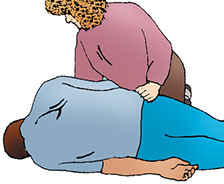
    *  After the seizure, lay the person on his or her side. Let the person sleep. Check for a medical alert tag. Respond as needed. Do not embarrass the person.

    *  Call 9-1-1 (except for a febrile seizure or a seizure in a person you know has a seizure disorder).

    Febrile Seizure Prevention

    For a child who has had a febrile seizure in the past, give acetaminophen or ibuprofen at the first sign of a fever. Give the right kind and dose for his or her weight. Insert suppositories that lower fevers, instead, if prescribed by the child’s doctor. {Note: Don’t give aspirin to anyone less than 19 years old.}

    *  Dress the child in light, loose clothes.

    *  Apply washcloths rinsed in lukewarm (not cold) water to your child’s forehead and neck. Sponge the child’s arms, legs, and trunk with lukewarm water. Don’t use cold water, ice, or rubbing alcohol.

    *  Keep trying to bring the fever down until it is 101ºF or less.
    Healthier at Home book by the American Institute for Preventive Medicine. www.HealthyLife.com. All rights reserved.

    © American Institute for Preventive Medicine