Tag: fit

  • Different Shoes For Different Sports

    BE FIT

    Pair of shoes with apple and water bottle.

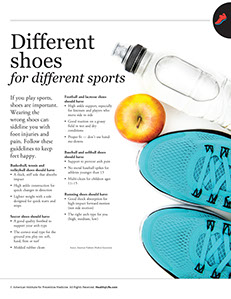
    If you play sports, shoes are important. Wearing the wrong shoes can sideline you with foot injuries and pain. Follow these guidelines to keep feet happy.

    Basketball, tennis and volleyball shoes should have:

    *  A thick, stiff sole that absorbs impact

    *  High ankle construction for quick changes in direction

    *  Lighter weight with a sole designed for quick starts and stops

    Soccer shoes should have:

    *  A good quality footbed to support your arch type

    *  The correct stud type for the ground you play on: soft, hard, firm or turf

    *  Molded rubber cleats

    Football and lacrosse shoes should have:

    *  High ankle support, especially for linemen and players who move side to side

    *  Good traction on a grassy field in wet and dry conditions

    *  Proper fit – don’t use hand-me-downs

    Baseball and softball shoes should have:

    *  Support to prevent arch pain

    *  No metal baseball spikes for athletes younger than 13

    *  Multi-cleats for children ages 11-15

    Running shoes should have:

    *  Good shock absorption for high-impact forward motion (not side motion)

    *  The right arch type for you (high, medium, low)

    Source: American Podiatric Medical Association
    © American Institute for Preventive Medicine
  • Workout Wear 101

    BE FIT

    Women riding stationary bike.

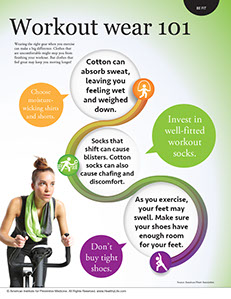
    Wearing the right gear when you exercise can make a big difference. Clothes that are uncomfortable might stop you from finishing your workout. But clothes that feel great may keep you moving longer!

    *  Choose moisture-wicking shirts and shorts. Cotton can absorb sweat, leaving you feeling wet and weighed down.

    *  Invest in well-fitted workout socks. Socks that shift can cause blisters. Cotton socks can also cause chafing and discomfort.

    *  Don’t buy tight shoes. As you exercise, your feet may swell. Make sure your shoes have enough room for your feet.

    Source: American Heart Association

    © American Institute for Preventive Medicine
  • How To Buy Sports Shoes That Fit

    Fitness

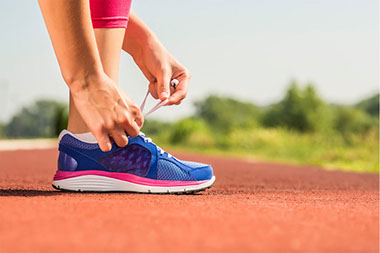
    Image of person lacing tennis shoe.

    A carpenter needs a saw, a painter needs a brush, and an accountant needs a calculator. And anyone who’s serious about fitness needs a good pair of shoes (or several, if you’re active in more than one activity besides swimming). The right shoes can make the difference between comfort and discomfort, between safety and injury, between performing well and not performing well.

    Consider these factors before you buy activewear shoes.

    *  Are the shoes suitable for the sport or activity for which you intend to wear them? Walking, hiking, racquetball, tennis, aerobics, and so forth require differently designed footwear. But you may want to consider cross-training shoes, suitable for several different activities.

    *  Can you wiggle your toes in the shoes while sitting and standing? (You should be able to.)

    *  Does the widest area of your foot correspond to the widest area of the shoe? (To find out, try this: Stand on a piece of paper, bend down, and trace a line around each shoe with a pencil. Then slip off your shoes, stand in the same place, and trace a line around each foot with a different colored pencil. If at any point the outline of your feet is larger than the outline of your shoes, you’re squeezing some or all of the bones, ligaments and muscles in each foot.)

    *  Do the inner seams rub against your foot? (They shouldn’t.)

    *  Does the shoe have a firm heel cradle and arch support?

    *  Does the shoe provide adequate shock absorption?

    *  Are the shoes comfortable when you move from side to side or when you walk or jump? Test these movements before you buy.

    Good shoes don’t need to be “broken in.” The shoes you buy should be comfortable from the start.

    Page image from A Year of Health Hints book by the American Institute for Preventive Medicine. www.HealthyLife.com. All rights reserved.

    © American Institute for Preventive Medicine
  • Choosing A Doctor Or Health Care Provider

    Medical Care

    Finding the right doctor or health care provider for you is a big part of your medical care. Don’t wait until you get sick to find one. When you look for or change doctors, follow these tips:

    *  Look for one who accepts your health plan. Check with the plan. Ask the person at work who handles employee benefits.

    *  If you belong to a managed care plan, get a list of providers who work with the plan. Health Maintenance Organizations (HMOs) and Preferred Provider Organizations (PPOs) are two types of managed care plans. The doctor(s) you see now may be on your HMO or PPO list.

    *  Ask relatives and friends for doctors they trust and have given them good medical care.

    *  Find out if a doctor is taking new patients. Check with your health plan. Call the doctor’s office.

    *  Look for a doctor you can relate to. How do you want medical decisions to be made? The doctor alone? You and the doctor together? Find one that meets your needs.

    *  Ask about office hours and staffing. Ask how many patients are scheduled to be seen in an hour and how long they usually wait to see the doctor.

    *  Ask how payment is handled. Must you pay at the time of your visit or can you be billed?

    *  Find out what other providers serve as backups when the doctor is away. Ask what you should do at non-office hour times.

    *  Find out which hospital(s) the doctor or provider sends patients to.

    *  Look for a doctor who is competent and can care for all your general health needs. Ask if and who the doctor will refer you to for any special health needs.

    Resources

    American Board of Medical Specialties (ABMS)

    866.ASK.ABMS (275.2267)

    www.abms.org

    Federation of State Medical Boards

    888.ASK.FCVS (275.3287)

    www.fsmb.org

    Health Grades

    www.healthgrades.com

    U.S. Department of Health & Human Services

    www.healthfinder.gov

    Page from the Healthier at Home book by the American Institute for Preventive Medicine. www.HealthyLife.com. All rights reserved.

    © American Institute for Preventive Medicine
  • Guard Against Denture Trouble

    Mature Health: Over Age 50

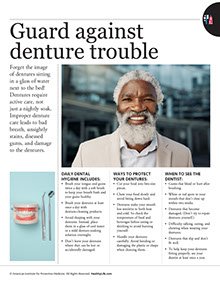
    Close up image of a mature women smiling showing her dentures.

    Forget the image of dentures sitting in a glass of water next to the bed! Dentures require active care, not just a nightly soak. Improper denture care leads to bad breath, unsightly stains, diseased gums, and damage to the dentures. Daily dental hygiene should include these measures.

    *  Brush your tongue and gums with a soft brush to keep your breath fresh and your gums healthy.

    *  Brush your dentures at least once a day with denture-cleaning products.

    *  Rinse your mouth with a mild salt-water solution (1 teaspoon of ordinary table salt in 1/2 cup warm water) after meals and before going to bed.

    *  Don’t leave your dentures where they can be lost or accidentally damaged.

    How you eat can also protect your dentures, so take these precautions.

    *  Cut your food into bite-size pieces.

    *  Chew your food slowly and avoid biting down hard.

    *  Dentures make your mouth less sensitive to both heat and cold. So check the temperature of food and beverages before eating or drinking to avoid burning yourself.

    To help keep your dentures fitting properly, see your dentist at least once a year. See your dentist if you have any of the following problems.

    *  Gums that bleed or hurt after brushing.

    *  White or red spots in your mouth that don’t clear up within two weeks.

    *  Dentures that become damaged. (Don’t try to repair dentures yourself.)

    *  Difficulty talking, eating, and chewing when wearing your dentures.

    *  Dentures that slip and don’t fit well.

    A Year of Health Hints book by the American Institute for Preventive Medicine. www.HealthyLife.com. All rights reserved.

    © American Institute for Preventive Medicine

  • Be Physically Active

    Healthylife® Weigh

    Part 5

    Group of friends outside exercising.

    All physical activity has benefits for the body and mind. This section will help you find reasons to be active that go beyond weight management. This section will also help you to:

    *  Add variety to the physical activity you already enjoy.

    *  Value different types of activity that have different benefits.

    *  Make a plan to be more physically active.

    *  Manage time and other barriers to do physical activity.

    *  Develop a healthy relationship with your body.

    *  Appreciate what your body is capable of doing.

    HealthyLife® Weigh

    QUICK LINKS: PART 5

    Current Exercise Habits

    Find Reasons to Care About Physical Activity

    Mental Health

    Energy, Learning, Focus

    Physical Health

    Exercise and Sleep

    Reduce Sit-Time

    Do Activities You Enjoy

    Types of Physical Activity

    Cardio Training

    Resistance Training

    Stretching & Rehabilitation

    Yoga

    Massage

    Avoid Injury

    Appreciate the Journey

    Set Fitness Goals

    Plan Physical Activity

    Tackle Limitations

    Injury and Disability

    Manage Your Time

    Set Up for Success

    What Are You Waiting For?

    Responsibility for Change

    Create “If, Then” Plans

    Exercise and Eating

    Eating and Body Image

    How Do You View Your Body?

    Identify Disordered Eating

    Review and Prepare

    © American Institute for Preventive Medicine