Tag: flare

  • Gout: Relief At Last

    Abdominal & Urinary Conditions

    If you wake up in the middle of the night with excruciating pain in your big toe, you could have gout. Or perhaps your instep, heel, ankle, or knee hurts. How about your wrists and elbows? Your joints can become so inflamed that even rubbing against the bed sheet can be torture. You may even experience fever and chills.

    Gout is a form of arthritis most common in men in their fifties. It is caused by increased blood levels of uric acid, produced by the breakdown of protein in the body. When blood levels of uric acid rise above a critical level, thousands of hard, tiny uric acid crystals collect in the joints. These crystals act like tiny, hot, jagged shards of glass, resulting in pain and inflammation. Crystals can collect in the tendons and cartilage, in the kidneys (as kidney stones), and in the fatty tissues beneath the skin.

    A gout attack can last several hours to a few days and can be triggered by:

    *  Mild trauma or blow to the joint.

    *  Drinking alcohol (beer and wine more so than distilled alcohol).

    *  Eating a diet rich in red meat (especially organ meats such as liver, kidney, or tongue).

    *  Eating sardines or anchovies.

    *  Taking certain drugs, such as diuretics.
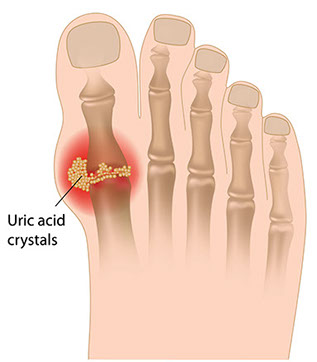
    Illustration of gout.

    Don’t assume you have gout without consulting a physician. Many conditions can mimic an acute attack of gout (including infection, injury, or rheumatoid arthritis). A doctor can accurately diagnose your problem.

    If you do have gout, treatment will depend on why your uric acid levels are high. Your doctor can conduct a simple test to determine whether your kidneys aren’t clearing uric acid from the blood the way they should, or whether your body simply produces too much uric acid.

    The first goal, then, is to relieve the acute gout attack. The second goal is to normalize the uric acid levels to prevent a recurrence.

    *  For immediate relief, your doctor may prescribe colchicine or a nonsteroidal anti-inflammatory drug and tell you to rest the affected joint.

    *  For long-term relief, your doctor will probably recommend that you lose excess weight, limit your intake of alcohol and red meat, drink lots of liquids, and take medication (if necessary).

    A Year of Health Hints book by the American Institute for Preventive Medicine. www.HealthyLife.com. All rights reserved.

    © American Institute for Preventive Medicine
  • Multiple Sclerosis

    Brain & Nervous System

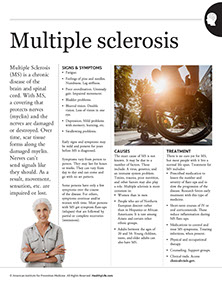
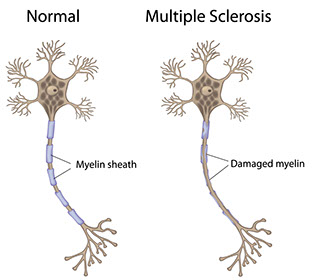
    Multiple Sclerosis (MS) is a chronic disease of the brain and spinal cord. With MS, a covering that protects nerves (myelin) and the nerves are damaged or destroyed. Over time, scar tissue forms along the damaged myelin. Nerves can’t send signals like they should. As a result, movement, sensation, etc. are impaired or lost.

    Illustration showing multiple sclerosis.

    Signs & Symptoms

    *  Fatigue.

    *  Feelings of pins and needles. Numbness. Leg stiffness.

    *  Poor coordination. Unsteady gait. Impaired movement.

    *  Bladder problems.

    *  Blurred vision. Double vision. Loss of vision in one eye.

    *  Depression. Mild problems with memory, learning, etc.

    *  Swallowing problems.

    Early signs and symptoms may be mild and present for years before MS is diagnosed.

    Symptoms vary from person to person. They may last for hours or weeks. They can vary from day to day and can come and go with no set pattern.

    Some persons have only a few symptoms over the course of the disease. For others, symptoms continue and/or worsen with time. Most persons with MS get symptom flare-ups (relapses) that are followed by partial or complete recoveries (remissions).

    Causes

    The exact cause of MS is not known. It may be due to a number of factors. These include: A virus, genetics, and an immune system problem. Toxins, trauma, poor nutrition, and other factors may also play a role. Things known to come before the onset of MS include: Overwork; fatigue, the postpartum period for women; acute infections; and fevers. Multiple sclerosis is more common in:

    *  Women than in men.

    *  Caucasians than in Hispanics or African Americans. It is rare among Asians and certain other ethnic groups.

    *  Adults between the ages of 20 and 50. Young children, teens, and older adults can also have MS.

    *  People who are born and live up to at least age 15 years old in places farther from the equator. These include North America, Europe, and Southern Australia.

    Treatment

    There is no cure yet for MS, but most people with it live a normal life span. Treatment for MS includes:

    *  Prescribed medication to lessen the number and severity of flare-ups and to slow the progression of the disease. Research favors early treatment with this type of medicine.

    *  Short-term courses of IV or oral corticosteroids. These reduce inflammation during MS flare-ups.

    *  Medications to control and treat MS symptoms. Treating infections, when present.

    *  Physical and occupational therapy.

    *  Counseling. Support groups.

    *  Clinical trails. Accesswww.clinicaltrials.gov.

    Questions to Ask

    Self-Care / Prevention

    *  Follow your doctor’s guidelines for home care.

    *  Maintain a normal routine at work and at home. Avoid activities that lead to fatigue or put too much physical stress on the body. Get plenty of rest.

    *  Manage emotional stress.

    *  Avoid the heat and sun. Don’t take hot showers or baths. Increased body temperature can cause symptoms. Cool baths or swimming in a pool may improve symptoms by lowering body temperature.

    *  Have body massages to help maintain muscle tone.

    *  Treat a fever as soon as it occurs.

    *  Get regular exercise. Physical therapy may be helpful.

    *  Get counseling, if needed.

    *  Get a seasonal flu shot every year and other vaccines as advised.

    *  If you smoke, quit!

    Resources

    Multiple Sclerosis Foundation

    888.MS.FOCUS (673.6287)

    www.msfocus.org

    National Multiple Sclerosis Society

    800.FIGHT.MS (344.4867)www.nationalmssociety.org

    Healthier at Home book by the American Institute for Preventive Medicine. www.HealthyLife.com. All rights reserved.

    © American Institute for Preventive Medicine