Tag: flu

  • Covid-19, Cold, Flu, Or Allergy?

    SELF-CARE CORNER

    Women wearing a face mask.

    Know the difference

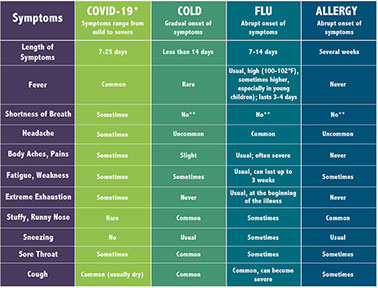
    You’re feeling pretty lousy. You’ve got sniffles, sneezing, and a sore throat. Is it COVID-19, a cold, flu, or allergies? It can be hard to tell them apart because they share so many symptoms. But understanding the differences will help you choose the best treatment.

    Comparison chart of symptoms between COVID-19, Cold, Flu and Allergies.

    © American Institute for Preventive Medicine

  • Stop The Spread Of Respiratory Infections

    MEDICAL NEWS

    Women sitting with a portable oxygen mask.

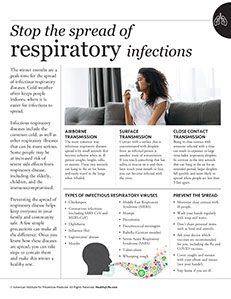
    The winter months are a peak time for the spread of infectious respiratory diseases. Cold weather often keeps people indoors, where it is easier for infections to spread.

    Infectious respiratory diseases include the common cold, as well as other respiratory illnesses that can be more serious. Some people may be at increased risk of severe side effects from respiratory disease, including the elderly, children, and the immunocompromised.

    Preventing the spread of respiratory disease helps keep everyone in your family and community safe. A few simple precautions can make all the difference. Once you know how these diseases are spread, you can take steps to contain them and make this winter a healthy one.

    Airborne transmission

    The most common way infectious respiratory diseases spread is by small aerosols that become airborne when an ill person coughs, laughs, talks, or sneezes. These tiny aerosols can hang in the air for hours and easily travel to the lungs when inhaled.

    Surface transmission

    Contact with a surface that is contaminated with droplets from an infected person is another route of transmission. If you touch something that has saliva or mucus on it and then later touch your mouth or face, you can become infected with the virus.

    Close contact transmission

    Being in close contact with someone infected with a virus can result in exposure to large virus-laden respiratory droplets. In contrast to the tiny aerosols that can hang in the air for an extended period, larger droplets fall quickly and most likely to spread when people are less than 3 feet apart.

    Types of infectious respiratory viruses

    *  Chickenpox

    *  Coronavirus infections (including SARS-CoV and MERS-CoV)

    *  Diphtheria

    *  Influenza (flu)

    *  Legionnaires’ disease

    *  Measles

    *  Middle East Respiratory Syndrome (MERS)

    *  Mumps

    *  Pneumonia

    *  Pneumococcal meningitis

    *  Rubella (German measles)

    *  Severe Acute Respiratory Syndrome (SARS)

    *  Tuberculosis

    *  Whooping cough

    Prevent the spread

    *  Minimize close contact with ill people.

    *  Wash your hands regularly with soap and water.

    *  Don’t share personal items such as food and utensils.

    *  Ask your doctor which vaccines are recommended for you, including the flu and COVID vaccines.

    *  Cover coughs and sneezes with your elbow and tissues (not your hands!).

    *  Stay home if you are ill.

    © American Institute for Preventive Medicine

  • Cold, Flu, Or Allergy?

    SELF-CARE CORNER

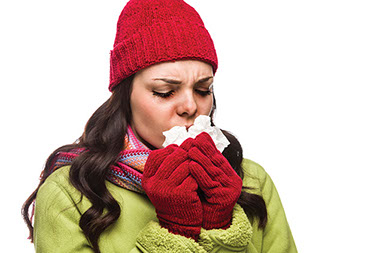
    Image of young women dressed warmly coughing into a tissue.

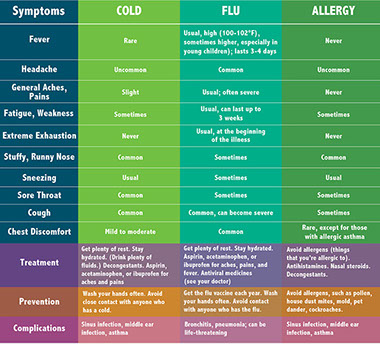
    You’re feeling pretty lousy. You’ve got sniffles, sneezing, and a sore throat. Is it a cold, flu, or allergies? It can be hard to tell them apart because they share so many symptoms. But understanding the differences will help you choose the best treatment, advises the NIH News in Health.

    Chart showing symptoms of a cold vs the flu vs an allergy.

    © American Institute for Preventive Medicine

  • Is It The Flu?

    MEDICAL NEWS

    Image with the words "Fight the Flu" written in a banner.

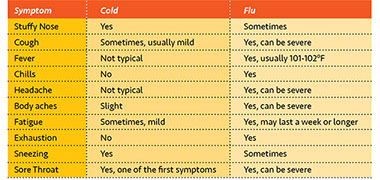
    Influenza, or the flu, circulates every winter and leaves thousands of people sick with a cough, aches, fever, and fatigue. The flu is much more serious than a cold: thousands of people die each year from flu-related complications. Unfortunately, many people don’t realize they have the flu until it’s too late. By then, they may have exposed people at work, school, or other public places. Here’s how to know if you have the flu, or just a cold:

    Chart showing symptoms of the cold vs the flu.

    When you come down with a cold, your symptoms usually appear very gradually over a few days. They often start with a sore throat followed by a runny nose. The flu often hits hard, very quickly. Symptoms appear suddenly and the exhaustion and aches can quickly become severe.

    If in doubt, try to stay home and stay away from others when you’re sick. In particular, try to avoid exposing young children and older adults, who may be more likely to suffer from flu-related problems. Wash your hands frequently and encourage others in your household to do the same.

    If you think you have the flu, call your doctor right away. You may be able to take an antiviral medication (brand name: Tamiflu), which can decrease your symptoms and the amount of time you are sick. Antiviral medications should be taken within 48 hours of the start of symptoms.

    Finally, talk to your doctor about getting a flu shot each year: it’s the number one way to help avoid getting – and spreading – the flu!

    Sources: Centers for Disease Control, U.S. Department of Veterans Affairs

    © American Institute for Preventive Medicine