Tag: fluid

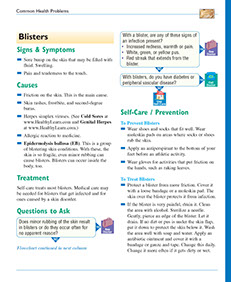
  • Blisters

    Skin Conditions

    Signs & Symptoms

    *  Sore bump on the skin that may be filled with fluid. Swelling.

    *  Pain and tenderness to the touch.

    Causes

    *  Friction on the skin. This is the main cause.

    *  Skin rashes, frostbite, and second-degree burns.

    *  Herpes simplex viruses.

    *  Allergic reaction to medicine.

    *  Epidermolysis bullosa (EB). This is a group of blistering skin conditions. With these, the skin is so fragile, even minor rubbing can cause blisters. Blisters can occur inside the body, too.

    Treatment

    Self-care treats most blisters. Medical care may be needed for blisters that get infected and for ones caused by a skin disorder.

    Questions to Ask

    Self-Care / Prevention

    To Prevent Blisters

    *  Wear shoes and socks that fit well. Wear moleskin pads on areas where socks or shoes rub the skin.

    *  Apply an antiperspirant to the bottom of your feet before an athletic activity.

    *  Wear gloves for activities that put friction on the hands, such as raking leaves.

    To Treat Blisters

    *  Protect a blister from more friction. Cover it with a loose bandage or a moleskin pad. The skin over the blister protects it from infection.

    *  If the blister is very painful, drain it. Clean the area with alcohol. Sterilize a needle. Gently, pierce an edge of the blister. Let it drain. If no dirt or pus is under the skin flap, pat it down to protect the skin below it. Wash the area well with soap and water. Apply an antibiotic ointment and cover it with a bandage or gauze and tape. Change this daily. Change it more often if it gets dirty or wet.

    Healthier at Home book by the American Institute for Preventive Medicine. www.HealthyLife.com. All rights reserved.

    © American Institute for Preventive Medicine

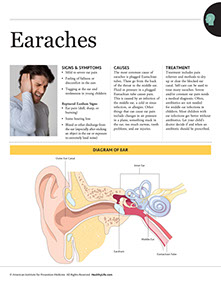
  • Earaches

    Ear, Nose & Throat Conditions

    Signs & Symptoms

    *  Mild to severe ear pain.

    *  Feeling of fullness or discomfort in the ears.

    *  Tugging at the ear and restlessness in young children.

    *  Ear pain.

    *  Some hearing loss.

    *  Blood or other discharge from the ear (especially after sticking an object in the ear or exposure to extremely loud noise).

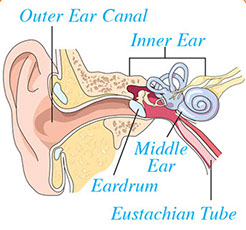
    Illustration of ear.

    Causes

    The most common cause of earaches is plugged Eustachian tubes. These go from the back of the throat to the middle ear. Fluid or pressure in a plugged Eustachian tube causes pain. This is caused by an infection of the middle ear, a cold or sinus infection, or allergies. Other things that can cause ear pain include changes in air pressure in a plane, something stuck in the ear, too much earwax, tooth problems, and ear injuries.

    Treatment

    Treatment includes pain relievers and methods to dry up or clear the blocked ear canal. Self-care can be used to treat many earaches. Severe and/or constant ear pain needs a medical diagnosis. Often, antibiotics are not needed for middle ear infections in children. About 8 in 10 children with ear infections get better without antibiotics. Let your child’s doctor decide if and when an antibiotic should be prescribed.

    Questions to Ask

    Self-Care / Prevention

    To Help Prevent Ear Pain

    *  Don’t put cotton-tipped swabs, bobby pins, etc., in your ears. This could damage the eardrum.

    *  Don’t blow your nose with too much force.

    *  If you can, avoid places that have very loud noises (construction sites, etc.). Wear earplugs when exposed to loud noises.

    *  Keep the volume on low when using stereos, compact discs (CDs), etc. If someone else can hear the music when you are listening to one of these devices with earphones, the volume is too loud.

    To Avoid Getting “Swimmer’s Ear”

    *  Wear wax or silicone earplugs.

    *  Wear a bathing cap.

    *  Don’t swim in dirty water. Swim on the surface not underneath the water.

    *  Use an over-the-counter product, such as Swim-Ear, as directed.

    To Reduce Ear Pain

    *  Place a warm washcloth next to the ear. Some health professionals recommend putting an ice bag or ice in a wet washcloth over the painful ear for 20 minutes.

    *  Take an over-the-counter medicine for pain as directed on the label.

    To Open Up the Eustachian Tubes and Help Them Drain

    *  Sit up. Prop your head up when you sleep.

    *  Yawn. This helps move the muscles that open the Eustachian tubes.

    *  Chew gum or suck on hard candy. (Do not give to children under age 5.) This tip is especially helpful during pressure changes that take place during air travel, but can also help if you wake up with ear pain.

    *  When traveling by air, stay awake when the plane takes off and lands. Wear ear plugs.

    *  Take a steamy shower.

    *  Use a cool-mist vaporizer, especially at night.

    *  Drink plenty of cool water.

    *  Gently, but firmly, blow through your nose while holding both nostrils closed until you hear a pop. This can be done several times a day.

    *  If okay with your doctor, take a decongestant to help relieve the swelling that causes the pain. (Don’t use a nasal spray decongestant for more than 3 days unless directed by your doctor.)

    *  When you give a baby a bottle, hold the baby in an upright position.

    To Treat a Mild Case of “Swimmer’s Ear”

    The goal is to clean and dry the outer ear canal without doing further damage to the top layer of skin.

    *  Shake the head to expel trapped water.

    *  Dry the ear canal. Get a clean facial tissue. Twist each corner into a tip and gently place each tip into the ear canal for 10 seconds. Repeat with the other ear using a new tissue.

    *  Use an over-the-counter product, such as Swim-Ear. Drop it into the ears to fight infection. Follow package directions.

    *  Do not remove earwax. This protects the ear canal.

    For an Insect in the Ear

    Shine a flashlight into the ear. Doing this may cause the insect to come out.

    Resources

    National Institute on Deafness and Other Communication Disorders (NIDCD)

    800.241.1044

    www.nidcd.nih.gov

    Healthier at Home book by the American Institute for Preventive Medicine. www.HealthyLife.com. All rights reserved.

    © American Institute for Preventive Medicine

  • Heart Failure

    Heart & Circulation Problems

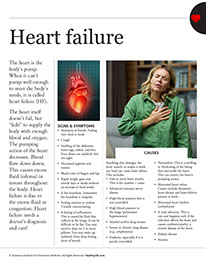
    The heart is the body’s pump. When it can’t pump well enough to meet the body’s needs, it is called heart failure (HF). The heart itself doesn’t fail, but “fails” to supply the body with enough blood and oxygen. The pumping action of the heart decreases. Blood flow slows down. This causes excess fluid (edema) in tissues throughout the body. The term congestive heart failure, used in the past, is due to the excess fluid or congestion. Heart failure needs a doctor’s diagnosis and care!

    Signs & Symptoms

    *  Shortness of breath.

    *  Feeling very tired or weak.

    *  Dry cough or a cough with pink, frothy mucus.

    *  Swelling of the lower legs, ankles, and feet. Your shoes can suddenly feel too tight.

    *  Decreased appetite and nausea.

    *  Rapid weight gain over several days or weeks without an increase in food intake. You could gain up to 1 pound a day.

    *  A fast heartbeat. Sometimes the heartbeat is irregular.

    *  Feeling anxious or restless.

    *  A feeling of suffocation. This is caused by fluid that collects in the lungs. It can be difficult to lie flat. You may need to sleep on 2 or more pillows. You may wake up suddenly from sleep feeling short of breath.

    Causes

    Anything that damages the heart muscle or makes it work too hard can cause heart failure. This includes:

    *  One or more heart attacks. This is the number 1 cause.

    *  Advanced coronary artery disease.

    *  High blood pressure that is not controlled.

    *  High blood pressure in the lungs (pulmonary hypertension).

    *  Alcohol and/or drug abuse.

    *  Severe or chronic lung disease (e.g., emphysema).

    *  Diabetes, especially if it is poorly controlled.

    *  Pericarditis. This is a swelling or thickening of the lining that surrounds the heart. This can restrict the heart’s pumping action.

    *  Abnormal heart valves. Causes include rheumatic heart disease and heart defects present at birth.

    *  Abnormal heart rhythm.

    *  A viral infection. This is rare and happens only if the infection affects the heart and causes cardiomyopathy, a muscle disease of the heart.

    Diagnosis

    Ways to Diagnose Heart Failure:

    *  A medical history and physical exam. Blood and urine tests.

    *  A chest X-ray to see if the heart is enlarged and if the lungs are congested.

    *  An ECG (also called EKG) to look for an enlarged heart, heart muscle damage, and abnormal heart rhythms.

    *  An echocardiogram. This test uses sound waves to show the heart’s size, shape, and movement.

    *  An exercise stress test.

    *  A cardiac catheterization. This test diagnoses coronary artery disease and checks for past heart attacks.

    Self-Care / Prevention

    Some causes of heart failure can be prevented. These include heart attacks, coronary artery disease, high blood pressure, rheumatic fever, and substance abuse.

    To Prevent Heart Attacks and Coronary Artery Disease:

    *  Don’t smoke. If you smoke, quit!

    *  Have regular medical checkups. Get your blood pressure checked at each office visit or at least every 2 years. Get your blood cholesterol tested as advised by your doctor.

    *  Take all medicines as prescribed. These include ones for high blood pressure, etc.

    *  Ask your provider about taking a low dose of aspirin (e.g., 1 baby aspirin) daily.

    *  Get to or stay at a healthy body weight.

    *  Strictly limit or avoid alcohol.

    *  Do regular physical activity. {Note: Talk to your health care provider before you start an exercise program. This is important if you have been inactive for a long period of time, are overweight, are over age 35, or have any medical problems.}

    *  Get a test to screen for diabetes as advised by your doctor. Having diabetes and high blood cholesterol increase the risk for heart disease.

    Self-Care

    *  Weigh yourself daily to check for excess fluid weight gain. Keep a record of what you weigh. Take it with you when you visit your health care provider. Call your provider, though, if your weight increases suddenly (3 or more pounds in 1 day).

    *  Limit sodium (part of salt) to about 2,000 milligrams per day.

    *  Limit fluids as advised by your health care provider.

    *  Have 5 to 6 small (instead of 3 large) meals a day.

    *  Stay as active as you can.

    *  Do not have more than one alcoholic drink a day, if at all. One drink equals 4 to 5 oz. of wine; 12 oz. of beer; or 1-1⁄2 oz. of 80 proof liquor.

    *  Eat healthy.

    *  Exercise on a regular basis as advised by your health care provider.

    *  Modify your daily activities as needed so you don’t place too heavy a demand on your heart. Alternate activity with periods of rest.

    *  Sit up when you rest, if this makes breathing easier. Sleep on 2 or more pillows and/or raise the head of your bed 6 inches when you sleep.

    *  Don’t smoke. If you do, quit!

    *  Lose weight if you are overweight.

    *  Follow your health care provider’s treatment program. Take your medication(s) as prescribed.

    Medical Care

    Call Health Care Provider For:

    *  A new onset of shortness of breath or fatigue when you do your normal activities or lie down.

    *  A new onset of swelling in the ankles and feet and it is harder to breathe when you lie down flat.

    *  Coughing up pink or frothy mucus with mild shortness of breath.

    *  An unexplained weight gain of 3 to 5 pounds.

    *  Having heart failure and you have symptoms of a cold or flu. These may add stress to your heart.

    *  Having heart failure and your symptoms worsen.

    Get Immediate Care For:

    *  Severe shortness of breath (you are too short of breath to say a few words) with or without wheezing (a high pitched whistling sound).

    *Heart Attack Warning Signs

    Resources

    American Heart Association

    800.242.8721

    www.heart.org/HEARTORG

    National Heart, Lung, and Blood Institute

    www.nhlbi.nih.gov
    Heart Failure brochure by the American Institute for Preventive Medicine. www.HealthyLife.com. All rights reserved.

    © American Institute for Preventive Medicine