Tag: focus

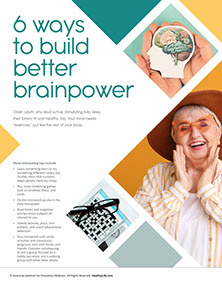
  • Six Ways To Build Better Brainpower

    Mature Health: Over Age 50

    Image of adults writing and using a computer.

    Research shows that older adults who lead active, stimulating lives keep their brains fit and healthy, too. Your mind needs “exercise,” just like the rest of your body.

    Some mind-stimulating tips include:

    *  Learn something new-or try something different-every day. Studies show that curiosity keeps people mentally sharp.

    *  Play mind-stretching games such as Scrabble, chess, and cards.

    *  Do the crossword puzzle in the daily newspaper.

    *  Read books and magazine articles about subjects of interest to you.

    *  Attend lectures, plays, and exhibits, and watch educational television.

    *  Use memory aids, such as appointment calendars, “to do” lists, and Post-it notes.

    Also, concentrate on what people say, repeat what you want to remember out loud, and associate an action with an object (like leaving your tote bag near the door so you remember to take it with you when you leave).

    A Year of Health Hints book by the American Institute for Preventive Medicine. www.HealthyLife.com. All rights reserved.

    © American Institute for Preventive Medicine

  • Energy, Learning, And Focus

    Healthylife® Weigh

    Part 5

    Senior couple exercising in gym.

    Improved Energy Levels

    Exercise helps transport oxygen and nutrients to your tissues. When your heart and lungs are working more efficiently, you have more energy to work, do daily chores, keep up with active kids, and have fun.

    Improved Ability to Learn

    Exercise increases production of cells in the brain responsible for memory and learning. Exercise can help with decision-making and higher-level thinking. Exercise also helps increase brain volume and reduce the number and size of age-related holes in the brain. This decreases the risk for dementia and Alzheimer’s.

    Improved Focus

    Exercise that requires hand-eye coordination or quick foot work helps your brain cells grow. These exercises, like tennis or basketball, may improve your concentration skills better than more simple exercises, like riding a stationary bike.

    © American Institute for Preventive Medicine

  • Mindfulness

    Healthylife® Weigh

    Part 6

    Man mediating on bedroom floor.

    Mindfulness means you are fully aware of all aspects of what you are sensing in the current moment. Practice mindfulness while you listen to music, walk, run, garden, or eat.

    *  Focus on current thoughts without judging them.

    *  Put past thoughts and what the future has in store out of your mind.

    Mindfulness can activate areas in the brain that give you feelings of calmness and help reduce stress.

    Mindfulness Exercise

    *  Set aside five (or more) minutes. Find a place with no distractions.  Get comfortable.

    *  Focus on your breathing or anything in the present, such as the sounds you hear or an object in your sight.

    *  As thoughts pop up in your mind, let them go without judging them. Return your focus to what you see, hear, and feel.

    Mindful Eating

    *  Have a space for eating that is separate from where you do other tasks.

    *  Calm yourself first. Use other relaxation techniques to help you focus on the present.

    *  When you are eating, just eat. Avoid multi-tasking. Distractions like watching TV or looking at your phone take away from being mindful.

    *  Savor your food and the act of eating it. Embrace all of the senses-touch, smell, sight, taste, and sound.

    *  Avoid judging yourself while you eat. Once you have chosen what to eat, enjoy it fully.

    Practice Mindfulness with an Orange

    Peeling an orange or other fragrant fruit can help you practice focusing on the moment. Press your nail into the thick skin to break through. Breathe in the citrus scent as you slowly take pieces off the fruit. Bite into a slice of the orange. Notice the taste on your tongue and the feel of the juices.

    © American Institute for Preventive Medicine

  • Set Goals

    Healthylife® Weigh

    Part 3

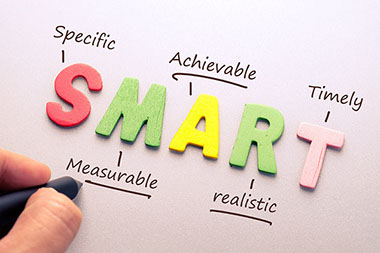
    The word Smart spelled out with wood lettering and hand writing definition for setting a smart goal.

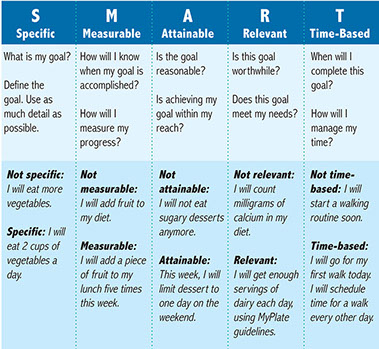
    Think of the actions you take on a daily basis as small steps toward your bigger goal. This guide has already given you many ideas for small steps, such as making half of your plate fruits and vegetables and choosing fewer sugar-sweetened drinks. Identify your next step and use the S.M.A.R.T. tool to improve the chances of reaching your goal.

    Stay motivated with the small successes you achieve along the way. Use yourEating & Exercise Tracker™every day for feedback on the effect your actions have on your energy level, mood, and weight.

    S.M.A.R.T. chart.

    © American Institute for Preventive Medicine

  • The Power Of A Phrase

    Healthylife® Weigh

    Part 4

    Mother and adult daughter having coffee together.

    Fill in the blank after the victim phrase with something you have caught yourself saying or feeling. In the third column, use an accountability phrase to re-write this statement.

    Victim Phrase

    *  I can’t…

    *  It’s useless…

    *  I have to…

    *  Why am I always the one who…

    *  I should…

    Drained Feeling

    *  Defeated

    *  Hopeless

    *  Obligated

    *  Burdened

    *  Guilt

    Accountability

    *  I can…

    *  There’s always a chance…

    *  I choose to…

    *  I’ll be the one who…

    *  I want to…

    In Control Feeling

    *  Confident

    *  Hopeful

    *  Decisive

    *  Secure

    *  Power

    © American Institute for Preventive Medicine

  • 6 Tips To Become More Productive At Work

    WORK LIFE

    Image of women at work looking at notes posted on the wall.

    Productivity means you make the most of your time. You may get more done with less time or with fewer people. But it’s not just about being fast, it’s about maintaining quality too. Learning to be productive means you can showcase your talents and abilities by doing a great job with the resources and skills you have.

    Boosting productivity is often easier said than done. When you’re tired, distracted or simply don’t know how to organize your day, it can be hard to stay productive. Try these tips to make the most of your workday – and get more satisfaction out of your career while doing it!

    1.Break down big tasks.Large projects can be overwhelming, so we often put them off because we don’t know where to start. Instead of letting a large project sit on your to-do list, write down the first step you need to do to get it done. Make it something you know you can do, and set a deadline for yourself. Once that’s done, move on to the next step, and so on.

    2.Have real conversations instead of emailing.Email chains can become time-wasters and often lead to misunderstandings or missing information. When possible, talk to someone in person or on the phone instead of starting an email trail.

    3.Check email at set times.We can’t avoid email completely, but constant inbox chimes can quickly diminish your productivity. Instead of reading every email as it comes in, turn off your email program and only check it two to three times a day.

    4.Take quick breaks when you can.Back-to-back meetings or intense work sessions can drain you. But you don’t need to wait until your lunch hour to energize yourself. If you can, take a few moments to get up and walk around. Stretch at your desk or try deep-breathing exercises.

    5.Tackle those little things to clean up your to-do list.If you have a bunch of small, quick tasks nagging at you, set some time aside to get them done. Then you can focus on the bigger, more important things without other distractions.

    6.Set your own deadlines.If a task or project doesn’t have a due date, it’s easier to put off. Even if a specific deadline hasn’t been set, you can give yourself one. This helps you avoid hanging onto those things that sit undone for days or weeks.

    © American Institute for Preventive Medicine

  • Avoiding Distractions At Work

    WORK LIFE

    Close up image of laptop with hands and phone.

    We all have days that are more productive than others. But you can be your best each day if you learn how to avoid the biggest distractions at your workplace.

    Put the phone away

    Is your phone frequently dinging with texts or people calling you “just to chat?” Do you find yourself checking social media or playing with apps when you should be working?

    Smart phones are a major cause of work-related distractions. Some employers have policies that prohibit cell phone use on the job. If that’s the case, you’ll need to follow those rules. But if your employer allows cell phones, turn off notifications and put the phone in a place that’s harder to reach. Some phones have an option that filters all calls except those from important or emergency numbers. This is a great way to allow people to reach you when it’s necessary, but to avoid non-essential calls and notifications.

    Use white noise

    If other people’s conversations or office noises are bothering you, consider ways you can soften or filter some of the sound. A white noise machine, fan or even headphones that play white noise or quiet non-distracting music may be helpful.

    Ways to get your focus back

    Everyone needs a mental break once in a while. Instead of checking your phone or social media, try these healthy tips that can energize you and help you get back to your work:

    *  Take a short walk around the building.

    *  Eat a healthy snack, such as fruits, vegetables, or lean protein.

    *  Drink a glass of water. Add a lemon or cucumber slice for more flavor.

    *  Get up from your chair and stretch for 3 minutes.

    *  Clean or organize your workspace. Clutter in your space can make your brain feel cluttered, too.

    © American Institute for Preventive Medicine

  • The Dangers Of Distracted Driving

    WELL-BEING

    Image of women driving while looking at her phone about to hit a pedestrian.

    Though driving a car may seem like a simple task, it requires quick reflexes, concentration and reasoning. When a driver is distracted, some – or all – of these important skills can be lost.

    Distracted driving means the driver is doing something other than focusing on the road ahead. It can be anything that takes the driver’s mind off of driving, hands off the wheel or eyes off the road. In the age of smartphones, tablets and other electronic devices, it’s easy to get distracted when driving – even for just a second.

    Though it seems harmless, a quick glance at a phone to read a text can be dangerous or even deadly. The National Highway Traffic Safety Administration (NHTSA) says sending or reading a text takes your eyes off the road for 5 seconds. That’s like driving the length of an entire football field with your eyes closed if you’re going 55 miles per hour. In that amount of time, a driver can hit a pedestrian, run a red light or stop sign, or crash into another vehicle.

    The NHTSA says nearly 3,500 people died and almost 400,000 were injured in 2015 due to distracted driving crashes. Here’s what we can do to help stop distracted driving:

    *  Never use a phone while driving. Put it in the back seat or out of reach to reduce the urge to look at it “just for a second.”

    *  Talk with your teens about distracted driving and tell them that the texts can wait. Lead by example.

    *  Sign a pledge to not drive distracted and stick to it. Ask family members and friends to sign it too. The “It Can Wait” pledge is available atitcanwait.usaa.com.

    Did you know?

    There are laws that prohibit distracted driving. Talking on a hand-held cellphone while driving is banned in 15 states and the District of Columbia. Text messaging is banned for all drivers in 47 states and the District of Columbia.

    To learn about your state laws, go towww.iihs.org/iihs/topics/laws/cellphonelaws.

    © American Institute for Preventive Medicine

  • Exercise Is Healthy For Your Mind

    BE FIT

    Image of older Asian couple brisk walking.

    Regular exercise offers many health benefits. You may already know it helps you stay strong and healthy, and can help you lose weight. It can also help prevent heart disease, diabetes, arthritis, and other diseases. But exercise is doing good for another vital organ in your body: your brain.

    Studies are now showing that regular aerobic exercise can help your brain work better. This includes:

    * Better memory

    * Ability to switch tasks

    * Ability to plan activities and stay organized

    * Possible reduced risk of Alzheimer’s disease

    Although researchers don’t know exactly why exercise helps the mind, there are some possibilities. It increases blood supply to the brain, and helps it form connections. These connections are responsible for forming memories and thinking about future activities. Exercise also improves an area of the brain that remembers and learns.

    Source: National Institute on Aging

    © American Institute for Preventive Medicine