Tag: future

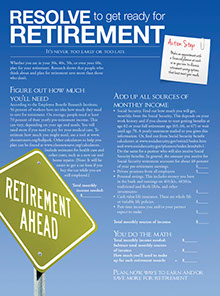
  • Resolve To Get Ready For Retirement

    Financial Health

    It’s never too early or too late.

    Whether you are in your 30s, 40s, 50s, or even your 60s, plan for your retirement. Research shows that people who think about and plan for retirement save more than those who don’t.

    Add up all sources of monthly income.

    *  Social Security. Find out how much you will get, monthly, from the Social Security. This depends on your work history and if you choose to start getting benefits at age 62 or your full retirement age (65, 66, or 67) or wait until age 70. A yearly statement mailed to you gives this information. Or, find out from Social Security benefit calculators atwww.socialsecurity.gov/retire2/index.htmandwww.socialsecurity.gov/planners/index.htm#a0=1. Do the same for a partner who will also receive Social Security benefits. In general, the amount you receive for Social Security retirement accounts for about 40 percent of your pre-retirement earnings.  $____

    *  Private pensions from all employers  $____

    *  Personal savings. This includes money you have  in the bank and earnings on 401(k)s, 403(b)s,  traditional and Roth IRAs, and other investments:  $____

    *  Cash value life insurance. These are whole life or variable life policies.  $____

    *  Part-time income you and/or your partner expect to make.   $____

    Total monthly sources of income:   $____

    You do the math:

    Total monthly income needed:  $______

    Subtract total monthly sources of income:  – $______

    How much you’ll need to make up for each retirement month:  = $______

    Plan, now, ways to earn and/or save more for retirement.

    Figure out how much you’ll need.

    According to the Employee Benefit Research Institute, 56 percent of workers have no idea how much they need to save for retirement. On average, people need at least 70 percent of their yearly pre-retirement income. This can vary, depending on your age and needs. You will need more if you need to pay for your medical care. To estimate how much you might need, use a tool atwww.choosetosave.org/ballpark. Other calculators to help you plan can be found atwww.choosetosave.org/calculators. Include estimates for health care and other costs, such as a new car and home repairs. {Note: It will be easier to get a car loan if you buy the car while you are still employed.}

    Total monthly income needed:  $____

    Action Step

    Make an appointment with a financial planner at work or on your own to discuss retirement saving options that best meet your needs.
    Ways to Well-Being book by the American Institute for Preventive Medicine. www.HealthyLife.com. All rights reserved.

    © American Institute for Preventive Medicine
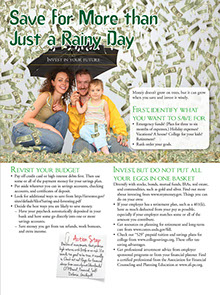
  • Save For More Than Just A Rainy Day

    Financial Health

    Invest in your future.

    Money doesn’t grow on trees, but it can grow when you save and invest it wisely. First, identify what you want to save for:

    *  Emergency funds? (Plan for three to six months of expenses.) Holiday expenses? Vacations? A house? College for your kids? Retirement?

    *  Rank order your goals.

    Invest, but do not put all your eggs in one basket.

    Diversify with stocks, bonds, mutual funds, IRAs, real estate, and commodities, such as gold and silver. Find out more about investing fromwww.mymoney.gov. Things you can do on your own:

    *  If your employer has a retirement plan, such as a 401(k), have as much deducted from your pay as possible, especially if your employer matches some or all of the amount you contribute.

    *  Get resources on planning for retirement and long-term care fromwww.csrees.usda.gov/fsll.

    *  Check out “529” prepaid tuition and savings plans for college fromwww.collegesavings.org. These offer tax-saving advantages.

    *  Get professional investment advice from employer sponsored programs or from your financial planner. Find a certified professional from the Association for Financial Counseling and Planning Education atwww.afcpe.org.

    Revisit your budget:

    *  Pay off credit card or high interest debts first. Then use some or all of the payment money for your savings plan.

    *  Put aside whatever you can in savings accounts, checking accounts, and certificates of deposit.

    *  Look for additional ways to save fromhttp://investor.gov/sites/default/files/Saving-and-Investing.pdf

    *  Decide the best ways you are likely to save money.

    – Have your paycheck automatically deposited in your bank and have some go directly into one or more savings accounts.

    – Save money you get from tax refunds, work bonuses, and extra income.

    Action Step

    Beware of investments that promise high returns with little or no risk. If it sounds too good to be true, it usually is.

    Ways to Well-Being. Published by the American Institute for Preventive Medicine.

    © American Institute for Preventive Medicine