Tag: gas

  • Bloated Belly: Ways To Get Relief

    SELF-CARE CORNER

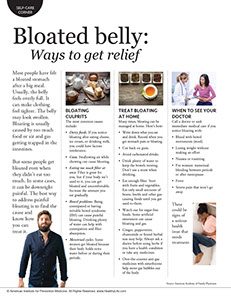
    Image of tea and different tea leaves.

    Most people have felt a bloated stomach after a big meal. Usually, the belly feels overly full. It can make clothing feel tighter. The belly may look swollen. Bloating is usually caused by too much food or air and gas getting trapped in the intestines.

    But some people get bloated even when they didn’t eat too much. In some cases, it can be downright painful. The best way to address painful bloating is to find the cause and know how you can treat it.

    Bloating culprits

    The most common causes include:

    *  Dairy foods. If you notice bloating after eating cheese, ice cream, or drinking milk, you could have lactose intolerance.

    *  Gum. Swallowing air while chewing can cause bloating.

    *  Eating too much fiber at once. Fiber is great for you, but if your body isn’t used to it, you can get bloated and uncomfortable. Increase the amount you eat gradually.

    *  Bowel problems. Being constipated or having irritable bowel syndrome (IBS) can cause painful bloating. Drinking plenty of water can help with constipation and fiber absorption.

    *  Menstrual cycles. Some women get bloated because their body holds extra water before or during their periods.

    Treat bloating at home

    Many times, bloating can be managed at home. Here’s how:

    *  Write down what you eat and drink. Record when you get stomach pain or bloating.

    *  Cut back on gum.

    *  Avoid carbonated drinks.

    *  Drink plenty of water to keep the bowels moving. Don’t use a straw when drinking.

    *  Eat enough fiber. Start with fruits and vegetables. Eat only small amounts of beans, lentils and other gas-causing foods until you get used to them.

    *  Watch out for sugar-free foods. Some artificial sweeteners can cause bloating and gas.

    *  Ginger, peppermint, chamomile or fennel herbal teas may help. Always ask a doctor before using herbs if you have a health condition or take any medicines.

    *  Over-the-counter anti-gas medicines with simethicone help move gas bubbles out of the body.

    When to see your doctor

    Call a doctor or seek immediate medical care if you notice bloating with:

    *  Blood with bowel movements (stool)

    *  Losing weight without making an effort

    *  Nausea or vomiting

    *  For women: menstrual bleeding between periods or after menopause

    *  Fever

    *  Severe pain that won’t go away

    These could be signs of a serious health issue that needs treatment.

    Source: American Academy of Family Physicians
    © American Institute for Preventive Medicine
  • Fight Back Against Radon

    WELL-BEING

    Women yawning while driving.

    Radon can get into your home and cause serious health problems. But you can take steps to remove this dangerous gas that you can’t see, taste or smell.

    Radon is a natural radioactive gas. When uranium breaks down in the soil, it makes radon. Then, radon can seep into a home’s foundation, causing health problems for the people who live there.

    Why is radon harmful?

    When you breathe in radon, its natural radioactive particles can get trapped in your lungs. Radon is a leading cause of lung cancer in non-smokers. If you smoke and breathe radon, your risk of lung cancer is especially high.

    How do I know if I have radon?

    The only way to know if a home has radon is through a radon test. You can buy radon tests at hardware stores or online. Your local health department may sell them.

    Radon tests are easy to use. Usually, you let the test stay in your basement or the lowest point in your house for a few days. When the test is complete, you mail it in. The testing company sends you the results.

    If your test results say your radon level is 4pCi/L or higher, take a second test to be sure. If the average between the two tests is 4pCi/L or higher, you need to fix the problem. You can do this with radon removal, also called radon mitigation.

    How do I get rid of radon?

    Removing radon from a home requires special skills and tools. Choose a qualified radon mitigation contractor to fix your home.

    Ask your state radon office for names. Many states require radon professionals to be licensed, certified or registered for your added safety.

    New homes aren’t safe

    No matter how old or new your home, radon can get in. It seeps in through foundation seams, joints and cracks. It can also get in through a sump pump or drain located in the basement.

    If you’re buying a home, make sure the home has been tested for radon or that it has a radon mitigation system in place.

    Source: Environmental Protection Agency

    © American Institute for Preventive Medicine
  • Abdominal Pain

    Abdominal & Urinary Conditions

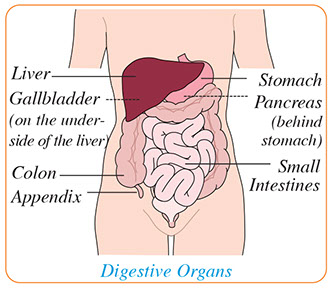
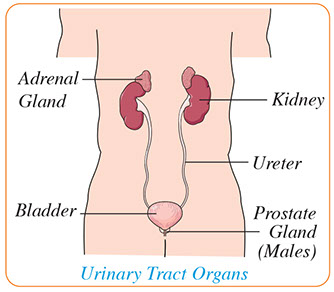
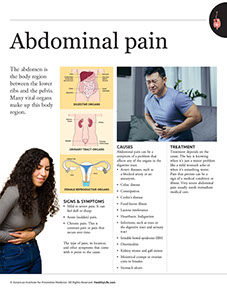
    The abdomen is the body region between the lower ribs and the pelvis. Many vital organs make up this body region.

    Signs & Symptoms

    The type of pain, its location, and other symptoms that come with it point to the cause.

    *  Mild to severe pain. It can feel dull or sharp.

    *  Acute (sudden) pain.

    *  Chronic pain. This is constant pain or pain that recurs over time.

    Illustration of digestive organs.
    Illustraion of urinary tract organs.
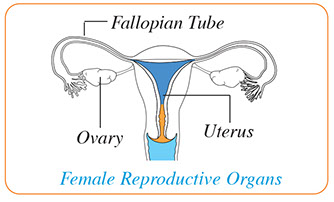
    Illustration of female reproductive organs.

    Causes

    Abdominal pain can be a symptom of a problem that affects any of the organs. Causes of abdominal pain include:

    *  Artery diseases, such as a blocked artery or an aneurysm.

    *  Celiac disease.

    *  Constipation.

    *  Crohn’s disease.

    *  Food poisoning.

    *  Gallstones.

    *  Heartburn. Indigestion.

    *  Infections, such as ones in the digestive tract and urinary tract.

    *  Irritable bowel syndrome (IBS).

    *  Kidney stones.

    *  Menstrual cramps or ovarian cysts in females.

    *  Reflux.

    *  Stomach ulcers.

    Treatment

    Treatment depends on the cause. The key is knowing when it’s just a minor problem like a mild stomach ache or when it’s something worse. Pain that persists can be a sign of a medical condition or illness. Very severe abdominal pain usually needs immediate medical care.

    Questions to Ask

    Self-Care / Prevention

    *  Find a comfortable position. Relax.

    *  Take an over-the-counter pain medicine as directed on the label.

    *  Apply a heating pad set on low (adults only).

    *  Don’t wear clothes that fit tight.

    *  Don’t exercise too hard.

    *  Use a hot water bottle on the area that aches.

    Crohn’s Disease

    Crohn’s Disease is a chronic problem that can cause abdominal pain and diarrhea. Other symptoms are fever, fatigue, and, at times, rectal bleeding or drainage. Symptoms occur when the disease flares up. This is followed by periods when symptoms go away or lessen.

    With Crohn’s disease, any part of the GI tract, from the mouth to the anus, can be inflamed. Usually, the colon and the last part of the small intestine, the ileum, are affected.

    Treatment for Crohn’s disease includes medicines, nutrition supplements, and surgery.

    Resources

    Crohn’s & Colitis Foundation of America

    www.ccfa.org

    Healthier at Home book by the American Institute for Preventive Medicine. www.HealthyLife.com. All rights reserved.

    © American Institute for Preventive Medicine
  • Colic

    Children’s Health

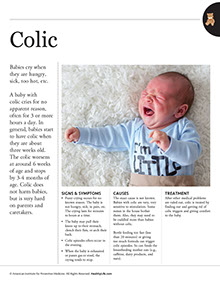
    Babies cry when they are hungry, sick, too hot, etc. In general, babies start to have colic when they are about three weeks old. The colic worsens at around six weeks of age and stops by 3 months of age. Colic does not harm babies, but is very hard on parents and caretakers.

    Signs & Symptoms

    *  Fussy crying occurs for no known reason. The baby is not hungry, sick, in pain, etc. The crying lasts for minutes to hours at a time.

    *  The baby may pull his or her knees up to the stomach.

    *  Colic episodes often occur in the evening.

    Causes

    The exact cause is not known. Babies with colic are very, very sensitive to stimulation. Noises in the house bother them. Also, they may need to be cuddled more than babies without colic.

    Bottle feeding too fast (less than 20 minutes) or giving too much formula can trigger colic episodes. So can foods the breast-feeding mother eats (e.g., caffeine, dairy products, and nuts).

    Treatment

    After other medical problems are ruled out, colic is treated by finding out and getting rid of colic triggers and giving comfort to the baby.

    Questions to Ask

    Self-Care / Prevention

    *  Be sure the baby has enough to eat. Check with the baby’s doctor about trying a new formula.

    *  Try different bottle nipples. Make the hole bigger if it is too small. Cut across the hole that is already there. (You will make an X- shaped hole.) Here’s how to find out if the hole is too small:

    –  Put cold formula in the bottle.

    –  Turn the bottle upside down.

    –  Count the drops of formula that fall out. If the drops come out slower than 1 drop per second, the hole is too small.

    *  Don’t allow smoking in your home.

    *  Do not give fruit juice (e.g., apple juice, pear juice) to infants younger than 6 months old.

    *  Hold the baby up for feeding. Keep holding the baby up for awhile after feeding.

    *  Burp the baby after each ounce of formula or every few minutes when breast-feeding.

    *  Use a pacifier, but never put a pacifier on a string around the baby’s neck.

    *  Give the baby a warm bath and a massage.

    *  Wrap or swaddle the baby snugly in a soft blanket. Rock him or her or use a baby swing.

    *  Try the “colic carry.” Lay the baby on his or her stomach across your arm. Put the baby’s face in your hand and let the legs straddle your inner elbow. Hold the baby’s back with your other hand so he or she won’t fall. Walk around like this for awhile.

    *  Carry the baby while you vacuum. Use a baby carrier that you wear on your back or chest.

    *  Play soft, gentle music.

    *  Take your baby for a stroller or car ride.

    *  Run the dryer or dishwasher. Buckle your baby in a baby seat. Lean the seat against the side of the dryer or on the counter near the dishwasher. The sounds from these machines may help the baby fall asleep. Stay with your baby. Make sure the heat or steam won’t hurt the baby.

    *  Don’t give the baby antacids like Maalox or simethicone drops unless a doctor tells you to.

    *  Let your baby cry himself or herself to sleep if nothing else helps and your baby has been fed within 2-1/2 hours. Do call the doctor if the baby cries for more than 2 hours without stopping.

    *  Get someone else to take care of your baby if you get too stressed. Get some rest.

    Resources

    American Academy of Pediatrics

    www.aap.org

    Healthier at Home book by the American Institute for Preventive Medicine. www.HealthyLife.com. All rights reserved.

    © American Institute for Preventive Medicine
  • Flatulence (Gas)

    Abdominal & Urinary Conditions

    Image of man plugging his nose with hand.

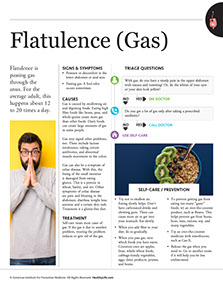
    Flatulence is passing gas through the anus. For the average adult, this happens about 6 to 20 times a day.

    Signs & Symptoms

    *  Pressure or discomfort in the lower abdomen or anal area.

    *  Passing gas. A foul odor occurs sometimes.

    Causes

    Gas is caused by swallowing air and digesting foods. Eating high fiber foods like beans, peas, and whole-grains create more gas than other foods. Dairy foods can create large amounts of gas in some people.

    Gas may signal other problems, too. These include lactose intolerance, taking certain antibiotics, and abnormal muscle movement in the colon.

    Gas can also be a symptom of celiac disease. With this, the lining of the small intestine is damaged from eating gluten. This is a protein in wheat, barley, and rye. Other symptoms of celiac disease are pain and bloating in the abdomen; diarrhea; weight loss; anemia; and a certain skin rash. Treatment is a gluten-free diet. Find out about celiac disease fromwww.celiac.nih.gov.

    Treatment

    Self-care treats most cases of gas. If the gas is due to another problem, treating the problem reduces or gets rid of the gas.

    Questions to Ask

    Self-Care / Prevention

    *  Try not to swallow air. Don’t have carbonated drinks and chewing gum. These can cause more air to get into your stomach.

    *  When you add fiber to your diet, do so gradually.

    *  When you pass gas, note which foods you have eaten. Eat less of the foods that often cause gas. Common ones are apples, bran, whole-wheat foods, cabbage-family vegetables, eggs, dairy products, prunes, and beans.

    *  To prevent getting gas from many “gassy” foods, try an over-the-counter product, such as Beano. This helps prevent gas from beans, bran, nuts, onions, soy, and many vegetables.

    *  Try an over-the-counter medicine with simethicone, such as Gas-X.

    *  Release the gas when you need to. Go to another room if it will help you be less embarrassed.

    Healthier at Home book by the American Institute for Preventive Medicine. www.HealthyLife.com. All rights reserved.

    © American Institute for Preventive Medicine
  • Gas Leak

    WELL-BEING

    Illustration of 911 Emergency written.

    Be aware of all the possible signs of a gas leak, including a distinct unpleasant smell. The odor is added to natural gas to help identify leaks.

    If a leak is suspected:

    *  Stay calm.

    *  Don’t light a match, candle, or cigarette, and don’t turn any electrical devices on or off, including light switches, or use any device or equipment that could cause a spark.

    *  Immediately evacuate the area where the leak is suspected and from a safe location call your gas company or 911.

    © American Institute for Preventive Medicine
  • Is Your Home Safe From Radon?

    MEDICAL NEWS

    Image of hand holding an illustration of a home.

    Indoor radon is the second leading cause of lung cancer in the U.S. Breathing it over long periods can present a significant health risk to families all over the country.

    Radon is an invisible radioactive gas that seeps into homes undetected through foundation cracks. It can reach harmful levels if trapped indoors. It travels up from underground sources of uranium in the earth’s crust.

    The radon threat is preventable with some simple steps. In existing homes, families can begin protecting themselves by buying an easy-to-use radon test kit to find out if a high level exists. If so, a high level might be lowered simply with a straight-forward radon venting system installed by a contractor.

    In new homes, builders can easily and economically include radon-resistant features during construction. Home buyers should ask for these. The EPA also recommends that home buyers ask their builder to test for radon gas before they move in.

    According to the EPA, 1 in every 15 homes nationwide has a high radon level. Test your home for radon every 2 years. Retest for it any time you move, make structural changes to your home, or occupy a previously unused level of a house.

    © American Institute for Preventive Medicine