
Tag: genetic

  • Cystic Fibrosis Awareness

    MEDICAL NEWS

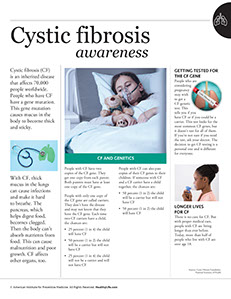
    Girl in bed with breathing mask on while holding a teddy bear.

    Cystic fibrosis (CF) is an inherited disease that affects 70,000 people worldwide. People who have CF have a gene mutation. This gene mutation causes mucus in the body to become thick and sticky.

    With CF, thick mucus in the lungs can cause infections and make it hard to breathe. The pancreas, which helps digest food, becomes clogged. Then the body can’t absorb nutrients from food. This can cause malnutrition and poor growth. CF affects other organs, too.

    CF and genetics

    People with CF have two copies of the CF gene. They get one copy from each parent. Both parents must have at least one copy of the CF gene.

    People with only one copy of the CF gene are called carriers. They don’t have the disease and may not know that they have the CF gene. Each time two CF carriers have a child, the chances are:

    *  25 percent (1 in 4) the child will have CF

    *  50 percent (1 in 2) the child will be a carrier but will not have CF

    *  25 percent (1 in 4) the child will not be a carrier and will not have CF

    People with CF can also pass copies of their CF genes to their children. If someone with CF and a CF carrier have a child together, the chances are:

    *  50 percent (1 in 2) the child will be a carrier but will not have CF

    *  50 percent (1 in 2) the child will have CF

    Getting tested for the CF gene

    People who are considering pregnancy may wish to get a CF genetic test. This tells you if you have CF or if you could be a carrier. This test looks for the most common CF genes, but it doesn’t test for all of them. If you’re not sure if you need the test, ask your doctor. The decision to get CF testing is a personal one and is different for everyone.

    Longer lives  for CF

    There is no cure for CF. But with proper medical care, people with CF are living longer than ever before. Today, more than half of people who live with CF are over age 18.

    Sources: Cystic Fibrosis Foundation, National Institutes of Health
    © American Institute for Preventive Medicine
  • Sickle Cell Anemia

    Bone & Muscle Problems

    Red blood cells are normally round. In sickle cell anemia, the red blood cells take on a sickle shape. This makes the blood thicker and doesn’t let oxygen get to the body’s tissues like it should. When sickled cells get stuck in the blood vessels, they cut off the blood supply. With no oxygen, pain occurs. The result is a “Sickle Cell Crisis.”

    Signs & Symptoms

    *  Bone and joint pain. This is the most common complaint. The pain can also be in the chest, back, or abdomen.

    *  Shortness of breath and a hard time breathing.

    *  Swollen hands and feet.

    *  Jaundice. The whites of the eyes and/or the skin looks yellow.

    *  Paleness.

    *  Repeated infections, especially pneumonia or meningitis.

    *  Kidney problems. Leg ulcers. Gallstones (at an early age). Gout.

    *  Seizures.

    *  Strokes (at an early age).

    Causes

    Sickle cell anemia is inherited. In the U.S., it mostly affects African Americans, but can occur in other ethnic groups. Examples are persons whose ancestors are from Cuba, Central and South America, Greece, Italy, Turkey, and Saudi Arabia. About 1 in 12 African Americans carries the gene for the sickle cell trait. If both parents carry the trait, the chance of having a child with sickle cell anemia is 1 out of 4. About 1 in 375 African Americans and about 1 in every 1,000 Latin Americans are born with sickle cell anemia. Signs of the disease aren’t noticed until the end of the infant’s first year. All hospitals in the U.S. screen newborns for sickle cell disease.

    To prevent sickle cell anemia in offspring, couples, especially African American couples, should have a blood test to see if they are carriers for the sickle cell trait. Genetic counseling can help them decide what to do.

    Treatment

    Medical treatment is needed. Painful episodes are treated with painkillers, fluids, and oxygen. Other treatments:

    *  Hydroxyurea medicine.

    *  Blood transfusions.

    *  Stem cell transplant. This may be an option for children who have a brother or sister without sickle cell disease that is a matched donor.

    In the U.S., the life span for a person with sickle cell disease is 40-60 years.

    Questions to Ask

    Self-Care / Prevention

    *  Follow your doctor’s treatment plan. Wear a medical alert tag.

    *  Avoid physical stress and high altitudes.

    *  Discuss airplane travel with your doctor.

    *  Ask your doctor what over-the- counter medicines you can use before you try any.

    *  Drink at least 8 glasses of water a day. Get the rest you need.

    *  Follow a balanced diet. Have at least 5 servings of fruits and vegetables a day. Take folic acid (a B vitamin) supplements and other vitamins and minerals, as advised by your doctor.

    *  Don’t wear tight clothing.

    *  If at home and in a “sickle cell crisis:”

    – Stay warm. Apply warm compresses to painful parts of your body.

    – Rest in bed.

    – Take pain medication, as prescribed.

    Healthier at Home book by the American Institute for Preventive Medicine. www.HealthyLife.com. All rights reserved.

    © American Institute for Preventive Medicine