Tag: goal

  • Tips For A Healthy Budget

    FINANCIAL HEALTH

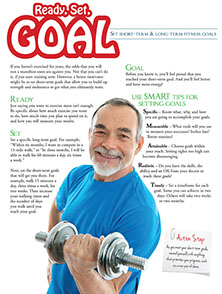
    Couple smiling going over budget.

    Not sure where to start with a budget? It doesn’t have to be complicated. Here are some tips.

    Add up your monthly income.

    Look at paystubs or your bank deposits from your job for one month. Include other income, like child support payments, if you have them.

    Cut back where you can.

    Put a limit on coffee stops or meals out. Too much online shopping? Give yourself a 48-hour waiting period before you buy.

    Add up your expenses.

    Think about bills you pay each month, such as mortgage, rent, utilities and car payment. Look at credit card bills or bank withdrawals. This tells you how much you’re spending.

    Divide into optional and essential.

    On a piece of paper or computer, divide your expenses into two columns: optional and essential. When needed, cut expenses from your optional column.

    Source: Federal Trade Commission

    © American Institute for Preventive Medicine

  • Commit To Be Fit 2

    Fitness

    Couple stretching.

    You don’t have to join a gym to get fit. There are lots of ways you can break a sweat, shed pounds and improve your health. Small steps can make a big difference.

    *  Do leg lifts before you get out of bed.

    *  Walk the dog. Instead of slowing Fido down, pick up your pace.

    *  Use exercise equipment as intended, not as a clothes rack.

    *  Clean the house. That’s right, dust, mop, scrub and vacuum.

    *  Brainstorm ideas with co-workers while walking.

    *  Take the stairs instead of the elevator.

    *  If you must take the elevator, do squats during the ride.

    *  Do sit ups, pushups, and jumping jacks during TV commercials.

    *  Take your bike for a spin around the block.

    *  March while talking on the phone. (Stop if you start panting.)

    *  Work in your garden, garage, and basement.

    *  Drink plenty of water.

    Action Step:Challenge family to a contest of sit ups or pushups during TV commercials. Try to improve your count each time.

    Page from HealthyLife Weigh book by the American Institute for Preventive Medicine. www.HealthyLife.com. All rights reserved.

    © American Institute for Preventive Medicine
  • Ready, Set, Goal

    Fitness

    Set short-term & long-term fitness goals.

    If you haven’t exercised for years, the odds that you will run a marathon soon are against you. Not that you can’t do it, if you start training now. However, a better motivator might be to set short-term goals that allow you to build up strength and endurance to get what you ultimately want.

    Ready

    Just saying you want to exercise more isn’t enough. Be specific about how much exercise you want to do, how much time you plan to spend on it, and how you will measure your results.

    Set

    Set a specific long-term goal. For example, “Within six months, I want to compete in a 15-mile walk,” or “In three months, I will be able to walk for 60 minutes a day, six times a week.”

    Next, set the short-term goals that will get you there. For example, walk 15 minutes a day, three times a week, for two weeks. Then increase your walking times and the number of days you walk until you reach your goal.

    Goal

    Before you know it, you’ll feel proud that you reached your short-term goal. And you’ll feel better and have more energy!

    Use SMART tips for setting goals

    *  Specific – Know what, why, and how you are going to accomplish your goals.

    *  Measurable – What tools will you use to measure your successes? Inches lost? Better stamina?

    *  Attainable – Choose goals within your reach. Setting sights too high can become discouraging.

    *  Realistic – Do you have the skills, the ability and an OK from your doctor to reach these goals?

    *  Timely – Set a timeframe for each goal. Some you can achieve in two days. Others will take two weeks or two months.

    Action Step

    As you meet your short-term goals, reward yourself with anything that promotes your progress, such as a new pair of shoes.

    Page image from the Ways to Well-Being book by the American Institute for Preventive Medicine. www.HealthyLife.com. All rights reserved.

    © American Institute for Preventive Medicine

  • Commit To Be Fit

    BE FIT

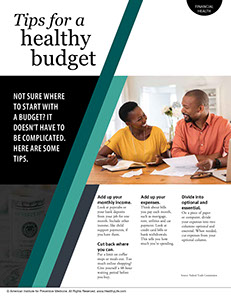
    Image of middle-aged women with dumb bells.

    How are those resolutions going about now? You can make a renewed commitment to yourself and your health anytime. Here’s advice from Life Time Fitness to move forward:

    *Create a vision statement.Make your resolution a commitment and create a vision statement that projects clear personal investment and connects directly to your happiness and health. Once you’ve created your personal vision, you can identify what goals will get you there.

    *Don’t assume you know how to exercise.Many people who exercise think they know what to do when they walk into a gym, but it is common to use poor form, train at an inappropriate intensity, or choose the wrong exercises for your needs. A well-planned program using proper exercise technique will prove much more successful. Sit down with a well-qualified and certified personal trainer to talk about your exercise program to start on the right track.

    *Test your readiness.Ask yourself how ready you are to make an actual change. If your vision is health-based and you’ve made the goal of working out every morning of the week, ask yourself (on a scale of 1 to 10 with 10 being absolutely positive) how likely you’ll be able to commit and achieve that task and identify barriers that might get in the way. If your readiness is 7 or above, you’re ready to embark on your vision. If it’s below 7, change or revise your goal until you’re confident enough to know you’ll succeed. Small steps to succeed are better than big steps to fail.

    *Junk the junk.Don’t think you can stick to your diet while keeping junk food in the house. Make a commitment to get rid of all the foods that don’t promote health. Instead, fill your kitchen with good choices.

    *Put it on the fridge.Laminate it, frame it or post it on your mirror. The goal is to have your resolution statement somewhere where you will see it often as a reminder of what you are working toward. If you’re a social person, share it.

    © American Institute for Preventive Medicine

  • Miles To Go

    WELL-BEING

    Image of a glass of soda.

    Would you choose that soda if you were told how many miles you needed to walk to burn off the calories?

    You’d choose a lower calorie drink if you saw signs explaining how many miles you would need to walk to burn off the calories in that sugary drink. Research at Johns Hopkins, reported in the American Journal of Public Health, found that simply showing calories is not enough to change bad eating habits.

    But when calories are tied to miles of walking, then behavior changes.

    Teens who shopped in neighborhood stores in Baltimore were presented facts on signs about various soft drinks. Researchers found that the teens who saw the signs either bought lower-sugar choices or smaller bottles.

    A typical 20-oz. soda or sports drink has 16 teaspoons of SUGAR and would take 50 minutes of RUNNING or 5 MILES of WALKING for a 110-pound adolescent to burn off the calories.

    © American Institute for Preventive Medicine