Tag: growth

  • The Importance Of Chores

    FAMILY LIFE

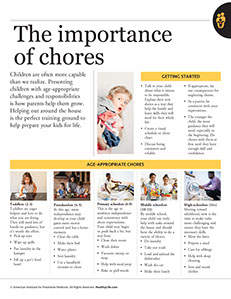
    Child holding a load of clothes in her arms.

    Children are often more capable than we realize. Presenting children with age-appropriate challenges and responsibilities is how parents help them grow. Helping out around the house is the perfect training ground to help prepare your kids for life.

    Getting started

    *  Talk to your child about what it means to be responsible. Explain their new duties as a way they help the family and learn skills they will need for their whole life.

    *  Create a visual schedule or chore chart.

    *  Discuss being consistent and reliable.

    *  If appropriate, lay out consequences for neglecting chores.

    *  As a parent, be consistent with your expectations.

    *  The younger the child, the more guidance they will need, especially in the beginning. Do chores with them at first until they have enough skill and confidence.

    Age-appropriate chores

    Toddlers (2-3)

    Toddlers are eager helpers and love to do what you are doing. They will need lots of hands-on guidance, but it’s worth the effort.

    *  Pick up toys

    *  Wipe up spills

    *  Put laundry in the hamper

    *  Fill up a pet’s food bowl

    Preschoolers (4-5)

    At this age, more independence may develop as your child gains more motor control and has a better memory.

    *  Clear the table

    *  Make their bed

    *  Water plants

    *  Sort laundry

    *  Use a handheld vacuum to clean

    Primary schoolers (6-9)

    This is the age to reinforce independence and consistency with chore expectations. Your child may begin to push back a bit, but stay firm.

    *  Clean their room

    *  Wash dishes

    *  Vacuum, sweep, or mop

    *  Help with meal prep

    *  Rake or pull weeds

    Middle schoolers (10-13)

    By middle school, your child can truly help with tasks around the house and should have the ability to do a variety of chores.

    *  Do laundry

    *  Take out trash

    *  Load and unload the dishwasher

    *  Wash the car

    *  Make their lunch

    High-schoolers (14+)

    Moving toward adulthood, now is the time to make tasks more challenging and ensure they have the necessary skills.

    *  Mow the lawn

    *  Prepare a meal

    *  Care for siblings

    *  Help with deep cleaning

    *  Iron and mend clothes

    © American Institute for Preventive Medicine

  • How Your Body Changes, How Your Baby Grows

    Pregnancy & Prenatal Care

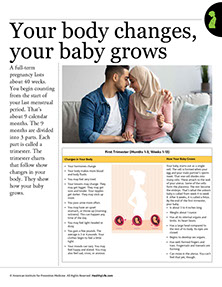
    A full-term pregnancy lasts about 40 weeks. You begin counting from the start of your last menstrual period. That’s about 9 calendar months. The 9 months are divided into 3 parts. Each part is called a trimester. The trimester charts that follow show changes in your body. They show how your baby grows.

    First Trimester

    (Months 1-3, Weeks 1-13)

    Changes in Your Body

    *  Your hormones change.

    *  Your body makes more blood and body fluids.

    *  You may feel very tired.

    *  You pass urine more often.

    *  You may have an upset stomach, or throw up (morning sickness). This can happen any time of the day.

    *  You may feel light-headed or dizzy.

    *  You gain a few pounds. The average is 3 or 4 pounds. Your clothes begin to feel a little tight.

    *  Your moods can vary. You may feel happy and elated. You may also feel sad, cross, or anxious.

    *  Your breasts may change.

    – They may get bigger.

    – They may get sore and tender.

    – Your nipples get darker. They may stick up more.

    How Your Baby Grows

    Your baby starts out as a single cell. The cell is formed when your egg and your male partner’s sperm meet. That one cell divides into many cells. These attach to the wall of your uterus. Some of the cells form the placenta. The rest become the embryo. That’s what the unborn baby is called from week 4 to week 8. After 8 weeks, it is called a fetus. By the end of the first trimester, your baby:

    *  Is about 3 to 4 inches long

    *  Weighs about 1 ounce

    *  Has all its internal organs and limbs. Its heart beats.

    *  Has a large head compared to the rest of its body. Its eyes are closed.

    *  Begins to develop sex organs

    *  Has well-formed fingers and toes. Fingernails and toenails are forming.

    *  Can move in the uterus. You can’t feel that yet, though.

    Second Trimester

    (Months 4-6, Weeks 14-27)

    Changes in Your Body

    *  You probably feel really good during this trimester. Most women do.

    *  You start to look pregnant as your belly expands. You gain about a pound a week. Loose or maternity clothes feel best.

    *  Your heart beats stronger. This helps push the extra body fluids around your body. It helps push them into the placenta, too.

    *  You start to feel your baby move. This usually starts between weeks 15 and 20 with a first baby. It may come earlier than that with babies after the first one. First you feel flutters. Then you feel kicks.

    *  Your breasts get ready to make milk.

    *  Your uterus starts to stretch out and get thinner.

    *  You may notice that you have:

    –  Backache

    –  Constipation

    –  Headache

    –  Mood swings

    –  Braxton-Hicks contractions

    –  Mild swelling of the ankles and feet

    –  Less morning sickness or none at all

    –  Less need to pass urine

    –  Bigger appetite

    –  Heartburn

    –  Larger veins in your hands and arms

    –  Stretch marks on your breasts and belly

    –  Leg cramps at night

    None of these is apt to change your sense of well-being, though.

    How Your Baby Grows

    Your baby begins to grow fast. Its organs mature. By the end of the second trimester, your baby:

    *  Is about 11 to 14 inches long

    *  Weighs about 2 to 2-1/2 pounds

    *  Swallows

    *  Sucks its thumb

    *  Moves and kicks

    *  Has wrinkly skin. Its skin is covered by a thick, white coating called vernix.

    *  Has hair growing on its head

    *  Has teeth forming in the jawbone

    *  Can open and close its eyelids

    *  Has eyes that are almost fully developed. Eyebrows and eyelashes start to grow.

    Third Trimester

    (Months 7-9, Weeks 28-40)

    Changes in Your Body

    You gain about a pound a week until the final few weeks. Then you may stop gaining weight or lose a pound or two. As the baby grows, your uterus and belly expand. You feel lots of pressure on your bladder. You need to pass urine more often.

    The baby pushes up on the bottom of your rib cage. The baby pushes up on the diaphragm. This can cause you to feel short of breath.

    The baby makes stronger movements and moves more often. You can feel its head, elbows, and feet as they push against your belly. You may be able to see the baby’s kicks! You may notice that:

    *  You feel hot and you sweat more than usual.

    *  A yellow liquid leaks from your breasts.

    *  Your hands and feet swell.

    *  Your navel may look flat or stick out.

    *  You feel tired.

    *  You have mood swings.

    Toward the very end of this trimester (near your due date):

    *  You may feel your uterus getting tight and hard.

    *  You may have “practice” contractions. These stop when you move your body or walk around.

    *  The baby “drops” into your pelvis. It is easier for you to breathe. It also makes you need to pass urine more often.

    *  You lose the mucus plug. You usually lose it shortly before delivery. It’s called bloody show then. You may notice it as a thick, stringy discharge for days. Or you may pass a big clump that looks like a wet cotton ball. Some women never notice the bloody show.

    How Your Baby Grows

    Your baby keeps growing and gaining weight. During this trimester, your baby:

    *  Grows to about 20 inches long

    *  Gains weight to 7 pounds or more

    *  Fills the uterus

    *  Opens and closes its eyes

    *  Responds to light and sound

    *  Moves a lot. Its movements are more like rolls and turns instead of kicks. These may slow down close to labor. But the baby does not stop moving before birth. Tell your health care provider if you notice a big decrease in your baby’s activity.

    *  Settles further down into your pelvis. Your baby is getting ready to be born!

    Prenatal Self-Care book by the American Institute for Preventive Medicine. www.HealthyLife.com. All rights reserved.

    © American Institute for Preventive Medicine

  • Nutrition For Children

    Children’s Health

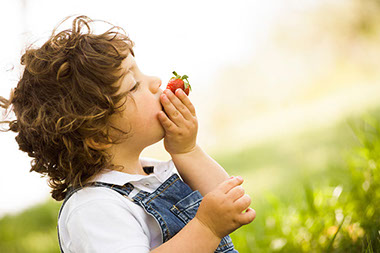
    Image of toddler eating a strawberry.

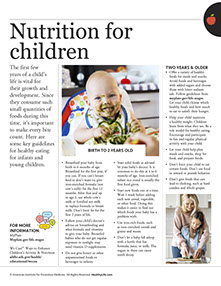
    Birth to 2 Years Old

    *  Breast-feed your baby from birth to 6 months of age. Breast-feed for the first year, if you can. If you can’t breast-feed or don’t want to, give iron-enriched formula (not cow’s milk) for the first 12 months. After that and up to age 2, use whole cow’s milk to replace formula or breast milk. Don’t limit fat for the first 2 years of life.

    *  Follow your child’s doctor’s advice on breast-feeding and what formula and vitamins to give your baby. Breast-fed babies who do not get regular exposure to sunlight may need vitamin D supplements.

    *  Start solid foods as advised by your baby’s doctor. It is common to do this at 4 to 6 months of age. Iron-enriched infant rice cereal is usually the first food given.

    *  Start new foods one at a time. Wait 1 week before adding each new cereal, vegetable, or other food. Doing this makes it easier to find out which foods your baby has a problem with.

    *  Use iron-rich foods, such as grains, iron-enriched cereals, and meats.

    *  Do not give honey to infants during the first 12 months of life.

    *  Don’t let a baby fall asleep with a bottle that has formula, juice, or milk. The sugars in these can cause tooth decay.

    Two Years and Older

    *  Give a variety of healthy foods for meals and snacks. Follow guidelines from theChooseMyPlate.gov/kidsWeb site. Let your child choose which healthy foods and how much to eat to satisfy his or her hunger.

    *  Help your child maintain a healthy weight. Give proper foods. Promote regular exercise. Lead by example. Children learn from what they see parents do, as well as, from what parents say. Eat with your children. Be a role model for good eating. Exercise, too.

    *  Let your child help plan meals and snacks, shop for food, and prepare foods.

    *  Don’t force your child to eat certain foods. Don’t use food to reward or punish behavior.

    *  Don’t give foods that can lead to choking, such as hard candies and whole grapes.

    *  Teach healthy behaviors in a fun way. For ideas to help get children to eat well and be more active, access the Web sites under “Resources”.

    Resources

    5-2-1-0 Let’s Go!

    www.letsgo.org

    ChooseMyPlate.gov

    www.choosemyplate.gov/kids/index.html

    We Can!™ Ways to Enhance Children’s  Activity & Nutrition

    www.nhlbi.nih.gov/health/educational/wecan

    Page from Healthier at Home book by the American Institute for Preventive Medicine. www.HealthyLife.com. All rights reserved.

    © American Institute for Preventive Medicine

  • New You

    WELL-BEING

    Image of smiling man.

    Why wait to create a new you? Live your best life now. This advice comes from researchers at Washington University:

    *Learn something new.Take a class in a subject you enjoy or are curious about. Check your community colleges for noncredit continuing education classes. Rekindle your love of learning.

    *Volunteer.It’s good for your physical and mental health whether you’re building a house for someone, ladling out soup for the homeless, or collecting canned goods. You’ll make valuable community connections.

    *Get your social media house in order.The Internet and social media have opened up exciting new avenues to connect with others and new vistas to share preferences in films, books, and music. Have fun. But be cautious. Check your default privacy settings. Log out and see what your profile looks like to the outside world. Make sure passwords are complex – Use upper and lowercase letters and a special character, such as $. Don’t use the same password for all social media accounts.

    *Rediscover the library.The digital revolution has changed your local library. You can often download books online. Consider how much your library offers: novels and nonfiction works for all ages, how-to books, music CDs, movies on DVD or videotape, maps and reference works. Read the latest magazines or journals.

    *Step away from your desk.Physical activity improves health, lowers stress, and increases productivity. And if those weren’t reasons enough, research shows that exercise reduces the risk of diseases such as breast cancer, colon cancer, and Alzheimer’s.

    *Pay down your credit card debt.Put extra money toward the loans with the highest interest rates. Consolidate several small debts.

    *Use your smartphone to quit smoking.You can tap into apps for messages of support and access websites that give step-by-step encouragement.

    *Kick the car habit.Leave the SUV in the garage and try alternate means of transportation such as the bus or train, bicycling, walking, or park-and-ride commuting.

    *Parents:Make every day count. Happy, well-adjusted children need happy, well-adjusted parents.

    *Get more sleep.

    *Consume more culture.The arts not only educate and entertain, they help us to better understand ourselves and others. Visit your local museums, galleries, theaters, dance companies, and music halls.

    © American Institute for Preventive Medicine

  • The One Question Parents Need To Ask

    FAMILY LIFE

    Image of gun and bullets.

    Before you let your child play at another person’s house, you may ask some safety questions. For instance, you’ll probably want to know if adults are there, when they will be home, and what they will be doing.

    There’s another question that may be harder to ask, but your child’s life may depend on it: “Is there an unlocked gun in your house?”

    The American Academy of Pediatrics says half of all U.S. homes contain firearms. More than a third of all accidental shootings of children happen in the homes of friends, neighbors or relatives.

    Follow these gun safety tips to help keep loved ones safe:

    *  Never keep a loaded gun in the house or in a car.

    *  Keep guns locked up and unloaded. Lock ammunition up in a separate location. Be sure your kids can’t get the keys.

    *  Put trigger locks on all guns.

    *  Know how to operate a gun before you load it.

    *  Don’t point a gun at another person.

    *  Unload the gun before setting it down.

    © American Institute for Preventive Medicine

  • What Is Marriage Counseling?

    FAMILY LIFE

    Image of a couple with a marriage counselor.

    Marriage and relationships take lots of work. When a couple has a problem, they may wonder whether marriage therapy or couples counseling could help.

    Counseling usually includes talk therapy. This means you talk to a professional counselor about your issues. But, therapy isn’t just about talking. Your counselor may help one or both partners address mental health problems that can interfere with the relationship. For example, issues such as depression or anxiety may need treatment. This can go hand-in-hand with the couples counseling.

    When a couple goes to counseling, they can get “tools” to use in daily life that help them with their communications. For instance, therapy can give you new ways to look at challenges or problems. This can help you address issues before they become too big to handle. You may also learn ways to talk to each other so you can work out arguments in positive and constructive ways.

    However, if the marriage involves physical or emotional abuse, couples counseling is not going to be the answer. Instead, the person who is abusing their partner should seek treatment for their problems. The victim of abuse should speak privately with their doctor about how they can get away from the abuse.

    Help for resolving arguments

    If you need to talk something out with your spouse, try these tips:

    *  Listen first. Rather than tell your side, calmly listen to what your partner has to say. When he or she is done, then take your turn to speak.

    *  Don’t interrupt, and don’t yell.

    *  Be honest, but don’t insult. Talk about the behavior or incident that upset you. For instance: “When you did X, I felt like you didn’t care about my feelings.” Avoid name-calling.

    Sources: American Academy of Family Physicians, National Domestic Violence Hotline

    © American Institute for Preventive Medicine