Tag: habits

  • Face Up To Your Drinking Habits

    Substance Use & Abuse

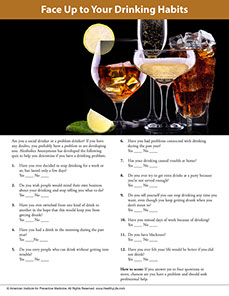
    Are you a social drinker or a problem drinker? If you have any doubts, you probably have a problem or are developing one. Alcoholics Anonymous has developed the following quiz to help you determine if you have a drinking problem.

    1.  Have you ever decided to stop drinking for a week or so, but lasted only a few days?  Yes ____ No ____

    2.  Do you wish people would mind their own business about your drinking and stop telling you what to do?  Yes ____ No ____

    3.  Have you ever switched from one kind of drink to another in the hope that this would keep you from getting drunk?  Yes ____ No ____

    4.  Have you had a drink in the morning during the past year?  Yes ____No ____

    5.  Do you envy people who can drink without getting into trouble?  Yes ____ No ____

    6.  Had problems connected with drinking during the past year?  Yes ____ No ____

    7.  Has your drinking caused trouble at home?  Yes ____ No ____

    8.  Do you ever try to get extra drinks at a party because you’re not served enough?

    Yes ____      No ____

    9.  Do you tell yourself you can stop drinking any time you want, even though you keep getting drunk when you don’t mean to?  Yes ____ No ____

    10. Have you missed days of work because of drinking?  Yes ____ No ____

    11. Do you have blackouts?  Yes ____ No ____

    12. Have you ever felt your life would be better if you did not drink?  Yes ____ No ____

    How to score: If you answer yes to four questions or more, chances are you have a problem and should seek professional help.

    Page from A Year of Health Hints book by the American Institute for Preventive Medicine. www.HealthyLife.com. All rights reserved.

    © American Institute for Preventive Medicine

  • Mind Your Mindless Munching 2

    Weight Control

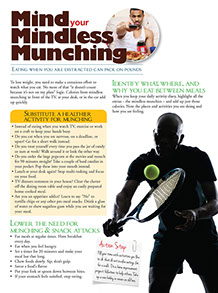
    Eating when you are distracted can pack on pounds.

    To lose weight, you need to make a conscious effort to watch what you eat. No more of that “it doesn’t count because it’s not on my plate” logic. Calories from mindless munching in front of the TV, at your desk, or in the car add up quickly.

    Lower the need for munching & snack attacks.

    Image of teenage boys eating out of big bag of chips.

    *  Eat meals at regular times. Have breakfast every day.

    *  Eat when you feel hungry.

    *  Set a timer for 20 minutes and make your meal last that long.

    *  Chew foods slowly. Sip; don’t gulp.

    *  Savor a food’s flavor.

    *  Put your fork or spoon down between bites.

    *  If your stomach feels satisfied, stop eating.

    Identify what, where, and why you eat between meals.

    When you keep your daily activity diary, highlight all the extras – the mindless munchies – and add up just those calories. Note the places and activities you are doing and how you are feeling.

    Substitute a healthier activity for munching.

    *  Instead of eating when you watch TV, exercise or work on a craft to keep your hands busy.

    *  Do you eat when you are nervous, on a deadline, or upset? Go for a short walk instead.

    *  Do you treat yourself every time you pass the jar of candy or nuts at work? Walk around it or look the other way.

    *  Do you order the large popcorn at the movies and munch for 90 minutes straight? Take a couple of hard candies in your pocket. Pop these into your mouth instead.

    *  Lunch at your desk again? Stop multi-tasking and focus on your food.

    *  TV dinners common in your house? Clear the clutter off the dining room table and enjoy an easily prepared home cooked meal.

    *  Are you an appetizer addict? Learn to say “No” to tortilla chips or any other pre-meal snacks. Drink a glass of water or chew sugarless gum while you are waiting for your meal.

    Action Step

    Fill your time with activities you like to do that do not involve eating. Go for a walk. Do a home improvement project. Volunteer to help others. Take up a new hobby or renew an old one.

    Page from Ways to Well-Being book by the American Institute for Preventive Medicine. www.HealthyLife.com. All rights reserved.

    © American Institute for Preventive Medicine

  • Motivation Is The Gateway For Adopting Healthy Changes

    Weight Control

    Female standing outside with arms open taking in the fresh air.

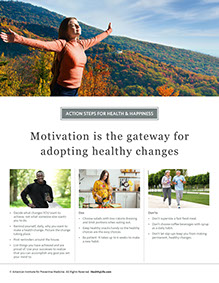
    *  Decide what changes YOU want to achieve, not what someone else wants you to do.

    *  Remind yourself, daily, why you want to make a health change. Picture the change taking place.

    *  Post reminders around the house.

    *  List things you have achieved and are proud of. Use your successes to realize that you can accomplish any goal you set your mind to.

    Dos

    *  Choose salads with low-calorie dressing and limit portions when eating out.

    *  Keep healthy snacks handy so the healthy choices are the easy choices.

    *  Be patient. It takes up to 6 weeks to make a new habit.

    Don’ts

    *  Don’t supersize a fast food meal.

    *  Don’t choose coffee beverages with syrup as a daily habit.

    *  Don’t let slip-ups keep you from making permanent, healthy changes.

    Page from HealthyLife Weigh book by the American Institute for Preventive Medicine. www.HealthyLife.com. All rights reserved.

    © American Institute for Preventive Medicine

  • New Year, New You

    Weight Control

    Smiling man.

    Take action now to reach your resolution to lose weight.

    *  Set an exercise goal you can reach. For example, by the end of this month, I will walk at least 20 minutes a day, five days a week.

    *  When you reach a goal, give yourself a nonfood reward, such as a new workout video or a new lunch bag.

    *  Substitute water for sweetened beverages.

    *  Eat fruits and veggies for snacks instead of candy, chips, and cookies.

    Action Step:Chew food slowly to give your body time to send a signal to your brain that you’ve had enough. You’ll enjoy your food more and eat less.

    Choose foods that won’t sabotage your goals.

    Page from HealthyLife Weigh book by the American Institute for Preventive Medicine. www.HealthyLife.com. All rights reserved.

    © American Institute for Preventive Medicine

  • Painless Ways To Eat Less Without Starving

    Weight Control

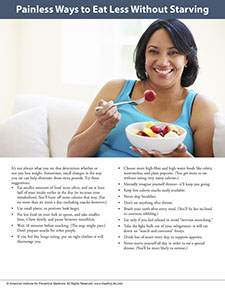
    It’s not always what you eat that determines whether or not you lose weight. Sometimes, small changes in the way you eat can help eliminate those extra pounds. Try these suggestions.

    *  Eat smaller amounts of food more often, and eat at least half of your intake earlier in the day (to increase your metabolism). You’ll burn off more calories that way. (Eat no more than six times a day-including snacks-however.)

    *  Use small plates, so portions look larger.

    *  Put less food on your fork or spoon, and take smaller bites. Chew slowly, and pause between mouthfuls.

    *  Wait 10 minutes before snacking. (The urge might pass.) Don’t prepare snacks for other people.

    *  If you feel like binge eating, put on tight clothes-it will discourage you.

    *  Choose more high-fiber and high-water foods like celery, watermelon, and plain popcorn. (You get more to eat without eating very many calories.)

    *  Mentally imagine yourself thinner–it’ll keep you going.

    *  Keep low-calorie snacks easily available.

    *  Never skip breakfast.

    *  Don’t eat anything after dinner.

    *  Brush your teeth after every meal. (You’ll be less inclined to continue nibbling.)

    *  Eat only if you feel relaxed to avoid “nervous munching.”

    *  Take the light bulb out of your refrigerator–it will cut down on “search-and-consume” forays.

    *  Drink lots of water every day, to suppress appetite.

    *  Never starve yourself all day in order to eat a special dinner. (You’ll be more likely to overeat.)

    Page from A Year of Health Hints book by the American Institute for Preventive Medicine. www.HealthyLife.com. All rights reserved.

    © American Institute for Preventive Medicine

  • The “Write” Way To Healthy Habits

    Weight Control

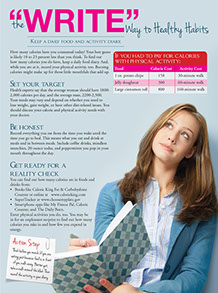
    Keep a daily food and activity diary.

    How many calories have you consumed today? Your best guess is likely 10 to 25 percent less than you think. To find out how many calories you do have, keep a daily food diary. And, while you are at it, record your physical activity, too. Burning calories might make up for those little mouthfuls that add up.

    Set your target.

    Health experts say that the average woman should have 1800-2,000 calories per day, and the average man, 2200-2,500. Your needs may vary and depend on whether you need to lose weight, gain weight, or have other diet-related issues. You should discuss your caloric and physical activity needs with your doctor.

    Be honest.

    Record everything you eat from the time you wake until the time you go to bed. This means what you eat and drink at meals and in between meals. Include coffee drinks, mindless munchies, 20-ounce sodas, and peppermints you pop in your mouth throughout the day.

    Get ready for a reality check.

    You can find out how many calories are in foods and drinks from:

    *  Books like Calorie King Fat & Carbohydrate Counter or online atwww.calorieking.com

    *  SuperTracker atwww.choosemyplate.gov

    *  Smartphone apps like My Fitness Pal, Calorie Counter, and The Daily Burn.

    Enter physical activities you do, too. You may be in for an unpleasant surprise to find out how many calories you take in and how few you expend in energy.

    If you had to pay for calories with physical activity:

    Food

    1 oz. potato chips

    Jelly doughnut

    Large cinnamon roll

    Calorie Cost

    150

    300

    800

    Activity Cost

    30-minute walk

    60-minute walk

    160-minute walk

    Action Step

    Think before you munch. If you are eating just because food is in front of you, walk away. Better yet, take a walk around the block. Then record the activity in your diary.

    Page from Ways to Well-Being book by the American Institute for Preventive Medicine. www.HealthyLife.com. All rights reserved.

    © American Institute for Preventive Medicine

  • A To Z Guide To Help Kids Be Healthy & Safe

    Child Safety

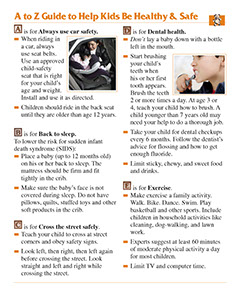
    A is for Always use car safety.

    *  When riding in a car, always use seat belts. Use an approved child-safety seat that is right for your child’s age and weight. Install and use it as directed.

    *  Children should ride in the back seat until they are older than age 12 years.

    B is for Back to sleep.

    To lower the risk for sudden infant death syndrome (SIDS):

    *  Place a baby (up to 12 months old) on his or her back to sleep. The mattress should be firm and fit tightly in the crib.

    *  Make sure the baby’s face is not covered during sleep. Do not have pillows, quilts, stuffed toys and other soft products in the crib.

    C is for Cross the street safely.

    *  Teach your child to cross at street corners and obey safety signs.

    *  Look left, then right, then left again before crossing the street. Look straight and left and right while crossing the street.

    D is for Dental health.

    Don’t lay a baby down with a bottle left in the mouth.

    Start brushing your child’s teeth when his or her first tooth appears. Brush the teeth 2 or more times a day. At age 3 or 4, teach your child how to brush. A child younger than 7 years old may need your help to do a thorough job.

    Take your child for dental checkups every 6 months. Follow the dentist’s advice for flossing and how to get enough fluoride.

    Limit sticky, chewy, and sweet food and drinks.

    E is for Exercise.

    *  Make exercise a family activity. Walk. Bike. Dance. Swim. Play basketball and other sports. Include children in household activities like cleaning, dog-walking, and lawn work.

    *  Experts suggest at least 60 minutes of moderate physical activity a day for most children.

    *  Limit TV and computer time.

    F is for Feed your child healthy foods.

    G is for Give positive feedback.

    *  Praise good behaviors.

    *  Hug, read, and play together.

    H is for Hand washing.

    Teach your child to wash his or her hands often. Show them how to do it the right way. Use soap and running water. Take at least 20 seconds to wash the hands. This is the amount of time it takes to sing “Happy Birthday” two times. Dry the hands with clean paper towels that can be thrown away.

    Hand washing is important before your child eats and after he or she goes to the bathroom, plays, handles pets, and sneezes or coughs.

    I is for Install.

    *  Install smoke alarms. Install carbon monoxide detectors, too.

    *  Follow the rules of the city you live in.

    *  Check to see that they work well. Do this every month.

    *  Ask your local fire department for help, if you need it.

    J is for Join.

    Join your child in being physically active and in eating healthy foods. Join group activities as a family.

    K is for Keep harmful things out of children’s reach. These include:

    *  Medicines and vitamins. Store these in “child- safe” bottles.

    *  Bleach and other household products. Read labels to find out which ones can harm a child and for first aid information.

    *  Matches, lighters, guns and bullets.

    *  All knives and sharp utensils.

    L is for Listen and Learn.

    Listen to your child.

    Learn about your child’s interests. Learn who their friends are, too.

    Learn child first aid and CPR.

    M is for Medicine safety.

    *  When you give medicine to your child, make sure it is the right kind and dose for your child’s weight.

    *  Give medicine as advised by your child’s doctor.

    *  Do not give aspirin to anyone under 19 years of age due to its link to Reye’s Syndrome.

    N is for Never leave a baby, toddler, or young child unattended.

    *  Never leave a baby alone on a bed or table.

    *  It takes only seconds for a toddler or curious children to get into something they should not be into.

    *  Never leave a child alone in a bathtub or baby bath.

    *  Never leave a child alone in a car and around cars.

    O is for Obey traffic laws and other rules.

    *  Laws and rules are made to keep people safe. Teach your child to obey them.

    *  Set rules that your child needs to follow.

    P is for Poison Control Center hotline.

    This number is 800.222.1222. Keep it by each phone. Program it in your cell phone.

    Q is for Quit Smoking!

    *  Smoking and secondhand smoke are very harmful to you and your child.

    *  Don’t smoke. Don’t let your child smoke.

    *  Do not allow smoking in your home.

    *  If needed, get help to quit smoking. Get help from your doctor or from 800.QUIT.NOW (784.8669) andwww.smokefree.gov.

    R is for Role model.

    *  Children copy what they see.

    *  Eat healthy foods. Do regular exercise.

    S is for Safety-proof the house.

    *  Set the thermostat on your water heater to 120ºF or less.

    *  Put safety plugs in outlets.

    *  Teach your child to stay away from the stove.

    *  Keep guard rails around space heaters. Gate off unsafe areas.

    *  Do not let young children get toys or other things with small parts. They could choke on them.

    *  Never leave a child alone near water. Wear life jackets when boating or near a lake. Empty buckets with water, etc. right away after use.

    *  Get more safety tips from Safe Kids Worldwide atwww.usasafekids.org.

    T is for Talk to your child.

    Talk about ways to be healthy and safe. Tell your child what you expect of him or her. Tell your child often that you love him or her.

    U is for Use products that are safety approved for kids.

    *  These include: Car seats, cribs, playpens, toys, and sleepwear.

    *  Find out if a product is safe or has been recalled from The U.S. Consumer Product Safety Commission atwww.cpsc.gov.

    V is for Vaccines.

    W is for Wear protective gear.

    *  Wear a helmet when riding a bike, rollerblading, skating, etc.

    *  Wear the right gear when practicing and playing team sports.

    *  Wear clothes or material that reflects the light when outdoors in the dark.

    X is for eXams from a health care provider.

    Children age 3 years and older should get a yearly checkup. Children under age 3 years need checkups when they are 1, 2, 4, 6, 9, 12, 15, 18, and 24 months old.

    Y is for Yearly flu vaccine.

    A yearly flu vaccine is the single best way to prevent getting the flu. All children ages 6 to 59 months should get a flu vaccine. So should others as advised by their doctors.

    Z is for ZZZZs (sleep).

    Get enough sleep each night:

    *  Adults need at least 7 to 9 hours.

    *  Teens need at least 8-1⁄2 to 9-1⁄2 hours.

    *  After 6 months of age, most children need 9 to 12 hours. Up to age 5 years, children may also take daytime naps for a total of 1⁄2 to 2 hours a day.

    Children's Self-Care book by the American Institute for Preventive Medicine. www.HealthyLife.com. All rights reserved.

    © American Institute for Preventive Medicine

  • Be Healthy At Each Cycle Of Life. Recycle Along The Way.

    Home Safety

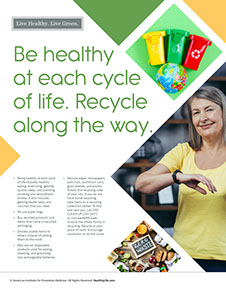
    Women with smart watch and fist up in the air.

    *  Being healthy at each cycle of life includes healthy eating, exercising, getting quality sleep, and avoiding smoking and secondhand smoke. It also includes getting health tests and vaccines that you need.

    *  Re-use paper bags.

    *  Buy recycled products and items that come in recycled packaging.

    *  Donate usable items to others instead of adding them to the trash.

    *  Rely less on disposable products used for eating, cleaning, and grooming. Use rechargeable batteries.

    *  Recycle paper, newspapers, junk mail, aluminum cans, glass bottles, and plastic. Follow the recycling rules of your city. If you do not have home recycling, take items to a recycling collection center. To find one near you, call 800.CLEAN.UP (253.2687) or visitearth911.com. Involve the whole family in recycling. Recycle at your place of work. Encourage coworkers to do the same.

    A Year of Health Hints book by the American Institute for Preventive Medicine. www.HealthyLife.com. All rights reserved.

    © American Institute for Preventive Medicine

  • Breaking Bad Habits Now

    WELL-BEING

    Doctor holding an apple in hand wrap with a tape measure.

    If you’re hoping to make a change, these tips may help:

    Avoid.If certain places or people make you want to engage in unhealthy habits, try your best to stay away.

    Replace.Focus on what you can do instead of the bad habit. For instance, take a walk or drink a glass of water.

    Plan.If you know you’ll be tempted with a bad habit, practice what you can do. Picture yourself not giving in. Have a plan for yourself.

    Buddy up.Ask a friend or family member to support you. They can cheer you on and encourage you when you need it.

    Source: National Institutes of Health

    © American Institute for Preventive Medicine