Tag: habits

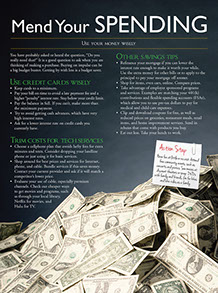
  • Mend Your Spending

    Financial Health

    Use your money wisely.

    You have probably asked or heard the question, “Do you really need that?” It is a good question to ask when you are thinking of making a purchase. Buying on impulse can be a big budget buster. Getting by with less is a budget saver.

    Use credit cards wisely:

    *  Keep cards to a minimum.

    *  Pay your bill on time to avoid a late payment fee and a higher “penalty” interest rate. Stay below your credit limit.

    *  Pay the balance in full. If you can’t, make more than the minimum payment.

    *  Try to avoid getting cash advances, which have very high interest rates.

    *  Ask for a lower interest rate on credit cards you currently have.

    Trim costs for tech services:

    *  Choose a cellphone plan that avoids hefty fees for extra minutes and texts. Consider dropping your landline phone or just using it for basic services.

    *  Shop around for best prices and services for Internet, phone, and cable. Bundle services if this saves money. Contact your current provider and ask if it will match a competitor’s lower price.

    *  Evaluate your use of cable, especially premium channels. Check out cheaper ways to get movies and programs, such as through your local library, Netflix for movies, and Hulu for TV.

    Other savings tips:

    *  Refinance your mortgage if you can lower the interest rate enough to make it worth your while. Use the extra money for other bills or to apply to the principal to pay your mortgage off sooner.

    *  Shop for items, even cars, online. Compare prices.

    *  Take advantage of employer sponsored programs and services. Examples are matching your 401(k) contributions and flexible spending accounts (FSAs), which allow you to use pre-tax dollars to pay for medical and child care expenses.

    *  Clip and download coupons for free, as well as reduced prices on groceries, restaurant meals, retail items, and home improvement services. Send in rebates that come with products you buy.

    *  Eat out less. Take your lunch to work.

    Action Step

    Have fun at little or no cost. Attend free community events, such as concerts and picnics. See movies at discount theaters or swap DVDs with family and friends. Go for hikes and bike rides as a family.
    Ways to Well-Being book by the American Institute for Preventive Medicine. www.HealthyLife.com. All rights reserved.

    © American Institute for Preventive Medicine

  • Are You Driving Yourself To Burnout?

    SUCCESS OVER STRESS

    Image of elevated train and cars on road.

    Commuting length, distance, and means are stress factors that can lead to burnout, said Annie Barreck of the University of Montreal’s School of Industrial Relations.

    By car:

    No surprises: the bigger the city, the more stressful the commute, at least for people traveling by car. Passengers are more likely to be stressed out than drivers because carpooling reduces the passenger commuters’ sense of control, which causes them more stress before they’ve even arrived at work.

    By public transit:

    People with long commutes from rural areas via bus or train connections are stressed about uncontrollable delays. The stress carries over into the workplace. But transit users in major urban areas are less likely to have symptoms of burnout.

    By bike or on foot:

    Biking is also a mixed bag that is determined by the area the commuter is working in. Commuting by bike in the suburbs is more stressful than biking in the city where cyclists and walkers have access to safety features such as cycle paths and pedestrian crossings, which increase their sense of control over their commute.

    Study findings show that the risk of burnout increases significantly when a commute lasts more than 20 minutes. Above 35 minutes, all employees are at increased risk of cynicism toward their job. Barreck believes this should lead employers to adopt flexible commuting arrangements.

    © American Institute for Preventive Medicine

  • Breaking Bad Habits

    WELL-BEING

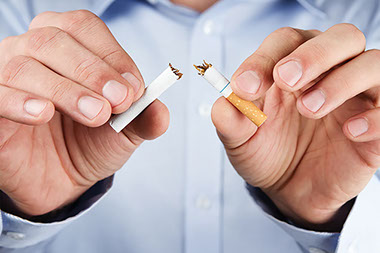
    Close-up image of a person breaking a cigarette in half.

    Bad habits may be hard to change, but it can be done. Smoking, for example, can be stopped. So can alcohol abuse.

    If you could only … but why don’t you? Scientists at the NIH study what happens in your brain as habits form. They come about through repetition. Brushing your teeth in the morning is a good habit. Reaching for a cigarette-bad habit.

    Habits trigger pleasure centers in your brain. First, focus on becoming more aware of your bad habits. Then try these strategies to counteract them:

    *  Avoid tempting situations. If you don’t buy candy bars, it won’t be as easy to eat one.

    *  Prepare mentally. Think about how you want to handle it and mentally practice what you plan.

    *  Enlist support. Ask friends, family, and coworkers to support your efforts to change.

    *  Replace unhealthy bad habits with healthy ones. Exercise or try a new hobby.

    *  Reward yourself for small steps.

    © American Institute for Preventive Medicine
  • Sleep, But How?

    MEDICAL NEWS

    Image of man awake in bed.

    “We know that how much you sleep and the quality of your sleep can have a tremendous impact on your overall health,” said Dr. David J. Earnest, professor at the Texas A&M Health Science Center College of Medicine, who studies circadian rhythms-the human body’s master clock.

    “We’re starting to recognize that sleep deprivation and disorders are more prevalent than any other health disorder that affects Americans,” he said.

    If you feel like there’s a deeper cause to your sleep woes, you may be like 1 in 10 Americans who suffer from insomnia or other sleep disorders, including these:

    Delayed Sleep Phase Disorder (DSPD)-a tendency to go to bed later (around 2 or 4 in the morning) and to sleep until the early afternoon. This kind of disorder can interfere with a normal work or school schedule.

    Advanced Sleep Phase Disorder (ASPD)-the tendency to go to bed earlier (6 or 8 in the evening) and to wake earlier than most people (around 3 or 5 in the morning). While this kind of disorder doesn’t typically interfere with a normal work or school schedule, it can pose a challenge for social activities or events that occur later in the evening.

    Non-24-Hour Sleep-Wake Syndrome-a circadian rhythm that is 25 hours or longer, which leads to sleep and wake times becoming gradually later.

    Jet Lag-one of the most common and usually occasional sleep disorders that occurs when your internal clock is out of synch with a new time zone. After traveling to a new time zone, you may find it difficult to fall and stay asleep during suitable times.

    Shift Work-with constantly changing shifts, it can be difficult for workers to adjust to their new sleep schedules. Shift work has been linked with a higher risk of developing metabolic or cardiovascular diseases.

    Sleep Apnea-breathing temporarily stops due to a blockage of the upper airways during sleep. Most people with sleep apnea do not know that they have it. Symptoms include daytime sleepiness, irritability, depression, and fatigue the next day, because their sleep lacks quality.

    Narcolepsy-extreme sleepiness during the day, usually resulting in suddenly falling asleep. It’s caused by a dysfunction in the brain mechanism that controls sleeping and waking.

    Restless Leg Syndrome (RLS)-itching, tingling, or burning in the lower legs, that makes it difficult to get comfortable and fall asleep.

    If you think you might have a sleep disorder, discuss your symptoms with your doctor or a sleep specialist.

    © American Institute for Preventive Medicine

  • Small Changes Your Heart Will Love

    MEDICAL NEWS

    Image of a basket filled with fruits and vegetables.

    You may know the basics of heart health that include a healthy diet, exercise, healthy weight, and avoiding tobacco. But, don’t let these major goals overwhelm you. Instead, take small steps each day that add up to big heart-healthy benefits.

    Say bye-bye to beige and eat the rainbow.

    Look at your plate’s color before you eat a meal. If it’s mostly browns, such as breads, pasta and meat, see if you can brighten it up with fruits and vegetables. Leafy greens, yellow peppers, carrots, blueberries and strawberries are just a few of the brightly colored foods that are great for your heart.

    Cut back on sodium when you can.

    If you’ve been eating salt for years, it can be hard to cut it out completely. But you may not taste the difference if you gradually replace some of the salt in your diet with herbs and spices without sodium. Cutting back on sodium can reduce your risk of heart attack, heart failure, and stroke. Many processed foods already contain high amounts of sodium, and adding salt to food greatly increases sodium intake for many people.

    Walk, if you can’t run.

    For many people, jogging, running, or other high-intensity workouts aren’t possible. Fortunately, you don’t have to choose a tough workout to get heart benefits. Start walking just a few minutes a day. Increase the amount of time you walk when you can until you are walking 30 minutes a day most days of the week. Brisk walking can be just as beneficial to your heart as running.

    If you use tobacco, keep trying to quit.

    Quitting tobacco is hard, and many people struggle to succeed. You may have strong urges to use tobacco or you may slip up and start again after you’ve quit. When this happens, be patient with yourself. Understand that many people have to quit several times before they’ve quit for good. When you quit, your heart – and your entire body – will start to heal. You’ll reduce your risk of heart disease, lung cancer, and many other serious diseases. Talk with your health care provider about prescription medication or nicotine replacement therapy.  Many of these treatments are now covered by insurance.

    Source: American Heart Association

    © American Institute for Preventive Medicine

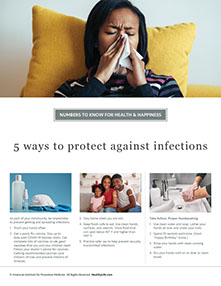
  • 5 Ways To Protect Against Infections

    General Health Conditions

    Parents with child all smiling showing upper arm with vaccine bandage.

    As part of your community, be responsible to prevent getting and spreading infections.

    1.  Wash your hands often.

    2.  Get a yearly flu vaccine. Stay up to date with COVID-19 booster shots. Get complete lists of vaccines atcdc.gov/vaccinesthat you and your children need. Follow your doctor’s advice for vaccines. Getting recommended vaccines save millions of lives and prevent millions of illnesses.

    3.  Stay home when you are sick.

    4.  Keep foods safe to eat. Use clean hands, surfaces, and utensils. Store food that can spoil below 40° F and higher than 140° F.

    5.  Practice safer sex to help prevent sexually transmitted infections.

    Take Action: Proper Handwashing

    1.  Use clean water and soap. Lather your hands all over and under your nails.

    2.  Spend 20 seconds each time. (Hum “Happy Birthday” twice.)

    3.  Rinse your hands with clean running water.

    4.  Dry your hands with an air drier or clean towel.

    Health at Home Lifetime book by the American Institute for Preventive Medicine. www.HealthyLife.com. All rights reserved.

    © American Institute for Preventive Medicine

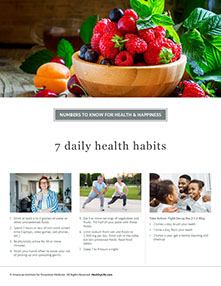
  • 7 Daily Health Habits

    General Health Conditions

    A wooden bowl filled with berries.

    1.  Drink at least 6 to 8 glasses of water or other unsweetened fluids.

    2.  Spend 2 hours or less of non-work screen time (laptops, video games, cell phones, etc.).

    3.  Be physically active for 30 or more minutes.

    4.  Wash your hands often to lower your risk of picking up and spreading germs.

    5.  Eat 5 or more servings of vegetables and fruits. Fill half of your plate with these foods.

    6.  Limit sodium from salt and foods to 2,300 mg per day. Omit salt at the table. Eat less processed foods. Read food labels.

    7.  Sleep 7 to 9 hours a night.

    Take Action: Fight Decay the 2-1-2 Way

    *  2 times a day, brush your teeth

    *  1 time a day, floss your teeth

    *  2 times a year, get a dental cleaning and checkup

    Health at Home Lifetime book by the American Institute for Preventive Medicine. www.HealthyLife.com. All rights reserved.

    © American Institute for Preventive Medicine

  • Surprisingly Simple Ways To Prevent Disease

    MEDICAL NEWS

    Image of happy man with thumbs up as he weighs himself.

    Five new studies support simple steps to prevent illness and improve overall health. The American Journal of Medicine reports the following based on multiple studies in several countries:

    *  Eating fresh fish regularly may reduce your risk of colorectal cancer.

    *  Still trying to stop smoking? Try acupuncture and hypnosis. Several studies found smokers had good success.

    *  Have your teeth cleaned regularly. Scaling removes harmful bacteria. You can reduce your risk for heart attack and stroke.

    *  Talk to your doctor about weight loss. People who were moderately obese, followed a diet plan from their doctors (not a weight loss clinic), and stuck with it at least 12 weeks, lost over 10% of their body weight.

    *  Low-dose aspirin, for people who can take it, offers preventive cancer benefits along with heart healthy help.

    © American Institute for Preventive Medicine