Tag: Health Conditions

  • Ticked Off

    MEDICAL NEWS

    Close up image of a tick being removed from a person's skin.

    Act fast to lower your risk for problems related to Lyme disease caused by tick bites, urges Time for Lyme, Inc.

    Have I been bitten? Lyme disease can only be transmitted from a bite by an infected deer tick, not from another person or animal, although pets commonly bring ticks into the home. All family members and pets should be inspected immediately and carefully after exposure to tick environments. You’ve been bitten if you find a tick attached to the skin. The longer it has been attached, the greater the risk of disease.

    How should I remove the tick? The proper way to remove a tick is with a set of fine-point tweezers. Do not attempt to burn the tick or use your fingers or soap or any other substance on it, as these may irritate the tick and cause it to inject bodily fluids into the wound.

    Using fine-point tweezers, grasp the tick as close to the skin surface as possible, near the head of the tick. Pull backward gently but firmly, using an even, steady pressure. Do not jerk or twist. Do not squeeze, crush, or puncture the body of the tick, as this may cause transmission of infection-causing organisms. If any mouth parts of the tick remain in the skin, leave them alone; they will come out naturally.

    If the tick is found crawling, a good way to remove it is by using a piece of tape: stick the tape to the tick and then suffocate it by sealing it into the tape. Otherwise, you can dispose of it in alcohol or flush it down the toilet. After removing the tick, wash your skin and hands thoroughly with soap and water.

    Monitor any bite site for redness that might mean a rash of Lyme disease. A bull’s-eye pattern might develop. Other typical symptoms that may develop within a few days of being bitten include headache, stiff neck, swollen glands, fatigue, dizziness, and pains that come and go.

    See your doctor if you have symptoms or concerns. Early Lyme disease is treated with antibiotics. For more information, go towww.LymeResearchAlliance.org.

    © American Institute for Preventive Medicine

  • You May Need To Get Tested For Hepatitis C

    MEDICAL NEWS

    Image of doctor talking to a patient.

    An estimated 3.2 million Americans are infected with chronic hepatitis C, a viral infection of the liver. Among those are larger numbers of Veterans and baby boomers.

    The CDC recently recommended that all baby boomers in the U.S. (those born between 1945 and 1965) get a simple one-time blood test for hepatitis C. They estimate that this testing could identify more than 800,000 additional people with the disease.

    Here’s what we know:

    *  Chronic hepatitis C won’t go away on its own.

    *  Many people living with hepatitis C are not aware they have the condition and may go years without showing symptoms. Hepatitis C is treated with a combination of medications.

    *  The rate of hepatitis C among people born in 1945 through 1965 is about 4%, compared to about 1% among other Americans. That difference is likely due to risky behaviors among this group.

    *  You can get hepatitis C from infected blood or body fluids. Today, the most common way people get infected is by needle-sharing during intravenous drug use. Most new infections occur among drug users. In addition, an infected pregnant woman can infect her unborn baby.

    *  Since 1992, when reliable blood screening procedures became available, the risk of transmission of hepatitis C by blood transfusion has fallen to less than one per million units of transfused blood, according to the CDC. Rarely, the virus can be transmitted through sexual intercourse.

    *  Hepatitis C is not transmitted through shaking hands, coughing, sneezing, breastfeeding, or sharing cups and utensils.

    *  Hepatitis C can cause serious liver problems.

    © American Institute for Preventive Medicine

  • Bad Breath

    Dental & Mouth Concerns

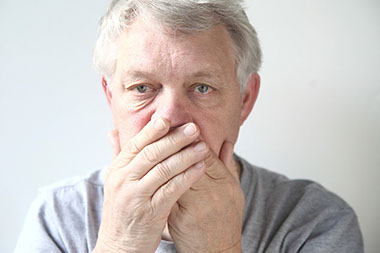
    Image of man holding hands over mouth.

    Bad breath (halitosis) is a social concern. It can be a health issue, too.

    Signs & Symptoms

    *  A bad odor from the mouth. To detect this, wipe the back of your tongue with a piece of white, sterile gauze. After 5 minutes, smell the gauze for an odor.

    *  An unpleasant taste is in the mouth.

    *  You are told you have bad breath.

    Causes

    Bacteria on the tongue, dry mouth, and strong odors of food, such as garlic and onions, are common causes of bad breath. Other causes are smoking, alcohol, ill-fitting dentures, and infections of the gums or teeth. Less often, bad breath is due to another problem, such as a sinus infection or indigestion.

    Treatment

    TheSelf-Care/Preventionitems listed on this page treat most cases of bad breath. If not, your dentist can prescribe:

    *  A special toothpaste.

    *  A mouth rinse.

    *  A special brush.

    *  A tongue scraper.

    *  An antimicrobial solution.

    Questions to Ask

    Self-Care / Prevention

    *  Practice good oral hygiene.

    *  If you wear dentures, clean and care for them as advised by your dentist.

    *  Don’t smoke. Limit or avoid alcohol.

    *  To prevent dry mouth, drink plenty of water and other liquids.

    *  Use a baking soda toothpaste. Brush your teeth and tongue. Do this after all meals, if you can. If not, rinse your mouth with water, chew parsley, mint leaves, celery, or carrots after meals.

    *  Don’t rely on mouthwash or mints. They mask bad breath and help cause it, because they dry out the mouth. Try chlorophyll tablets.

    *  Eat at regular times. Eat nutritious foods. Limit sugary foods.

    *  Chew sugarless gum or suck on lemon or other citrus drops. These help make saliva. Saliva helps deal with bacteria on the teeth and washes away food particles.

    Healthier at Home book by the American Institute for Preventive Medicine. www.HealthyLife.com. All rights reserved.

    © American Institute for Preventive Medicine

  • Cold Hands & Feet

    Skin Conditions

    Signs & Symptoms

    *  Fingers or toes turn pale white or blue, then red, in response to cold temperatures.

    *  Pain when the fingers or toes turn white.

    *  Tingling or numbness in the hands or feet.

    Causes

    Often the cause is unknown and not serious. Cold hands and feet can be a symptom of the conditions that follow.

    *  Poor circulation. This is most often due to diseased arteries.

    *  Raynaud’s disease. This is a disorder that affects the flow of blood to the fingers and sometimes to the toes.

    *  Any underlying disease that affects the blood flow in the tiny blood vessels of the skin. Women who smoke may be more prone to this.

    *  Frostbite.

    *  Stress.

    *  A side effect of taking certain medicines

    *  Cervical rib syndrome. This is a compression of the nerves and blood vessels in the neck that affects the shoulders, arms, and hands.

    Treatment

    Emergency care is needed for frostbite. If a medical condition causes cold hands and/or feet, treatment for the condition is needed.

    Questions to Ask

    Self-Care / Prevention

    *  Don’t smoke. If you smoke, quit.

    *  Avoid caffeine.

    *  Don’t handle cold objects with bare hands. Use ice tongs to pick up ice cubes, etc.

    *  Set your indoor thermostat at 65ºF or higher.

    *  Wear mittens and wool socks to keep hands and feet warm.

    *  Don’t wear tight-fitting footwear.

    *  Wiggle your toes. It may help keep them warm by increasing blood flow.

    *  Stretch your fingers straight out. Swing your arms in large circles like a baseball pitcher warming up for a game. This may increase blood flow to the fingers. Skip this tip if you have bursitis or back problems.

    *  Meditate. Learn and practice biofeedback.

    Healthier at Home book by the American Institute for Preventive Medicine. www.HealthyLife.com. All rights reserved.

    © American Institute for Preventive Medicine

  • Dry Mouth

    Dental & Mouth Concerns

    Dry mouth is an abnormal dryness of the mucus membranes in the mouth. This happens when there isn’t enough saliva or the composition of the saliva changes. Dry mouth is common in the elderly.

    Signs & Symptoms

    *  Dry, parched feeling in the mouth

    *  Lack of saliva

    *  Problems with talking and/or swallowing

    *  Lessened taste

    *  Bad breath

    *  Burning sensation in the mouth

    *  Dry mouth is worse after sleeping

    Causes, Risk Factors & Care

    Dry mouth can be due to a side effect of many medications. These include antidepressants, antihistamines, water pills, and medicines for high blood pressure.

    Dry mouth can also result from many health conditions. These include nasal congestion, gum disease, diabetes, stroke, and Sjögren’s syndrome, an autoimmune disorder.

    Treatment is aimed at relief and/or treating the underlying cause. If not treated, dry mouth may lead to severe tooth decay, infection, and poor nutrition.

    Self-Care

    *  Try an over-the-counter artificial saliva, such as Xerolube.

    *  Avoid caffeine and alcohol.

    *  Have regular dental checkups.

    *  Drink at least 8 glasses of water each day. Avoid drinks with sugar.

    *  Avoid salty, spicy, or acidic foods.

    *  Don’t use tobacco products.

    *  Take a multivitamin that your doc- tor recommends.

    *  Use a humidifier in the bedroom.

    *  Keep your lips moist with lip balm.

    *  Breathe through your nose, not your mouth.

    *  Do not use mouthwashes with alcohol.

    *  Read about the side effects of medicines.

    Medical Care

    Contact Doctor When:

    *  The dry mouth is a chronic problem or there are marked changes on the tongue.

    *  You have any of these problems with dry mouth:

    – Dry, burning eyes

    – Chewing or swallowing problems

    – Sore throat

    – Signs of an infection, such as fever and/or redness, or pus in the mouth

    Health at Home Lifetime book by the American Institute for Preventive Medicine. www.HealthyLife.com. All rights reserved.

    © American Institute for Preventive Medicine

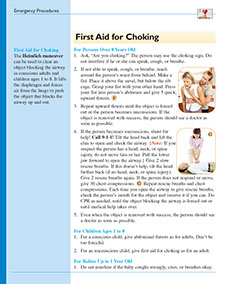
  • First Aid For Choking

    First Aid

    The Heimlich maneuver can be used to clear an object blocking the airway in conscious adults and children ages 1 to 8. It lifts the diaphragm and forces air from the lungs to push the object that blocks the airway up and out.

    Persons Over 8 Years Old

    1. Ask, “Are you choking?”

    The person may use the choking sign. Do not interfere if he or she can speak, cough, or breathe.

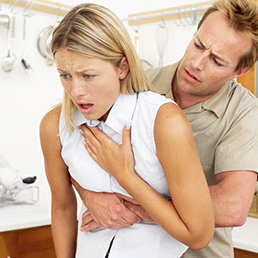
    2. If not able to speak, cough, or breathe, reach around the person’s waist from behind.

    Make a fist. Place it above the navel, but below the rib cage. Grasp your fist with your other hand. Press your fist into person’s abdomen and give 5 quick, upward thrusts. See image A.

    Image of giving a person first aid for choking.

    Image A

    3. Repeat upward thrusts until the object is forced out or the person becomes unconscious.

    If the object is removed with success, the person should see a doctor as soon as possible.

    4. If the person becomes unconscious, shout for help! Call 9-1-1!

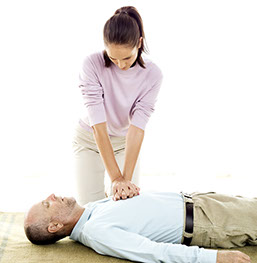
    Tilt the head back and lift the chin to open and check the airway. {Note: If you suspect the person has a head, neck, or spine injury, do not move him or her. Pull the lower jaw forward to open the airway.} Give 2 slow rescue breaths. If this doesn’t help, tilt the head further back (if no head, neck, or spine injury). Give 2 rescue breaths again. If the person does not respond or move, give 30 chest compressions. See image B. Repeat rescue breaths and chest compressions. Each time you open the airway to give rescue breaths, check the person’s mouth for the object and remove it if you can. Do CPR as needed, until the object blocking the airway is forced out or until medical help takes over.

    Image of adult chest compressions.

    Image B

    5. Even when the object is removed with success, the person should see a doctor as soon as possible.

    Children Ages 1 to 8

    1.  For a conscious child, give abdominal thrusts as for adults. Don’t be too forceful.

    2.  For an unconscious child, give first aid for choking as for an adult.

    Babies Up to 1 Year Old

    1.  Do not interfere if the baby coughs strongly, cries, or breathes okay.

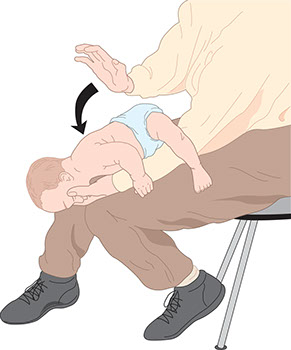
    2.  If the baby is conscious, hold the baby’s head (face down) in one hand. Straddle the baby over your forearm. Rest your forearm on your leg for support. Keep the baby’s head lower than the rest of his or her body.

    3.  With the heel of your free hand, give up to 5 quick, forceful blows on the baby’s back between the shoulder blades. See image C. If the object still blocks the airway, go to step 4.

    4.  Turn the baby over (face up). Cradle the baby on your forearm. Support the head with one hand. Keep the baby’s head lower than the rest of his or her body. Rest your arm on your leg for support. Place 2 fingers 1/2 inch below and in between the nipples on the baby’s chest. Give 5 quick downward thrusts. Depress the sternum about 1-1/2 inches with each thrust.

    5.  Repeat steps 3 and 4 until the object is removed or the baby is unconscious.

    6.  If the baby is unconscious, shout for help. Have someone call 9-1-1! If no one calls 9-1-1, give first aid for 1 minute, stop to call 9-1-1, then resume rescue efforts.

    7.  Put the baby on his/her back. Keep the head tilted back with one hand and give 30 chest compressions using 2 fingers on your other hand. Give 2 slow rescue breaths. If the object is expelled, stop. If not, give cycles of 30 compressions and 2 slow rescue breaths until the object is removed or help arrives.

    8.  Check for and remove the object in the airway, if visible. Repeat steps 7 and 8 as needed.

    9.  Don’t give up! Give CPR until medical help takes over or until the object is removed. Even if it is, get medical care right away.

    Illustration on giving a baby first aid when choking.

    Image C

    Healthier at Home book by the American Institute for Preventive Medicine. www.HealthyLife.com. All rights reserved.

    © American Institute for Preventive Medicine

  • Hair Loss

    Skin Conditions

    Most men have some degree of baldness by age 60. After age 60, 50% of women do.

    Signs & Symptoms

    *  Thinning of hair on the temples and crown.

    *  Receding hair line.

    *  Bald spot on back of head.

    *  Areas of patchy hair loss.

    Causes

    *  Normal aging. Family history of hair loss. Hormonal changes, such as with menopause.

    *  A side effect of some medicines, chemotherapy, and radiation therapy. Crash dieting.

    *  A prolonged or serious illness. Major surgery. Thyroid disease.

    *  Areata. This causes areas of patchy hair loss. It improves quickly when treated, but can go away within 18 months without treatment.

    Treatment

    *  Medications. These include over-the- counter Rogaine and prescribed ones.

    *  Hair transplant with surgery.

    Questions to Ask

    Self-Care / Prevention

    *  Try the over-the-counter medication, Rogaine.

    *  Avoid (or don’t use often) hair care practices of bleaching, braiding, cornrowing, dyeing, perming, etc. Avoid hot curling irons and/or hot rollers. Use gentle hair care products.

    *  Air dry or towel dry your hair. If you use a hairdryer, set it on low.

    *  Keep your hair cut short. It will look fuller.

    *  Don’t be taken in by claims for products that promise to cure baldness.

    Resources

    American Academy of Dermatology

    866.503.SKIN (503.7546)

    www.aad.org

    Healthier at Home book by the American Institute for Preventive Medicine. www.HealthyLife.com. All rights reserved.

    © American Institute for Preventive Medicine

  • Irritable Bowel Syndrome (Ibs)

    Abdominal & Urinary Conditions

    Image of women sitting holding stomach in pain.

    Irritable bowel syndrome (IBS) is a problem that mostly affects the bowel (the large intestine) and is not caused by any other bowel disease. It can be painful, does not damage the colon or lead to other health problems.

    Signs & Symptoms

    *  Gas, bloating, pain, or discomfort in the abdomen.

    *  Chronic diarrhea, constipation (or both).

    *  Mucus in the stool.

    Causes

    The cause is not known. A person with IBS has an extra sensitive colon. Muscles in the intestines go into spasm, causing symptoms.

    Treatment

    Changes in eating habits, stress relief, and medications treat IBS.

    Questions to Ask

    Self-Care / Prevention

    *  Don’t smoke. If you smoke, quit. Avoid secondhand smoke.

    *  Maintain a healthy diet. Lose weight if you are overweight.

    *  Avoid constipation. Don’t strain to pass stool.

    *  Exercise to keep abdominal muscles strong. Follow your doctor’s advice.

    *  When you do sit ups, keep your knees bent and your feet flat on the floor.

    *  Follow proper lifting techniques.

    *  Wear a weight lifting belt to support the back when lifting.

    *  Wear a truss. This is a device that holds a hernia in place.

    *  For mild pain, take an over-the-counter medicine for pain. If even mild pain lasts longer than a week, see your doctor.

    Resources

    National Institute of Diabetes and Digestive and Kidney Diseases (NIDDK)

    www.niddk.nih.gov

    Healthier at Home book by the American Institute for Preventive Medicine. www.HealthyLife.com. All rights reserved.

    © American Institute for Preventive Medicine

  • Near-Drowning

    First Aid

    Near-drowning is when a person is in danger of drowning. Each year, almost 8,000 people die from drowning. Seventy percent of all near-drowning victims recover; 25% die, and 5% have brain damage.

    A toddler can drown in as little as 2 inches of water in a bathtub, sink, etc. Toilet bowls are unsafe, too, if a small child falls into one head-first.

    Signs & Symptoms

    *  A person is in the water with signs of distress. He or she can’t stay above water, swims unevenly, signals for help, etc.

    *  Blue lips or ears. The skin is cold and pale.

    *  Bloated abdomen. Vomiting. Choking.

    *  Confusion. Lethargy.

    *  The person does not respond or can’t breathe.

    Causes

    *  Not being able to swim. Being in water too deep and too rough for one’s ability to swim.

    *  Water sport and other accidents. Not following water safety rules. Not wearing a life preserver, etc. Unsupervised swimming.

    *  Falling through ice while fishing, skating, etc.

    *  Injury or problems that occur while swimming, boating, etc. Examples are leg or stomach cramps, fatigue, and alcohol or drug use. A heart attack, stroke, seizure, and a marine animal bite or sting may have occurred.

    Prevention

    For Children

    *  Never leave an infant or child alone in any type of bathtub. Supervise young children in the bathroom.

    *  Never leave a child alone near water, swimming pools, etc. Lock gates to keep children from getting near swimming pools.

    *  Have a phone near outdoor pools, etc.

    *  Teach children to swim. Tell them not to swim alone and not to swim too far from shore without a lifeguard or other adult swimmer.

    *  Put a personal floatation device on each child when near the water or on a boat.

    *  Tell children to check the depth of water before diving in. It should be at least 9 feet deep.

    *  Do not allow children to go on untested ice.

    *  Take CPR and water safety courses.

    For Adults

    *  Learn to swim. Never swim alone at the beach or in a swimming pool. A lifeguard or other adult swimmer should be nearby in case you suffer a leg cramp or other problem.

    *  Wear a personal floatation device when you are on a boat, when you fish, etc.

    *  Check the depth of the water before diving in. It should be at least 9 feet deep. Never dive into an above-ground pool.

    *  Do not use a hot tub or jacuzzi if you’ve had any alcoholic drinks. You could fall asleep, slip under the surface, and drown.

    *  Take CPR and water safety courses.

    Questions to Ask

    Self-Care / First Aid

    First Aid for Near-Drowning

    *  Shout for help! Send someone to call 9-1-1!

    *  If it is safe and possible, try to reach the person. Use a long pole, rope, life preserver, etc. Then pull him or her to safety.

    *  Did the person fall through ice? Try a human chain rescue to safely reach the person, but stay as far away from cracked ice as you can.

    *  If you must swim to the person, be sure you are strong and capable enough. Take a flotation device with you. Approach the person from behind in a calm manner. Grab a piece of the person’s clothing. Or, cup one hand under the person’s chin.

    *  When getting the person out of the water, support the head and neck. (Suspect a neck injury, especially with diving or water sports.)

    *  CHECK for a response. Give Rescue Breaths and CPR, as needed. If you suspect a spinal injury, use jaw thrust instead of chin-lift for rescue breaths.

    *  Once out of the water, keep checking the person for a response. Give first aid, as needed.

    *  Put the person in the Recovery Position. Immobilize the person as much as possible. If the person is vomiting, clear his or her mouth of it.

    *  Remove cold, wet clothes. Cover the person with a blanket, etc.

    Healthier at Home book by the American Institute for Preventive Medicine. www.HealthyLife.com. All rights reserved.

    © American Institute for Preventive Medicine

  • Shingles

    Skin Conditions

    Shingles (herpes zoster) is a skin condition. It is triggered by the chicken pox virus, which is thought to lie dormant in the spinal cord until later in life. Most often, shingles occurs in people over 50 years old.

    Signs & Symptoms

    *  Pain, itching, or a tingling feeling before a rash appears.

    *  A rash of painful red blisters. These later crust over. Most often, the rash appears in a band on one side of the body or in a cluster on one side of the face.

    *  Fever and general weakness can occur.

    *  The crusts fall off, usually within 3 weeks.

    *  Pain can persist in the area of the rash. This usually goes away within 1 to 6 months. Chronic pain called postherpetic neuralgia (PHN) can last longer, even for years. The older you are, the greater the chance that this is the case. The recovery time may also take longer.

    *  Blindness can occur if the eye is affected.

    *  Most cases of shingles are mild.

    Image of the shingles.

    Causes

    The virus that causes chicken pox – varicella zoster virus (VZV) causes shingles. To get shingles, you must have had chicken pox. You are more likely to get shingles after an illness or taking medicine that lowers the immune system. Stress or trauma can also increase the risk for shingles.

    Treatment

    If you think you might have shingles, see your doctor right away! He or she can prescribe:

    *  An oral antiviral medicine. This can make symptoms less severe and help you get better sooner. To help, this medicine needs to be started within 24 to 72 hours after the rash first appears.

    *  Medicine for pain. This includes over-the-counter pain relievers and capsaicin topical cream. Prescribed medicine may be needed for pain. A skin patch called Lidoderm may be helpful for PHN.

    *  Other medicines to treat symptoms.

    Questions to Ask

    Self-Care / Prevention

    *  A Zoster vaccine may help prevent getting shingles. It can also reduce the pain due to shingles. The vaccine is advised for persons age 60 and older.

    *  Unless your doctor has prescribed pain medicine, take an over-the-counter one as directed.

    *  Don’t wear clothing that irritates the skin area where sores are present.

    *  Keep sores open to the air. Until the blisters are completely crusted over, do not go near children or adults who have not yet had chicken pox. Do not go near persons who have a condition which weakens their immune system. Examples are cancer, HIV/AIDS, and chronic illnesses. They could get chicken pox from exposure to shingles.

    *  Wash blisters. Don’t scrub them.

    *  To relieve itching, apply calamine lotion to the affected area. You can also use a paste made of 3 teaspoons of baking soda mixed with 1 teaspoon of water.

    *  Avoid drafty areas.

    *  Put a cool compress, such as a cold cloth dipped in ice water, on the blisters. Do this for 20 minutes at a time.

    *  Drink lots of liquids.

    Resources

    National Institute of Allergy and Infectious Diseases (NIAID)

    www.niaid.nih.gov

    National Shingles Foundation

    212.222.3390

    www.vzvfoundation.org

    Healthier at Home book by the American Institute for Preventive Medicine. www.HealthyLife.com. All rights reserved.

    © American Institute for Preventive Medicine