Tag: Health Conditions

  • Put Your Tennis Elbow On Ice

    Bone & Muscle Problems

    Close up image of elbow.

    If you’re a tennis player with a hard, single-handed backhand shot, you can end up with a painful condition known as tennis elbow. Pain originates in the outer portion of the elbow and works its way down the forearm. Tennis players who are new to the game or use their forearms instead of the force of their whole bodies to swing the racket are most vulnerable.

    Other factors that contribute to the problem include:

    *  Using a racket that’s too heavy.

    *  Using a racket that’s too tightly strung.

    *  Using played out, deflated tennis balls or ones that are wet and heavy.

    *  Using an improper grip.

    *  Trying to put spin on the ball with improper wrist action.

    *  Using poor backhand technique.

    Continuing to use the arm aggravates the situation. Even several weeks of rest won’t prevent repeat episodes. The best game plan is to rest, then strengthen your forearm muscles and get coaching to improve your skill level.

    To relieve tennis elbow pain:

    *  Apply ice for the first two or three days.

    *  Take an over-the-counter medicine to reduce pain and inflammation. Examples are aspirin, ibuprofen, and naproxen sodium. Take as directed.

    If you still have pain after three weeks, see a doctor for proper diagnosis and treatment.

    To prevent repeat bouts of tennis elbow:

    *  Wait until the pain is gone and your grip strength is normal before resuming play.

    *  Wear an elastic bandage or counter-force brace around the forearm,  as directed.

    *  To strengthen your forearm muscles, lift small 1- to 2-pound weights by alternately flexing and extending your wrists with the palms facing down and your forearms resting on a flat surface. Start with 10 repetitions and work up to 40, three or four times a week.

    A Year of Health Hints book by the American Institute for Preventive Medicine. www.HealthyLife.com. All rights reserved.

    © American Institute for Preventive Medicine

  • A Bucket Of Ice

    MEDICAL NEWS

    Image of a bucket filled with ice.

    Have you taken the ice bucket challenge? What do you know about the disease you were raising funds for?

    Amyotrophic lateral sclerosis (ALS), sometimes called Lou Gehrig’s disease, is a rapidly progressive, fatal neurological disease that attacks the nerve cells responsible for controlling voluntary muscles.

    According to the National Institute of Neurological Disorders and Stroke, ALS attacks nerve cells that control muscles in the arms, legs, and face. Eventually use of limbs and speech stop. Voluntary movement is lost. And with that comes loss of the ability to breathe.

    There is no test to diagnose it. There is no cure. And no one knows who will get it and who does not. Ongoing research is looking for answers.

    Lou Gehrig was a baseball legend, the first baseman for the New York Yankees who developed the disease that ended his incredible career and his life.

    © American Institute for Preventive Medicine

  • Decoding Sunscreen Labels

    MEDICAL NEWS

    Image of a man placing sunscreen on his face.

    You may already know you should wear sunscreen to decrease your risk of skin cancer and sun damage. In fact, the Skin Cancer Foundation says that wearing sunscreen regularly can decrease your chance of getting melanoma (the deadliest skin cancer) by 50 percent. Wearing sunscreen regularly will also help you avoid signs of aging like wrinkles and dark spots.

    But the sunscreen aisle at the store leaves many people feeling overwhelmed. There are so many choices, different labels, numbers and ingredients. How do you choose one?

    The best sunscreen is one you like, because you should use it every day, says the American Academy of Dermatology (AAD). Here’s how to narrow it down and choose the sunscreen that’s right for you:

    BROAD SPECTRUM

    Always look for the words “broad spectrum.” This means it protects against both kinds of UV rays, and it’s important for proper protection.

    SPF

    Choose an SPF of at least 30.

    SPF NUMBERS

    Don’t let high numbers fool you. The Skin Cancer Foundation says higher SPF sunscreens do protect more, but not by much. No matter what the SPF number says, you still need to reapply at least every two hours, and always after toweling off, sweating or swimming.

    WATER RESISTANT

    If you’re going to be sweating or swimming, choose one that says “water resistant.” There is no such thing as “waterproof” sunscreen. The bottle will say how long the sunscreen will remain water resistant. It may say “40 minutes” or “80 minutes.” That’s how often you need to reapply it when you’ve been in the water.

    LIPS

    Choose a sunscreen for your lips too. A lip balm with broad spectrum SPF 30 is also important. Skin cancer can – and does – affect the lips.

    GELS vs CREAMS

    Sunscreen gels are great for oily skin, while creams work well for dry skin.

    SENSITIVE SKIN

    If you have sensitive skin, consider a physical-only sunscreen. This means the active ingredients on the bottle will only include titanium dioxide or zinc oxide, or both. While chemical sunscreens work well, they can irritate some sensitive-skin types.

    PRICE TAG

    Expensive doesn’t always mean better. A higher price tag may be due to the brand name or certain extra ingredients that make it feel nicer or smell good. It doesn’t mean it will protect you more than a cheaper bottle.

    NO COMBINATION

    Don’t choose a combination sunscreen and insect repellant. The AAD says sunscreen should be reapplied liberally every two hours. But insect repellant should only be applied lightly every several hours as needed.

    BABIES

    Most sunscreens are only approved for babies over 6 months of age. Look for a physical-only sunscreen or one formulated for babies. Babies younger than 6 months should be kept in the shade and covered with lightweight protective clothing and hats, says the American Academy of Pediatrics.

    © American Institute for Preventive Medicine

  • Kidney Stones Hurt

    MEDICAL NEWS

    Image of male doctor.

    Although they can be painful, kidney stones rarely cause permanent damage, and you may be able to prevent them, according to the National Institutes of Health. Back or side pain that won’t go away is the primary symptom of a kidney stone. You may also have pinkish or foul-smelling urine, a fever, or painful urination. Caucasians are more prone to kidney stones than African Americans, and men are more prone than women. Age is also a factor. The chance of getting a kidney stone rises as men enter their 40s and continues to rise into their 70s. For women, the risk peaks in their 50s.

    Each day, about 50 gallons of blood flows through your kidneys. The kidneys remove waste products including various minerals and other substances from the blood and transfer them into urine so your body can get rid of these waste products. In people who get stones, certain minerals in the urine combine with other waste products and start to form a stone.

    Kidney stones aren’t all the same. The most common type is made of the mineral calcium, combined with either oxalate or phosphate. Less common types of stones are made of uric acid or other chemicals, all of which are naturally found in the body. No one knows why these substances form kidney stones in some people but not in others, since we all have them in our urine.

    Most kidney stones eventually pass out of the body during urination. But some can grow large enough to begin blocking the flow of urine. That causes intense pain and may also put you at risk for infection. Most kidney stones that don’t pass on their own are treated in an outpatient setting. The most common procedure is called lithotripsy. Greek for “stone crushing,” this technique uses shock waves to reduce kidney stones into small fragments, which then easily flow away in urine.

    If you’ve had more than one kidney stone, you’re at higher risk for forming another. But there are ways to help prevent most types of kidney stones. First, your doctor needs to know what type of stone it is. If you pass a stone, try to catch it in a strainer. A laboratory analysis can help your doctor plan a strategy to prevent more stones. Other tests, which may include urine and blood tests, can help your doctor figure out why you had a kidney stone.

    Drinking more water may help prevent kidney stones. Depending on the type of stone you’re at risk for, your doctor may also advise you to avoid certain foods or drinks. For example, people prone to forming calcium oxalate stones should avoid spinach, peanuts, and chocolate. People prone to forming uric acid stones should cut back on meat. Doctors can also prescribe certain medications to help prevent these types of stones.

    Stone watch

    Call a doctor if you have any of the following signs of a kidney stone:

    *  Extreme pain in your back or side that won’t go away

    *  Blood in your urine (it will look pink)

    *  Fever and chills

    *  Vomiting

    *  Urine that smells bad or looks cloudy

    *  A burning feeling when you urinate

    © American Institute for Preventive Medicine

  • Got Breakouts? Proven Tips For Clear Skin

    SELF-CARE CORNER

    Image of man looking at face in mirror.

    Acne can be an emotionally challenging condition for people of almost any age. The American Academy of Dermatology says acne affects up to 50 million people each year.

    Fortunately, there are a variety of products that can help you manage acne. If you or your child is dealing with acne, check out some of the most popular options to treat this condition.

    Salicylic acid

    What it does:Reduces redness and unclogs pores.

    Side effects:Minor redness, peeling or stinging.

    How to get it:Drugstore acne cleansers, toners, pads and creams. Dermatologists offer higher strength products and peels.

    Benzoyl peroxide

    What it does:Kills bacteria in the pores that causes acne.

    Side effects:Dryness, redness, peeling or stinging. May bleach hair or clothing.

    How to get it:Drugstore acne washes, creams and gels. Dermatologists offer products that combine benzoyl peroxide with other ingredients, such as an antibiotic.

    Retinoid

    What it does:Decreases the buildup of cells within pores.

    Side effects:Dryness, redness, peeling and burning that can be severe. Should not be used by pregnant or breastfeeding women or women who may become pregnant.

    How to get it:Only available from a dermatologist. Usually used for moderate to severe acne only.

    Antibiotics

    What it does:Kills acne bacteria on the skin.

    Side effects:Dryness and irritation. Some antibiotics can cause antibiotic resistance, especially if not used as directed by a doctor. This means the bacteria is no longer affected by the antibiotic and the medicine will no longer work correctly.

    How to get it:Only available from a dermatologist. Some antibiotics are applied to the skin. Others are taken as a pill.

    Getting breakouts under control can improve self-confidence and emotional well-being. If drugstore products don’t work for you, ask your doctor about stronger options. If your acne treatment is too drying, try a facial moisturizer labeled “non-comedogenic,” which means it won’t clog pores.

    © American Institute for Preventive Medicine

  • Too Loud

    SELF-CARE CORNER

    Image of workers wearing proper safety glasses and headphones while working on machinery.

    Noise-induced hearing loss is the only type of hearing loss you can prevent. If you understand the hazards of noise and how to practice good hearing health, you can protect your hearing for life. Here’s how:

    *  Know which noises can cause damage (those at or above 85 decibels, such as a motorcycle).

    *  If you can’t reduce the noise or protect yourself from it, move away from the source.

    *  Wear earplugs or other protective devices when involved in a loud activity, even Zumba class (activity-specific earplugs and earmuffs are available at hardware and sporting goods stores).

    *  Be alert to hazardous noises in the environment.

    *  Protect the ears of children who are too young to protect their own.

    *  Have your hearing tested if you think you might have hearing loss.

    About sound

    Sound is measured in units called decibels. Sounds of less than 75 decibels, even after long exposure, are unlikely to cause hearing loss. But long or repeated exposure to sounds at or above 85 decibels can cause hearing loss. The louder the sound, the shorter the amount of time it takes for hearing loss to happen.

    © American Institute for Preventive Medicine

  • Zika Virus: What To Know

    MEDICAL NEWS

    Infograph showing the zika virus.

    According to the CDC, Zika has not yet been spread by mosquitoes in the U.S., but cases have been reported here. These occurred in people who recently traveled to one of the known Zika areas.

    Graph showing symptoms of zika virus.

    Treatment

    At this time, there is no vaccine for Zika.

    *  Rest

    *  Drink water

    *  Take medications for pain and fever

    *  Call your doctor

    Prevention

    *  Use an insect repellent regularly on yourself and your children. Use one registered with the EPA.

    *  Wear light-colored clothes that cover as much of your body as possible.

    *  Sleep under a mosquito bed net if you are sleeping outside or not able to protect yourself from mosquito bites.

    *  Get rid of standing water. This is where mosquitoes breed. Cover rain barrels and other containers that store water.

    *  Protect windows and doors with screens or mosquito nets. Use air conditioning, if possible.

    *  If you’ve recently been to a known Zika area, are pregnant or are having symptoms of Zika, call your doctor.

    Sources: World Health Organization and Centers for Disease Control and Prevention

    © American Institute for Preventive Medicine

  • Bedsores

    Skin Conditions

    Image of older man sitting on bed.

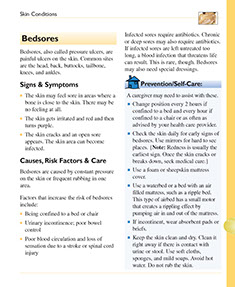
    Bedsores, also called pressure ulcers, are painful ulcers on the skin. Common sites are the head, back, buttocks, tailbone, knees, and ankles.

    Signs & Symptoms

    *  The skin may feel sore in areas where a bone is close to the skin. There may be no feeling at all.

    *  The skin gets irritated and red and then turns purple.

    *  The skin cracks and an open sore appears. The skin area can become infected.

    Causes & Risk Factors

    Bedsores are caused by constant pressure on the skin or frequent rubbing in one area. Factors that increase the risk of bedsores include:

    *  Being confined to a bed or chair

    *  Urinary incontinence; poor bowel control

    *  Poor blood circulation and loss of sensation due to a stroke or spinal cord injury

    Infected sores require antibiotics. Chronic or deep sores may also require antibiotics. If infected sores are left untreated too long, a blood infection that threatens life can result. This is rare, though. Bedsores may also need special dressings.

    Self-Care / Prevention

    A caregiver may need to assist with these.

    *  Change position every 2 hours if confined to a bed and every hour if confined to a chair or as often as advised by your health care provider.

    *  Check the skin daily for early signs of bedsores. Use mirrors for hard to see places. {Note: Redness is usually the earliest sign. Once the skin cracks or breaks down, seek medical care.}

    *  Use a foam or sheepskin mattress cover.

    *  Use a waterbed or a bed with an air filled mattress, such as a ripple bed. This type of airbed has a small motor that creates a rippling effect by pumping air in and out of the mattress.

    *  If incontinent, wear absorbent pads or briefs.

    *  Keep the skin clean and dry. Clean it right away if there is contact with urine or stool. Use soft cloths, sponges, and mild soaps. Avoid hot water. Do not rub the skin.

    *  Apply cornstarch to the skin.

    *  Lift (do not drag or slide) an immobile person.

    *  Don’t sit on donut-shaped cushions.

    *  Put pillows between knees and ankles so they don’t touch.

    *  Use sheepskin under heels and buttocks.

    *  Don’t massage bony body parts.

    *  Eat well and get adequate fluids.

    *  Ask your doctor about taking a vitamin C supplement.

    *  Handle a person with bedsores gently.

    *  Apply topical medication, as advised.

    When to Seek Medical Care

    Contact Doctor When:

    *  The skin is cracked.

    *  Sores show signs of infection (fever; redness; pain; heat; pus; swelling).

    *  Sores have not improved after 2 weeks of self-care.

    Health at Home Lifetime book by the American Institute for Preventive Medicine. www.HealthyLife.com. All rights reserved.

    © American Institute for Preventive Medicine

  • Cold Sores

    Dental & Mouth Concerns

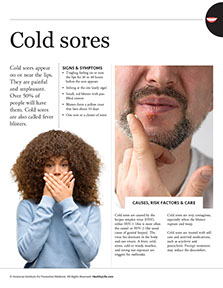
    Cold sores appear on or near the lips. They are painful and unpleasant. Nearly 1 in 3 people will have them. Cold sores are also called fever blisters.

    Signs & Symptoms

    *  Tingling feeling on or near the lips for 36 to 48 hours before the sore appears

    *  Itching at the site (early sign)

    *  Small, red blisters with pus-filled centers

    *  Blisters form a yellow crust that lasts about 10 days

    *  One sore or a cluster of sores

    Causes, Risk Factors & Care

    Cold sores are caused by the herpes sim- plex virus (HSV), either HSV-1 (this is most often the cause) or HSV-2 (the usual cause of genital herpes). The virus lies dormant in the body and can return. A fever, cold, stress, cold or windy weather, and strong sun exposure are triggers for outbreaks.

    Cold sores are very contagious, especially when the blisters rupture and weep.

    Cold sores are treated with self-care and antiviral medications, such as acyclovir and penciclovir. Prompt treatment may reduce the discomfort.

    Self-Care / Prevention

    *  Keep the sore clean and dry.

    *  Apply antiviral medication, if prescribed, to the affected area at the first sign of a cold sore.

    *  Try an over-the-counter treatment, such as Abreva antiviral cream, Campho-Phenique, Blistex, or make a paste with cornstarch and water. Dab some on the sore with a cotton swab.

    *  Dab aloe vera or petroleum jelly on the sore. Use a cotton swab.

    *  Apply ice to the sore or suck on a frozen popsicle.

    *  Take an over-the-counter medicine for pain.

    *  Learn to relax. Meditate, practice yoga, etc. Learn to deal with stress, too.

    *  Avoid foods that are sour, spicy, or acidic. These may irritate the sores.

    *  Take vitamin C and/or zinc supplements, as directed by your doctor.

    *  Apply cool compresses when the sores have crusted over.

    *  Try not to worry or be too self-conscious. This only makes the situation worse.

    Prevention

    To avoid getting or spreading cold sores:

    *  Don’t share drinking glasses, towels, or cooking utensils.

    *  Don’t touch cold sores with your fingers. If you do touch the cold sores, do not touch your eyes. This could cause a serious eye infection.

    *  Wash your hands often.

    *  Avoid kissing or direct skin contact with the sores. This includes oral sex. The virus that causes cold sores can cause genital herpes, too.

    *  When in the sun, wear a hat and use a sunblock with a sun-protective factor (SPF) of 15 or more on the lips.

    *  Use a lip balm on cold or windy days.

    *  Ask your doctor about a prescribed antiviral medicine to take or apply when you feel a cold sore coming on.

    *  Try to figure out what triggers the sores. Once you identify a trigger, do what you can to avoid it.

    *  Get regular exercise.

    Medical Care

    Contact Doctor When:

    *  You have eye pain with the cold sore. Pain from the sore limits normal activity.

    *  The cold sore has lasted longer than 2 weeks.

    *  Cold sores appear 4 or more times a year.

    *  Cold sores appeared after you started a new medicine or are present while taking steroid medicines.

    *  Eczema

    Healthier at Home book by the American Institute for Preventive Medicine. www.HealthyLife.com. All rights reserved.

    © American Institute for Preventive Medicine

  • Dry Skin

    Skin Conditions

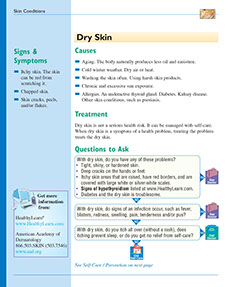
    Signs & Symptoms

    *  Itchy skin. The skin can be red from scratching it.

    *  Chapped skin.

    *  Skin cracks, peels, and/or flakes.

    Causes

    *  Aging. The body naturally produces less oil and moisture.

    *  Cold winter weather. Dry air or heat.

    *  Washing the skin often. Using harsh skin products.

    *  Chronic and excessive sun exposure.

    *  Allergies. An underactive thyroid gland. Diabetes. Kidney disease. Other skin conditions, such as psoriasis.

    Treatment

    Dry skin is not a serious health risk. It can be managed with self-care. When dry skin is a symptom of a health problem, treating the problem treats the dry skin.

    Questions to Ask

    Self-Care / Prevention

    *  Drink 8 or more glasses of water a day.

    *  Apply an oil- based lotion daily.

    *  Wear rubber gloves when you wash dishes.

    *  Take showers instead of baths. Use warm (not hot) water. Try sponge baths.

    *  Apply a moisturizing cream while your skin is damp. Use products with lanolin.

    *  If you do bathe, do so for only 15 to 20 minutes in lukewarm water. Pat yourself dry. Do not rub.

    *  Put soap on a washcloth, not right on the skin.

    *  Use a mild liquid soap, like Cetaphil lotion or use a fatted soap. Avoid deodorant, medicated, or alkaline soaps.

    *  Don’t use moisturizers with fragrances, preservatives, or alcohol.

    *  Use a night cream for the face.

    *  Stay out of the strong sun. Do not use tanning salons. When in the sun, use a sunblock with a sun protection factor (SPF) of at least 15.

    *  Don’t scratch or rub dry skin.

    Resources

    American Academy of Dermatology

    866.503.SKIN (503.7546)

    www.aad.org

    Healthier at Home book by the American Institute for Preventive Medicine. www.HealthyLife.com. All rights reserved.

    © American Institute for Preventive Medicine