Tag: Health Conditions

  • Shoulder Pain & Neck Pain

    Bone & Muscle Problems

    Signs & Symptoms

    *  The pain can be mild to severe. It can be felt in one spot, in a large area, or travel to another area. Movement can cause the pain or make it worse.

    *  Stiffness and/or swelling may occur.

    Causes

    *  Overuse and wear and tear on neck and shoulder muscles and joints.

    *  Strains. Broken or dislocated shoulder.

    *  Poor posture. Awkward sleeping positions. Sleeping on a soft mattress.

    *  Pinched nerve. Pain from a pinched nerve usually runs down one side of the arm.

    *  Frozen shoulder. This can result from lack of use due to pain from an injury. At first, pain occurs with movement. Over time, the pain gets better, but stiffness remains.

    *  Torn rotator cuff. This is a tear in a ligament that holds the shoulder in place. Symptoms are pain at the top and outer sides of the shoulders, especially when you raise or extend your arm. You may also feel or hear a click when the shoulder is moved.

    *  Tendinitis. This is swelling of a tendon (tissue that connects a muscle to bone). Left untreated, tendinitis can turn into “frozen shoulder.” “Wry” neck is a similar problem.

    *  Bursitis. This is swelling of the sac (bursa) that surrounds the shoulder joint. Bursitis can be caused by injury, infection, overuse, arthritis, or gout.

    *  A whiplash injury.

    *  Osteoarthritis.

    *  Infections that cause swollen lymph nodes in the neck.

    Treatment

    Treatment for shoulder pain and/or neck pain depends on the cause. Emergency medical care is needed for:

    *  A serious injury.

    *  A broken bone.

    *  A heart attack.

    *  Meningitis. This is an infection of the membranes that surround the brain.

    Self-care can treat less serious causes of shoulder pain and/or neck pain.

    Questions to Ask

    Self-Care / Prevention

    For Pain

    *  Take an over-the-counter medicine for pain and/or swelling.

    *  To relieve tension and improve circulation, take walks. Start with 3 to 5 walks a day, each lasting 5 to 10 minutes. Gradually increase walking times.

    For Bursitis, Tendinitis, or an Injury That Does Not Appear Serious

    *  Use R.I.C.E.

    *  Try liniments and balms. These provide a cooling or warming sensation, but only mask the pain. They do not promote healing.

    To Treat Neck Pain from a Whiplash Injury or Pinched Nerve

    See a doctor anytime your motor vehicle is hit from the rear because the accident can cause a whiplash injury. After first checking with your doctor, do these things to ease neck discomfort:

    *  Rest as much as you can by lying on your back.

    *  Use cold and hot packs.

    *  Improve your posture. When you sit, use a chair with a straight back. Make sure your buttocks go all the way to the chair’s back. When you stand, pull in your chin and stomach.

    *  Use a cervical (neck) pillow or a rolled hand towel under your neck.

    *  Avoid activities that may aggravate your injury.

    *  Cover your neck with a scarf if you go outside when the weather is cold.

    Ways to Prevent Shoulder Pain & Neck Pain

    *  Avoid repeated activities that twist or put strain on the neck and shoulders. When you do repeated tasks, use proper posture, equipment, and techniques.

    *  Wear seat belts in vehicles. Use protective gear when you take part in sporting events.

    *  If you are out of condition, strengthen your muscles gradually.

    *  Don’t sleep on your stomach. You may twist your neck in this position. Use a firm polyester pillow, a neck (cervical) pillow, or a rolled towel under your neck.

    *  Practice good posture. Stand straight. Don’t let your shoulders slump, your head droop, or your lower back slouch.

    *  When you carry things, such as a shoulder bag, switch from one shoulder to the other.

    *  Don’t prop a telephone between your ear and shoulder.

    *  Stretch and warm up before activities that require joint movement, such as sports.

    *  Do stretching and strengthening exercises to keep your shoulder, neck, and arm muscles strong and flexible.

    – Shoulder Stretch: Reach your right arm across your chest. With your left hand, grasp your arm just above the elbow. Gently pull your arm farther across your body until you feel a stretch in the back of your shoulder. Hold for 30 seconds. Rest and repeat. Do the same with your left arm.

    – Neck and Shoulder Stretch: Tilt your head forward and let it hang. Relax your neck and shoulders. Slowly, roll your head to one side then back to the front and then slowly roll it to the other side. (Do not roll your neck backward.) Repeat 10 times.

    Resources

    National Institute of Arthritis and Musculoskeletal and Skin Diseases (NIAMS)

    877.22.NIAMS (226.4267)

    www.niams.nih.gov

    Healthier at Home book by the American Institute for Preventive Medicine. www.HealthyLife.com. All rights reserved.

    © American Institute for Preventive Medicine

  • Thyroid Problems

    General Health Conditions

    The thyroid is a small, butterfly-shaped gland in the lower front of the neck, below the voice box (larynx), and above the collarbone. It makes hormones that help convert food to energy. It regulates growth and fertility. It also maintains body temperature.

    Signs & Symptoms

    Hypothyroidism occurs when the thyroid gland does not make enough thyroid hormone. Body functions slow down. Signs and symptoms are:

    *  Fatigue. Sleeping too much.

    *  Depression.

    *  Dry, pale skin. Dry hair that tends to fall out.

    *  The voice deepens.

    *  Weight gain for no reason.

    *  Feeling cold often.

    *  Heavy and/or irregular menstrual periods in females.

    *  Poor memory.

    *  Constipation.

    Hyperthyroidism occurs when the thyroid makes too much thyroid hormone. Body functions speed up. Two common forms are Graves’ disease and multinodular goiter. Signs and symptoms are:

    *  Swelling in the front of the neck. The thyroid gland gets larger. This is called goiter.

    *  One or both eyes bulge. Tremors. Feeling nervous.

    *  Mood swings.

    *  Weakness.

    *  Frequent bowel movements.

    *  Heat intolerance.

    *  Shortened menstrual periods in females.

    *  Weight loss for no reason.

    *  Fine hair or hair loss.

    *  Rapid pulse. Heart palpitations.

    {Note: In elderly persons, symptoms for this can be more like ones for hypothyroidism.}

    Causes

    For Hypothyroidism

    *  Immune system problems.

    *  Removal of the thyroid gland.

    *  Treating the thyroid gland with radioactive iodine for hyperthyroidism.

    *  Too much or too little iodine in the diet.

    Risk factors for hypothyroidism include: A family history of the disease; having diabetes; and taking certain medicines, such as lithium.

    For Hyperthyroidism

    *  Immune system problems.

    *  Family history of the illness.

    *  Taking too much thyroid hormones from pills.

    Treatment

    Medical care is needed for thyroid problems.

    Hypothyroidism is treated with iodine and/or thyroid medicine.

    Hyperthyroidism treatment varies. It includes radioactive iodine, medication, and surgery, if needed.

    Some treatments result in the need to continue to take thyroid medicine.

    Follow-up care is needed for both of these thyroid problems.

    Questions to Ask

    Self-Care / Prevention

    *  Take medication as directed.

    *  Tell your doctor if symptoms come back or still bother you.

    *  Follow your doctor’s advice for self-care measures.

    Neck Check

    To see if you have a lump on your thyroid gland or if it is enlarged, the American Association of Clinical Endocrinologists recommends this quick self-test:

    1.  Tilt your chin up slightly and swallow a glass of water in front of a mirror.

    2.  Look at your neck as you swallow.

    3.  Check for any bulges or protrusions between your Adam’s apple and collarbone. If you see any, contact your doctor.

    Resources

    American Thyroid Association

    www.thyroid.org

    Healthier at Home book by the American Institute for Preventive Medicine. www.HealthyLife.com. All rights reserved.

    © American Institute for Preventive Medicine

  • The Abcs Of Hepatitis

    MEDICAL NEWS

    Illustration of liver.

    Millions of Americans are living with hepatitis today, and many don’t know they have it. Hepatitis can be serious and can lead to lifelong health problems. To help fight this dangerous disease, it’s important to know how it is spread and what you can do to prevent it.

    What is hepatitis?

    Hepatitis is an inflammation of the liver. Without the liver, the body cannot process nutrients, fight infection, or filter the blood. Hepatitis can make someone very sick. Some people with viral hepatitis can get liver cancer or severe scarring of the liver, known as cirrhosis.

    How does someone get hepatitis?

    The three most common types of viral hepatitis are spread in different ways:

    *  Hepatitis A can spread if a person eats or drinks something that has been contaminated with the virus. A person with hepatitis A spreads the virus through their stool.

    *  Hepatitis B can spread when blood, semen or other body fluids from an infected person get into the body of another person. This can happen during childbirth, sexual contact, getting tattoos or piercings, sharing needles or medical equipment, or sharing personal items, such as razors.

    *  Hepatitis C spreads through blood. Sharing needles or personal equipment that comes into contact with blood is the main way it gets spread. It may also spread during sexual contact. Like hepatitis B, Hep C can infect a baby during childbirth if the mother has it.

    How do I prevent hepatitis?

    Many people don’t have symptoms of hepatitis and don’t know they are infected. This means they can spread it to others without knowing it.

    The best ways to help prevent the spread of hepatitis are:

    *  Getting the vaccine, if needed. Vaccines are available for hepatitis A and B.

    *  Getting screened for hepatitis if you are at risk and getting treatment when available.

    *  Being aware of risk factors and avoiding them whenever possible. This may include not sharing needles or other personal equipment as listed on this page. Use latex condoms during sexual activity.

    Is there a cure for viral hepatitis?

    Most people who get hepatitis A will recover after a few weeks or months. People with hepatitis B may need to be checked regularly for liver damage, and the infection may be lifelong. Hepatitis C can often be cured with today’s advanced medications.

    Ask your doctor if you are at risk for hepatitis and whether you should be screened or vaccinated.

    Sources: Centers for Disease Control, World Health Organization

    © American Institute for Preventive Medicine

  • Do You Have Celiac Disease?

    SELF-CARE CORNER

    Image of wheat on top of white flour.

    If you can’t eat bread or anything containing wheat, rye, and barley because of gluten-a protein found in these grains-you may have celiac disease. Different people have different symptoms, but talk with your doctor if you or your child has one or more of these problems after eating bread or cookies, for example:

    *  Gas

    *  Bloating, belly pain

    *  Ongoing diarrhea

    *  Pale, foul-smelling or fatty stool

    *  Weight loss or weight gain

    *  Fatigue

    *  Bone or joint pain

    *  Bone loss or weakening

    *  Anemia (lower red blood cell count)

    *  Behavior changes (children become irritable)

    *  Tingling, numbness in the legs

    *  Muscle cramps

    *  Seizures

    *  Itchy skin rash

    © American Institute for Preventive Medicine

  • Latex Allergy

    MEDICAL NEWS

    Close up image of a medical ID.

    If you are allergic to latex, you usually know it. You can react with sneezing or worse symptoms because your body is reacting to proteins in natural rubber latex, which is made from the rubber tree.

    The Asthma and Allergy Foundation of America suggests you do this:

    *  Always wear a medical ID that alerts others about your allergy if you need emergency care.

    *  Ask doctors, dentists, and others who examine you to wear latex-free exam gloves. Carry gloves with you to give your dentist or doctor.

    *  Check labeling. Do not assume a product labeled “hypoallergenic” is latex-free.

    *  Know that latex can be found in some elastic in clothing, rubber bands, condoms, balloons, disposable diapers, and many more products.

    *  If you’re allergic to latex, you may have reactions to bananas, kiwi, and cantaloupe, which contain some of the same allergens found in latex.

    © American Institute for Preventive Medicine

  • Safe Ways To Get Rid Of Warts

    SELF-CARE CORNER

    Close up image of a wart.

    Warts are noncancerous growths caused by a contagious virus. Common warts usually appear on the hands, and plantar warts appear on the bottoms of the feet.

    Most common and plantar warts are harmless and will go away on their own with time. But, they may cause pain or embarrassment. As a result, many people would rather see them gone sooner rather than later.

    Wart basics

    If you’re not sure whether you have a wart, it’s best to see your doctor. Some skin cancers can look like warts.

    You can get warts from other people or from touching a surface that had the wart virus on it. The virus that causes warts is known as human papillomavirus (HPV). Children and teens get warts most often, but they can happen to anyone.

    Keep warts away

    It’s best to try and avoid getting warts in the first place. To help avoid warts, doctors say:

    *  Don’t go barefoot in public showers, bathrooms, locker rooms, and around swimming pools. Wear flip flops or waterproof shoes.

    *  Don’t share towels or personal items with others unless it has been washed.

    *  Wash hands regularly, including before and after eating, after using the bathroom, and after touching shared surfaces like doorknobs and ATMs.

    *  Finally, never pick at or scratch warts. This can spread the wart to other parts of the body.

    Medicines for warts

    There are a few ways to help speed the healing process for warts and get rid of them sooner. They include:

    *Wart medicine:Look for one that contains salicylic acid as the active ingredient. This medicine helps peel the wart off gradually. It can be purchased in a liquid or gel you apply to the skin, or in patches that stick on the wart.

    *Wart freezing sprays:An over-the-counter wart freezing spray can help get rid of warts. The spray blisters the wart and the skin around it, allowing it to fall off in a few days.

    *Duct tape:Some studies suggest that applying duct tape to the wart may help it go away. Put a small piece of duct tape over the wart and change the tape every couple of days. This may help peel the wart off.

    Be patient with any wart treatment. It may take several applications before the wart goes away. If these home remedies aren’t working, talk to your doctor. Most dermatologists offer stronger wart removal treatments when needed.

    Sources: American Academy of Dermatology, American Academy of Family Physicians

    © American Institute for Preventive Medicine

  • Ulcers Not Caused By Stress

    MEDICAL NEWS

    Image of man holding this stomach.

    The lining of your stomach makes acid and enzymes that help break down food into the nutrients you need. The lining protects itself from acid damage by releasing mucus. But sometimes the lining gets inflamed and starts making less acid, enzymes, and mucus. This type of inflammation is called gastritis.

    You may have gastritis if you have pain or an uncomfortable feeling in your upper stomach. You could have nausea or vomiting. Or you may have no symptoms at all.

    Untreated, some types of gastritis can lead to ulcers. These are sores in the stomach lining.

    Some people think ulcers are caused by stress and spicy foods. But according to the NIH in Health, bacteria called H. pylori are often to blame. These bacteria break down the inner protective coating in the stomach and can cause inflammation.

    H. pylori can spread by passing from person to person or through contaminated food or water. Infections can be treated with antibiotics.

    One type of gastritis, called erosive gastritis, wears away the stomach lining. The most common cause of erosive gastritis is long-term use of medications called non-steroidal anti-inflammatory drugs. These include aspirin and ibuprofen. Stop taking these pain relievers and the gastritis usually clears up.

    Less common causes of gastritis include digestive disorders (such as Crohn’s disease) and autoimmune disorders in which the body’s protective immune cells attack healthy cells in the stomach lining.

    Gastritis can be diagnosed with an endoscope. A thin tube with a tiny camera on the end is inserted through the patient’s mouth or nose and into the stomach. The doctor looks at the stomach lining and may remove some tissue samples for testing. Treatment will depend on the type of gastritis found.

    Although stress and spicy foods don’t cause gastritis and ulcers, they can make symptoms worse. Milk might provide brief relief, but it also increases stomach acid, which can worsen symptoms. Your doctor may advise taking antacids or other drugs to  reduce acid in the stomach.

    Gastritis can lead to ulcers over time. Symptoms of ulcers include pain between the belly button and breastbone that starts between meals or during the night. It briefly stops if you eat or take antacids, lasts for minutes to hours, and comes and goes for several days or weeks.

    Contact your doctor right away if you have sudden sharp stomach pain that doesn’t go away, black or bloody stools, or vomit that is bloody or looks like coffee grounds.

    © American Institute for Preventive Medicine

  • All About Red Blood Cells

    MEDICAL NEWS

    Lab tube with blood.

    Blood nourishes every part of the body. Red blood cells are a major component of blood and a key player in how the body receives the oxygen it needs.

    What they do

    Red blood cells contain a special protein called hemoglobin that carries oxygen from the lungs and delivers it to the organs and tissues. Once a red blood cell drops off oxygen, it picks up carbon dioxide and returns it to the lungs to be exhaled when you breathe out.

    Every cell in the body relies on oxygen delivery from red blood cells. To keep a constant supply of healthy red blood cells, the bone marrow produces an impressive 2 million cells every second.

    Measuring red blood cells

    When you go to the doctor, they often order a complete blood count (CBC) to assess the health of your blood. Several of those values provide information about your red blood cells:

    *  Red blood cells (RBC) – the number of red blood cells in a specific volume of blood

    *  Hemoglobin – the amount of hemoglobin (by weight in grams) per the volume in blood (in deciliters)

    *  Hematocrit – how much of the blood is made up of red blood cells

    *  MCV – the average size of red blood cells

    *  MCH – the amount of hemoglobin in each red blood cell

    *  MCHC – the average amount of hemoglobin in a group of red blood cells

    When red blood cells are high

    Common causes include:

    *  Dehydration

    *  Kidney disease

    *  Heart disease

    *  Lung disease

    *  Smoking (causes scarring of lung tissue)

    *  Conditions of the bone marrow

    What to do:

    If your doctor finds your red blood cell values are higher than normal, they may do further testing to identify a cause. Staying well-hydrated keeps your blood cells healthy and in the right concentration.

    When red blood cells are low

    You may experience fatigue, weakness, shortness of breath, and irregular heart rates. Common causes include:

    *  Anemia

    *  Malnutrition

    *  Certain types of cancer

    *  Kidney disease

    *  Liver disease

    *  Certain medications

    What to do:

    A healthy diet high in iron and other vitamins and minerals is essential for red blood cells. Leafy greens, beans, nuts, seeds, fish, meat, and iron-fortified foods keep blood cells healthy. Your doctor may also recommend supplements or medications.

    © American Institute for Preventive Medicine

  • 5 Ways To Protect Against Infections

    General Health Conditions

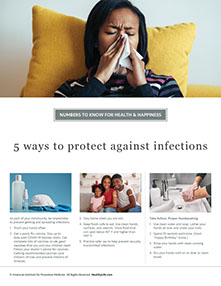
    Parents with child all smiling showing upper arm with vaccine bandage.

    As part of your community, be responsible to prevent getting and spreading infections.

    1.  Wash your hands often.

    2.  Get a yearly flu vaccine. Stay up to date with COVID-19 booster shots. Get complete lists of vaccines atcdc.gov/vaccinesthat you and your children need. Follow your doctor’s advice for vaccines. Getting recommended vaccines save millions of lives and prevent millions of illnesses.

    3.  Stay home when you are sick.

    4.  Keep foods safe to eat. Use clean hands, surfaces, and utensils. Store food that can spoil below 40° F and higher than 140° F.

    5.  Practice safer sex to help prevent sexually transmitted infections.

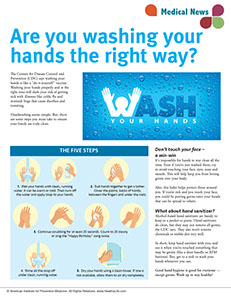
    Take Action: Proper Handwashing

    1.  Use clean water and soap. Lather your hands all over and under your nails.

    2.  Spend 20 seconds each time. (Hum “Happy Birthday” twice.)

    3.  Rinse your hands with clean running water.

    4.  Dry your hands with an air drier or clean towel.

    Health at Home Lifetime book by the American Institute for Preventive Medicine. www.HealthyLife.com. All rights reserved.

    © American Institute for Preventive Medicine

  • Bites & Stings

    First Aid

    For Bites

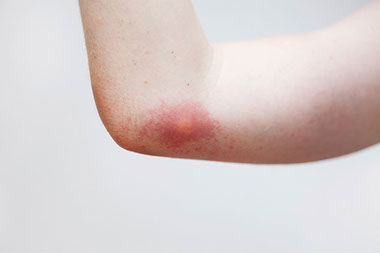
    Image of arm with an insect bite mark.

    Signs & Symptoms

    *  Swelling. Redness. Pain. Itching.

    *  Bleeding.

    *  Tissue loss, if the wound is severe.

    *  Skin rash.

    *  Lockjaw. This is a painful, persistent stiffness of the jaw due to a toxin. Tetanus shots can prevent this.

    *  Allergic reaction, such as with insect bites.

    Causes

    *  Dog, cat, and human bites are the most common animal bites in the U.S.

    *  Deer tick bites can cause Lyme disease, a bacterial infection.

    *  Bed bug bites cause redness, swelling, and large, red welts or raised areas on the skin.

    *  Black widow and brown recluse spider bites can cause severe reactions.

    *  Less common, but more dangerous, are bites from skunks, raccoons, bats, and other animals that live in the wild. These animals can have rabies – a serious viral infection. It can be fatal. Most house pets are vaccinated for rabies. It’s unlikely they carry the virus.

    *  Mosquito bites can cause West Nile virus if the mosquito is infected with it.

    *  Snake bites can be fatal if the bite is from a poisonous snake (e.g., rattlesnakes, cotton mouths, copperheads, and coral snakes).

    *  Shark bites are a potential problem when swimming in shark-infested waters.

    Treatment

    Self-care can be used for dog and cat bites that cause scratches on the skin and for insect bites that do not cause a severe allergic reaction. All human bites that break the skin should be checked by a doctor due to the high risk for infection.

    A series of rabies shots can prevent the spread of rabies to humans. The shots should begin soon after a bite from an infected animal.

    Antivenom can be given for poisonous snake bites at emergency medical facilities. It should be given within 4 hours of the bite.

    For Stings

    Signs & Symptoms

    *  Quick, sharp pain.

    *  Swelling, itching, and redness at the sting site. These can occur beyond the sting site.

    *  Raised bump (with or without pus).

    *  Signs of a severe allergic reaction.

    Causes

    *  Insect stings.

    *  Marine animals that sting include jellyfish, Portuguese Man-of-War, and sea nettles.

    Treatment

    Self-care treats mild reactions to stings. A severe allergic reaction needs immediate care. Symptoms of a severe allergic reaction usually happen soon after or within an hour of the sting.

    Persons with a severe allergic reaction to a sting in the past should carry an emergency kit, prescribed by a doctor. A medical alert tag should be worn to let others know of the allergy. Persons who have had severe reactions to bee or wasp stings should ask their doctors about allergy shots.

    Questions to Ask

    Self-Care / First Aid

    For Poisonous Snake Bites Before Medical Care

    *  Carefully move the person away from the snake. Calm the person. Have him or her rest. Moving about can help spread the venom.

    *  Gently wash the bite area with soap and water. Keep the limb of the bite site level with the heart (or just below this). Apply a splint to the limb of the bite site to keep it from moving.

    *  Being careful, note, if you can, the shape of the snakes eyes, pupils, and head, the colors it is, and if it has rattles.

    *  Don’t try to kill the snake, cut the fang mark, or suck out the venom.

    *  Don’t apply a tourniquet, a bandage, or ice to the bite.

    For Non-Poisonous Snake Bites

    *  Gently wash the site with soap and water.

    *  Treat the bite as a minor wound.

    *  If you notice signs of an infection, call your doctor.

    For Poisonous Spider Bites Until Emergency Care Arrives

    *  Perform rescue breathing, if needed.

    *  If you can, keep the bitten area lower than the level of the heart.

    *  Calm the person and keep him or her warm.

    *  Gently clean the site of the bite with soap and water or rubbing alcohol.

    *  Put an ice pack over the bite site for pain relief.

    *  If you can, catch the spider in a closed container to show what kind it is.

    For Poisonous Spider and Scorpion Bites Before Medical Care

    *  Do rescue breathing, if needed.

    *  If you can, keep the bitten area lower than the level of the heart.

    *  Calm the victim and keep him or her warm.

    *  Gently clean the site of the bite with soap and water or rubbing alcohol.

    *  Put an ice pack over the bite site to relieve pain.

    *  If you can, catch the spider in a closed container to show the doctor. n Get emergency care!

    For Human Bites Before Medical Care

    *  Wash the wound area with soap and water for at least 5 minutes. Don’t scrub hard. Rinse with running water or with an antiseptic solution, such as Betadine.

    *  Cover the wound area with sterile gauze. Tape only the ends of the gauze in place. Then get medical care.

    For Deer Tick Bites

    *  Remove any ticks found on the skin. Use tweezers to grasp the tick(s) as close to the skin as you can. Pull gently and carefully in a steady upward motion at the point where the tick’s mouthpart enters the skin. Try not to crush the tick. The secretions released may spread disease.

    *  After you remove the ticks, wash the wound area and your hands with soap and water. Apply rubbing alcohol to help disinfect the area.

    *  Use an ice pack over the bite area to relieve pain.

    *  Save one tick in a closed jar with rubbing alcohol to show the doctor.

    For Dog and Cat Bites

    *  Wash the bite area right away with soap and warm water for 5 minutes. If the bite is deep, flush the wound with water for 10 minutes. Dry the wound with a clean towel. Then get medical care.

    *  If the wound is swollen, apply ice wrapped in a towel for 10 minutes.

    *  Get a tetanus shot, if needed.

    *  If the bite hurts, take an over-the-counter (OTC) medicine for pain.

    *  Report the incident to the animal control department. If a pet’s immunizations are not current, arrange with the animal control department for the pet to be observed for the next 10 days to check for rabies.

    *  Observe the wound for a few days. Look for signs of infection. Often, cat bite wounds need an antibiotic.

    For a Stingray Bite

    *  Remove the person from the water.

    *  Apply a local pressure bandage for a wound that bleeds a lot.

    *  Immerse the wound area in hot water for 30 to 90 minutes. Make sure the water is not hot enough to burn the skin.

    *  Scrub the wound area well with soap and water.

    *  Unless the wound is a slight one in only one limb, get medical help right away.

    For Stings from Jellyfish or Sea Nettles, etc.

    *  Remove the person from the water. Don’t touch the sting area with bare hands.

    *  Rinse the sting area with salt (not fresh) water right away. Don’t put ice on the skin. If you can, put vinegar or rubbing alcohol on the area several times for 30 or more minutes until the pain is relieved.

    *  Apply dry or moist heat to the sting area until the pain subsides. You can mix one part ammonia with 3 parts salt water and apply this to the sting area.

    *  Wear gloves when you remove stingers. Use a towel to wipe the stingers or the tentacles off. Use tweezers to lift large tentacles. Don’t scrape or rub them.

    *  To relieve itching, apply OTC calamine lotion or 1% hydrocortisone cream to the affected area as directed on the label.

    *  Contact your doctor for any signs of infection.
    Healthier at Home book by the American Institute for Preventive Medicine. www.HealthyLife.com. All rights reserved.

    © American Institute for Preventive Medicine