Tag: Health Conditions

  • Avoid Summer Headaches

    SELF-CARE CORNER

    Image of women sitting at the beach talking on the phone.

    The sun can be especially bothersome if you suffer from migraine. Looking directly or indirectly at the sun can trigger a migraine attack for some people.

    Don’t forget your shades-sunglasses, visors, or sun hat when you are out and enjoying the sunshine at the beach, tennis court, golf course, or a baseball game, advises the National Headache Foundation.

    Other summer headache triggers include changes in barometric pressure. Watch out for those sudden thunderstorms and windy days.

    Drink plenty of water, not soft drinks, to help prevent those “dehydration” headaches. You don’t want to drink too many soft drinks containing caffeine, which can also contribute to your headaches.

    At backyard barbecues and picnics, you may encounter food items that you wouldn’t normally eat. The sauces and dry rubs on those tasty ribs may contain monosodium glutamate (MSG) to which many headache sufferers are sensitive. The spread at a picnic may include aged cheeses, hot dogs, and other meats with nitrates, and pickles-all possible triggers. Also watch your intake of beer and cocktails.

    © American Institute for Preventive Medicine

  • Face Facts About Acne

    SELF-CARE CORNER

    Image of young women washing her face.

    Acne. It’s embarrassing. It’s annoying. And it’s the most common skin condition in the U.S. Fortunately, acne can often be reduced with simple changes to your skin care routine, say experts from the American Academy of Dermatology.

    For clearer skin, follow these tips:

    *  Wash twice a day and after sweating. Perspiration, especially when wearing a hat or helmet, can make acne worse, so wash your skin as soon as possible after sweating.

    *  Use your fingertips to apply a gentle, non-abrasive cleanser. Using a washcloth, mesh sponge, or anything else can irritate the skin. Do not use skin care products that irritate the skin, which may include astringents, toners, and exfoliants. Dry, red skin makes acne appear worse.

    *  Rinse with lukewarm water.

    *  Shampoo regularly. If you have oily hair, shampoo daily.

    *  Let your skin heal naturally. If you pick, pop or squeeze your acne, your skin will take longer to clear and you increase your risk of getting acne scars.

    *  Keep your hands off your face. Touching your skin throughout the day can cause flare-ups.

    *  Stay out of the sun and tanning beds. Tanning damages your skin. In addition, some acne medications make the skin very sensitive to ultraviolet (UV) light, which you get from both the sun and indoor tanning devices.

    *  See a skin specialist for the most current treatments.

    © American Institute for Preventive Medicine

  • Minutes Count With A Stroke

    MEDICAL NEWS

    Image of older women with hand on head.

    If someone were having a stroke, would you recognize the signs? Would you know what to do?

    These are important questions to consider. During a stroke, brain cells are damaged due to a blood clot or rupture of a blood vessel in the brain. This can lead to serious disability and death.

    According to the National Institute of Neurological Disorders and Stroke, about 795,000 strokes occur every year. It is the third leading cause of death in the U.S. But with fast action, you might save someone from permanent brain damage.

    Preventing stroke

    Health problems like atrial fibrillation (an irregular beating of the heart), high cholesterol, high blood pressure, heart disease and diabetes increase your risk. Take medicines to control risk factors and follow a heart-healthy lifestyle. Eat right, exercise, limit alcohol and don’t smoke. See your doctor as recommended for health exams and screenings.

    Aspirin may help reduce the risk of stroke due to a blood clot in women ages 55-79 years, but you should discuss the use of aspirin with your doctor before taking it.

    Know the signs of stroke

    The five most common signs and symptoms of stroke:

    *SUDDENnumbness or weakness of the face, arm or leg

    *SUDDENconfusion, trouble speaking or understanding others

    *SUDDENtrouble seeing in one or both eyes

    *SUDDENdizziness, trouble walking or loss of balance or coordination

    *SUDDENsevere headache with no known cause

    What to do

    Call 9-1-1 immediately. Hospital emergency rooms have medication that can dissolve blood clots and restore blood flow to the brain. The window of opportunity is three hours, but in order to receive treatment in time, patients must get to the hospital within 60 minutes. Don’t wait – if you see signs of stroke, seek emergency medical care!

    © American Institute for Preventive Medicine
  • Shingles (And We’re Not Talking About Your Roof)

    SELF-CARE CORNER

    Image of shingles the rash on a person's back.

    Shingles is a painful viral infection that affects 30% of Americans every year. It is caused by Varicella Zoster virus, the same virus that causes chicken pox.

    The outbreak occurs mostly in people 50 years of age and older. The virus can lie dormant in the nerve tissue of the body for many years, then becomes activated and causes shingles later in life.

    According to the Centers for Disease Control and Prevention, shingles is not passed from one person to another. However, the virus that causes shingles can spread from a person with active shingles to another person who has never had chicken pox. In such cases, the person exposed to the virus might develop chickenpox, not shingles.

    “If you are diagnosed with shingles, you are contagious as long as you have blisters and ulcers. It is important to cover your rash and wash your hands frequently. It also is important to avoid people who have not received the chicken pox vaccine, pregnant women and anyone with a weak immune system,” said Dr. Khalilah Babino, physician at Loyola University Health System and assistant professor in the Department of Family Medicine at Loyola University Chicago Stritch School of Medicine.

    A shingles outbreak can last several weeks. Before the rash appears, the following symptoms may occur:

    *  Fatigue

    *  Headache

    *  Tingling

    *  Itching

    *  Burning Pain

    After a few days, a blistering rash in clusters appears. The shingles rash is always located along the involved nerve pattern called a dermatome, typically in a band on one side of the body. Most often, the rash is on the chest and/or back, but can occur on other body parts.

    “If you develop shingles on your face, especially near your eye, you should seek immediate medical care as this type may result in loss of vision,” Dr. Babino said. The blisters that form will pop in a few days and become open sores, which are contagious. Usually, these ulcers scab over within 7 to 10 days and the rash goes away within 4 weeks.

    “Fortunately, there is antiviral medication to help slow the virus and speed recovery. The earlier the medication is started, the more effective it is against the virus. I recommend starting these medications within 72 hours of the onset of rash. Since shingles can be very painful, you might also need prescription pain medication,” Dr. Babino said.

    Most people with shingles do not suffer any complications. Still, there is a 10% chance of developing a painful condition called post-herpetic neuralgia after the rash has gone away. The pain can last from a few months to a year.

    You can decrease your risk of developing shingles and its complications by getting the shingles vaccine. One dose of shingles vaccine is advised for adults age 60 years and older, but can be given between the ages of 50 and 59.

    “People who have had shingles previously can still receive the vaccine. If you are above the age of 50 years old, you should talk to your health care provider about the shingles vaccine,” Dr. Babino said.

    © American Institute for Preventive Medicine

  • Wash Away The 5 Most Common Handwashing Myths

    WELL-BEING

    Image of hands being washed with water and soup.

    Think you know how to wash your hands? Think again. A 2013 study in the Journal of Environmental Health showed that only 5% of people properly wash their hands on a daily basis. Cintas Corporation and Henry the Hand Foundation have teamed up to dispel the  5 most common handwashing myths.

    Keeping hands clean is one of the most important ways to avoid getting sick and spreading germs. Researchers at the NIH found that people touch their faces on average 3.6 times per hour. So handwashing is the answer. Test your knowledge about the best way to clean your hands.

    1. It doesn’t matter how long I wash my hands as long as I use soap – FALSE

    The next time you’re in the restroom and washing your hands, think of the chorus of your favorite song. Studies show that you should scrub your hands with soap for a minimum of 15-30 seconds in order to effectively remove germs.

    2. Hand sanitizers can replace washing your hands with soap and water – FALSE

    Washing hands with soap and water is the best and most effective way to reduce the number of microbes and germs on hands. Although alcohol-based (at least 60%) hand sanitizers can quickly reduce the number of germs on hands in some situations, they are not as effective as soap and water when it comes to removing and inactivating dangerous gastrointestinal illness-causing germs.

    3. The hotter the water you use for handwashing, the better – FALSE

    Studies show that water temperature does not affect germ removal. In fact, there is no research to prove that higher temperatures improve handwashing at all. Hotter water can also dry out skin, which leaves your skin more susceptible to germs and can make handwashing painful. It is best to wash your hands with the temperature that you find comfortable.

    4. You don’t have to dry your hands after washing them – FALSE

    Studies show that germs can be more easily transferred to and from wet hands, which is why drying hands is essential to staving off bacteria after handwashing.

    5. Hand dryers are more hygienic than paper towels – FALSE

    Researchers found that paper towels are superior to air dryers and can help remove bacteria, unlike air dryers, which can increase bacteria counts. Because air dryers have been shown to spread bacteria between 3 and 6 feet from the device, paper towels are also far less likely to contaminate other restroom users.

    © American Institute for Preventive Medicine

  • Are Your Ears Ringing?

    WELL-BEING

    Women covering her ears with her fingers.

    Ringing in the ears, known as tinnitus, is not a disease. It’s a symptom of something wrong with your body’s hearing system. And, it may not be “ringing” at all. Some people hear sounds like roaring, hissing, clicking or buzzing.

    Experts think that tinnitus happens when certain nerve cells are out of balance. This makes a person hear a sound that isn’t really there.

    Why does it happen?

    Tinnitus can be caused by many different things. Some possible causes include:

    *  Certain medicines – see a doctor right away if this happens. Tinnitus can be a serious side effect.

    *  High blood pressure

    *  Being around loud noises

    *  Sinus infections

    *  Brain injuries

    *  Injuries to the neck or head

    * .  Anemia

    *  Thyroid problems

    *  Autoimmune diseases

    *  Temporomandibular joint (TMJ) disorders

    Sometimes a person has tinnitus without being able to identify an obvious cause.

    Can I make it stop?

    There is no cure for all types of tinnitus. But, if your doctor can find out what’s causing it, there may be a treatment to resolve the issue. For instance, you might need treatment for high blood pressure or a sinus or ear infection.

    Some people have tinnitus because they also have some hearing loss. That’s why using a hearing aid may be helpful in these cases.

    If there’s no obvious cause, other things may help. They include:

    *  Wearable sound generators. These small devices fit inside the ear. They create a soft, pleasant noise that helps you ignore the sound of tinnitus.

    *  White noise machines or sound machines. Some people notice tinnitus more at night. This is probably because when you’re lying down in a quiet room, the tinnitus is easier to hear. For these times, you may benefit from a machine that plays noise while you sleep to override the tinnitus sound.

    *  Antidepressants or anti-anxiety medicines. Some people have severe tinnitus that interferes with their life. Tinnitus can cause anxiety or depression. In these cases, medicine to treat these health conditions can help.

    If you notice sounds or ringing in your ears, see your doctor. They may be able to help you find a solution that improves your quality of life.

    Sources: American Tinnitus Association, National Institutes of Health

    © American Institute for Preventive Medicine

  • In Case Of Accidental Poisoning, Act Fast

    First Aid

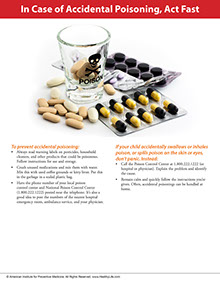
    Image of skull and bones that represent poison.

    To prevent accidental poisoning:

    *  Always read warning labels on pesticides, household cleaners, and other products that could be poisonous. Follow instructions for use and storage.

    *  Crush unused medications and mix them with water. Mix this with used coffee grounds or kitty litter. Put this in the garbage in a sealed plastic bag.

    *  Have the phone number of your local poison control center and National Poison Control Center (1.800.222.1222) posted near the telephone. It’s also a good idea to post the numbers of the nearest hospital emergency room, ambulance service, and your physician.

    If your child accidentally swallows or inhales poison, or spills poison on the skin or eyes, don’t panic. Instead:

    *  Call the Poison Control Center at 1.800.222.1222 (or hospital or physician). Explain the problem and identify the cause.

    *  Remain calm and quickly follow the instructions you’re given. Often, accidental poisonings can be handled at home.

    A Year of Health Hints book by the American Institute for Preventive Medicine. www.HealthyLife.com. All rights reserved.

    © American Institute for Preventive Medicine

  • Bonding For A Beautiful Smile

    Dental & Mouth Concerns

    Bonding can correct certain dental problems effectively and inexpensively. By bonding plastic or porcelain to the tooth, a dentist can:

    *  Cover discoloration.

    *  Close small gaps between teeth.

    *  Repair fractured and chipped teeth.

    *  Protect exposed roots caused by receding gums.

    *  Seal out decay-causing bacteria on back teeth.

    If you’ve had your teeth bonded, take these steps to prevent chips, stains, or other problems.

    *  Don’t chew ice or bite down on hard foods or candy.

    *  Avoid smoking, drinking coffee or tea, or eating blueberries or other foods that easily stain.

    *  Have the bonded teeth checked every three to five years. They may need to be touched up or done over.

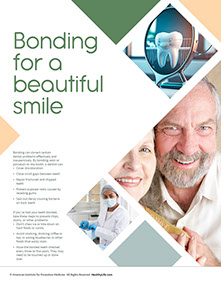
    Image of women smiling.
    A Year of Health Hints book by the American Institute for Preventive Medicine. www.HealthyLife.com. All rights reserved.

    © American Institute for Preventive Medicine
  • Daily Defense Against Dandruff

    Skin Conditions

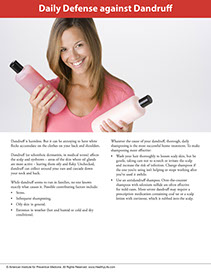
    Image of women holding shampoo bottles.

    Dandruff is harmless. But it can be annoying to have white flecks accumulate on the clothes on your back and shoulders.

    Dandruff (or seborrheic dermatitis, in medical terms) affects the scalp and eyebrows – areas of the skin where oil glands are most active – leaving them oily and flaky. Unchecked, dandruff can collect around your ears and cascade down your neck and back.

    While dandruff seems to run in families, no one knows exactly what causes it. Possible contributing factors include:

    *  Stress.

    *  Infrequent shampooing.

    *  Oily skin in general.

    *  Extremes in weather (hot and humid or cold and dry conditions).

    Whatever the cause of your dandruff, thorough, daily shampooing is the most successful home treatment. To make shampooing more effective:

    *  Wash your hair thoroughly to loosen scaly skin, but be gentle, taking care not to scratch or irritate the scalp and increase the risk of infection. Change shampoos if the one you’re using isn’t helping or stops working after you’ve used it awhile.

    *  Use an antidandruff shampoo. Over-the-counter shampoos with selenium sulfide are often effective for mild cases. More severe dandruff may require a prescription medication containing coal tar or a scalp lotion with cortisone, which is rubbed into the scalp.

    A Year of Health Hints book by the American Institute for Preventive Medicine. www.HealthyLife.com. All rights reserved.

    © American Institute for Preventive Medicine

  • Eye Health At Work

    Eye Conditions

    Man wearing protective eye and hearing gear while using machinery.

    Follow your workplace’s safety rules to protect your eyes. Wear safety glasses, goggles, face shields, etc. Keep your safety eyewear clean and in good condition.

    More than 700,000 persons in the U.S. have eye injuries at work a year. Most of these could have been prevented.

    Find out if and what type of eyewear is required for your job. Ask loved ones if they wear required safety eyewear at work.

    Persons who walk through work areas that have eye hazard areas need to wear protective eyewear.

    When you visit a worksite that poses a risk of eye injuries, ask for protective eyewear if it is not provided.

    Glasses and contact lenses used for other activities may not be effective when working with computer screens.

    Let your eye doctor know if you work at a computer so they can prescribe the proper eyewear for you to use.

    Health at Home Lifetime book by the American Institute for Preventive Medicine. www.HealthyLife.com. All rights reserved.

    © American Institute for Preventive Medicine