Tag: Health Conditions

  • Uv Safety

    Skin Conditions

    Man holding sun block in hand with sun screen on face.

    Exposure to the sun’s UV rays causes most skin cancers. Even a few serious sunburns can raise the risk.

    Limit exposure to the sun. When in the sun, wear sun screen and lip balm with a sun protective factor (SPF) of 30 or higher.

    Ultraviolet (UV) radiation comes in three forms: UVA, UVB, and UVC. UVA and UVB rays cause skin and eye damage. UVC rays don’t reach the earth.

    UV rays also reflect off of surfaces like water, sand, and snow.

    Use sun screens that protect against both UVA and UVB rays. Choose eyewear that absorbs 99-100% of both UVA and UVB rays. Wrap-around sunglasses work best because they block UV rays from sneaking in from the side.

    High doses of UVA radiation comes from tanning beds.

    For the look of a tan, use sunless tanning lotions, sprays, and bronzers, instead of sun bathing, tanning beds, and sun lamps.

    Health at Home Lifetime book by the American Institute for Preventive Medicine. www.HealthyLife.com. All rights reserved.

    © American Institute for Preventive Medicine

  • Back In Action

    MEDICAL NEWS

    Image of older women holding her back in pain.

    Back pain. In the last 3 months, about 1 in 4 adults has had at least one day of back pain, mostly in the lower back, according to NIH in Health.

    The good news is that most back pain goes away by itself-in time. If pain continues for more than 3 months, you have chronic back pain. If doctors can find out the source of your pain, you may be treated effectively with certain surgeries.

    But even chronic pain can clear up without surgery. Don’t let the pain take over. Doctors advise:

    *  Stay active and maintain a healthy weight.

    *  Stretch before exercise or other strenuous physical activity.

    *  Don’t slouch when standing or sitting.

    *  Make sure your work surface is at a comfortable height for you.

    *  Wear comfortable, low-heeled shoes.

    *  Lift, if you must, with your back straight, bend at the knees, and put the stress on your legs and hips.

    *  Don’t smoke.

    *  Talk with your doctor to make sure you’re getting enough calcium and vitamin D.

    © American Institute for Preventive Medicine

  • Germs: Just Don’T Share Them

    WORK LIFE

    Image of hands being wash with soap and water.

    If you must go to work or do necessary errands with a minor illness, follow these tips from the CDC to help prevent the spread of germs:

    *  Wash your hands often with soap and running water. Wash your hands after blowing your nose and using the bathroom.

    *  Cough or sneeze into a tissue and throw it away. If you do not have a tissue, cough or sneeze into your elbow, not your hand.

    *  Avoid touching your eyes, nose, or mouth.

    © American Institute for Preventive Medicine

  • Nail The Infection

    SELF-CARE CORNER

    Image of a women's feet.

    Despite the wealth of over-the-counter products available that claim to treat fungal nail infections (in the toenails and sometimes in the fingernails), the only way to cure an infection is to see a skin doctor (a dermatologist).

    Over-the-counter topical medications don’t penetrate the nail and therefore aren’t as effective as oral prescriptions. A dermatologist can prescribe the proper drugs to get rid of the fungi that are the problem in yellowing and misshapen nails.

    One of the best ways to deal with fungal nail infections is to prevent them from happening. The fungi love warm, damp environments around swimming pools and gym locker rooms-and inside your warm, sweaty socks.

    The best way to nail a nail infection is to keep your feet clean and dry and wear sandals in public shower areas.

    © American Institute for Preventive Medicine

  • Skin Check

    SELF-CARE CORNER

    Close-up image of a person checking to see if they have any skin moles on their hand.

    It is important to understand what will help prevent skin cancer and what might actually increase your risk, according to Caliber I.D., a company that makes diagnostic lab instruments.

    Fact: All skin types and ethnic groups can develop skin cancer. While it is true that Caucasians have a greater risk of skin-related cancer, everyone should protect their skin against the sun’s harmful rays.

    Although fair-skinned people can often easily see stage 1 melanoma (dark spots, changing or new moles) and other cancers, darker skin makes catching it in the early stages more unlikely. Also, darker-skinned people tend to develop a more lethal type of melanoma that develops on the soles of the feet, between the toes, and on the palms of the hands.

    Let your health care provider know if you have any of these signs.

    Chart showing the different types of skin cancers.

    © American Institute for Preventive Medicine

  • What Do You Do 100 Times A Day?

    WELL-BEING

    Image of man on his smart phone.

    You check your smartphone 100 times a day, or spend 2 or more hours every day on a digital device, says The Vision Council. The result: digital eye strain.

    Digital eye strain-experienced by a majority of American adults-is characterized as temporary physical discomfort such as redness, irritation or dry eyes, blurred vision, eye fatigue, back and neck pain, and headaches.

    Several environmental factors can contribute to the condition, including the size of the text on screens, time spent at devices, posture, computer setup, existing vision issues, and the blue light emitted from digital screens and lighting.

    Relieve digital eye strain this way:

    *  Remember the 20/20/20 rule: every 20 minutes, take a 20-second break and look at something 20 feet away.

    *  Build an optimal workspace to lessen stressors-this includes adjusting lighting, computer screen height, and your posture.

    *  Increase the text size on your devices to better define the content on your screen.

    *  Visit an eye care provider to learn more about computer eyewear and lens options that can help reduce symptoms of digital eye strain and improve vision

    © American Institute for Preventive Medicine

  • Age Spots

    Skin Conditions

    Age spots are skin blemishes that come with aging. All age spots are generally harmless. They are more a cosmetic issue than a medical one. It is important, though, to distinguish them from skin cancer.

    Signs & Symptoms

    *  Small or large, flat, freckle-like marks that are different shades of brown (liver spots). These most often appear on the arms, backs of hands, back, face, or shoulders.

    *  Brown or yellow slightly raised spots (seborrheic warts)

    *  Red, pinpoint blemishes (cherry angiomas)

    Causes

    Aging skin is thinner and more sensitive to the sun’s rays. Small, dark patches appear in response.

    In general, age spots do not need medical treatment. A doctor can freeze an age spot with liquid nitrogen or remove it in a minor surgical procedure, if skin cancer is suspected.

    Prevention

    Reduce exposure to the sun. When you are outdoors, use a sunscreen with a sun protection factor (SPF) of 15 or higher.

    Self-Care

    To Help Make Age Spots Less Noticeable:

    *  Avoid sun exposure.

    *  Try a bleaching cream.

    *  Apply lemon juice twice a day to age spots.

    *  Dab buttermilk on spots and lightly pat dry.

    *  Use fresh aloe gel on spots. Do this twice a day for a month.

    *  Use a mild, moisturizing make-up.

    When to Seek Medical Care

    Contact Doctor When:

    *  You suspect the spots are skin cancer.

    *  An age spot bleeds, itches, or tingles.

    *  You have bothersome age spots that resist fading after using self-care.

    *  You want advice on removing age spots; on creams with the medicine Retin-A; or on chemical peels.

    Health at Home Lifetime book by the American Institute for Preventive Medicine. www.HealthyLife.com. All rights reserved.

    © American Institute for Preventive Medicine

  • Bruises

    Skin Conditions

    Image of nurse examing patient bruise on knee.

    Bruises are broken blood vessels under the skin. In areas where the skin is thin, like around the eyes, the bruise will show up more. Bruises on the head or shin tend to swell the most because the bones in these areas are very close to the skin.

    Signs & Symptoms

    *  Black and blue or red skin. As it heals, the skin turns greenish-yellow.

    *  Pain or tenderness

    *  Possible swelling

    *  A bruise usually lasts less than 2 weeks.

    Causes, Risk Factors & Care

    Bruises are common. Most often, they occur after a fall or being hit by some force. They can, though, occur for no apparent reason. The risk of getting bruises increases with:

    *  Taking certain medications, such as aspirin, blood thinners, corticosteroids, water pills, and drugs for arthritis

    *  Being female, middle aged, or elderly

    *  Being an alcoholic or drug user

    *  Having certain medical conditions. Examples are anemia, a blood platelet disorder, liver disease, and lupus.

    Most small bruises need no treatment and will go away on their own. For some larger bruises, especially if there is pain or swelling, self-care can help. If bruises result from a medical condition, the medical condition needs to be treated.

    Self-Care

    *  Apply a cold pack to the bruised area within 15 minutes of the injury. Keep the cold pack on for 10 minutes at a time. Apply pressure to the cold pack. Take it off for 30 to 60 minutes. Repeat several times for 2 days.

    *  Rest the bruised area.

    *  Raise the bruised area above the level of the heart, if practical.

    *  Two days after the injury, use warm compresses. Do this for 20 minutes at a time.

    *  Do not bandage a bruise.

    When to Seek Medical Care

    Contact Doctor When:

    *  You have any of these problems with a bruise:

    – Vision problems with a bruise near the eye

    – Signs of infection (fever; increased pain; redness, and/or swelling; pus)

    – Nosebleeds or excessive bleeding from cuts

    – Loss of weight and appetite

    – Joint pain, fever, or swollen lymph nodes

    *  You have any of these problems:

    – Bruising on the hip after a fall

    – Bruises appear often and easily.

    – Bruises take longer than 2 weeks to go away.

    – Over a year’s time, more than 2 or 3 bruises appear for no apparent reason.

    Health at Home Lifetime book by the American Institute for Preventive Medicine. www.HealthyLife.com. All rights reserved.

    © American Institute for Preventive Medicine

  • Dementias

    Brain & Nervous System

    Dementias are brain diseases. They result in a decline of all areas of mental ability. This includes learning, memory, problem solving, behaviors, and language.

    Signs & Symptoms

    Symptoms of most forms of dementia usually appear slowly over time. However, with a certain form, multi- infarct dementia, the onset of symptoms can be sudden. Symptoms of dementia include:

    *  Poor memory of recent events, etc.

    *  Making up stories to explain memory loss

    *  Getting lost in familiar settings

    *  Not being able to finish tasks

    *  Decreased energy

    *  Social withdrawal or depression

    *  General confusion

    *  Behaviors that are paranoid, anxious, irritating, childlike, or rigid

    *  No interest in personal hygiene, grooming, or dressing oneself

    *  Unclear speech

    Causes & Care

    Primary or True Dementias

    The origin of the dementia is in the brain itself. Examples of this type are:

    *  Alzheimer’s disease. This is the most common type of dementia.

    *  Multi-infarct dementia. This is due to blocked blood vessels in the brain. Often the cause is a stroke.

    *  Parkinson’s disease

    *  Pick’s disease. This is like Alzheimer’s disease, but has different changes in the brain.

    *  Huntington’s disease. This is an inherited disease. Dementia symptoms usually start in middle age. Facial tics and other uncontrolled movements also occur.

    *  Creutzfeldt-Jacob disease. This is caused by a virus that lies dormant in the body for years. When the virus is activated, the dementia progresses quickly.

    *  Multiple sclerosis. With this, scar tissue in the brain can prevent the normal travel of nerve impulses used for mental function. Dementia with multiple sclerosis is rare, though, and may occur with the end stage of this disease.

    Secondary Dementias

    *  Depression

    *  Alcohol problems

    *  Reactions to certain medicines

    *  Poor nutrition. Lack of vitamin B12.

    *  Hypothyroidism

    *  Dehydration

    *  Head injuries

    *  Infections, such as HIV which causes AIDS or syphilis

    *  Brain tumors

    {Note: A recent study found that older Veterans with posttraumatic stress disorder (PTSD) are nearly two times as likely to have dementia than their peers who do not have PTSD.}

    Dementias need medical diagnosis and treatment. When another condition, such as depression, is the cause and is treated with success, the dementia can be cured. For others, such as Alzheimer’s disease, there is no cure. The goal of treatment is to treat symptoms and provide safety and comfort.

    Self-Care

    The person with dementia needs to:

    *  Follow a simple daily routine

    *  Limit activities

    *  Wear an ID tag

    *  Be kept in a safe environment

    *  Have labels put on objects

    *  Eat a well balanced diet and drink plenty of fluids

    *  Have regular sensory stimulation, like touching, exercising, etc.

    Caretakers should:

    *  Assume a non-combative approach to difficult behaviors. Steer the person into another activity.

    *  Give medicines as advised by the person’s doctor and report and review medicines with the doctor and/or pharmacist.

    *  Get home care, respite care, hospital, or nursing home care, if needed.

    When to Seek Medical Care

    Contact Doctor When:

    *  You are unable to care for someone with dementia or he or she is too agitated or hostile to control.

    *  A medical evaluation is needed for a person with symptoms of dementia.

    Get Immediate Care When:

    Any of the “Stroke Warning Signs” are present.

    Delirium

    Delirium is mental confusion, behavior changes, etc. that develop in a matter of hours to a day or so. Delirium is a symptom of another condition, such as:

    *  A high fever

    *  Pneumonia or other infection

    *  Diabetes

    *  Substance abuse or withdrawal

    *  Misuse or withdrawal of certain medicines

    Immediate medical care is needed for delirium so the cause can be found and treated.

    Health at Home Lifetime book by the American Institute for Preventive Medicine. www.HealthyLife.com. All rights reserved.

    © American Institute for Preventive Medicine

  • Eyestrain From Computer Use

    Eye Conditions

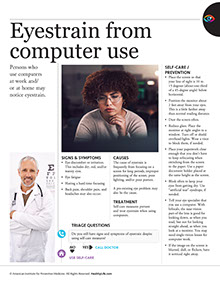
    Persons who use computer video display terminals (VDTs) at work and/or at home may notice eyestrain.

    Signs & Symptoms

    *  Eye discomfort or irritation. This includes dry, red, and/or watery eyes.

    *  Eye fatigue.

    *  Having a hard time focusing.

    *  Back pain, shoulder pain, and headaches may also occur.

    Causes

    The cause of eyestrain is most likely from conditions that surround the VDT, not the VDT itself. These include improper positioning of the VDT and supplies, poor lighting, and/or poor posture.

    A pre-existing eye problem may also be the cause.

    Treatment

    Self-care measures prevent and treat eyestrain when using VDTs.

    Questions to Ask

    Self-Care / Prevention

    *  Place the screen so that your line of sight is 10 to 15 degrees (about one-third of a 45-degree angle) below horizontal.

    *  Position the VDT screen about 2 feet away from your eyes. This is a little farther away than normal reading distance.

    *  Dust the screen often.

    *  Reduce glare. Place the VDT at right angles to a window. Turn off or shield overhead lights. Wear a visor to block them, if needed.

    *  Place your paperwork close enough that you don’t have to keep refocusing when switching from the screen to the paper. Use a paper document holder placed at the same height as the VDT screen.

    *  Blink often to keep your eyes from getting dry. Use “artificial tear” eyedrops, if needed.

    *  Tell your eye specialist that you use a VDT. Glasses and contacts worn for other activities may not be good for VDT work. With bifocals, the near-vision part of the lens is good for looking down, as when you read, but not for looking straight ahead, as when you look at a video display screen. You may need single-vision lenses for VDT work.

    *  If the image on the VDT screen is blurred, dull, or flickers, have it serviced right away.

    Resources

    Prevent Blindness America

    www.preventblindness.org

    Healthier at Home book by the American Institute for Preventive Medicine. www.HealthyLife.com. All rights reserved.

    © American Institute for Preventive Medicine