Tag: Health Conditions

  • What Makes Your Head Hurt?

    MEDICAL NEWS

    Image of women with a headache.

    Headaches are one of the most common health complaints.

    About 95% of headaches are primary headaches, meaning they are not caused by some other medical condition. Most people can relieve headache pain by making lifestyle changes, learning how to relax, and taking pain relievers. Your doctor may have more suggestions.

    Here are the 3 main types of headaches, according to the National Institutes of Health:

    *Tension headachescan be treated with over-the-counter pain relievers. Stress management, relaxation exercises, or a hot shower may  also help.

    *Migraine headachescan be treated with over-the-counter or prescription drugs. Migraines often happen again and again but may be prevented with prescription drugs. Avoid food and drinks that can trigger migraines, such as caffeine, alcohol, and processed meats. Relaxation practices may reduce the number and severity.

    *Cluster headachescan be treated or prevented with prescription drugs. Nasal sprays that numb the nose and nostrils may help. Doctors also recommend avoiding alcohol.

    © American Institute for Preventive Medicine

  • How Aging Affects Memory

    Brain & Nervous System

    Image of 2 elderly male friends hugging.

    Many people are afraid that growing old means losing the ability to think, reason, or remember.

    Some short-term memory loss does come with aging. You may, for example, forget where you put your keys or not remember the name of a person you just met. This is normal. Memory lapses that interfere with your normal activities, though, are not a normal part of aging. Nor is confusion.

    People who have changes in personality, behavior, or skills may have a brain or nervous system condition. These problems could also be a side effect of certain medicines, too much alcohol, or depression. This chapter gives information on common brain and nervous conditions in older persons.

    Health at Home Lifetime book by the American Institute for Preventive Medicine. www.HealthyLife.com. All rights reserved.

    © American Institute for Preventive Medicine

  • Burns

    First Aid

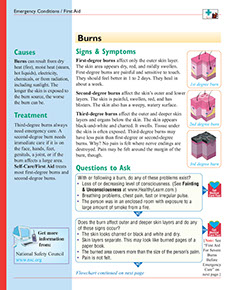
    Signs & Symptoms

    First-degree burns affect only the outer skin layer. The skin area appears dry, red, and mildly swollen. First-degree burns are painful and sensitive to touch. They should feel better in 1 to 2 days. They heal in about a week.

    Second-degree burns affect the skin’s outer and lower layers. The skin is painful, swollen, red, and has blisters. The skin also has a weepy, watery surface.

    Third-degree burns affect the outer and deeper skin layers and organs below the skin. The skin appears black-and-white and charred. It swells. Tissue under the skin is often exposed. Third-degree burns may have less pain than first-degree or second-degree burns. Why? No pain is felt where nerve endings are destroyed. Pain may be felt around the margin of the burn, though.

    Causes

    Burns can result from dry heat (fire), moist heat (steam, hot liquids), electricity, chemicals, or from radiation, including sunlight. The longer the skin is exposed to the burn source, the worse the burn can be.

    Treatment

    Third-degree burns always need emergency care. A second-degree burn needs immediate care if it is on the face, hands, feet, genitals, a joint, or if the burn affects a large area.Self-Care/First Aidtreats most first-degree burns and second-degree burns.

    Questions to Ask

    Self-Care / Prevention

    For Severe Burns Before Emergency Care

    *  Remove the person from the source of heat. Call 9-1-1! Keep the person’s airway open. Treat for Shock.

    *  Remove hot or burned clothes that come off easily, not if they are stuck to the skin.

    *  Cover the burns loosely with clean cloths. Use direct pressure to control bleeding. Don’t rub.

    *  Stay with the person until medical care arrives.

    *  If lye or a dry chemical gets on the skin, brush off the powder. Then flush with clean water for at least 20 minutes or until EMS arrives. Remove glasses, but not contacts, before treating the eyes.

    For First-Degree and Second-Degree Burns (that are less than 3” in diameter)

    *  Use cold water or cloths soaked in cold water on burned areas for 15 minutes or until the pain subsides. Do not use ice at all. Doing this could result in frostbite.

    *  Cover the area loosely with a dry cloth, such as sterile gauze. Hold it in place by taping only the edges of the gauze. Change the dressing the next day and every 2 days after that.

    *  Don’t use ointments. Aloe vera can be applied over closed skin 3 to 4 times a day. For a more severe burn less than 3” x 2”, use Second Skin Moisture Pads, etc.

    *  Don’t break blisters. If they break on their own, apply an antibacterial spray or ointment or treatment prescribed by your doctor. Keep the area loosely covered with a sterile dressing.

    *  Prop the burned area higher than the rest of the body, if you can.

    Resources

    National Safety Council

    www.nsc.org

    Healthier at Home book by the American Institute for Preventive Medicine. www.HealthyLife.com. All rights reserved.

    © American Institute for Preventive Medicine

  • Ways To Relieve Dental Anxiety

    Dental & Mouth Concerns

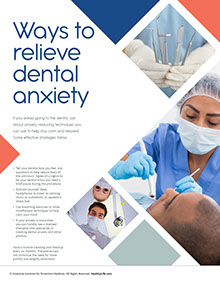
    Image of smiling dentist.

    If you dread going to the dentist, ask about anxiety-reducing techniques you can use to help stay calm and relaxed. Some effective strategies follow.

    *  Tell your dentist how you feel. Some dentists are trained in helping anxious patients overcome fear of dental procedures.

    *  Ask if you can listen to soothing music or relaxation CDs played on a stereo headset. Ask if the dentist offers a hand-held device that allows you to press a button to stop the dentist’s drill.

    *  If your dentist is skilled at hypnosis, consider being hypnotized.

    *  If your anxiety is more than you can handle, see a psychotherapist who specializes in treating dental anxiety and other phobias.

    Have a routine cleaning and checkup every six months. Preventive care will minimize the need for more painful and lengthy treatment.

    A Year of Health Hints book by the American Institute for Preventive Medicine. www.HealthyLife.com. All rights reserved.

    © American Institute for Preventive Medicine

  • Fainting & Unconsciousness

    First Aid

    Signs & Symptoms

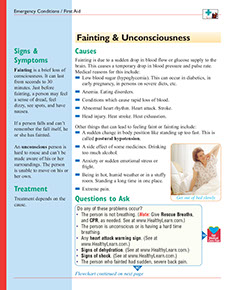
    Fainting is a brief loss of consciousness. It can last from seconds to 30 minutes. Just before fainting, a person may feel a sense of dread, feel dizzy, see spots, and have nausea.

    If a person falls and can’t remember the fall itself, he or she has fainted.

    An unconscious person is hard to rouse and can’t be made aware of his or her surroundings. The person is unable to move on his or her own.

    Causes

    Fainting is due to a sudden drop in blood flow or glucose supply to the brain. This causes a temporary drop in blood pressure and pulse rate. Medical reasons for this include:

    *  Low blood sugar (hypoglycemia). This can occur in diabetics, in early pregnancy, in persons on severe diets, etc.

    *  Anemia. Eating disorders.

    *  Conditions which cause rapid loss of blood.

    *  Abnormal heart rhythm. Heart attack. Stroke.

    *  Head injury. Heat stroke. Heat exhaustion.

    Other things that can lead to feeling faint or fainting include:

    *  A sudden change in body position like standing up too fast. This is called postural hypotension.

    *  A side effect of some medicines. Drinking too much alcohol.

    *  Anxiety or sudden emotional stress or fright.

    *  Being in hot, humid weather or in a stuffy room. Standing a long time in one place.

    *  Extreme pain.

    Treatment

    Treatment depends on the cause.

    Questions to Ask

    Self-Care / Prevention

    For Unconsciousness

    *  Check for a response. Call 9-1-1! Give Rescue Breaths and CPR, or treat for Shock, as needed.

    *  Check for a medical alert tag or information. Call the emergency number if there is one. Follow instructions given.

    *  Don’t give the person anything to eat or drink, not even water.

    For Fainting

    *  Catch the person before he or she falls.

    *  Lie the person down with the head below heart level. Raise the legs 8 to 12 inches to promote blood flow to the brain. If the person can’t lie down, have him or her sit down, bend forward, and put the head between the knees.

    *  Loosen any tight clothing.

    *  Don’t slap or shake a person. Don’t give anything to eat or drink.

    *  Check for a medical alert tag. Respond as needed.

    To Reduce the Risk of Fainting

    *  Follow your doctor’s advice to treat any medical problem which may lead to fainting. Take medicines as prescribed. Let the doctor know about any side effects.

    *  Get up slowly from bed or from a chair.

    *  Avoid turning your head suddenly.

    *  Wear loose-fitting clothing around the neck.

    *  Don’t exercise too much when it is hot and humid. Drink a lot of fluids when you exercise.

    *  Avoid stuffy rooms and hot, humid places. When you can’t do this, use a fan.

    *  If you drink alcohol, do so in moderation.

    For a Low Blood Sugar Reaction

    *  Have a sugar source, such as: One half cup of fruit juice or regular (not diet) soda; 6 to 7 regular (not sugar free) hard candies; 3 glucose tablets; or 6 to 8 ounces of milk.

    *  If you don’t feel better after 15 minutes, take the same amount of sugar source again. If you don’t feel better after the second dose, call your doctor.

    Healthier at Home book by the American Institute for Preventive Medicine. www.HealthyLife.com. All rights reserved.

    © American Institute for Preventive Medicine

  • Fractured Jaw

    Dental & Mouth Concerns

    Image of man holding jaw in pain.

    A fractured (or broken) jaw is when the jaw bone breaks.

    Signs & Symptoms

    *  Jaw and/or facial pain, swelling, or numbness.

    *  Not being able to open or close the mouth normally.

    *  Bleeding from the mouth.

    *  Having a hard time drinking, speaking, and swallowing.

    *  Drooling.

    *  The jaw area is bruised or discolored.

    *  Teeth are loose or damaged.

    *  The jaw area is tender to touch.

    Causes

    Most often, the cause is trauma from a blow to the face, such as from a car accident, sports injury, assault, etc. Osteoporosis can also be the cause.

    Treatment

    A fractured jaw needs emergency medical care.

    Questions to Ask

    Self-Care / Prevention

    First Aid Before Medical Care

    *  Gently align the jaws. Do not use force.

    *  Try not to talk. Write notes instead.

    *  Close your mouth and secure the jaw with a necktie, towel, or scarf tied around your head and chin. Remove this if vomiting occurs. Tie it back when vomiting stops. If you don’t have anything to tie the jaw with, keep it from moving by holding the jaw gently with your hands.

    *  Hold an ice pack on the fractured bone to reduce pain and swelling.

    Self-Care after Jaw Surgery

    *  Follow post-operative instructions from your doctor.

    *  Remove elastic bands if you are choking on food or need to vomit. Go to the dentist to replace the elastic bands.

    To Help Prevent a Fractured Jaw

    *  Wear a seat belt whenever you ride in a car, etc.

    *  Wear protective gear, as needed, for boxing, football, etc.

    Healthier at Home book by the American Institute for Preventive Medicine. www.HealthyLife.com. All rights reserved.

    © American Institute for Preventive Medicine

  • Hemorrhoids

    Abdominal & Urinary Conditions

    Hemorrhoids are veins in or outside of the anus that may become dilated or swollen.

    Signs & Symptoms

    *  Bright red blood on or in the stool, on toilet paper, or in the toilet.

    *  Anal or rectal tenderness. Anal itching.

    *  Uncomfortable, painful bowel movements, especially with straining.

    *  A lump can be felt at the anus.

    *  Mucus passes from the anus.

    Causes

    Hemorrhoids are usually caused by repeated pressure in the rectal or anal veins. Often this is due to repeated straining to pass stool. The risk for getting hemorrhoids increases with:

    *  Prolonged sitting on the toilet and straining to have a bowel movement.

    *  Constipation.

    *  A low dietary fiber intake.

    *  Obesity.

    *  Pregnancy.

    Treatment

    Hemorrhoids are common. They are not likely to be a serious health problem. Most people have some bleeding from them once in a while.

    Don’t assume that rectal bleeding is “just hemorrhoids.” See your doctor to find out the cause.

    If symptoms of hemorrhoids are not relieved with self-care or with time, medical care may be needed. This includes:

    *  Laser heat or infrared light.

    *  Rubber band ligation. A rubber band is placed around the base of the hemorrhoid inside the rectum. The band cuts off blood flow to the hemorrhoid.

    *  Surgery.

    *  Cryosurgery. This freezes the affected tissue.

    Questions to Ask

    Self-Care / Prevention

    *  Drink at least 6 to 8 cups of fluid per day.

    *  Eat foods with good sources of dietary fiber, such as bran, whole- grain breads and cereals, vegetables, and fruits.

    *  Add bran to your foods. Add about 3 to 4 tablespoons per day.

    *  Eat prunes. Drink prune juice.

    *  Lose weight if you are overweight.

    *  Get regular exercise.

    *  Pass stool as soon as you feel the urge. If you wait and the urge goes away, your stool could become dry and hard. This makes it harder to pass.

    *  Don’t strain to pass stool.

    *  Don’t hold your breath when trying to pass stool.

    *  Keep the anal area clean. Use moist towelettes or wet (not dry) toilet paper after you pass stool.

    *  Don’t sit too much. This can restrict blood flow around the anal area. Don’t sit too long on the toilet. Don’t read while on the toilet.

    *  For itching or pain, put a cold compress on the anus for 10 minutes at a time. Do this up to 4 times a day.

    *  Take warm baths or use a sitz bath with hot water. A sitz bath is a basin that fits over the toilet. Get one at a medical supply or drug store.

    *  Check with your doctor about using over-the-counter products, such as:

    – Stool softeners.

    – Zinc oxide or anesthetic (numbing) products, such as Preparation H.

    – Medicated wipes, such as Tucks.

    – Suppositories.

    Resources

    National Institute of Diabetes and Digestive and Kidney Diseases (NIDDK)

    www.niddk.nih.gov

    Healthier at Home book by the American Institute for Preventive Medicine. www.HealthyLife.com. All rights reserved.

    © American Institute for Preventive Medicine

  • Learn Cpr. It Could Help Save A Life!

    First Aid

    An image of a class learning CPR.

    Knowing how to perform cardiopulmonary resuscitation (CPR) can mean the difference between life and death. CPR can restore the flow of oxygen to the brain if the heart has stopped beating due to heart attack, drowning, electrical shock, suffocation, or a drug overdose. Learn to perform CPR correctly. Take a CPR training course to learn:

    *  How to contact emergency medical help.

    *  How to use an automated external defribrillator (AED).

    *  How to give rescue breaths, compress the person’s chest and when and how to do chest-compression only CPR. (It is important to push hard and push fast, giving 100 compressions a minute in cycles of 30 compressions for every 2 breaths.) {Note: Guidelines for CPR may change. Get updates for CPR and find out where you can learn how to perform it from the American Heart Association atwww.americanheart.org.}

    You can also call your local chapter of the Red Cross or your local hospital to find out where you can learn CPR.

    A Year of Health Hints book by the American Institute for Preventive Medicine. www.HealthyLife.com. All rights reserved.

    © American Institute for Preventive Medicine

  • Rectal Problems

    Abdominal & Urinary Conditions

    The rectum is the lowest part of the large bowel (colon). The opening of the rectum is the anus. Stool are passed from the anus.

    Signs & Symptoms

    *  Rectal pain.

    *  Rectal bleeding.

    *  Anal itching.

    *  Redness, swelling, or a rash in the rectal area.

    Causes

    Often there is no clear cause. Persons with diabetes and liver disease are more prone to rectal itching.

    For Anal / Rectal Pain and/or Bleeding

    *  Constipation. Straining to pass stool. Hemorrhoids.

    *  Anal fissures. These are splits or tears in the skin around the anus.

    *  Polyps or small growths.

    *  Injury due to anal intercourse or the insertion of a foreign object.

    *  Blockage in the intestines.

    *  Colon or rectal cancer.

    For Anal / Rectal Itching

    *  Dry skin. Products that irritate or cause a skin allergy in the anal area. Examples are over-the-counter anesthetic ointments that end in “caine,” such as benzocaine.

    *  Hemorrhoids.

    *  Psoriasis. This is a chronic skin disease. With this, itchy, scaly red patches form on a part of the body.

    *  Pinworms. These are intestinal parasites. They usually affect children. The anal itching is at night and can be painful.

    *  A fungal infection.

    Treatment

    Treatment for rectal problems depends on the cause. Any sign of rectal bleeding should be evaluated by a doctor. This includes blood on toilet paper. Colon cancer should be checked for, despite the person’s age or family history of this disease.

    Questions to Ask

    Self-Care / Prevention

    For Anal / Rectal Bleeding

    *  Don’t lift heavy things.

    *  Stop taking anti-inflammatory medicines and/or aspirin (unless prescribed and monitored by your doctor).

    *  Don’t strain to pass stool.

    For Anal / Rectal Itching

    *  Practice good hygiene. Clean the rectal area daily.

    *  Use an over-the-counter ointment, such as one with zinc oxide or one for hemorrhoids, such as Preparation H. Follow package directions.

    *  Wear clothes and undergarments that fit loosely.

    *  Take a warm bath or sitz bath. A sitz bath is a shallow, warm water bath. You can get a sitz bath device from a medical supply company and some drug stores. Then dry the rectal area well. Use talcum powder, as needed.

    *  Take warm tub baths.

    *  Lose weight if you are overweight.

    *  If you are diabetic, keep blood sugar under control.

    *  For pinworms:

    – Check for pinworms in this way: In a dark room, a few hours after bedtime, shine a flashlight on the anus. Pinworms, if present, will go back into the anus when the flashlight is shined on them.

    – Wash the hands often.

    – Keep fingernails closely trimmed.

    – Try to get your child to not suck his thumb and not bite his nails.

    – Wash underwear and bed linen in hot soapy water.

    – If medication for pinworms is prescribed, use it as directed.

    For Rectal Pain

    *  Take warm baths.

    *  Use a warm water sitz bath for 15 minutes, 2 to 3 times a day.

    *  Put towels soaked in warm water on the anal area. Or, apply a cold compress to the painful area, if this helps with the pain. You can buy a sitz bath from a medical supply or drug store.

    *  Follow measures to prevent constipation.

    *  Don’t strain to pass stool.

    *  Keep the rectal area clean.

    *  Use soft, plain, unscented, two-ply toilet paper. Take your own toilet paper to work or other places that may use harsh paper. Use wet, not dry, toilet paper, if that helps.

    *  Use an over-the-counter wipe, such as Tucks, after using toilet paper.

    *  Don’t sit for long periods of time. When you do sit, raise your legs, as often as you can.

    *  If needed, take an over-the-counter medicine for pain as directed.

    Healthier at Home book by the American Institute for Preventive Medicine. www.HealthyLife.com. All rights reserved.

    © American Institute for Preventive Medicine

  • Sticky Snacks Spell Trouble

    Dental & Mouth Concerns

    Image of chewy candy.

    Sticky, chewy foods-like cough drops, hard candies, and sugary pastries-cling to the surface of your teeth, where they mix with bacteria in the mouth and produce acids that gradually wear away tooth enamel. Granola bars, many dried fruits, and foods or cereals sweetened with honey, corn syrup, or molasses are particularly troublesome. But starchy foods like bread, crackers, potato chips, or pretzels-which are turned into sugar by saliva-can also be a problem. To minimize this difficulty:

    *  If you eat fruit and other foods high in sugars, eat them with meals.  Finish a meal with foods that help buffer acid formation.

    *  Don’t eat sweets, fruit, or starchy foods before bedtime. Saliva production slows down overnight, enabling cavity-causing bacteria to feed on food particles more easily. Brushing your teeth doesn’t effectively prevent the problem.

    *  Avoid sugar-sweetened gum and beverages. Chew a sugar-free gum instead, especially one with the artificial sweetener xylitol.

    A Year of Health Hints book by the American Institute for Preventive Medicine. www.HealthyLife.com. All rights reserved.

    © American Institute for Preventive Medicine