Tag: Healthcare

  • The Facts About Donating Organs

    MEDICAL NEWS

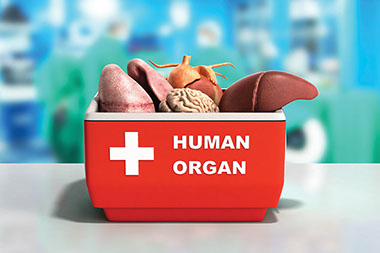
    Illustration of organs.

    Thousands of children and adults are in need of an organ transplant. The biggest needs are for kidneys, followed by livers.

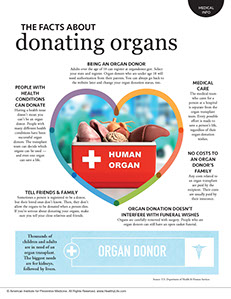
    Being an organ donor

    Adults over the age of 18 can register at organdonor.gov. Select your state and register. Organ donors who are under age 18 will need authorization from their parents. You can always go back to the website later and change your organ donation status, too.

    People with health conditions can donate

    Having a health issue doesn’t mean you can’t be an organ donor. People with many different health conditions have been successful organ donors. The transplant team can decide which organs can be used – and even one organ can save a life.

    Tell friends & family

    Sometimes a person is registered to be a donor, but their loved ones don’t know. Then, they don’t allow the organs to be donated when a person dies. If you’re serious about donating your organs, make sure you tell your close relatives and friends.

    Medical care

    The medical team who cares for a person at a hospital is separate from the organ transplant team. Every possible effort is made to save a person’s life, regardless of their organ donation wishes.

    No costs to an organ donor’s family

    Any costs related to an organ transplant are paid by the recipient. Their costs are usually paid by their insurance.

    Organ donation doesn’t interfere with funeral wishes

    Organs are carefully removed with surgery. People who are organ donors can still have an open casket funeral.

    Source: U.S. Department of Health & Human Services
    © American Institute for Preventive Medicine
  • Home Medical Tests

    Medical Exams

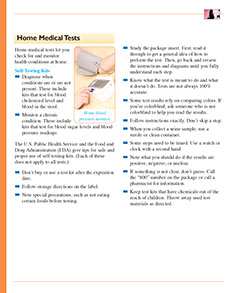
    Home medical tests let you check for and monitor health conditions at home.

    Self-Testing Kits

    *  Diagnose when conditions are or are not present. These include kits that test for blood cholesterol level and blood in the stool.

    *  Monitor a chronic condition. These include kits that test for blood sugar levels and blood pressure readings.

    The U.S. Public Health Service and the Food and Drug Administration (FDA) give tips for safe and proper use of self-testing kits. (Each of these does not apply to all tests.)

    *  Don’t buy or use a test kit after the expiration date.

    *  Follow storage directions on the label.

    *  Note special precautions, such as not eating certain foods before testing.

    *  Study the package insert. First, read it through to get a general idea of how to perform the test. Then, go back and review the instructions and diagrams until you fully understand each step.

    *  Know what the test is meant to do and what it doesn’t do. Tests are not always 100% accurate.

    *  Some test results rely on comparing colors. If you’re colorblind, ask someone who is not colorblind to help you read the results.

    *  Follow instructions exactly. Don’t skip a step.

    *  When you collect a urine sample, use a sterile or clean container.

    *  Some steps need to be timed. Use a watch or clock with a second hand.

    *  Note what you should do if the results are positive, negative, or unclear.

    *  If something is not clear, don’t guess. Call the “800” number on the package or call a pharmacist for information.

    *  Keep test kits that have chemicals out of the reach of children. Discard away used test materials as directed.

    Page from the Healthier at Home book by the American Institute for Preventive Medicine. www.HealthyLife.com. All rights reserved.

    © American Institute for Preventive Medicine
  • Over-The-Counter Drugs: Reducing The Risks Of Self-Prescribing

    Medication

    Image of male pharmacist.

    Over-the-counter (OTC) drugs are widely advertised in magazines and on TV and are consumed by millions of people. Generally less potent than prescription drugs, they can be taken without the authorization of a doctor. But before purchasing an over-the-counter remedy, ask yourself:

    *  Am I trying to cover up symptoms that need to be evaluated by a doctor?

    *  Will continued use cause new problems (dependency on laxatives or sleeping pills, for example)?

    *  Are there unwanted side effects from these drugs (for example, increased blood pressure, dizziness, headaches, rashes)?

    *  Do I already have a similar product at home?

    Often, reading the package labels-or looking up the name of the drug at the Web site:www.medlineplus.gov, can help you answer these questions. For information on over-the-counter medicine labels, contact the U.S. Food and Drug Administration (FDA) at 1.888.INFO.FDA (463.6332) orwww.fda.gov.

    Keep in mind, too, that when taken in large quantities, an OTC drug might equal the dose of a medicine that is available only by prescription.

    If there is any uncertainty in your mind whether or not a particular OTC medication will help or harm you, call and check with your doctor before you purchase it.

    Page from A Year of Health Hints book by the American Institute for Preventive Medicine. www.HealthyLife.com. All rights reserved.

    © American Institute for Preventive Medicine
  • Save If You Have No Insurance

    Medical Care

    Image of nurse standing in front of the nurse station.

    Look into getting some.

    Insurance costs money, but having none may end up costing you more. Medical costs from a chronic illness, surgery, etc. could erase any savings you have and may cause you to file for bankruptcy. Discuss your health needs and ability to pay for premiums with an insurance broker. Find out about health insurance in your state fromwww.naic.org/state_web_map.htm.

    You may need short-term coverage.

    If you are between jobs, a recent college graduate, etc., contact an insurance broker about short-term health insurance. This has a low monthly cost and high coverage limits for most (especially healthy) people. Read about COBRA in tip number 60, too.

    Look into group coverage.

    Find out if you can get health insurance from groups you belong to, such as AARP. Your costs are likely to be cheaper than if you buy an individual policy. If you are a veteran or a dependent of a veteran, find out if you are eligible for health care fromwww.va.gov/health/index.aspor from 800.827.1000.

    Look into an HSA.

    This is a Health Savings Account. It is also called a Medical Savings Account (MSA). It is like an IRA, but is used for medical costs. Instead of paying the costs for a fee-for-service health plan, you pay the cost for two things. One is a high deductible policy. The other is a tax-deductible savings account. You take money out of the savings account for medical costs when they are needed. Money not used from the savings account grows interest on a tax-sheltered basis and can be used to add funds to your retirement. Find out more about HSAs fromwww.msainfo.netandwww.consumerdrivenhealthcare.us. An MSA is a kind of Consumer Driven Health Plan.

    Know about “Insure Kids Now!”

    Infants, children, and teens may be able to get free or low-cost health insurance from your state. Find out from  877.KIDS NOW (543.7669) orwww.insurekidsnow.com.

    Honesty is the best policy.

    If you give false information on insurance forms, your coverage could be cancelled. Before you sign the dotted line, read the fine print. Find out if any conditions would limit or cancel your coverage.

    Know about clinical trials.

    You may be able to get expert medical care if you take part in a clinical trial. Find out what clinical trials are and which ones you could qualify for fromwww.clinicaltrials.gov. Find out about studies on mental health and disorders fromwww.nimh.nih.gov/health/ trials/index.shtml.

    If you are on a very limited income, find out if you qualify for Medicaid.

    Contactwww.cms.hhs.gov. Medicaid is a state sponsored health care program.

    If you cannot pay for health care.

    Contact the Bureau of Primary Health Care. Use the Web sitewww.findahealthcenter.hrsa.govto find a clinic in your area that will give you medical care at a reduced cost or for free. Search the Internet, too, for “National Free Clinic Directory.” Also, contact a social worker at your local hospital or community health agency to recommend resources that can help with medical problems.

    Opt for medical coverage with your auto insurance plan.

    This can cover expenses for medical services if you and passengers are injured in an accident.

    Find out about free and low-cost cancer screening.

    *  The American Cancer Society at 800.227.2345 orwww.cancer.org.

    *  The National Comprehensive Cancer Control Program atwww.cdc.gov/cancer/screening.htm.

    Find out if you have a health credit report.

    Before you buy a health insurance plan, contact the Medical Information Bureau (MIB). The MIB keeps track of medical information on persons who have applied for individual disability, health or life insurance in the past seven years. You can get a copy of your record fromwww.mib.comor by calling 866.692.6901.

    Cover image to the Healthy Savings book by the American Institute for Preventive Medicine. www.HealthyLife.com. All rights reserved.

    © American Institute for Preventive Medicine

  • What Is Cbd?

    WELL-BEING

    CBD oil in small glass jar.

    CBD (or cannabidiol) oil may be purchased in many pharmacies and other stores. It is claimed to treat more than 50 health conditions like sleep problems, anxiety and pain. But, experts say there’s little evidence that it works for most of them.

    What is CBD?

    CBD oil comes from the cannabis plant. Cannabis plants can be marijuana or hemp.

    A chemical called tetrahydrocannabinol (THC) causes the mental changes that make a person “high” when they use marijuana. CBD oil should contain little to no THC so it can’t make a person high. However, there is no way to know for sure that the CBD product is THC-free.

    The Food and Drug Administration (FDA) tested CBD products. Some products were found to contain THC, even though CBD should not contain it. Other products had a different amount of CBD than what the label stated.

    What does CBD do?

    Experts don’t know exactly how CBD works in the body. There is solid evidence that it can help control seizure disorders in children. But, evidence that it helps treat other conditions is lacking. In fact, the FDA has warned several companies about selling CBD with untested health claims.

    Does CBD have side effects?

    In studies, people didn’t report serious side effects when taking CBD. There were some reports of diarrhea. Also, CBD may interact with a person’s other medications. People who take other medicines or have health conditions should ask a doctor before using CBD.

    Should I use CBD?

    There isn’t enough evidence to recommend CBD for health problems other than seizures. Experts say you should stick with proven treatments for health problems. Always talk with a doctor before using any natural treatment, including CBD.

    Source: National Institutes of Health

    © American Institute for Preventive Medicine
  • How To Take Painkillers Safely

    Medication

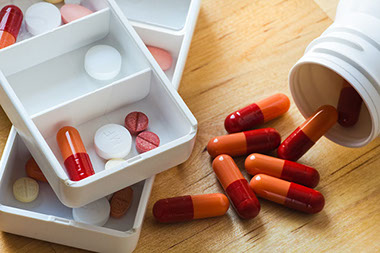
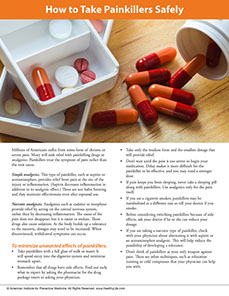
    Image of pills.

    Millions of Americans suffer from some form of chronic or severe pain. Many will seek relief with painkilling drugs or analgesics. Painkillers treat the symptom of pain rather than the root cause.

    Simple analgesics. This type of painkiller, such as aspirin or acetaminophen, provides relief from pain at the site of the injury or inflammation. (Aspirin decreases inflammation in addition to its analgesic effect.) These are not habit forming and they maintain effectiveness even after repeated use.

    Narcotic analgesics. Analgesics such as codeine or morphine provide relief by acting on the central nervous system, rather than by decreasing inflammation. The cause of the pain does not disappear, but it is easier to endure. These drugs also cause sedation. As the body builds up a tolerance to the narcotic, dosages may need to be increased. When discontinued, withdrawal symptoms can occur.

    To minimize unwanted effects of painkillers:

    *  Take painkillers with a full glass of milk or water. It will speed entry into the digestive system and minimize stomach upset.

    *  Remember that all drugs have side effects. Find out early what to expect by asking the pharmacist for the drug package insert or asking your physician.

    *  Take only the weakest form and the smallest dosage that will provide relief.

    *  Don’t wait until the pain is too severe to begin your medication. Delay makes it more difficult for the painkiller to be effective, and you may need a stronger dose.

    *  If pain keeps you from sleeping, never take a sleeping pill along with painkillers. Use analgesics only for the pain itself.

    *  If you are a cigarette smoker, painkillers may be metabolized at a different rate so tell your doctor if you smoke.

    *  Before considering switching painkillers because of side effects, ask your doctor if he or she can reduce your dosage.

    *  If you are taking a narcotic type of painkiller, check with your physician about alternating it with aspirin or an acetaminophen analgesic. This will help reduce the possibility of developing a tolerance.

    *  Don’t think of painkillers as your only weapon against pain. There are other techniques, such as relaxation training or cold compresses that your physician can help you with.

    Page from A Year of Health Hints book by the American Institute for Preventive Medicine. www.HealthyLife.com. All rights reserved.

    © American Institute for Preventive Medicine

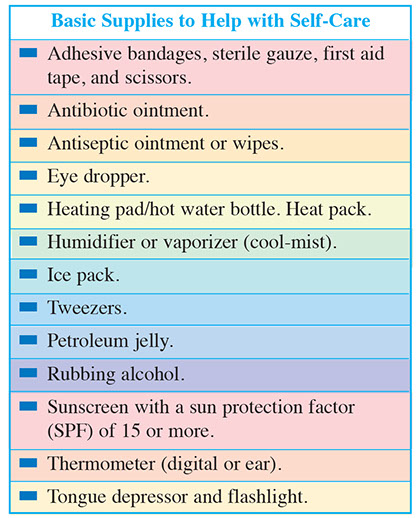
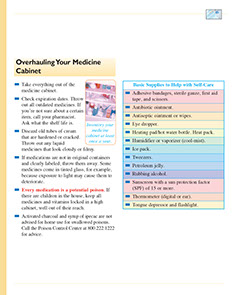
  • Overhauling Your Medicine Cabinet

    Medication

    Take everything out of the medicine cabinet.

    *  Check expiration dates. Throw out all outdated medicines. If you’re not sure about a certain item, call your pharmacist. Ask what the shelf life is.

    *  Discard old tubes of cream that are hardened or cracked. Throw out any liquid medicines that look cloudy or filmy.

    *  If medications are not in original containers and clearly labeled, throw them away. Some medicines come in tinted glass, for example, because exposure to light may cause them to deteriorate.

    *  Every medication is a potential poison. If there are children in the house, keep all medicines and vitamins locked in a high cabinet, well out of their reach.

    *  Activated charcoal and syrup of ipecac are not advised for home use for swallowed poisons. Call the Poison Control Center at 800.222.1222 for advice.

    Page from the Healthier at Home book by the American Institute for Preventive Medicine. www.HealthyLife.com. All rights reserved.

    © American Institute for Preventive Medicine
  • Save Money On Medications

    Medication

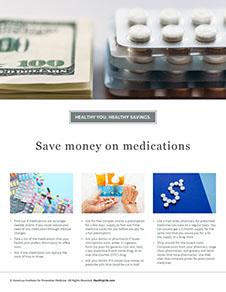
    Small stack of money next to a small stack of pills.

    *  Find out if medications are no longer needed and/or if you could reduce your need of any medication through lifestyle changes.

    *  Take a list of the medications that your health plan prefers (formulary) to office visits.

    *  Ask if one medication can replace the work of two or three.

    *  Ask for free samples and/or a prescription for a few days’ supply to find out if the medicine works for you before you pay for a full prescription.

    *  Ask your doctor or pharmacist if lower-cost options exist, either in a generic form (co-pays for generics cost less, too), a less expensive brand-name drug, or an over-the-counter (OTC) drug.

    *  Ask your doctor if it would save money to prescribe pills that could be cut in half.

    *  Use a mail order pharmacy for prescribed medicines you take on a regular basis. You can usually get a 3-month supply for the same cost that you would pay for a 30 day supply at a drug store.

    *  Shop around for the lowest costs. Compare costs from your pharmacy, large chain pharmacies, and grocery and retail stores that have pharmacies. Use Web sites that compare prices for prescription medicines.

    A Year of Health Hints book by the American Institute for Preventive Medicine. www.HealthyLife.com. All rights reserved.

    © American Institute for Preventive Medicine
  • Advance Directives

    Medical Care

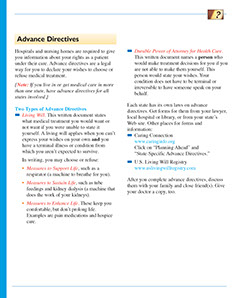
    Hospitals and nursing homes are required to give you information about your rights as a patient under their care. Advance directives are a legal way for you to declare your wishes to choose or refuse medical treatment.

    {Note: If you live in or get medical care in more than one state, have advance directives for all states involved.}

    Two Types of Advance Directives

    *  Living Will. This written document states what medical treatment you would want or not want if you were unable to state it yourself. A living will applies when you can’t express your wishes on your own and you have a terminal illness or condition from which you aren’t expected to survive. In writing, you may choose or refuse:

    – Measures to Support Life, such as a respirator (a machine to breathe for you).

    – Measures to Sustain Life, such as tube feedings and kidney dialysis (a machine that does the work of your kidneys).

    – Measures to Enhance Life. These keep you comfortable, but don’t prolong life. Examples are pain medications and hospice care.

    *  Durable Power of Attorney for Health Care. This written document names a person who would make treatment decisions for you if you are not able to make them yourself. This person would state your wishes. Your condition does not have to be terminal or irreversible to have someone speak on your behalf.

    Each state has its own laws on advance directives. Get forms for them from your lawyer, local hospital or library, or from your state’s Web site. Other places for forms and information:

    *  Caring Connection:www.caringinfo.org– Click on “Planning Ahead” and “State-Specific Advance Directives.”

    *  U.S. Living Will Registry:www.uslivingwillregistry.com

    After you complete advance directives, discuss them with your family and close friend(s). Give your doctor a copy, too.

    Page from the Healthier at Home book by the American Institute for Preventive Medicine. www.HealthyLife.com. All rights reserved.

    © American Institute for Preventive Medicine

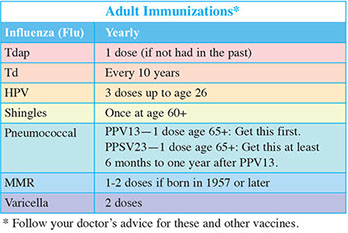
  • Immunization Schedule

    Medical Exams

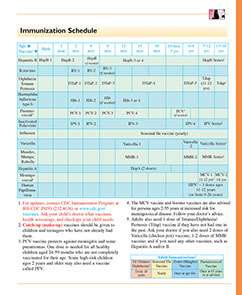
    1.  For updates, contact CDC Immunization Program at 800.CDC.INFO (232.4636) orwww.cdc.gov/vaccines. Ask your child’s doctor what vaccines, health screenings, and checkups your child needs.

    2.  Catch-up vaccines should be given to children and teenagers who have not already had them.

    3.  PCV vaccine protects against meningitis and some pneumonias. One dose is needed for all healthy children aged 24-59 months who are not completely vaccinated for their age.

    Vaccines for Traveling Abroad

    Before you travel to other countries, find out if you need certain vaccines. Get information from the CDC Travelers’ Information Line. Call 800.CDC.INFO (232.4636) or use thewww.cdc.gov/travelWeb site. Discuss your needs with your doctor.

    Page from the Healthier at Home book by the American Institute for Preventive Medicine. www.HealthyLife.com. All rights reserved.

    © American Institute for Preventive Medicine